
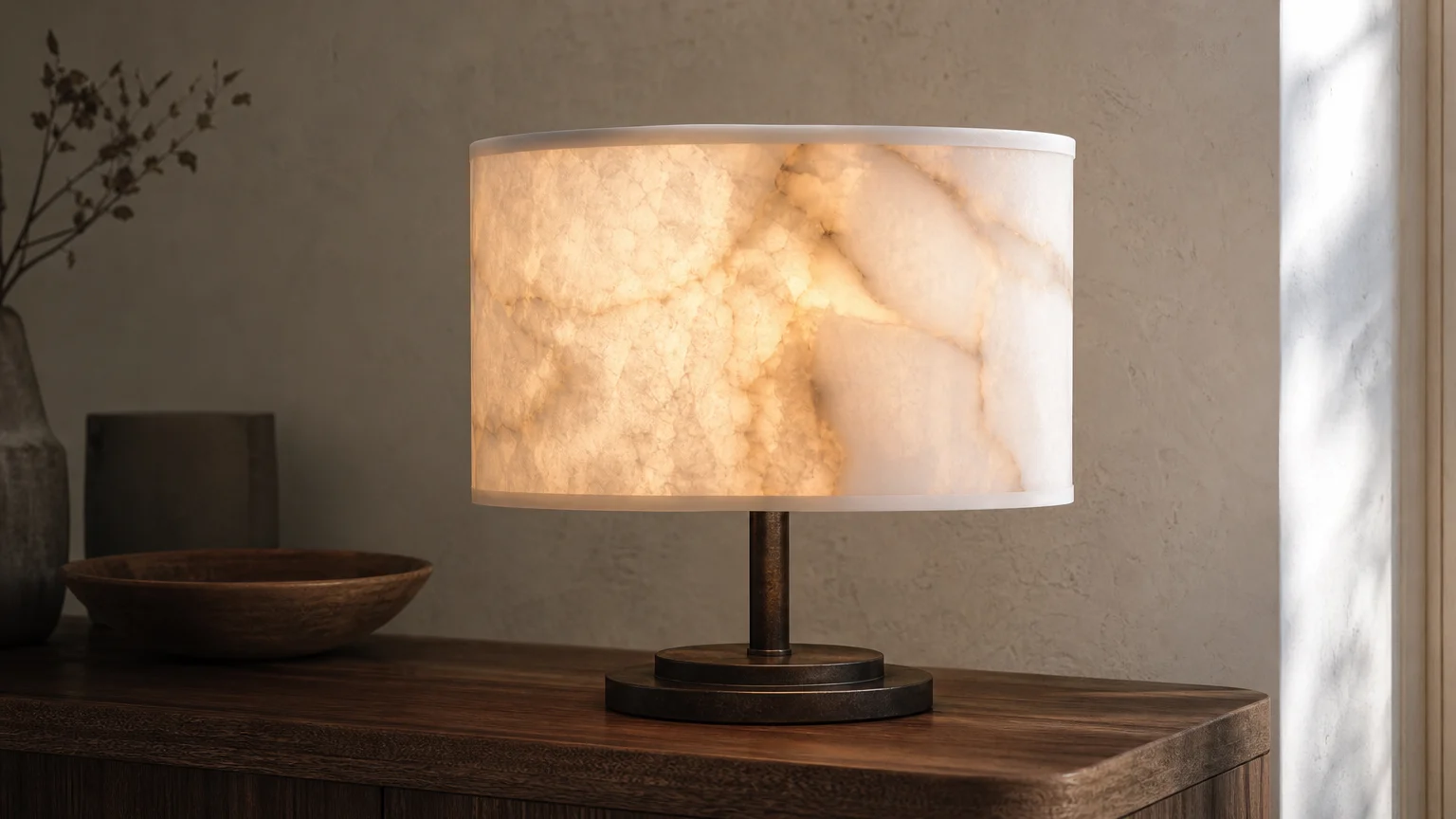
Somebody has a lamp they like and a shade they no longer like, and they would like the second problem solved without touching the first. It is a reasonable wish, and for fabric and paper it is ordinary practice: a shade is an accessory, sold in sizes, and replaced when taste moves on. Stone is the case where that habit breaks, and it breaks for a physical reason rather than a commercial one — and understanding the reason is the fastest route to a good decision.
This article answers the question that arrives most often about alabaster shades, and it answers it in the order the question actually arises: what the words on a shade label mean, why a stone shade behaves differently from every other kind, what has to be measured before anything can be matched, and when replacement is a sensible plan rather than an expensive detour. It is written for the person holding a tape measure, and for the designer or buyer who has been asked to find “the same shade in stone”.
One thing should be said at the outset, because it affects how the rest is read. In stone lighting, the shade is not usually an accessory attached to a fixture. It is the optical component the fixture was designed around, and in many designs it is the fixture. That single fact explains most of the mismatches, most of the disappointment, and most of the good outcomes.
- 01A Shade and a Fixture Are Not the Same Object
- 02What the Word Alabaster Means on a Shade
- 03Why Stone Reads Differently: Thickness Sets the Light
- 04The Four Measurements That Decide Anything
- 05The Connection: What Has to Match
- 06Mass and Heat: What a Stone Shade Asks of the Lamp
- 07Why Stone Shades Are Made With the Lamp
- 08When Replacement Is Reasonable
- 09A Short Buying Protocol
- 10The Honest Answer: Buy the Whole Fixture
A Shade and a Fixture Are Not the Same Object
In a fabric-shade lamp, the division of labour is clear. The base holds the socket and the switch; the shade sits on top and modifies the light that escapes upward, downward and sideways. The two are separate purchases, made to a rough proportion, and the relationship between them is aesthetic. You can change one without changing the other, and the lamp still works exactly as before.
In a stone fixture, the division of labour is different. The stone element often is the diffuser: the light source sits inside or behind it, and the stone is what turns a bare lamp into a soft, directional, warm field of light. Remove it and there is no lamp; there is a socket with a bulb in it. This is why the vocabulary drifts. What looks like a shade on a stone table lamp may be a carved section with a wall thickness chosen for the optical result, a machined seat at the top ring, and a bottom opening sized to clear the lamp and to control how much light escapes downward.
The practical consequence is that the shade and the fixture are a matched pair in the engineering sense, not only in the visual sense. The stone was selected, cut and finished against a specific light source and a specific set of fixing points. Ask a different stone element to take over that job and the question is no longer “does it look right?” but “does it sit on that seat, clear that lamp, carry that mass, and produce the same light?” Four questions, and any one of them can end the project.
None of this means a stone shade cannot be replaced at all. It means replacement is a small engineering exercise rather than a shopping exercise, and it should be approached in that order. The rest of this article is the exercise.
What the Word Alabaster Means on a Shade
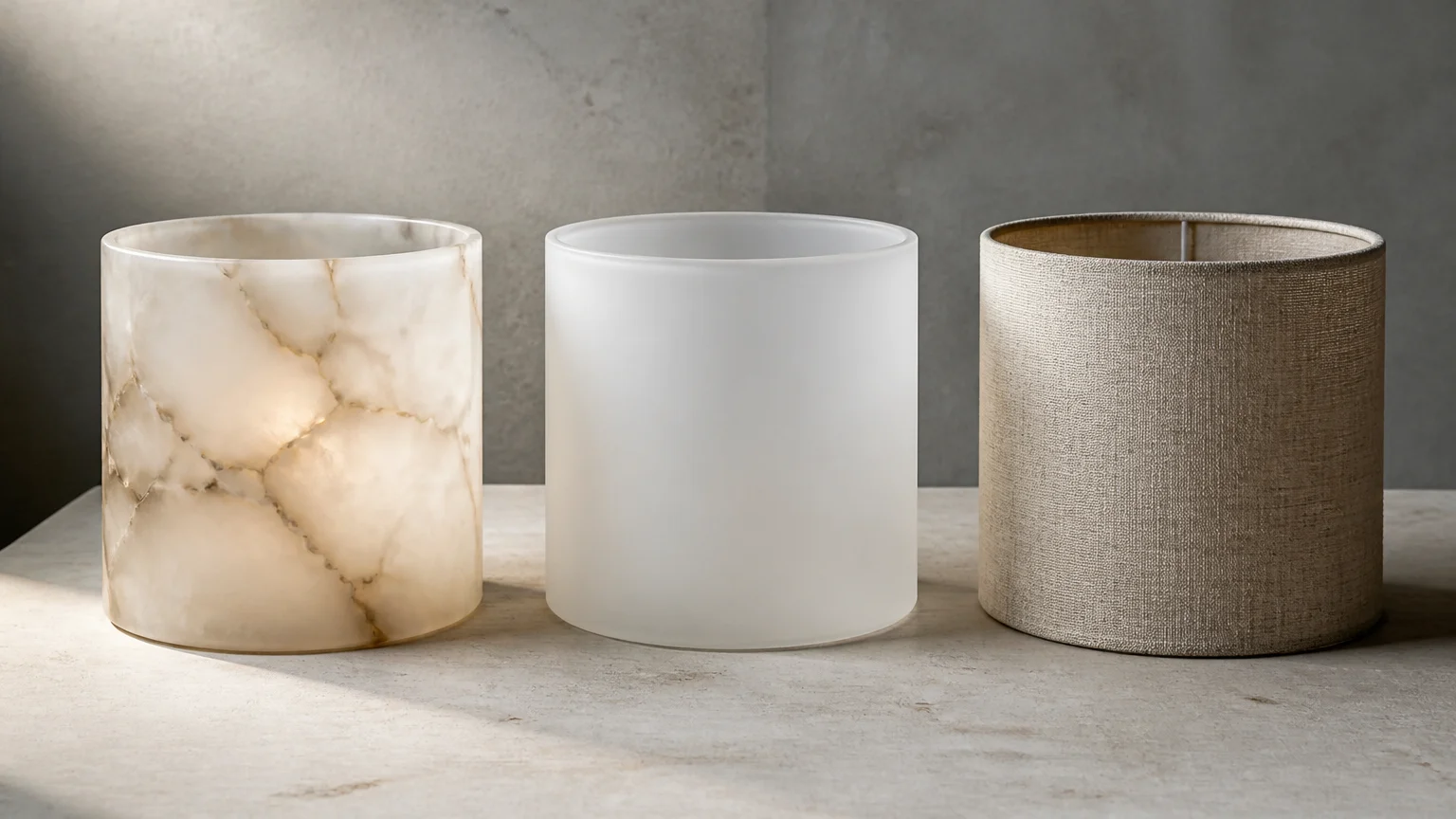
The photograph above shows the same silhouette in three materials, and it is the clearest argument for reading a label carefully. From left to right: a shade cut from translucent stone, a frosted glass shade, and a woven fabric shade. In daylight, at a distance, in a photograph, all three can be described as “an alabaster look”. Lit, in a room, they are three different products.
Genuine alabaster is a natural stone — a form of gypsum or of calcite, depending on which variety is meant — and it has been used for light-diffusing objects for a very long time precisely because it is soft enough to carve thin and translucent enough to pass light. In a shade, this shows as tonal variation that does not repeat, a depth of colour that changes with the light behind it, and a face that reads differently switched on and switched off. If you want to know what the material actually is, our guide to what alabaster stone is separates the varieties and the language around them.
Cast stone, resin and composite materials can be made to look like alabaster with considerable skill, and they have real advantages: uniform appearance, predictable translucency, lower mass, and the ability to be produced in a shape that stone would not allow. Their behaviour differs in ways that matter for a shade. They do not have the same depth of variation, so a face can look flat when lit; they may yellow or change with heat and time depending on the formulation; and their mass is different, which changes what the lamp has to carry.
Glass, whether frosted, opal or cast, is the most common “alabaster effect” in the market and the most misunderstood. It diffuses beautifully and evenly, it is stable, and it can be formed thin. What it does not do is show the internal structure that makes stone read as stone: the veining, the cloudiness, the small irregularities that give a lit stone face its depth. Glass glows; stone glows unevenly, and the unevenness is the point.
Fabric and paper achieve a warm, soft glow with no pretence of being stone, and they are the right answer for a great many lamps. They are included here because they are frequently what a buyer receives when ordering an “alabaster shade” from a general marketplace listing, where the word is used as a colour name rather than a material name.
Three quick checks separate them at the bench, and none requires equipment. Temperature: stone feels cold to the touch and stays cold for a moment; resin warms quickly. Weight: stone is heavy for its size, and the heaviness is concentrated at the wall rather than distributed evenly. Continuity: turn the shade through a full rotation in front of a window and watch a single vein or cloud. In stone it will run, change depth and disappear behind the wall; in a cast imitation it will repeat, or it will be uniformly absent. A fourth check helps with glass: look at the rim. A cut stone rim has a machined edge with a visible wall thickness and a slightly matte sawn face; a glass rim is usually fire-polished and reads as a rounded, continuous surface.
Why Stone Reads Differently: Thickness Sets the Light
The reason a stone shade cannot simply be swapped for a glass one is optical, and it is the most useful piece of theory in this article. In stone, the wall thickness is not a manufacturing detail. It is the control.
Cut thin enough, stone transmits: light passes through the body of the material, picks up the colour and the veining on the way, and emerges as a soft field in which the internal structure of the stone is visible. This is what people mean when they describe a lit alabaster panel as having depth — you are seeing into the material, not at it. Cut thicker, and less light passes through the body; more of it is directed out through the openings at the top and bottom, producing pools of light above and below the shade and a much dimmer face. The same stone, the same lamp, two entirely different lighting effects, decided by the saw.
That single relationship explains three things that otherwise look like inconsistencies. It explains why two alabaster lamps of similar shape can light a room completely differently. It explains why a shade that looks right unlit can look disappointing when switched on — the thickness that gives it presence in daylight is the thickness that blocks the glow. And it explains why a stone shade is difficult to specify as an accessory: the thickness has to be chosen against a specific lamp, a specific distance and a specific intended effect. The mechanism is set out in more detail in our note on thin stone and how thickness changes the glow.
There is a second-order effect worth knowing about, because it decides whether a replacement feels successful. Stone is not uniform, and neither is the way light leaves it. A face with denser veining will read slightly darker in those bands; a cloud will read brighter. Under a bare lamp this variation is the whole charm of the material. Under a lamp that is too bright for the thickness, the variation disappears into an even glare and the stone starts to look like plastic. The match between lamp output and stone thickness is therefore not a refinement; it is what makes the object look like what it is.
For anyone trying to match a shade to an existing lamp, this is the takeaway: you are not looking for a shade of the right size and colour. You are looking for a section thin enough for the lamp you have, thick enough to still read as stone, and consistent enough with the other elements in the room to look intentional. That is a specification, and it is why the next section starts with a tape measure rather than a catalogue.
The Four Measurements That Decide Anything
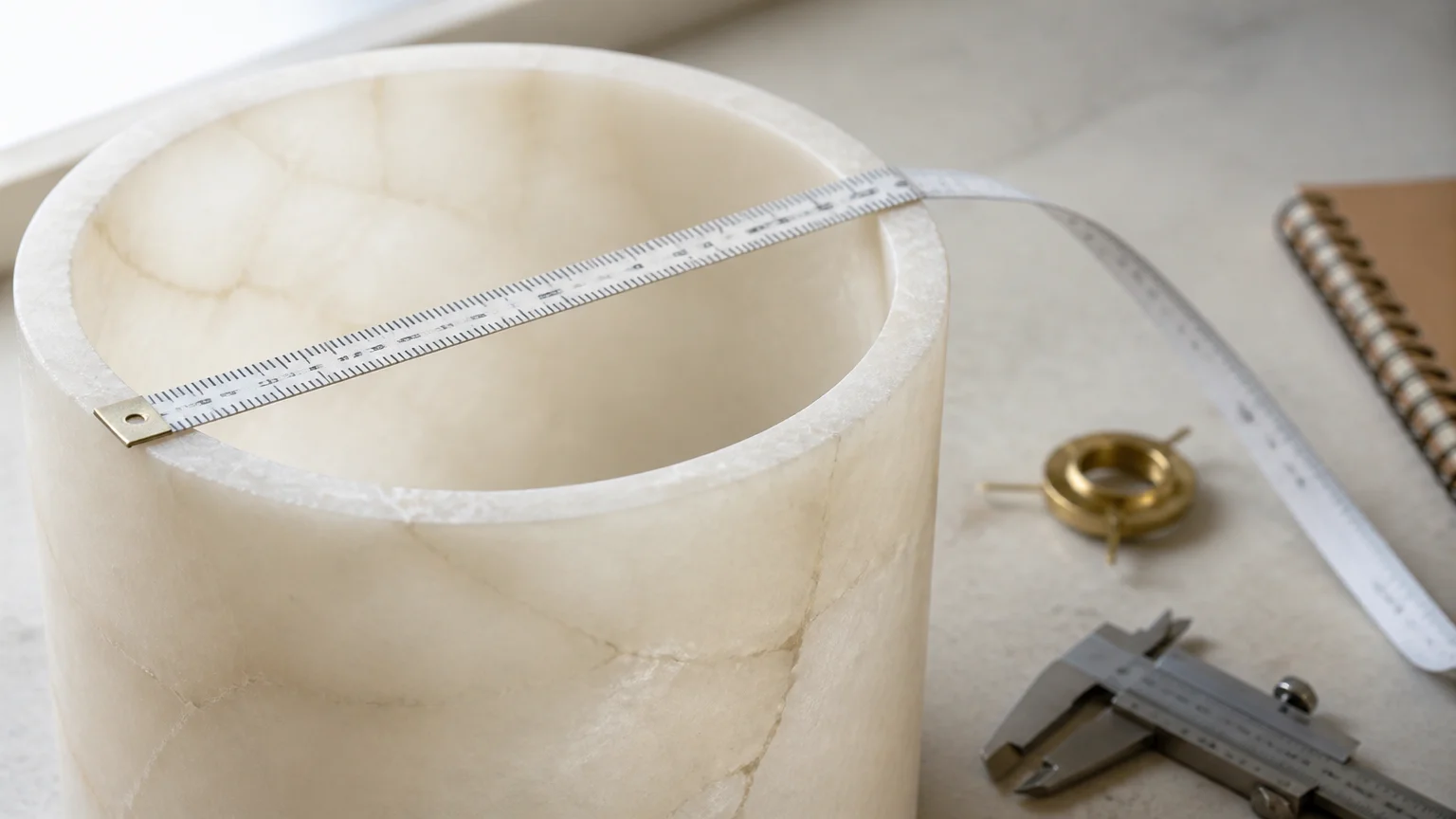
Before any question about stone, colour or availability, four measurements decide whether a shade can be considered at all. Take them on the existing shade, with it removed from the lamp, on a flat surface, and write them down rather than remembering them. The order matters, because each one rules out a different family of options.
Top opening. The diameter of the hole at the top, measured across the inside of the ring or the rim. This is the measurement that has to match the fitting, and it is the one most often taken loosely — “about the same” is not a specification when a stone ring has no give in it.
Bottom opening. The diameter at the lower edge. On a tapered shade this sets the spread of light downward; on a drum it usually equals the top. It also determines how much of the lamp is visible from below, which is a visual decision as much as a functional one.
Overall height. Rim to rim, following the slope if the shade is tapered. Height is what makes a shade look proportionate on a base, and it is the measurement people adjust when a shade “feels wrong” without being able to say why.
Wall thickness at the rim. The one measurement specific to stone, and the one that is almost invariably left untaken. It tells you what the section can do optically, and it tells a maker whether the piece can be reproduced without changing the light.
| Measurement | Where to take it | What it rules in or out |
|---|---|---|
| Top opening | Across the inside of the top ring or rim, shade off the lamp | Whether any fitting will connect at all; a stone ring has no flex |
| Bottom opening | Across the lower edge, at the widest point of the rim | Downward light spread and how much of the lamp reads from below |
| Overall height | Rim to rim, following the slope on a tapered shade | Proportion against the base; the measurement that makes a shade “feel wrong” |
| Wall thickness at the rim | On the cut edge, with a caliper or against a rule | The optical behaviour of the section, and whether it can be reproduced |
| Fitting position and drop | From the top opening down to the socket seat on the harp or spider | Where the shade will sit relative to the lamp, and whether it will clear it |
Two further notes on method. Measure the existing shade, not the lamp — the lamp tells you what the shade has to clear, but the four numbers above are properties of the shade. And measure twice with the shade resting on something flat, because a soft tape pulled around a curved rim reads differently depending on tension, and a stone ring does not forgive a millimetre of optimism in the same way a fabric shade with a wire frame does.
With those numbers written down, the conversation changes. Instead of “I need an alabaster shade”, the question becomes “I need a section with this opening, this height, this rim thickness, that will sit on this fitting and glow evenly with this lamp”. The first question has no reliable answer on a marketplace. The second has an answer, and it is usually a conversation with a maker rather than a purchase from a shelf.
The Connection: What Has to Match
Between the shade and the lamp there is a small assembly of parts, and in stone shades it carries more responsibility than it does in fabric. The general vocabulary — the ring, the spider, the uno fitter and the rest — is worth learning once, and we have set it out separately in our guide to lampshade shapes and fitter types. What matters here is not the names but the three things the connection has to do when the shade is heavy and rigid.
It has to seat, not grip. A fabric shade with a wire frame can be persuaded. A stone ring cannot: it either sits flat on its seat or it sits on an edge. A shade resting on an edge looks acceptable in a photograph and behaves badly in use — it rocks when touched, it loads one side of the fitting, and on a lit panel the uneven seat produces a visible bright line along the gap. Seating is a tolerance question, and it is decided before the shade is made.
It has to carry the mass through the frame, not through the stone. This is the structural difference that catches people out. A stone section is strong in compression over its face and weak at a thin rim. A fitting that clamps the rim, or that hangs the shade from a small number of drilled points, concentrates load exactly where the material is least able to take it. A well-designed connection spreads the load over a ring or a machined seat, and the shade hangs from the frame rather than from the stone.
It has to be openable. Lamps fail, and a stone shade that cannot be lifted clear without tools is a lamp that gets changed late or not at all. The connection should allow the shade to come off with a deliberate movement and go back on in the same position, which is also what allows the interior to be cleaned and the fit to be inspected.
When you are evaluating a shade for replacement, these three tests are visible without dismantling anything. Set the shade on a flat surface and look along the bottom rim: a rim that is not true will rock, and a stone rim that rocks will not sit properly on a lamp. Look at the top ring: a machined seat with a flat land is a sign the connection was designed; a ring bonded to the inside of a thin wall is a sign it was added. And check whether the fitting hardware is integrated into the shade or supplied with the lamp — a shade that arrives without its own hardware is relying on the lamp to provide the load path, which is not necessarily the assumption it was designed against.
Mass and Heat: What a Stone Shade Asks of the Lamp
Two physical properties of stone turn a shade replacement into a lamp question: it is heavy, and it does not conduct heat away.
The mass is the easier of the two to reason about. A stone shade of ordinary domestic size can weigh several times what a fabric shade of the same silhouette weighs, and that mass is carried by the socket assembly, the harp or the rod, and ultimately by the base. A lamp designed around a fabric shade was designed around a light load; the same lamp with a stone shade is a different structure. The visible symptoms are a shade that sits slightly off vertical, a harp that bows, a socket collar that works loose over months, and a base that becomes less stable than it was. None of these is dramatic until the day one of them is.
The heat is the subtler one, and it is the reason stone shades need a specific conversation about the lamp. Most of the heat from a lamp leaves by convection — air moving upward past the bulb and out through the top of the shade. A stone section does not vent the way fabric does, and it does not pass heat the way metal does; it holds warmth near the source. In a well-designed fixture this is anticipated: the openings are sized for it, the lamp type and rating are specified, and the distance between the lamp and the stone is set by the design. In a retrofit, none of that is anticipated, because the shade was not part of the original calculation.
This is why the lamp specification matters more than the shade specification in a replacement. The type and rating the fixture was designed for are part of the product, and substituting a lamp because it is brighter, or because it was what the store had, changes the thermal condition the stone is living in. Over time, a stone section run hotter than intended can discolour, can develop fine crazing on a polished face, and can put stress into a bonded joint. The fix is not a better shade; it is the correct lamp, and a check that the top opening actually vents.
There is a practical test that catches most of this in a showroom or a hallway, and it costs nothing. Fit the shade, run the lamp for a period that reflects normal use, and then feel the outside of the shade near the top and the air above the opening. A shade that is warm but comfortable to hold, with warm air moving freely out of the top, is behaving. A shade that is hot to the touch at the crown, with little air movement, is telling you that the lamp is too much for the ventilation or the opening is too small. Do this before the shade goes into a room, not after.
Why Stone Shades Are Made With the Lamp
Ask a stone workshop for a shade to match an existing lamp and the honest answer involves four obstacles, none of which is about willingness.
The block problem. Two translucent stone sections cut from different blocks will not match, and often will not even look related. Colour, density and the pattern of veining are properties of the block, not of the material category, so a replacement shade made later from a different block produces a lamp whose shade and body read as two objects. Where a fixture has stone in more than one place — a base and a shade — the pair has to be cut from the same selection. That is a decision made when the material is bought, not when the shade is ordered.
The seat problem. The top opening is not a hole; it is a machined feature with a flat land, a diameter and a concentricity, matched to a specific fitting. Reproducing it means reproducing the fixture’s interface, which means having the fixture or its drawing. A shade made to a nominal diameter from a tape measure will be close, and close is the failure mode: it will sit, and it will not seat.
The optical problem. The wall thickness has to be chosen against the lamp. A workshop producing a replacement is guessing at the lamp unless it is told, and the guess determines whether the finished shade glows through, pools light from the ends, or does neither. This is why the thickness measurement in the previous section is worth taking even when a replacement seems unlikely.
The tooling problem. A stone shade of a given size and section is produced with jigs and fixtures that hold it while it is cut and finished. A one-off to a different size means new tooling for one piece, which is why the cost of a single replacement shade is not proportional to its size. This is also why the answer to “can I get one made?” is often yes in principle and no in practice.
The result is that stone shades are, almost without exception, produced as part of a fixture. The lamp, the seat, the stone section, the thickness and the fitting are designed together, and the shade’s dimensions are an output of that design rather than an input to it. Understanding this early saves the most common wasted month in stone lighting: a search for a component that was not designed to exist on its own.
When Replacement Is Reasonable
There are real cases where changing a stone shade is the right move, and they are worth separating from the cases where it is not. The distinction is not about cost; it is about whether the fixture was designed with a serviceable interface.
| Situation | What usually works | What to watch |
|---|---|---|
| The shade is damaged and the fixture is a current model | Replace through the original maker, who holds the block and the tooling | Ask whether the replacement is from the same selection; a new block will read differently |
| The shade is intact but the lamp has been changed | Change the lamp back to the specified type and rating before changing anything else | Thermal and optical drift is a lamp problem far more often than a shade problem |
| You want a different look on a fixture with a designed interface | A second shade made by the original maker to the same seat | Two shades from one fixture is a matching question; keep the wall thickness consistent with the lamp |
| The shade is a generic add-on on a lamp with no designed seat | Accept a non-stone shade in the correct size, chosen for the light you want | A stone section on an undimensioned fitting loads the rim; check the seat before buying |
| You want stone where there is no stone | Buy the whole fixture; the stone section is the design | A retrofit asks the lamp to carry mass and heat it was not specified for |
The fourth row is the one that produces most of the disappointing outcomes, and it is worth spelling out. A lamp with a generic harp and a finial has no designed seat for a rigid section; it has a place where a shade can be balanced. Putting a stone shade there is possible, and it will look convincing on the day. What it will also do is load the rim, sit slightly off true, and put a heavier mass on a socket assembly that was built for fabric. If the look is what matters and the lamp is not precious, a glass or fabric shade in the same silhouette achieves most of the visual result with none of the load.
The first row is the one that produces the strongest outcomes, and it is also the one buyers forget. If the fixture is a current model, the maker has the block, the tooling and the fitting, and a replacement is a production question rather than a design question. The one thing to verify is that the new section comes from the same selection; a shade that matches in size and does not match in colour is a visible failure in a lit room.
A Short Buying Protocol
Six questions, in this order. Any of them can end the enquiry, and ending it early is a good result.
One: what is the material, precisely? Not the colour name. Stone, cast composite, glass, or fabric. If the answer is a trade name rather than a material, ask what the material is. This single question separates the market more effectively than price.
Two: what are the four measurements? Top opening, bottom opening, height, rim thickness. Supplied as numbers, not as “standard”. A maker who cannot supply them is not making the piece to a specification.
Three: how does it connect, and what carries the load? Look for a machined seat and a frame that takes the mass. If the answer describes a ring bonded inside a thin wall, the shade is decorative and should be treated as such.
Four: what lamp is it designed for? Type and rating, and whether the top opening is sized to vent it. This is the question that distinguishes a designed stone fixture from a stone object with a lamp inside.
Five: is it from one block, and can that be documented? For a single shade this matters less; for a pair, a set, or a fixture with stone in two places, it is the whole question. Our note on inspecting stone fixtures on receipt sets out what a receiving check should compare, and set consistency is at the centre of it.
Six: what happens if it arrives and does not seat? A return path for a made-to-order stone component is a different proposition from a return path for a fabric shade, and it is worth knowing before the order rather than after. If the answer is vague, treat the purchase as final.
Notice what is absent from that list: colour matching, style, and price. Not because they do not matter, but because they are the questions that get asked first and answered most easily, while the four that decide whether the object will work are asked last or not at all.
The Honest Answer: Buy the Whole Fixture
For most people who arrive at this question, the most useful answer is the one that sounds least helpful: if what you want is a stone shade, the practical route is a fixture that has one, not a shade to fit the fixture you already own.
The reasons are the ones set out above, and they compound. A stone shade is cut to a seat, a lamp and a thickness; it is matched to a block; it is finished with jigs made for its size; and it is loaded through a frame designed for its mass. Buying the shade alone means asking a supplier to reproduce an interface they cannot see, against a lamp they did not specify, from a block they do not have. Occasionally this works. Usually it produces a piece that fits well enough to be installed and not well enough to be forgotten, which is the worst outcome in lighting because nobody replaces a thing that almost works.
The alternative is also more inviting than it sounds. A stone table lamp, a stone wall light or a stone pendant is a complete optical design: the section, the lamp, the seat and the ventilation have been decided together, and the result is the even, deep, slightly uneven glow that makes the material worth using. Buy the fixture and you get the light. Buy the shade and you get a component.
If the lamp you already own is the reason for the question — because it was inherited, or because it fits a room that nothing else fits — then the practical move is to keep it and give it a shade in a material that tolerates being an accessory. Glass, in a thickness that diffuses evenly, or a tightly woven fabric in the right silhouette, will do most of what a stone shade appears to do, and will not ask the socket to carry a mass it was not designed for. That is not a compromise; it is the correct material for the job.
And if the room needs stone, let it be the whole object. Our alabaster table lamps, alabaster wall sconces and alabaster lamp collection are built that way — the stone is the diffuser, the seat is machined, and the lamp is specified against the section. If you want to understand how the sections are cut and matched before you choose, the note on how an alabaster lamp is made is the place to start.
Can I buy an alabaster shade on its own? Genuine stone shades are produced as part of a fixture rather than as a standalone accessory, because the section is cut to a seat, a lamp and a thickness. Some makers will reproduce one for a current model they produced, which is the realistic route. A universal stone shade in a nominal size is a different product, and it will not seat the way a made shade does.
How do I tell real alabaster from a resin imitation? Three checks at the bench. Stone feels cold and stays cold for a moment, while resin warms quickly. Stone is heavy for its size, with the mass concentrated in the wall. And a single vein or cloud, watched through a full rotation in front of a window, will run and change depth in stone, while a cast imitation repeats it or shows no variation at all.
Will a stone shade make my lamp dimmer? It will change where the light goes. A thin section passes light through the body, producing a soft field across the face; a thicker section sends more of it out of the openings at the top and bottom instead. The room may be no darker overall, but the distribution is different, and that is usually the effect people are actually looking for.
What if my lamp gets very hot? That is the signal to check the lamp type and rating before considering any shade. Stone holds warmth near the source and vents less freely than fabric, so a lamp that is already running hot in an open fitting will run hotter inside a stone section. The correct lamp, and an opening that vents, matter more than the shade itself.
Why is a single replacement shade so expensive? Because it is not one object but a small production run: a block selection, a machined seat, a thickness decision, and jigs to hold the piece while it is cut and finished. The cost is in the setup rather than the material, which is also why a second shade made at the same time as the first costs far less than one made later.
Can a stone shade be repaired if it chips? A chip at a rim can be assessed and, depending on its depth, either dressed back or treated as a replacement. A crack that reaches a fixing point is a structural question and the fixture should come out of service until someone qualified has judged it. Our guide to alabaster and marble in fixtures explains why the two materials behave differently under the same damage.
We build alabaster and marble lamps as complete optical designs, with the section, the seat and the lamp decided together, and with the material and finish documented so that a later match is possible. Send the room and the effect you want, and we will return the options and a sample set before production rather than after delivery.
See the alabaster table lamps · What alabaster stone is · The alabaster lamp collection · Talk to us about a project


