

A vanity light is asked to do three things at once: light a face evenly, look correct in a mirror, and survive a room that fills with steam every morning. Alabaster makes the first two easier and the third harder. Because the stone diffuses light across its whole face, it removes the harsh point that a bare lamp puts on a cheekbone; because it is a stone, it also brings a set of material constraints that a glass or metal sconce does not have. This guide covers the decisions that follow from that: whether stone belongs in a wet zone at all, how a protection classification should be read, what colour temperature and rendering do to a face, how the light should be thrown so the mirror stays calm, and what to settle before an order is placed.
One boundary is set deliberately. The arithmetic of vanity lighting — how wide a fixture should be relative to the mirror, at what height it should be mounted, how far apart a pair should sit — is a subject of its own, and it is covered in our guide to sconce height and vanity light sizing. This article stays on the questions that guide does not answer: material behaviour, protection, colour and the direction of light.
- 01Why the Vanity Position Is the Hardest in a Bathroom
- 02What Alabaster Can and Cannot Do in a Wet Zone
- 03Reading a Protection Classification Properly
- 04Zoning the Room Before Choosing the Fitting
- 05Colour Temperature and Rendering at a Mirror
- 06Throwing Light So the Mirror Stays Calm
- 07Sizes: What Settles Them
- 08Switching, Dimming and the Night Visit
- 09Steam, Cleaning and How Stone Ages
- 10A Checklist for the Bathroom Package
Why the Vanity Position Is the Hardest in a Bathroom
Most lighting positions have one viewer. The vanity has several, and they are looking in different directions. There is the person standing at the basin, who needs their own face lit from the front and slightly above, without a shadow under the brow or a bright line across the eyes. There is the person sitting or standing behind them, who sees the mirror at an angle and therefore sees the reflection of whatever is lighting the face. There is the person in the bath or shower, who sees the fittings as objects across a room full of steam. And there is the housekeeper, who sees them at close range with a cloth in hand.
The mirror is what makes this difficult. A mirror does not simply repeat a room; it doubles every bright object in front of it, and it does so at an angle that depends on where the viewer stands. A sconce that is comfortable to look at directly becomes a second, smaller glare source inside the mirror, positioned exactly where the standing viewer’s eye is drawn. Two sconces flanking a mirror can produce two reflections that frame the face with brightness the designer did not intend.
Steam adds the second difficulty. A warm bathroom with a running shower is a condensing environment, and condensation forms first on surfaces that are cooler than the air. A stone face that is not warmed by its own lamp will mist over, and a misted diffuser becomes a dull grey shape that produces almost no useful light while still being visible in the mirror. That is a lighting failure that no photometric file predicts, and it is the reason the thermal behaviour of the fitting matters as much as its output.
Finally there is the question of what the room is for. A guest bathroom in a hotel is used for a few minutes at a time by people who do not know where the switches are; a residential bathroom is used by the same people every day, in the dark, half awake. Both need a low-level option that does not require finding the main switch, and both need the main light to come on without a delay that makes a guest stand in the dark wondering whether they have found the right control.
What Alabaster Can and Cannot Do in a Wet Zone
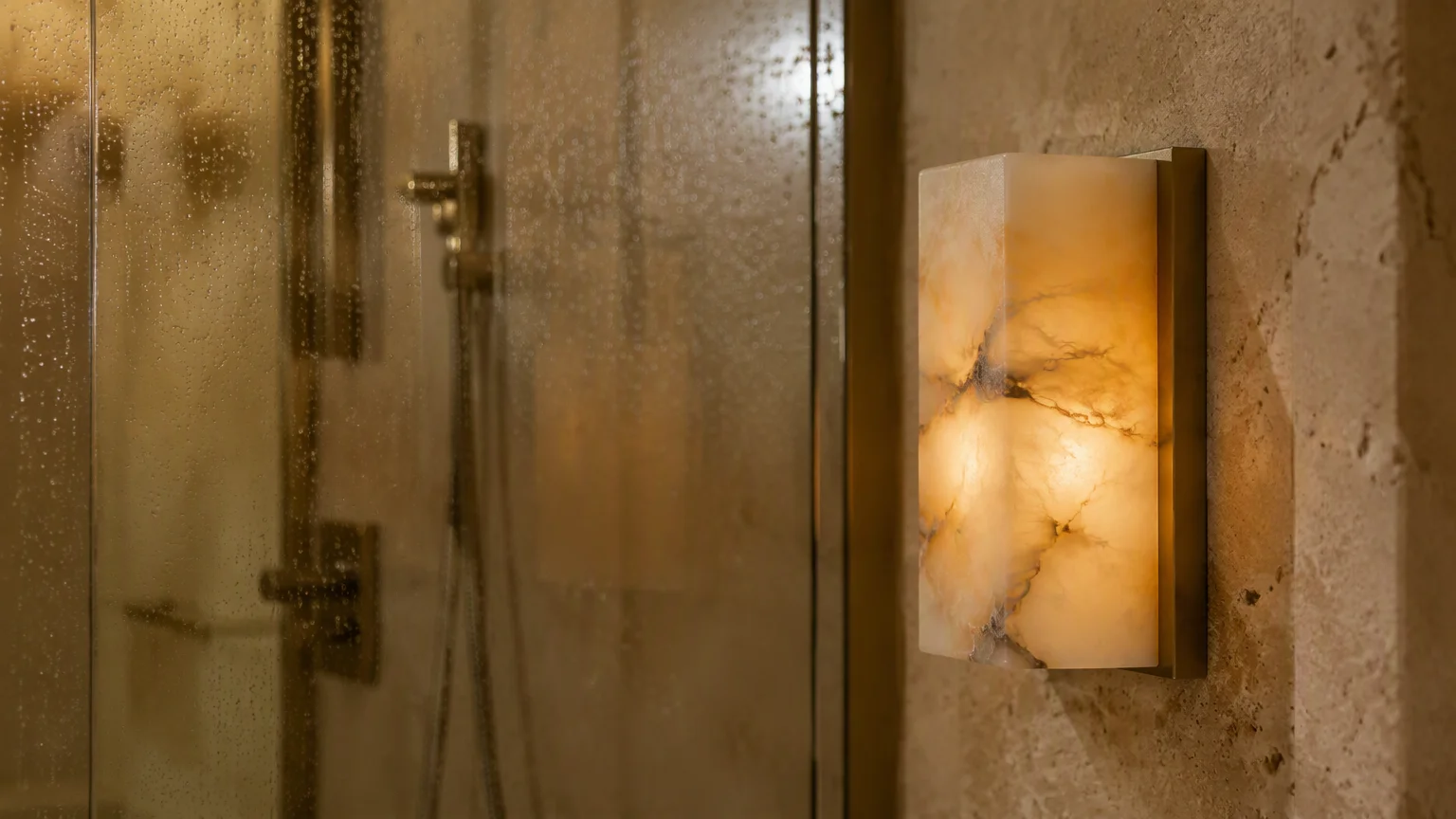
The first thing to establish is that alabaster is not marble. Both are sold as stone, both are used in bathrooms, and they behave very differently. Alabaster is a form of gypsum: it is soft enough to be marked by a fingernail, it is slightly soluble in water, and it will stain from strongly acidic or alkaline products. Marble is a carbonate rock, harder and heavier, and it is a common bathroom surface precisely because it tolerates being wet. Confusing the two leads to specifications that promise behaviour the material cannot deliver.
What that means in practice is a distinction between three conditions, not two. A dry position is a wall in a bathroom away from the basin, the bath and the shower: no direct water, some humidity. A damp position is the vanity wall: steam, splashes from hand washing, the occasional wet hand. A wet position is inside or immediately beside a shower or above a bath, where water lands on the fitting rather than merely condensing near it.
Alabaster fittings are commonly used in the dry and damp conditions, and the material’s own finish is part of why: a sealed stone face wipes clean and does not mind being damp for part of each day. They are not the natural choice for a position where water is thrown at the fitting, not because the stone dissolves on contact, but because the assembly has joints, a lamp behind the stone, and a canopy fixed to a wall; each of those is a place where water can sit. A glass or metal enclosure is a better answer where the fitting will be directly wetted, and that is a decision about the position, not a criticism of the material.
The consequences for a buyer are concrete. Ask whether the face is sealed and with what. Ask how the canopy meets the wall, because on a tiled or stone-clad wall that joint is the water path. Ask what cleaning products the maker expects, since an acidic descaler used on the glass will be used on the sconce by the same person in the same minute. And ask whether the fitting is designed so that condensation drains away from the lamp rather than collecting around it, which is a question about the geometry of the body and the position of the vents.
There is also an honest limit to what a specification can promise. No fitting survives a bathroom where the extract is inadequate: if the room stays saturated for hours, condensation will form inside any assembly that is not hermetically sealed, and a hermetically sealed stone fixture is a different product with different thermal problems. Ventilation is the first line of defence, and it belongs to the mechanical design rather than to the lighting package.
Reading a Protection Classification Properly
Ingress protection classifications are written as two digits. The first describes resistance to solid objects, including dust; the second describes resistance to water, from dripping at one end of the scale to prolonged immersion at the other. The system is standardised and internationally recognised, and the classification is only meaningful when it is attached to a complete, assembled product in its installed condition.
That last clause is where most specifications go wrong. A supplier may describe a diffuser as sealed, or a lamp housing as waterproof, and neither statement is a classification of the fixture on the wall. What a project needs is a single declaration for the finished assembly, including the joint between canopy and wall, the cable entry, and any gasket. If any of those is open, the assembly does not carry the classification of its best component.
Three practical rules follow. First, require the declaration in writing for the item as installed, and require it to name the assembly rather than a part. Second, check that the cable entry is included: a gland that is correct for a dry wall is not correct for a wall that gets splashed. Third, settle who is responsible for the zone-by-zone requirement. On most projects the classification required at each position is set by the electrical engineer against the local wiring regulations and the operator’s brand standard; the lighting specification’s job is to meet or exceed it. A lighting supplier who invents a zone rule is doing the engineer’s work badly, and a project that accepts a marketing phrase such as “bathroom safe” in place of a classification has no evidence at all.
For stone fixtures specifically, add one question that is rarely asked: how is the classification maintained after servicing? If the diffuser is removed to change a lamp and the gasket is not replaced, the fitting’s protection is degraded and nobody records it. A design that uses a captive, reusable seal, and a servicing note that says so, keeps the declaration true for the life of the installation.
Zoning the Room Before Choosing the Fitting
The most useful thing a designer can do before looking at products is to divide the bathroom into exposure zones and write down what each zone has to tolerate. The table below is the version we use when reviewing a schedule, and it is deliberately written in terms of conditions rather than products.
| Zone | What the fitting meets | What to require | Who decides |
|---|---|---|---|
| Vanity wall, outside the splash path | Steam, damp air, occasional droplets | Sealed stone face, protected lamp chamber, declared classification for the assembly | Electrical engineer, against local code |
| Vanity wall, close to the basin | Regular splashing, wet hands, cleaning agents | As above, plus a cable entry and canopy joint designed for wetting | Electrical engineer plus operator standard |
| Inside or beside a shower or over a bath | Direct spray, running water, heavy condensation | A fitting intended for that exposure, or a change of position | Electrical engineer; changes need a drawing revision |
| Ceiling over the room | Steam, no direct water | General-purpose fitting with condensation-tolerant geometry | Lighting designer |
| Outside the door | Dry | No special protection; durability and cleanability only | Lighting designer |
Two observations from using this table on real projects. The first is that most “bathroom lighting problems” are zone problems that were not written down: a fitting bought for the vanity wall gets installed inside the shower because the drawing showed a symbol in approximately the right place. The second is that the last two rows are usually where the cost is, because they are specified late and installed first. Settling the zones before the ceiling and wall layouts are frozen avoids both.
There is a third observation, about quantity. A vanity wall with two sconces and a ceiling light has three sources aimed at one face, and the result can be flat rather than flattering. The usual correction is to give each source a job: the sconces light the face from the sides, the ceiling light provides general illumination for the room, and a dedicated light at the mirror, if there is one, is for the task. Once each source has a job, dimming them as separate groups becomes meaningful rather than decorative.
Colour Temperature and Rendering at a Mirror
Under a mirror, colour is not an atmosphere question; it is a question about whether a person recognises their own face. Two variables do most of the work: the correlated colour temperature of the light, and how completely it renders colour across the spectrum.
Colour temperature sets the emotional register. A warm source flatters most skin and suits stone, because the amber in the stone and the amber in the light reinforce each other. A neutral source reads more clinical, shows texture and redness more plainly, and is often preferred in hotel bathrooms where make-up is applied and a guest wants to see what they will look like outside the room. The mistake is to mix the two in one sightline: a warm sconce on one side of a mirror and a neutral downlight above it produce a face that is amber on one cheek and grey on the other, which is worse than either choice alone.
Rendering is the more technical half. Colour rendering is expressed as an index, and the index is a summary of several sample colours rather than a guarantee about skin. Two sources with identical colour temperature and identical index can still render a face differently, because the index weights saturated reds less than a face needs. For a vanity position, the useful questions are whether the maker can provide measured spectral data rather than a headline figure, and whether the red tones are rendered faithfully. That is a question a supplier can answer with a test report and cannot answer with an adjective.
The stone modifies both variables. Light passing through alabaster is filtered by the material, so the light leaving the face is warmer and slightly more saturated than the light entering it. A neutral source behind alabaster arrives at the face as a warm one. That is an argument for choosing the source with the stone in front of it rather than on a sample board, and for approving the pair together: the same stone with a cooler source can look chalky, and the same source with a greyer stone can look cold.
Finally, dimming changes colour. Many LED sources shift warmer as they dim, which is pleasant in a bathroom at night and unhelpful at a mirror in the morning. If the same circuit serves both, the shift will be visible at the low end. A specification that states the dimming behaviour, rather than only the full-output colour, is the one that will not surprise anyone at handover.
Throwing Light So the Mirror Stays Calm
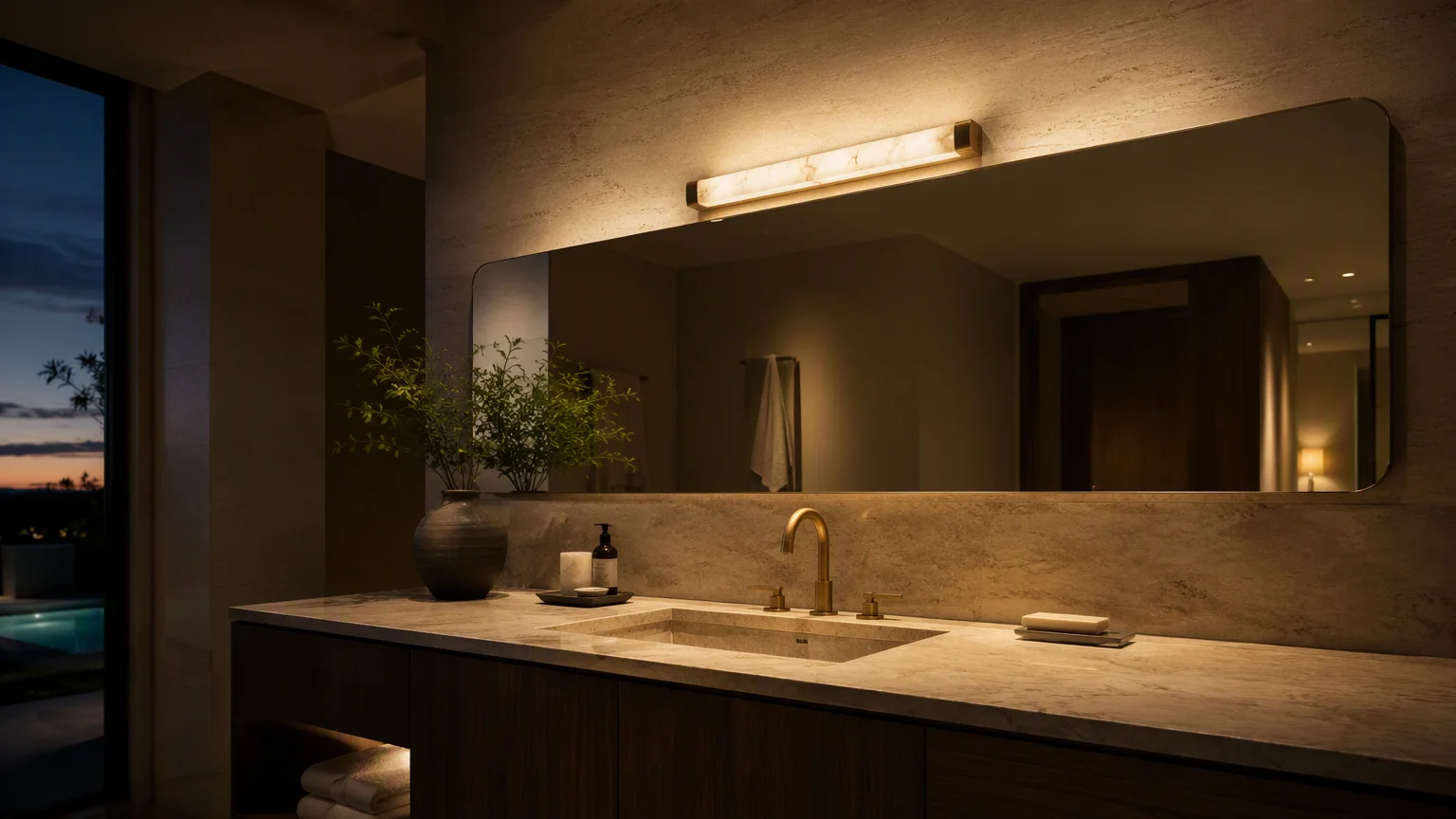
There are two broad ways a stone sconce can deliver its light at a vanity, and they produce different rooms.
The first is a wall-wash: the fitting throws light up and down the wall it is mounted on, so the wall becomes the luminous surface and the face is lit by a broad, soft gradient coming from the side. The advantage is that the source itself is not the brightest thing in the mirror, because the brightness is spread across the wall. The disadvantage is that the wall has to be worth lighting: a wash on a plain painted wall is a pleasant glow, a wash on a strongly veined stone panel is a composition, and a wash on a wall with a visible defect is an inspection lamp.
The second is a directed output, where the fitting is shaped or baffled so that most of its light goes forward and slightly downward onto the person at the basin. The advantage is efficiency and control: the light goes where the task is, and the surrounding wall stays quiet. The disadvantage is that a directed source has a visible brightness, and if the fitting sits within the field of the mirror, that brightness is reflected. The usual correction is to keep the fitting outside the mirror’s field — flanking the mirror rather than in front of it, or above the mirror’s top edge — and to use a diffuser that presents a large, even face rather than a small bright one.
Both approaches fail in the same way when they are overdone. A very bright source close to a face produces a hard shadow under the nose and a bright line on the forehead, and no diffuser completely removes that if the source is close enough. The remedy is distance and size: a larger, dimmer face further from the person reads softer than a small, bright one nearby, at the same delivered light.
Ceiling downlights deserve a separate warning, because they are the default specification and the most common cause of a bad vanity. A downlight above a basin lights the top of the head, the shoulders and the counter, and leaves the eye sockets and the underside of the chin in shadow. It is perfectly adequate for cleaning a basin and poor for looking at a face. Where a ceiling light is required for general illumination, it should be treated as fill, and the face should be lit from the mirror line.
Sizes: What Settles Them
The width of a vanity fitting and the height at which it is mounted are decided by four things: the width of the mirror, the wall space available beside it, the projection of the fitting from the wall, and the eye level of the people who will use the room. Each of them is measurable, and the arithmetic is set out in our guide to vanity light size and mounting height, which we will not repeat here.
What belongs in this article is the material constraint that the arithmetic does not capture. A stone sconce is deeper and heavier than a glass one of the same face size, because the diffuser has thickness and the canopy has to carry it. Projection therefore matters twice: it determines how far the light sits from the wall, and it determines whether the fitting intrudes into the space in front of the mirror. On a narrow vanity, a deep body can end up above the basin where a person leans in to look closely, and the fitting becomes something they duck under rather than something that lights them.
The other constraint is pairing. Alabaster is a natural material, and two sconces made as a pair will differ in veining. Whether that reads as character or as a defect depends on the design: a pair of identical geometric bodies with visibly different veining can look like a mismatch, while a pair whose veining runs in a complementary direction can look deliberate. The control is to ask for the pair to be selected together from the same block, and to see them side by side before they are packed. On a project with many rooms, that selection is the difference between a repeated detail and a repeated complaint.
Finally, the size question interacts with the light question. A wide face at low output and a narrow face at high output can deliver the same light to a basin, but the first will be calmer in the mirror and the second will be brighter as an object. If the mirror is large and the wall beside it is tight, the calmer option is usually the wide face, because it also solves the reflection problem described above.
Switching, Dimming and the Night Visit
A bathroom is used at night more often than its lighting schedule assumes, and the switch arrangement is where that shows. A single switch that brings on every light in the room at full output is a poor experience at three in the morning, and it is also the arrangement most commonly built.
The useful pattern is to separate the vanity light from the general light, and to give the vanity circuit a low-level setting. Two switches at the door, or one switch plus a dimmer, is enough: the guest can choose the mirror light alone for a night visit, and the general light for a shower. What matters is that the control is where a hand reaches when entering, outside the wet zone, and that it is findable in the dark without a search along the wall.
Dimming has three technical requirements that a stone fixture makes slightly harder. The driver has to be dimmable and compatible with the control gear chosen, since a mismatch produces flicker or a drop-out at the low end. The dimming range has to go low enough to be useful at night, which is a deeper range than most drivers offer by default. And the low end has to be stable, because a driver that flickers at low output is worse than one that simply stops at a higher level.
There is also the question of what the stone does at low output. A translucent face that is evenly lit at full output can become patchy when dimmed, if the lamp behind it is a small source and the stone is thin in places. This is visible only on site, at night, at the low end, and it is worth asking a maker to demonstrate rather than describe. A short video of the fitting ramping down is more informative than a photometric file for this particular question.
Motion sensing is the last item in this section, and it should be treated with caution in a bathroom. A sensor that switches a bright light on when someone enters a dark room at night defeats the purpose of the night setting. Where sensing is used, it should trigger the low level, not the main level, and it should have a manual override that a guest can find.
Steam, Cleaning and How Stone Ages
Alabaster does not stay exactly as delivered, and a specification that assumes it will is setting up a complaint. The changes are gradual and predictable: the surface dulls slightly where it is touched, the sealed face loses some of its sheen over years of cleaning, and a chip at an edge is permanent. None of that is a defect, but all of it needs to be anticipated in the handover.
Condensation is the main environmental factor. A stone face that is warmed by its own lamp dries quickly; one that is not stays damp for longer after each shower, and repeated damp-dry cycles are what drive staining at the joints and dulling of the finish. This is an argument for leaving the vanity light on for a period after use, or for specifying a fitting whose body is warmed by the lamp rather than isolated from it. It is also an argument for the extract fan being on the same circuit as the general light, so that the room is ventilated whenever the lights are on.
Cleaning is the second factor, and it is where facilities teams and designers most often disagree. The products that remove scale from glass and tile are acidic; the products that remove soap residue are often alkaline; both attack a sealed stone finish faster than a neutral cleaner. The handover file should name an acceptable neutral cleaner, name the products to avoid, and state the inspection interval. A stone diffuser that is wiped weekly with the right cloth will look new for years; the same diffuser cleaned with a descaler will show dull patches within a season.
The third factor is spares. A stone body cannot be repaired invisibly, and a batch made two years later will not match. Keeping one spare fitting per room type is cheap insurance for a hotel, and it is the sole way to replace a damaged unit without changing the appearance of a room. That recommendation belongs in the specification, not in a conversation after the first breakage.
A Checklist for the Bathroom Package
The table below condenses the article into the questions we ask when reviewing a bathroom lighting schedule. It is written so that each row can be answered from a submittal rather than from a conversation.
| Question | What a good answer looks like |
|---|---|
| Which zone is each fitting in? | A drawing that marks exposure zones, agreed with the electrical engineer |
| What protection does the assembly carry? | A written declaration for the installed fixture, including canopy joint and cable entry |
| Is the stone face sealed, and with what? | A named finish and a cleaning instruction that matches it |
| What colour is the delivered light? | A source chosen with the stone, approved as a pair, with dimming behaviour stated |
| How is the face lit? | A stated intent: wall-wash, directed, or fill, with the mirror reflection considered |
| Where does the light come from at night? | A separate low-level circuit that is findable in the dark |
| How is a failed lamp changed? | A release method and a reusable seal, documented |
| What is held in spares? | One unit per room type, from the approved batch |
Most of these rows cost nothing to answer and everything to leave open. The pattern across projects is consistent: the failures that a guest actually meets are rarely about the amount of light. They are about a fitting in the wrong zone, a reflection nobody modelled, a colour that flatters the stone and not the face, or a lamp that cannot be changed without damaging a seal. All four are decided on paper, early, and all four are cheap to get right at that stage.
Can alabaster be used in a shower? It is not the natural choice for a position where water is thrown at the fitting, because the assembly has joints and a lamp chamber rather than a single sealed shell. Stone sconces are commonly used on vanity walls, where the exposure is steam and splashes rather than direct spray.
Is a higher protection classification necessarily better? Not automatically. A higher classification usually means a more enclosed assembly, which changes thermal behaviour and servicing. The right answer is the classification the zone requires, declared for the assembly as installed.
Why do my sconces appear twice in the mirror? A mirror reflects every bright object in front of it. Fittings placed within the mirror’s field appear as reflected sources; moving them to flank the mirror, or using a larger and dimmer face, reduces the effect.
Do I need a warm or a neutral source? Warm light suits stone and flatters most skin; neutral light shows colour more plainly for make-up. What matters most is not mixing the two in one sightline, and selecting the source together with the stone rather than separately.
We make alabaster wall sconces and vanity fittings to project order, with the stone finish, protection requirement and light direction agreed against your bathroom layout and the zones your engineer has set. Send the wall elevations, the mirror sizes and the room schedule, and we will return a submittal that answers the questions above.
See alabaster wall sconces · Bathroom mirror lighting · Talk to us about a project


