
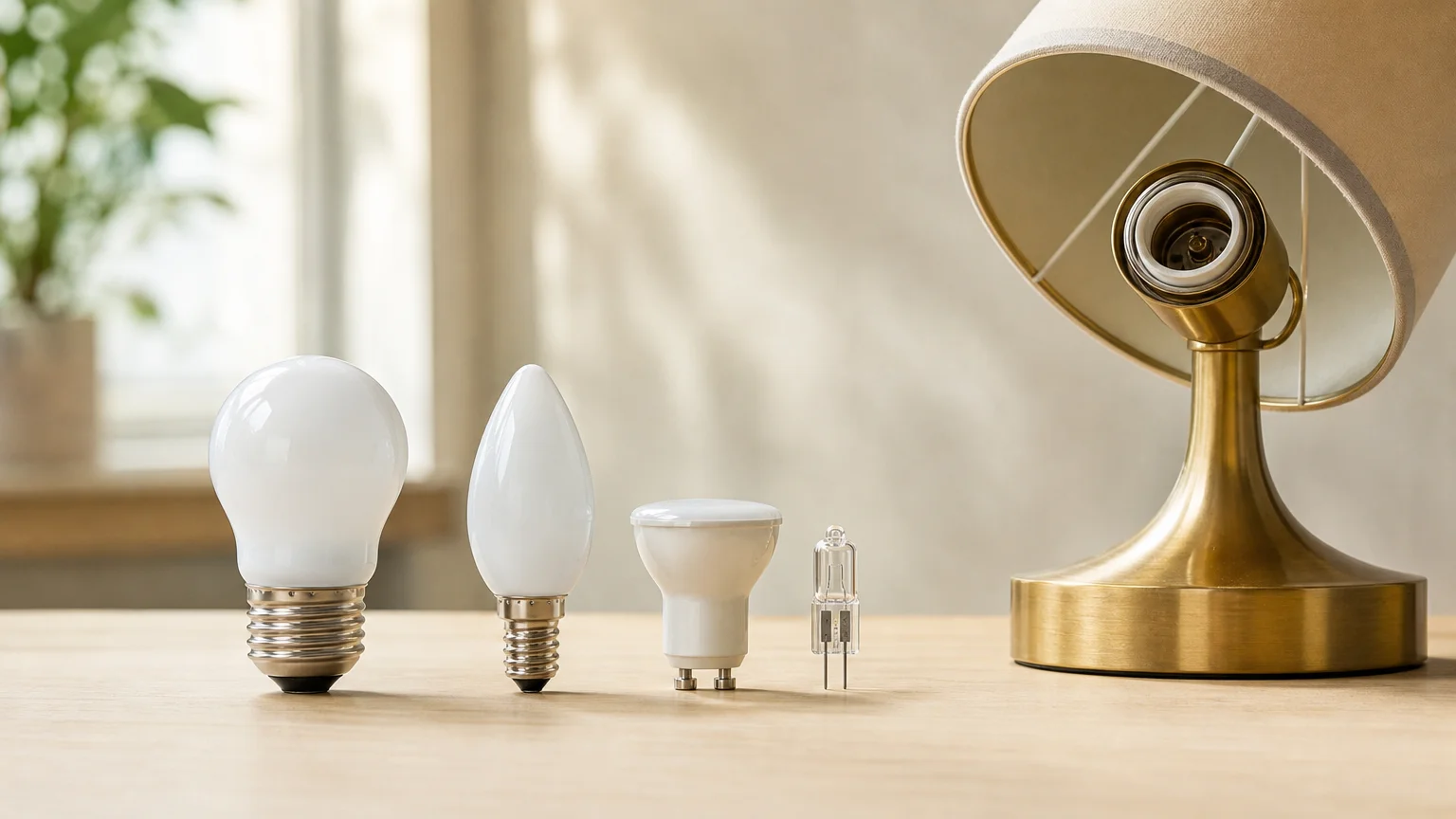
A bulb can look right, screw in smoothly, switch on — and still be the wrong bulb. The base code is the part of the specification that decides whether the lamp and the bulb belong together, and it is the part most often treated as a detail rather than as a requirement.
This guide compares the six base families that account for most household and decorative lighting: the two large Edison screw families, the small candelabra screw, the intermediate screw, the twist-lock reflector base and the small bi-pin capsule bases. It sets out how they differ physically, why two bases that look interchangeable are not, and a six-step check that a buyer can run in a shop, a warehouse or a hotel store room without any test equipment.
Two things are deliberately left out. There are no dimensions here, because a diameter written in a catalogue is easy to copy and easy to mistype, and the printed code on the bulb is a more reliable instruction than any table. There are also no part numbers from our own range or from anyone else’s, because the code on the socket is the language the whole supply chain reads, and a private numbering system breaks that conversation rather than helping it. What follows is the reading method, which travels across brands and markets.
The practical consequence is worth stating at the start: base codes are a compatibility layer, not a style choice. A shade, a finish or a colour temperature can be changed after the fixture is installed. A base cannot. It is fixed at the moment the socket is bought, and everything downstream — the bulb, the driver, the control gear, the spare that has to be found in three years — has to live with that decision.
- 01The Bulb That Looks Right and Does Not Fit
- 02Why the Codes Exist at All
- 03The Six Families in Plain Terms
- 04Same Shape, Different Rules
- 05The Six-Step Check
- 06Steps One to Three: Read, Read, Measure
- 07Steps Four to Six: Voltage, Envelope, Clearance
- 08The Reverse Lookup: Fixture to Base
- 09Where This Goes Wrong in Volume
- 10One Line for the Product Page
The Bulb That Looks Right and Does Not Fit
The failure usually arrives in a familiar shape. Somebody replaces a lamp in a bedroom, a hallway or a restaurant, picks a bulb from a drawer because it looks close to the one that came out, and it fits. It fits well enough to hold, well enough to light, and well enough that nobody thinks about it again until the fitting is warm, the bulb is running at a rating it was not designed for, or a guest reports that the lamp has stopped working and cannot be switched off at the wall.
There are three separate reasons a near-miss happens. The first is geometric: two screw families used in different regions differ by an amount small enough for one to start in the thread of the other. The second is electrical: the same physical shell may be sold in versions intended for different mains voltages. The third is dimensional in a different sense — the bulb may sit lower or higher in the socket than the shade or the glass was designed for, so a technically compatible bulb produces the wrong light distribution.
Each of those three is checkable before the purchase, and none of them requires special knowledge. What they require is a sequence: read the old bulb, read the fixture, measure if the two disagree, confirm the voltage basis, confirm the bulb’s physical envelope, and confirm that the assembled result fits the shade, the diffuser or the recess. That sequence is the substance of this article. Everything else is vocabulary.
The vocabulary matters, though, because the codes carry meaning that plain descriptions lose. A bulb described as a “small screw” could be a candelabra or an intermediate; a bulb described as “two pin” could be a mains-voltage capsule or a low-voltage capsule that needs a transformer in the circuit. When a buyer writes “small screw, warm white, dimmable”, the supplier may fill that specification correctly and still deliver something that cannot be installed, because two of those words are categories rather than rules.
Why the Codes Exist at All
A base code is a compact contract between three parties who may not meet at any point: the fixture maker who builds the socket, the bulb maker who builds the lamp, and the person who has to make them work together years later in a building that has changed hands twice. The code exists so that the third party does not have to guess.
The structure of the code follows a simple logic. A letter describes the family — screw, bi-pin, twist-lock, bayonet, and the sub-types within each. A number identifies the size within that family. Occasionally a further letter or number records a variant: a shroud, a skirt, a specific pin arrangement, a low-profile version. Once that logic is understood, a code stops being an arbitrary string and becomes a set of instructions that can be checked against a socket.
The reason this matters commercially is standardisation. Bases are the most standardised part of a decorative fixture, because they are the part that has to accept a consumable made by somebody else. A buyer can specify a bespoke metal finish, a custom glass shape and a proprietary arm geometry, and reasonably expect the factory to deliver exactly that. A buyer who specifies a bespoke socket is asking for a fixture that will only accept bulbs from one source, which is a decision with consequences for the life of the building.
Those consequences are easy to state. A non-standard socket pushes the whole spare-parts problem onto the buyer: the bulb becomes a special order, the lead time becomes the supplier’s lead time rather than a shelf lead time, and a single failed lamp in a public area turns into a procurement event. Standard bases avoid that by making the consumable a commodity. The trade-off is that standard bases constrain the design, which is why the constraint is usually accepted at the socket and expressed elsewhere — in the shade, the diffuser, the optical accessory.
The Six Families in Plain Terms
Six families cover the majority of what a buyer will meet in residential and hospitality interiors. They are described here by behaviour rather than by measurement, because the behaviour is what the buyer has to plan around.
The large Edison screw, European version. A screw shell with a single centre contact, used across most of the world on mains voltage. It is the default base for general-purpose lamps in decorative fixtures, and the family most often assumed when a specification says nothing at all. Its thread is close to the North American version but belongs to a different dimensional standard.
The large Edison screw, North American version. The same construction and the same role, on a different national standard and, in practice, a different voltage basis. The two are close enough in thread form that a bulb from one market can be started in a socket from the other. That is precisely the situation the six-step check exists to catch.
The small candelabra screw. A narrow screw shell used where the socket has to disappear inside a slender body: chandelier arms, candle-style sconces, small decorative table lamps. Because the socket is small, the bulb envelope that follows it is also small, which is why candelabra-based fixtures tend to have a characteristic proportion — a thin stem and a flame or globe on top.
The intermediate screw. A middle size that sits between the candelabra and the large Edison families, most often encountered in North American decorative and vanity fixtures. It is the family that causes the most confusion in conversation, because “small screw” is used for it and for candelabra interchangeably by people who have met both.
The twist-lock reflector base. Two stout pins on a flat face, inserted and turned to lock. It is a mains-voltage base in the form most buyers meet, and it is common in recessed downlights and track heads where the bulb sits inside a reflector body. The body is part of the optical design, so the bulb is usually bought as a complete reflector unit rather than as a bare lamp.
The small bi-pin capsule family. Two thin pins on a small ceramic or glass body, used in compact decorative fixtures, cabinet lights, and low-voltage systems. This family splits in a way that matters: some members run on mains voltage and some run on a low voltage supplied by a transformer or driver. The pins look similar across the split, and the difference is not visible from the outside of the bulb.
Same Shape, Different Rules
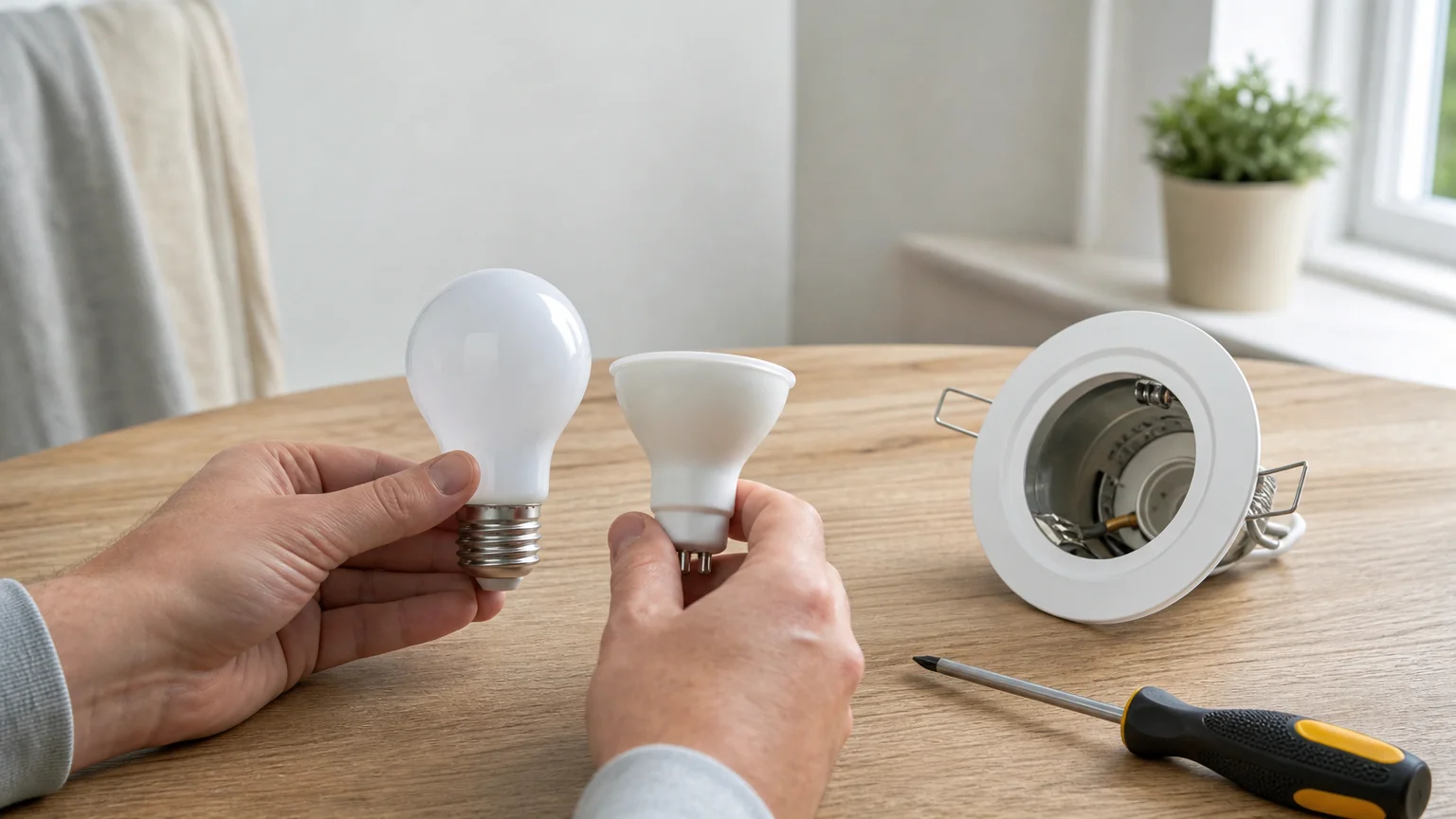
The most expensive misunderstanding in this subject is the belief that a base describes a shape. It does not. A base describes a connection. The shape of the glass is a separate specification, and the same base can carry a globe, a candle, a reflector, a capsule or a linear lamp.
Two consequences follow. First, a bulb with the correct base can still be wrong for the fixture, because its glass may be too wide for the shade, too long for the diffuser, or too directional for the place it has to light. Second, a bulb with the wrong base can look exactly like the one that came out, because the glass shapes and the colour temperatures may be identical while the connection is not.
This is where photographs fail as a purchasing document. A photograph shows the glass, the colour and the general proportion. It does not show the thread pitch, the pin spacing or the contact arrangement, and those are the parts that decide compatibility. A specification that lists a base code and a voltage basis is worth more than any number of images, and a supplier who answers a base question with a picture has not answered the question.
The same logic applies to adaptors. Screw-to-bayonet, screw-to-pin and pin-to-screw adaptors exist, and they are legitimately useful for a temporary fix or for a single awkward fixture. They are a poor basis for a project: every adaptor adds a joint, changes the position of the light source relative to the shade, and adds a component that nobody maintains. In a hotel with several hundred rooms, an adaptor is a maintenance liability disguised as a solution.
The Six-Step Check
The check below is ordered deliberately. Each step removes a class of error, and the later steps assume the earlier ones have passed. Running them out of order usually means running them twice.
Step one: read the old bulb. The base code is printed or stamped on the bulb itself, usually on the shell or on the ceramic body, sometimes on the collar. If the old bulb is still in place, this is the fastest evidence available and it reflects what the fixture has actually been accepting, which is stronger evidence than what a catalogue says it should accept.
Step two: read the fixture. The label on the fixture — on the body, inside the shade, on the backplate, or in the recessed housing — states the base, the maximum wattage and often the voltage basis. The label is the authoritative document. Where the old bulb and the label disagree, the label wins, because the old bulb may itself be the error being corrected.
Step three: measure only if the two disagree. Measuring a socket without the right gauge is imprecise, and it is easy to measure the outer shell rather than the contact geometry. The useful measurement is comparative rather than absolute: does the candidate bulb seat to the same depth and with the same contact pressure as the one that came out? If the answer is uncertain, the fixture label is a better guide than a ruler.
Step four: confirm the voltage basis. A bulb rated for a lower mains voltage will fail quickly on a higher-voltage supply, and in the worst case will fail in a way that damages the fixture; a bulb rated for a higher voltage on a lower supply will be dim and may not strike reliably. The voltage basis belongs to the market, not to the base, which is why a base code alone cannot settle it.
Step five: confirm the envelope. Check the glass shape and its overall size against the shade, the diffuser, the glass globe and the recess. A bulb that fits the socket but touches the shade will run hot and will discolour the fabric; a bulb that is too short for a deep shade will put a bright spot where the design intended a wash.
Step six: confirm the assembled fit. Install the bulb, fit the shade or diffuser, and check that nothing is under tension: no contact between glass and fabric, no trapped cable, no forced entry of the bulb into a recess that was designed for a smaller body. This last step catches the errors that all the paperwork missed.
Steps One to Three: Read, Read, Measure
The first three steps are about evidence, and the discipline they require is to prefer the printed code over the visual impression. In practice this means carrying the old bulb to the point of purchase, or photographing the code rather than the bulb. It also means reading the fixture label before ordering anything, which sounds obvious and is skipped constantly, because the label is usually in an inconvenient place — inside a shade, behind a backplate, under a base plate.
There is a specific trap in the label. Many fixtures state a maximum wattage alongside the base, and buyers read the wattage as the specification and the base as a formality. The reverse is closer to the truth: the base is the hard constraint, the wattage is a thermal limit that modern lamps often meet without difficulty. A buyer who orders by wattage and assumes the base will match is ordering by the softer of the two numbers.
Measurement has a narrow but real role. It is useful when the label is missing, when the fixture is old enough that the label has been painted over, or when a bulb seats but does not make reliable contact. In those cases, the comparison that matters is between the old bulb and the candidate, not between the candidate and a table. Comparing two physical objects removes the transcription errors that tables invite.
Where a fixture has been re-lamped many times by many people, the evidence can contradict itself: the label says one family, the bulb in place is another, and the shade has been changed at some point. That situation is worth resolving rather than working around, because it usually indicates that the original bulb type has become hard to source and somebody adapted informally. The correct response is to establish what the socket actually is, then decide whether to standardise the fixture or to keep the adaptation documented.
For hotel and multi-room work, the same logic scales into a schedule. One row per fixture type, with the base, the voltage basis, the envelope, the colour temperature and the control requirement, is enough to stop the drift that happens when each room is re-lamped independently. Our guide to light sources and lamp bases in hotel projects sets out that schedule view in the engineering context, and the two articles are intended to be read as a pair: this one for the household decision, that one for the project document.
Steps Four to Six: Voltage, Envelope, Clearance
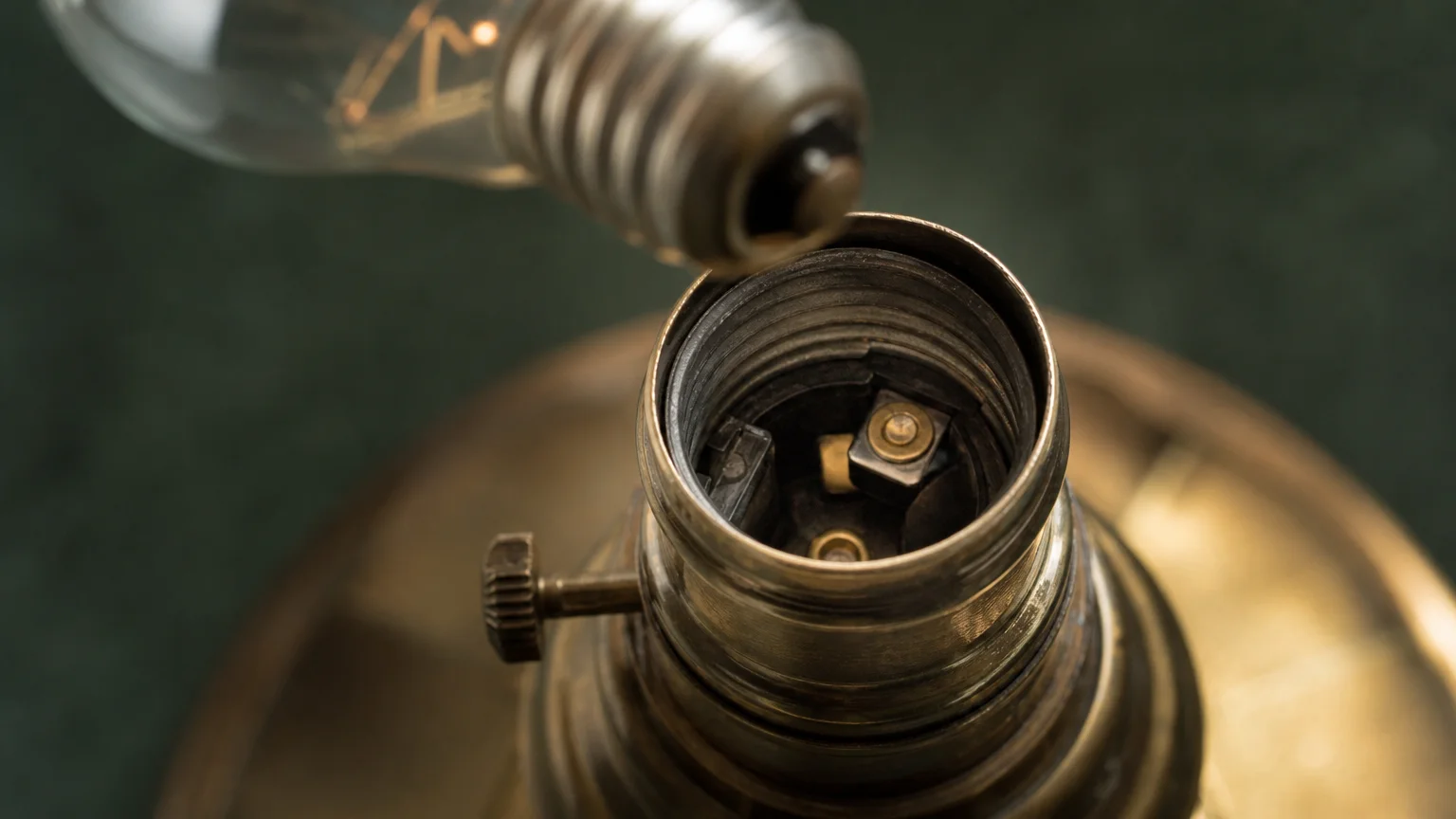
Voltage is the step that buyers skip because it feels like a regional detail rather than a compatibility issue. It is neither. The same base family is sold in versions intended for different mains voltages, and the difference is invisible from the outside. In markets with a lower mains voltage, a bulb intended for a higher-voltage market will be under-driven; in the reverse case it will be over-driven, which shortens life sharply and, in the worst case, produces a failure that damages the fixture.
The practical rule is to buy bulbs in the market where they will be used, or to buy from a supplier who states the voltage basis explicitly on the product document. Where a project is procuring across borders — a hotel group buying centrally for properties in several countries — the voltage basis belongs on the purchase order line, not in a footnote. Our cross-border procurement notes cover the wider set of exposures that come with centralised buying.
The envelope is the step that determines whether the light lands where the design intended. A candle bulb in a shade designed for a globe will produce a narrow column of light and a dark upper shade; a globe in a narrow candle tube will not fit at all. The consequence is not only aesthetic. A bulb that sits too close to a fabric shade raises the surface temperature of the fabric, and a bulb that is enclosed too tightly loses life. Both are avoidable by checking the assembled result rather than the individual parts.
Clearance is the final check and the one most often deferred to installation day. It has three parts: clearance to the shade or diffuser, clearance to the glass globe of an outdoor or bathroom fixture, and clearance to the recess in a downlight. All three are about air and about contact. Where a fixture is rated for a particular bulb envelope, that rating is a thermal statement as much as a dimensional one, and substituting a physically larger bulb because it fits the socket is a change to the fixture’s thermal design.
| Read the code | What it decides | What it does not decide |
|---|---|---|
| Family letter | Which socket will accept the bulb | Whether the glass will suit the shade |
| Size number | Which variant within the family | Which mains voltage the bulb is built for |
| Variant suffix | Shroud, skirt, pin arrangement | Whether the fixture is rated for that envelope |
| Fixture label | Base, thermal limit, voltage basis | Whether the control gear is compatible |
| Product document | Voltage basis, dimming behaviour, colour | Whether the assembled result looks right in place |
The Reverse Lookup: Fixture to Base
Buyers usually arrive at this subject from the fixture side rather than the bulb side: they have chosen a lamp, and they need to know what bulb it takes. The reverse lookup is straightforward once the fixture type is named, because the base follows the socket that the form allows.
Chandelier arms and candle sconces take the small candelabra screw family, because the arm has to stay slender and the socket has to hide inside it. Table lamps with a fabric shade take the large Edison family in the market where they are sold, with the candelabra family appearing in smaller decorative bodies. Vanity bars and bath brackets most often take the large Edison family, with the intermediate size appearing in North American decorative ranges. Recessed downlights and track heads take the twist-lock reflector base where the reflector body is part of the optical design, and a pin-based capsule where the fixture has its own reflector. Cabinet, shelf and display lights take the small bi-pin family, and this is the group where the voltage question has to be asked explicitly, because the same pins appear on mains-voltage and low-voltage versions.
Two fixtures deserve a warning rather than a rule. The first is the decorative fixture with an integral LED module: there is no bulb to look up, and the module is replaced as a component or not at all. The second is the fixture with a proprietary connector, which exists in some furniture-integrated and architectural ranges. Both are legitimate, and both should be identified at specification stage so that the spares strategy reflects them rather than discovering them at first failure.
Where the fixture type is unknown, the label and the socket are the two reliable pieces of evidence, and a supplier who cannot answer a base question from the fixture documentation is telling you something about the documentation as well as about the product. Our guide to lamp types covers the fixture-side taxonomy in more depth, and the table lamp collection shows how the base decision sits inside a finished product.
Where This Goes Wrong in Volume
Single replacements fail quietly. Volume replacements fail expensively, and the pattern is predictable enough to design against.
The first pattern is mixed stock. A property re-lamps over several years, buying in batches from different sources. Because the base is treated as a formality, batches arrive in the correct family but the wrong voltage basis, or in the correct family and voltage but a different envelope. The result is a store room in which visually identical boxes contain incompatible lamps, and a maintenance team that cannot tell them apart without reading the small print on every carton.
The second pattern is the dimming surprise. A lamp that is correctly based and correctly rated may still not dim smoothly, because dimming compatibility is a property of the driver and the control, not of the base. Replacing a lamp during a refurbishment without checking the dimmer is one of the most common causes of flicker, buzz and premature failure in hospitality interiors. The base check gets the lamp into the socket; the compatibility check keeps it working. Our dimming compatibility guide covers the second check, and specifying dimmable fixtures covers the design side.
The third pattern is the voltage mismatch in cross-border batches. A central purchasing team buys a container for several countries, and the base is standardised while the voltage basis is not. The error surfaces at installation, in one market, on a schedule that is already tight. Recording the voltage basis per destination on the purchase order is a low-cost control that prevents it.
The fourth pattern is colour drift inside a correct specification. Two batches of the same base and the same nominal colour render differently because they come from different production runs. This is not a base problem, but it is discovered during the same re-lamping exercise, and it is worth deciding at specification stage whether the property will accept batch variation or will hold a reference sample. Our colour temperature guide and the masterclass on colour consistency cover the decision framework.
One Line for the Product Page
The whole subject compresses into one sentence that belongs on every product page and every quotation: this fixture takes a [base code] lamp, on [voltage basis] mains, within [envelope] clearance, dimmable only with compatible control gear. Four fields, no ambiguity, and every one of them checkable by a buyer who has not seen the fixture.
Written that way, the specification does three jobs at once. It tells the buyer what to order, it tells the maintenance team what to keep in stock, and it tells the next supplier what the fixture is, which matters when the original source is no longer available. A product page that says “E27 bulb, max X” and stops there has answered the first question and left the other three to be rediscovered.
There is a commercial argument for the same discipline. Base clarity reduces returns, reduces installation call-backs and reduces the number of occasions on which a client discovers that the lamp they specified is not the lamp that fits. None of that is visible in a photograph, and all of it is visible in the first month after handover.
The broader point is that a lighting specification is a chain of compatibility decisions, and the base is the link that cannot be corrected later without changing hardware. Colour can be changed by changing a lamp. Dimming behaviour can be changed by changing a driver or a dimmer. Output can be changed by changing a lamp. The base is fixed. Treating it as the first decision rather than the last is what separates a specification that survives a decade of maintenance from one that generates a small, recurring, avoidable cost every year.
Frequently Asked Questions
Can I use a European screw bulb in a North American screw socket?
It may start in the thread, which is exactly why the question is worth asking. Physical entry is not compatibility: the bulb may be built for a different mains voltage, and the fixture may be rated for a different envelope and a different thermal limit. Check the fixture label and the voltage basis before treating the fit as evidence.
What does the number in a base code actually tell me?
It identifies the size within the family, which is what determines whether the socket and the bulb are the same standard. It does not tell you the voltage basis, the glass shape, the dimming behaviour or the thermal rating of the fixture. Those are separate lines in the specification, and each one has to be confirmed.
Are adaptors a reasonable solution in a hotel?
For one awkward fixture, yes. As a project strategy, no. An adaptor adds a joint, changes the position of the light source inside the shade and introduces a component that nobody inspects. In a property with hundreds of rooms, the adaptor count becomes a maintenance metric that nobody is measuring.
Why does the same bulb look different in two rooms?
Usually because the two rooms have different fixtures, different shades or different control gear, and sometimes because the two batches are from different production runs. Base compatibility gets the lamp into the socket; the appearance is decided by the shade geometry, the colour of the surfaces around it and the dimmer setting.
My fixture says one base and the bulb inside is another. Which is right?
The label is the authoritative document, and the bulb in place may be an informal adaptation made when the original type became hard to source. Establish what the socket actually is, then decide whether to standardise the fixture or to record the adaptation so the next person is not guessing.
Does a pin base mean low voltage?
Not by itself. The pin families include both mains-voltage and low-voltage members, and the difference is not visible from outside the bulb. Where a fixture uses pins, the voltage basis has to be confirmed from the fixture documentation rather than inferred from the connector.
How do I specify this in a purchase order?
Four fields: base code, voltage basis, envelope clearance and dimming requirement. Add the colour and the control protocol if the project uses them. Those four fields are enough for a supplier to quote accurately and enough for a maintenance team to re-order years later without a site visit.
Specifying Lamps and Fixtures Together?
Tell us the fixture, the market it will be installed in and the control gear it will run on, and we will set out the base, the voltage basis and the envelope in a form your maintenance team can re-order from. Where a detail depends on a document we do not yet have, we will say which document rather than assume a value.
Our ceiling lamp, wall sconce and table lamp ranges are supplied with the lamp base stated on the specification sheet, and where a fixture uses a pin-based source the voltage basis is written on the same line rather than left to inference.


