

Two quotations arrive for what the drawing calls a glass element. One is a third of the other, the lead time is different, the quantities available from stock are different, and both suppliers describe their product the same way. The material is not the explanation. Both parts are glass, formed from broadly the same raw materials, and neither is pretending to be anything else.
The explanation is the forming route, and it sits in the first two lines of each workshop’s process sheet.
Decorative lighting buyers are usually introduced to this conversation through the difference between hand-made and machine-pressed glass, which is a question about forming accuracy. That distinction is real and worth understanding, but it merges two separate axes. The one that decides the price of a handmade piece is different: it is the difference between casting, where molten glass is poured into a mould and cooled, and hand-blowing, where a gather of glass is inflated and shaped in the air. Both routes are manual.
Both are slow compared with machine pressing. Telling them apart is what allows a buyer to read a quotation, plan a project and write an acceptance clause that both sides can live with.
This article works through the two routes as processes first, and then follows them into the commercial consequences: rejects and inspection, batch identity and spares, lead time, the shape of a quotation, and the specification language that prevents most of the disputes these products otherwise generate. It is written for procurement teams, project designers and specifiers who have to commit to one route before the first sample exists.
If you are still working out how formed glass relates to pressed glass, the companion article on hand-made and machine-pressed glass in lighting sets out that axis, and the guide to specifying sculptural glass in statement fixtures covers what the material is being asked to do in a space. This article takes the next step down the process chain.
- 01Two Routes, One Word: Why the Process Explains the Price
- 02What Casting Actually Is
- 03What Hand-Blowing Actually Is
- 04Where Each Route Loses Money
- 05Consistency, Batch Identity and Spares
- 06Lead Time: Why the Routes Schedule Differently
- 07Reading a Quotation: Which Route Was Priced?
- 08Choosing Between Them in a Real Project
- 09The Specification Language That Protects Both Sides
- 10Two Myths Worth Retiring
Two Routes, One Word: Why the Process Explains the Price
Ask a supplier why one glass element costs several times another and the answer will usually be a word rather than a process: handmade, artisan, sculptural, designer. None of those words explains anything about the cost, because all of them can be truthfully applied to products at very different price points. The explanations live one level down, in the sequence of operations that produce the part and in the ratio between the labour those operations consume and the number of parts that survive to be shipped.
Two clear forming routes dominate the middle and upper reaches of decorative lighting, and both are manual. In the first, molten glass is poured into a mould and then cooled slowly, and the part takes its shape from the mould cavity. In the second, a gather of molten glass is taken from the furnace on the end of a hollow pipe, inflated, and shaped by hand in the air, and the part takes its shape from the maker’s actions. The raw materials are essentially the same family of glass.
The end products can look similar in a photograph. Almost everything that follows commercially — consistency, reject rate, lead time, the cost structure of a quotation, the meaning of a spare part — differs because of that one divergence.
Once a buyer learns to identify which route a product came from, three things become possible. A quotation can be read instead of guessed at. A specification can be written that is achievable by the route actually being used. And the questions asked at sample approval can be the ones that determine whether the production run will match the sample, rather than questions that only test the sample itself.
That is the practical value of the distinction, and it is worth more than the aesthetic vocabulary that usually surrounds it.
What Casting Actually Is
Casting begins with glass that is hot enough to flow. Molten glass is poured into a mould cavity shaped to the intended form, and it is then allowed to cool. The whole outcome of the process rests on the cooling. If the glass cools too quickly, or unevenly across the section, stresses build up inside it and the part either cracks during cooling or warps away from the intended shape.
If it cools too slowly, the cycle becomes prohibitively expensive and the mould is tied up for longer. The narrow band of temperature and rate that produces a sound part without wrecking the economics is the real craft content of this route, and it is why a casting workshop talks about its cooling schedule the way a bakery talks about its oven.
Because cooling happens in three dimensions and glass is a poor conductor of heat, parts produced this way develop internal character. Small bubbles remain trapped where they were in the pour, internal colour and density vary slightly through the section, and two parts from the same mould and the same pour end up visibly different from one another. This is not a defect in the process; it is the process. The mould gives the family resemblance, and the cooling gives each piece its individuality.
Buyers who expect cast parts to be identical to one another are expecting a different process.
After cooling, the parts are inspected and sorted. Because the yield is not perfect, this step is not a formality: parts with cracks, with unacceptable internal flaws, or with shape deviation are rejected here, and the accepted ones go forward. What follows is the part of the route that surprises most buyers. Glass parts normally need openings for the lamp holder and for the cable, and in a casting operation these are typically produced by drilling the cooled glass.
Drilling glass is a high-precision operation with its own risk of losses, because the wrong speed, the wrong support or a concealed internal stress can crack a part that was sound a moment earlier. Then the wiring is threaded through the drilled openings part by part, and the parts are assembled into the fixture or packed as components for assembly at the destination.
The consequence for a buyer is a cost structure that is easy to misread. Casting is often described as the more economical route at the point of forming, because the molten glass is handled at a lower temperature than a blowing operation requires, and because the operator’s time per part is spent on process control rather than on continuous shaping. That description is a process-level generalisation and should be treated as one: any specific claim about energy or price advantage is a claim about a particular workshop, its equipment and its local energy costs.
What the buyer can rely on, without knowing any of those details, is that the casting route front-loads its cost into mould making, cooling time and post-forming processing — drilling, inspection and threading — rather than into the forming action itself.
What Hand-Blowing Actually Is
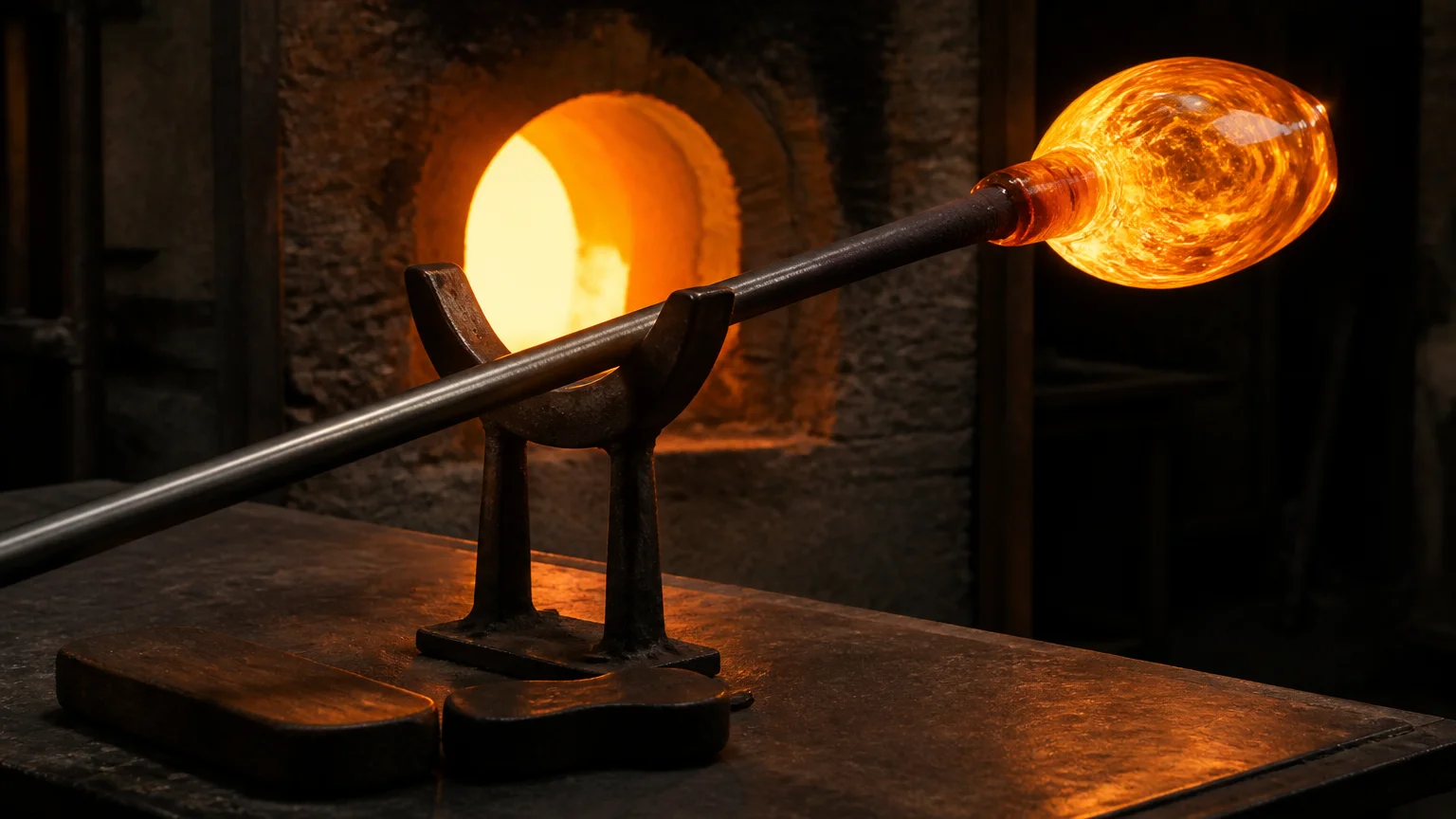
Hand-blowing begins with the same family of raw materials — silica sand, soda ash and lime — melted together in a furnace until the batch becomes a uniform molten glass. The maker then collects a gather on the end of a hollow steel pipe, and from that moment on the shape is made by a sequence of actions: inflating the gather with the breath, rotating it, using gravity and a rolling surface to lengthen or broaden it, and returning it to heat when it stiffens.
Tools are used throughout, but the forming energy comes from air pressure, rotation and timing rather than from a mould cavity.
What makes blowing a distinct commercial proposition rather than simply a more expensive way of reaching the same result is that skilled blowing deliberately preserves the material’s fluidity and unpredictability. Glass at working temperature behaves like a very stiff liquid. The maker is not eliminating that behaviour; they are steering it. The visible signatures of the route are the ones the material moved into and kept: soft, slightly asymmetric walls, a gentle spiral or swirl where the gather rotated, an organic edge on a rim, small variations in thickness that shift how light moves through the piece.
Two physical consequences follow. The first is that the part is a single continuous body. A blown shape has a skin that formed in one continuous action, without a mould seam to disguise or a cavity wall to interface with at the surface, which is why blown elements often look remarkably even and liquid when they are lit from within. The second is that the thickness distribution is not predetermined.
Where a cast part takes its thickness from the mould, a blown part’s thickness is a record of how the maker worked that gather, which is why two nominally identical blown pieces differ not only in surface detail but in how they glow.
Reproducibility is the trade-off. A skilled maker with a well-controlled process can produce a set of blown parts that sit inside an agreed tolerance, and a well-run workshop will do exactly that for a project. But the parts will not be identical, and no workshop can make them identical by hand. The practical question is therefore never “will the pieces match” but “what variation has the buyer agreed to accept, and how is it measured” — a question that belongs in the specification, and one that this article returns to below.
The wider craft vocabulary that surrounds hand-formed glass, including the technical names used for specific decorative effects, is set out in our guide to how surface treatments change the way glass behaves in a fixture.

Where Each Route Loses Money
Every manual process loses money somewhere, and the useful question for a buyer is where. Knowing the answer explains a supplier’s behaviour, predicts which risks will land on the project, and turns a quotation review into a technical conversation.
Casting loses money in three places. The first is mould making: a mould has to be produced or prepared for each form, which means tooling cost is committed before any saleable part exists. The second is cooling: the mould and the furnace are occupied while a part cools slowly, so throughput per unit of floor space is low, and a workshop’s capacity is set by its ability to keep parts cooling without cracking. The third is post-forming processing: inspection, drilling and threading are all operations that can destroy a finished part, and they are performed after the expensive forming step.
When a casting quotation is high, it is usually high because of these three, not because the material is better.
Blowing loses money in different places. Forming is continuous, so the maker’s time is the dominant cost and the rate at which a skilled hand can work is the ceiling on output. Consistency is the second exposure: because the process is steered rather than governed, the reject rate for a demanding dimensional tolerance can be materially higher than for a simple form, and the parts that fall outside tolerance have consumed the same furnace time and the same maker’s time as the ones that pass.
The third is rework: a blown part that has drifted out of specification can sometimes be corrected at heat, but the correction itself costs time and can compromise the piece.
Two consequences follow for anyone planning a project. First, a supplier’s responsiveness to a tolerance change is a reliable signal of which route is in use. If tightening a dimensional requirement has no cost consequence, the part is probably not hand-formed to that dimension in the first place, or the requirement is not being measured. If it produces an immediate and specific price response, the supplier is pricing a known reject rate.
Second, the route determines which defect you are likely to meet in the field. Cast parts fail in ways connected to cooling and to the drilled openings; blown parts vary in ways connected to wall thickness and form. Both are normal. What is not acceptable is a batch that varies outside the tolerance that was agreed, and that is a specification question rather than a process one.
Consistency, Batch Identity and Spares
Decorative lighting is unusual among manufactured products in that the appearance of a completed installation depends on the whole set matching. A single glass element that is slightly out of character in a row of thirty does not read as a defect in that element; it reads as a defect in the installation. This is why consistency matters commercially far more than any individual part’s quality.
Casting and blowing produce consistency in different ways, and the difference has direct consequences for spares. In casting, consistency comes from the mould and from the discipline of the cooling schedule, so a later production run using the same mould and the same schedule can be brought close to an earlier one — provided the mould survives and the same workshop performs the work. In blowing, consistency comes from the maker’s technique, so a later run can only be brought close to an earlier one if the same team works to the same reference and the same tolerance.
In neither case does the process produce an exact match, and in neither case should a buyer assume that a replacement part ordered years later will be indistinguishable from the original set.
The instrument that deals with this is the batch reference, and it needs to be agreed at the order stage rather than when a replacement is needed. Three commitments belong in it. The spares quantity held for the project should be stated, and it should be proportionate to the number of elements at risk rather than chosen by habit. The run the spares come from should be recorded, so that a later order can be compared with the correct baseline.
And the rule for matching a later replacement should be written down: whether the supplier will match against the original reference sample, against a retained production part, or against a specification stage only.
The same logic extends to ageing. Glass elements in a project change over time through cleaning, environmental exposure and simple accumulation of dust in surface detail, and they change together. A replacement inserted into a set that has aged will often be visually conspicuous even if it is dimensionally exact, which is an argument for holding spares from the original run rather than ordering replacements later. The material continuity principles set out in our article on upgrading lamps without disturbing antique and crystal fixtures apply to the clear elements as much as to the electrical side.
Lead Time: Why the Routes Schedule Differently
Lead time in this category is usually quoted as a single number and read as a single number, but the number is assembled from different components depending on the route, and understanding the assembly is what allows a buyer to negotiate a schedule that is actually achievable.
A casting order typically starts with tooling. The mould must be made or prepared, and that work has to complete before the first saleable part can exist. From there, production is paced by the cooling schedule rather than by the forming action, which means the throughput limit is a function of how many parts can be in process at once without the schedule slipping. Post-forming operations then run in sequence: inspection, drilling, threading, and in many cases assembly of the electrical components.
The drilling step is a common source of schedule surprise, because it is where a proportion of otherwise acceptable parts is lost and has to be replaced from a further casting cycle.
A blowing order is paced differently. There is usually no tooling step in the same sense, because the form is carried in the maker’s technique rather than in a mould, so production can begin sooner. What sets the schedule is the rate of output per maker, the availability of furnace time, and the reject rate at the agreed tolerance. A demanding tolerance on a hand-formed form can extend a schedule substantially, not because the work is slower but because more of it is discarded.
Small quantities are also handled differently: a casting run is economical in batches because the tooling and the cooling cycle reward volume, while a small blowing run can be produced in short bursts without the same fixed-cost penalty.
For a project, the practical advice is to ask a supplier to break the lead time into its parts: tooling or form preparation, forming, post-forming processing, assembly, and finishing and packing. A supplier who can do that is describing a real schedule and can be held to it. A supplier who can only give a total is quoting an estimate, and the difference matters most in the months before installation, when the lighting has to be coordinated with the ceiling and the building services.
Our guide to shipping and installing custom chandeliers on international projects works through why a schedule slip in the glass is rarely the only consequence, and the article on canopy and suspension design for sloped ceilings shows how early the fixing design has to be settled relative to the glass.
Reading a Quotation: Which Route Was Priced?
A quotation for a glass element is a description of a process whether or not the supplier intends it to be, and it can be read that way. Five entries in a well-written quotation identify the route with reasonable confidence.
The first is the treatment of tooling. A line for pattern, mould or tooling, whether billed separately or absorbed, indicates a route in which a form is being made before production. Its absence usually points to hand forming, though it can also mean the form is standard and the tooling cost is buried in the unit price.
The second is the consistency clause. A quotation that specifies a dimensional tolerance, a permitted variation in wall thickness, or an acceptance criterion for internal character is describing a process whose output varies — and the specific tolerance chosen tells you how much variation the supplier expects to control. A quotation that says the parts will be “identical to the sample” is making a claim that no manual process can keep, and it should be corrected before it becomes a dispute.
The third is the spares and replacement line. Whether spares are offered from the production run, and at what basis, is a strong signal of how the supplier thinks about continuity, and it is usually the cheapest line to fix at the quotation stage.
The fourth is the post-forming list: whether inspection, drilling, threading and assembly appear as distinct steps with their own conditions. Their presence indicates a route where significant value is added after forming, which is characteristic of casting and which is also where the losses concentrate.
The fifth is the basis of the quantity price. A quotation that becomes dramatically cheaper at higher quantities is pricing fixed process costs across more parts, which is typical of casting. A quotation whose unit price is comparatively flat across quantities is pricing maker time, which is typical of blowing. Neither pattern is good or bad in itself; what matters is that the pattern tells you what you are buying, and that the price you accept matches the route the specification implies.
Where the price and the process describe different products, the quotation is the wrong place to discover it, and the material costs framework in our article on what drives the cost of a custom chandelier gives a fuller structure for taking a quotation apart.
Choosing Between Them in a Real Project
The two routes are not ranked. They answer different briefs, and the brief usually decides the route before any aesthetic argument begins. Four questions separate them quickly.
The first is how many identical elements the project needs. Where the brief calls for a repeated element across a long run — a row of pendants over a banquette, a repeated sconce detail down a corridor, several hundred nominally identical components in a large lobby installation — a route that derives its form from a mould is the natural fit, because the mould carries the repetition and the workshop’s job is to control the cooling and the post-forming steps.
Where the brief calls for a small number of large or individually significant elements, hand forming is usually the more direct route, since there is no repetition to amortise a mould against.
The second is how much variation the design can absorb. A composition that depends on exact repetition, or that must integrate with a machined metal frame to tight clearances, is asking a lot of a hand-formed route and should be specified accordingly. A composition that treats each element as an individual — a sculptural cluster, a cascade, a fixture where the pieces are meant to read as a family rather than a set — turns the variation of hand forming into the point of the design.
Being explicit about which of those two the design is prevents the most common cause of disappointment at installation.
The third is the schedule. Where the lighting has to be delivered into a construction sequence with fixed dates, the route’s schedule structure matters as much as its duration. A casting route front-loads tooling and then runs at a throughput set by cooling; a blowing route can start sooner but is bounded by maker time and reject rate.
A short schedule and a large repeated quantity are a difficult combination on either route, and the honest answer to that combination is usually to reduce the quantity, simplify the form, or split the package — a conversation worth having at the design stage rather than after the order is placed.
The fourth is where the elements will be seen from. A blown piece rewards close viewing and appears to glow evenly because its wall formed in one continuous action; a cast piece reads through its internal character, which is visible from a distance but changes as the viewer moves. For elements seen up close, such as table lamps and low pendants, that difference decides the choice; for elements seen from across a lobby, the internal character of a casting is often the more reliable effect, because it remains legible at distance.
Our article on how a hotel lamp moves through a workshop follows a single fixture through the stages this article describes, which is a useful way to see where each decision lands in practice.
There is also a third family of translucent elements that buyers increasingly encounter: engineered translucent polymer materials, produced by casting or moulding into forms that would be difficult or impossible in glass, and offering consistency, low weight and complex geometry as their advantages. They are a legitimate specification choice for certain briefs, and comparing them with glass on the same axes as the two glass routes — consistency, weight, forming freedom, material character, repair and replacement — produces a clearer decision than comparing them on aesthetics alone.
As with the glass routes, the material name a supplier uses internally is not a specification; what belongs in the document is the behaviour the project requires.
The Specification Language That Protects Both Sides
Most disputes about glass elements are not disagreements about quality. They are disagreements about what was promised, discovered late. A specification that names the route and defines the acceptance criteria prevents the great majority of them, and it costs nothing to write.
Start by naming the route and the reference. The specification should state whether the elements are cast from a mould or hand-formed, identify the reference sample by date and by the person who approved it, and record the conditions under which that sample was viewed. A sample approved in a showroom under warm light and then delivered into a space lit with a different colour temperature will look different for reasons that have nothing to do with the workshop.
Then define variation rather than asserting uniformity. For each critical dimension, state the tolerance and how it will be measured. For wall thickness, state the acceptable range and the method of checking. For internal character, describe what is expected — whether bubbles are part of the effect, whether they are permitted anywhere in the section, and how they are to be assessed at inspection.
A specification that says “as sample” without these definitions gives an inspector nothing to work from and a supplier nothing to build to.
Then set out the acceptance procedure. This should name the sample size, where the parts are drawn from, the viewing conditions, the pass criterion, and who adjudicates. It should also state what happens to a batch that fails: whether it is rejected in full, accepted at a reduced price, or replaced in a further cycle. Deciding this in advance is what stops a rejection from turning into a schedule crisis.
The framework used for pre-shipment inspection in quality control for hotel lighting orders is directly applicable here, even for a single residential fixture.
Finally, include the continuity and safety clauses. The continuity clause states the spares quantity, the production run it comes from, and the matching rule for later replacements. The safety clause matters because both routes end in work that carries real risk: glass elements are drilled, cables are threaded through openings in finished parts, and the assembled fixture is lifted and suspended overhead. That work must be carried out by qualified personnel, following local regulations and the equipment manufacturer’s process documentation, both in the workshop and on site.
Writing that sentence into the specification is not a formality; it is the clause that determines who is responsible when a part breaks during installation. Buyers comparing suppliers should also settle the commercial model early, since the difference between a supplier who makes and one who assembles has its own consequences for both cost and accountability, as set out in our article on the signals that distinguish a factory from a trading company.
Two Myths Worth Retiring
Two beliefs about these processes cause a disproportionate share of avoidable problems, and both are half-true in a way that makes them worse than plainly wrong.
The first is that casting is the repeatable route. It is true that a mould gives casting its family resemblance and that a well-run casting workshop can keep production close to a reference. It is not true that cast elements are identical, and the buyers who suffer most are those who specified a cast part expecting the interchangeability of a machined component. Casting’s variation comes from cooling and from the internal structure of each pour; a replacement element produced later may match the mould and still differ perceptibly in how it holds light.
The correct expectation is a family, not a set of clones, and the specification should say so.
The second is that hand-blown means fragile. Fragility is a function of wall thickness, of form, of how the part is supported and protected, and of how it is handled in service — not of the forming route. Some hand-formed elements are robust and long-lived; some thin-walled cast forms are vulnerable. What the route does determine is where the risk sits: a hand-formed part’s thinnest zone may be a product of the maker’s working of that particular gather rather than a designed dimension, which is an argument for inspecting thickness at acceptance rather than for assuming weakness.
Conversely, a cast part’s risk concentrates around the drilled openings and at the transition to the metalwork, which is where the installation and maintenance instructions should focus attention.
Retiring both myths produces a more useful mental model. These elements are made by processes with known behaviour, their variation is predictable within a stated tolerance, and the buyer’s job is to state the tolerance the design requires, verify it at acceptance, and plan for continuity thereafter. The vocabulary of craft is genuinely useful for describing what the elements look like; it is not useful for describing what a supplier must deliver. For that, the documents do the work.
Buyers who want to see how quantity and fixed process costs interact when they are writing those documents will find the underlying arithmetic in our article on how order quantity affects unit price in lighting, and designers working at the upper end of the range will find the engineering side of large installations covered in engineering large custom chandeliers.
Frequently Asked Questions
Is cast glass cheaper than hand-blown glass?
Not as a rule, and the comparison depends on the brief rather than on the process. Casting commits cost to tooling and to a slow cooling cycle, then adds inspection, drilling and threading after forming; blowing consumes maker time continuously and its cost scales with the reject rate at the agreed tolerance. On a large run of one repeated form, casting often presents the more efficient structure. On a small number of individually formed elements, blowing usually does.
A quotation that shows which lines carry the cost is more useful than any generalisation about the two routes.
Why are hand-blown elements never perfectly identical?
Because the shape is made by steering a material that is still behaving like a stiff liquid. The maker controls air pressure, rotation, temperature and timing, which is enough to hold a set within an agreed tolerance but not enough to make two parts the same. The variation shows up as slightly uneven walls, an organic rim, and a gentle swirl where the gather rotated. It is a property of the process, and the practical response is to define the tolerance the design can accept rather than to ask for uniformity the process cannot deliver.
Do cast elements all come out of the mould the same?
They come out of the mould the same and out of the cooling differently. A mould gives a casting its form, but cooling in three dimensions leaves small bubbles and slight variations in internal density and colour, so parts from a single pour are recognisably related without being identical. Two later runs using the same mould and the same schedule can be brought close to each other. That is why casting is best understood as a route that produces a consistent family, with spares held from the production run rather than ordered later.
What should be in a specification for glass lighting elements?
Five things: the forming route and the approved reference sample with the date and viewing conditions; a stated tolerance for each critical dimension, with the measurement method; a description of the internal character that is expected and how it will be assessed; an acceptance procedure naming sample size, viewing conditions, pass criterion and adjudicator; and the continuity clause giving spares quantity, the run they come from and the rule for matching later replacements. A safety clause naming who performs drilling, threading and suspension work, and to which documents, should sit alongside them.
Can a replacement element be ordered years later and still match?
It can be made to match the specification the supplier holds, but it will not necessarily be indistinguishable from the installed set, because glass elements age together with their environment and their maintenance. The reliable protection is to hold spares from the original production run and to record the run reference with the project file. Where spares were not held, the replacement can still be correct on every measurable dimension while being visually conspicuous in a set that has been in service.
Specifying Glass Elements for a Project?
Send the fixture type and the number of elements, the form and the light effect you are aiming for, the quantities and the schedule, and the destination market. We will return the forming route with its process steps set out, the tolerance and acceptance criteria for the critical dimensions, the spares quantity and continuity rule, and the packing and installation conditions the elements require, so that the quotation and the specification describe the same product.
Our guide to hand-made and machine-pressed glass covers the forming accuracy question, and the article on specifying sculptural glass for statement fixtures sets out what the material is being asked to do in a space.


