
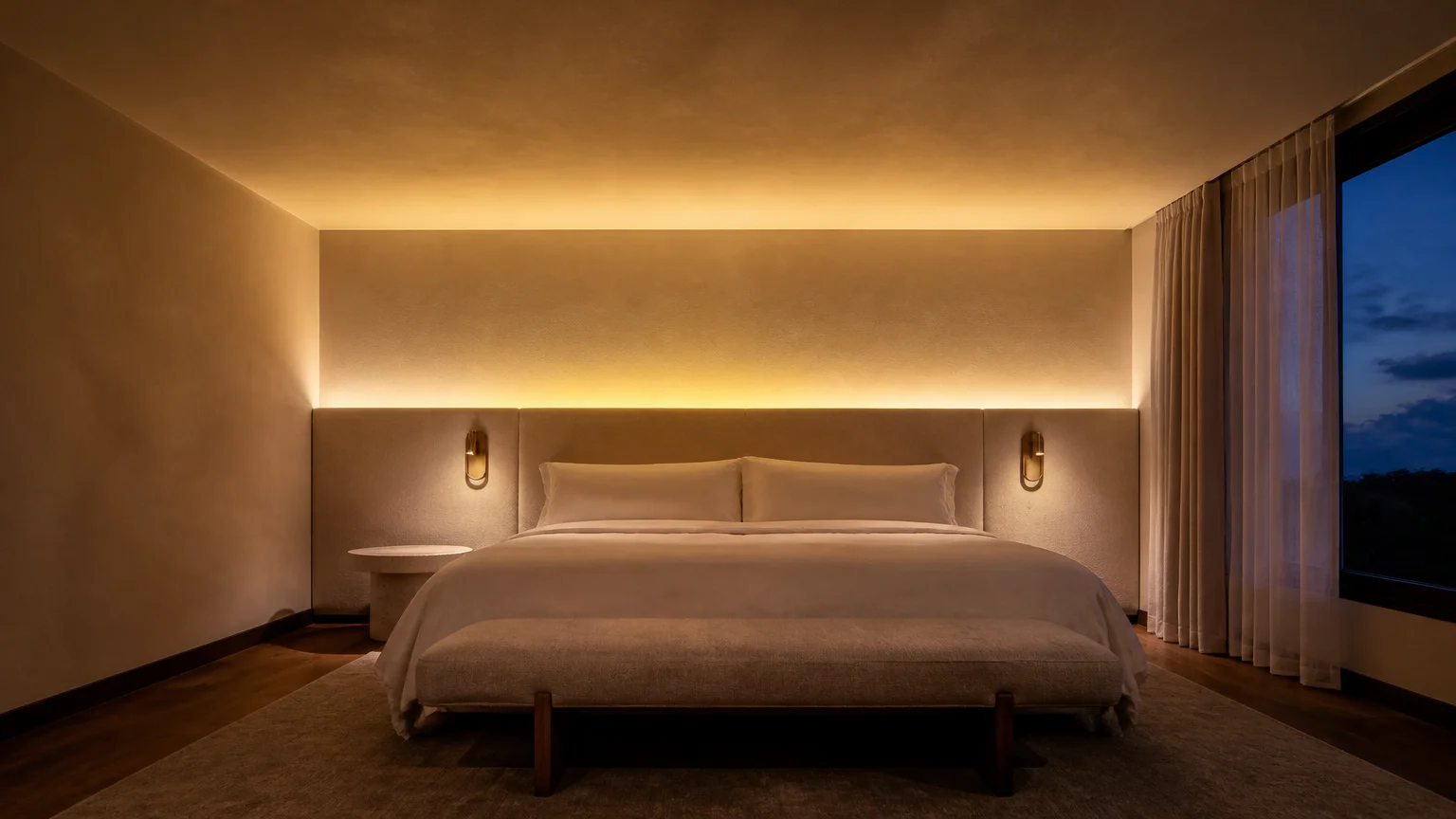
Most guestroom specifications treat indirect lighting as a single line item: a concealed detail, a warm colour temperature, and an instruction to keep the source hidden. That is not a specification, it is a wish. Cove, wash and bounce are three different optical jobs with three different failure modes, and a drawing that does not say which one it wants will be built as whichever is easiest on site.
The distinction matters commercially as much as technically. Indirect layers now carry a large share of a guestroom’s perceived quality, and they are the cheapest part of the room to get wrong, because the errors only appear once the plaster is finished and the room is occupied at night. A scalloped cove or a bright band at the top of a wall cannot be adjusted with a dimmer; it has to be rebuilt. This article separates the three techniques at the level of physics rather than fashion, then sets out the geometry, the surface conditions, the behaviour at the bottom of the dimming range and the defects that tell you which parameter was wrong — so that an indirect layer can be specified as a performance and not as an intention.
- 01Three Techniques, Not One
- 02The Physics All Three Share
- 03Cove: Washing a Plane From a Hidden Line
- 04Wash: Grazing a Surface Instead of Flooding It
- 05Bounce: The Large-Surface Technique
- 06Geometry: Setback, Depth, Throw, Spacing
- 07Surfaces: Reflectance, Texture and Finish
- 08The Bottom End: Behaviour When Dimmed Low
- 09Reading the Defect: What Each Flaw Tells You
- 10Specifying an Indirect Layer as Performance
01Three Techniques, Not One
The word indirect describes only where the source is; it says nothing about what the light is doing. In a guestroom, three techniques are routinely filed under the same heading, and they are not interchangeable.
A cove hides a linear source inside a rebate and lets it wash a plane above or beside it — usually a ceiling, a soffit or the reveal above a bed head. The receiving surface is flat, the geometry is linear, and the result is a gradient that runs along the length of the run.
A wall wash grazes a vertical surface at a shallow angle so that the surface itself produces the interest. The source is hidden, but the job is different: it is not lighting the room, it is lighting a material, and the material’s texture does most of the work.
A bounce layer puts light onto a large surface so that the surface becomes the visible source. Nothing about the fitting is meant to be perceived, only the plane it lights. This is the technique most often described loosely as “ambient”, and it is the one most often over-claimed.
Confusing them produces predictable disappointments. A designer asks for “indirect”, the contractor builds a shallow cove because that is what the ceiling void allows, and the room ends up with a single bright band where a soft gradient was expected. Or a wall wash is specified where a bounce layer was intended, and a beautifully textured timber panel reads as a set of hard stripes under a fitting that was never designed to graze. Both outcomes are specification failures, not installation failures, and both are avoidable for the cost of one section drawing.
There is a practical test for which technique a room actually needs. Ask what the guest is supposed to see. If the answer is a soft ceiling above the bed, it is a cove. If the answer is the grain in a timber or stone panel, it is a wash. If the answer is simply that the room should feel lit without an identifiable source anywhere, it is a bounce layer — and that answer should trigger a second question about where the light is coming from, because a bounce layer has to arrive from a surface large enough for the eye to accept it as ambient. Where the indirect layers sit in the wider scheme is set out in our guide to the six lighting layers of a hotel.
02The Physics All Three Share
Four physical facts govern all three techniques, and they explain nearly every defect covered later in this article.
The first is that the eye reacts to luminance, not to output. A fixture’s lumen figure says how much light leaves it; what a guest perceives is the brightness of the surfaces in the frame. This is why a small, bright source reads as glare even at low output, and why a large, dim surface reads as soft even when the room is objectively bright. How colour behaves across that range is covered in our colour temperature masterclass. Indirect lighting works because it moves the visible emitter from a small area to a large one.
The second is that reflected light loses output at every surface it touches. A bounce layer is measurably less efficient than a direct layer for the same perceived brightness at the eye. On a project where energy performance is a stated criterion, that has to be accounted for in the load calculation rather than discovered at commissioning. It also means that a bounce layer’s output requirement is set by the reflectance of the surface it depends on — change the finish from a light matt plaster to a dark polished stone and the room’s brightness changes with it, without any change to the fixtures.
The third is that distance controls evenness. A source close to the surface it washes produces a narrow, intense band with a visible boundary; move it further away and the same output spreads into a wider, softer gradient, at the cost of some intensity. Almost every ugly cove is a distance problem — either the source sits too close to the plaster, or the throw is too short for the width of plane the drawing wants covered.
The fourth is that grazing angles amplify texture. Light arriving almost parallel to a surface produces long shadows in every relief, which is what makes a wash attractive on a ribbed panel and intolerable on a surface that has been badly jointed. The same angle that reveals craftsmanship also reveals its absence, which is why a wash detail belongs in the joinery submittal and not only in the lighting package.
Two of the three techniques are therefore mostly geometry problems, and one is mostly a surface problem. Keeping that in mind while reading a specification is a reliable way to notice when the document is asking a surface to do something only geometry can do.
03Cove: Washing a Plane From a Hidden Line
A cove is the most common form of indirect light in a guestroom, most often washing the ceiling above a bed head, a wardrobe or a window reveal. It is also the form most frequently built badly, because its critical dimensions are decided by whoever is detailing the joinery, not by whoever is specifying the light.
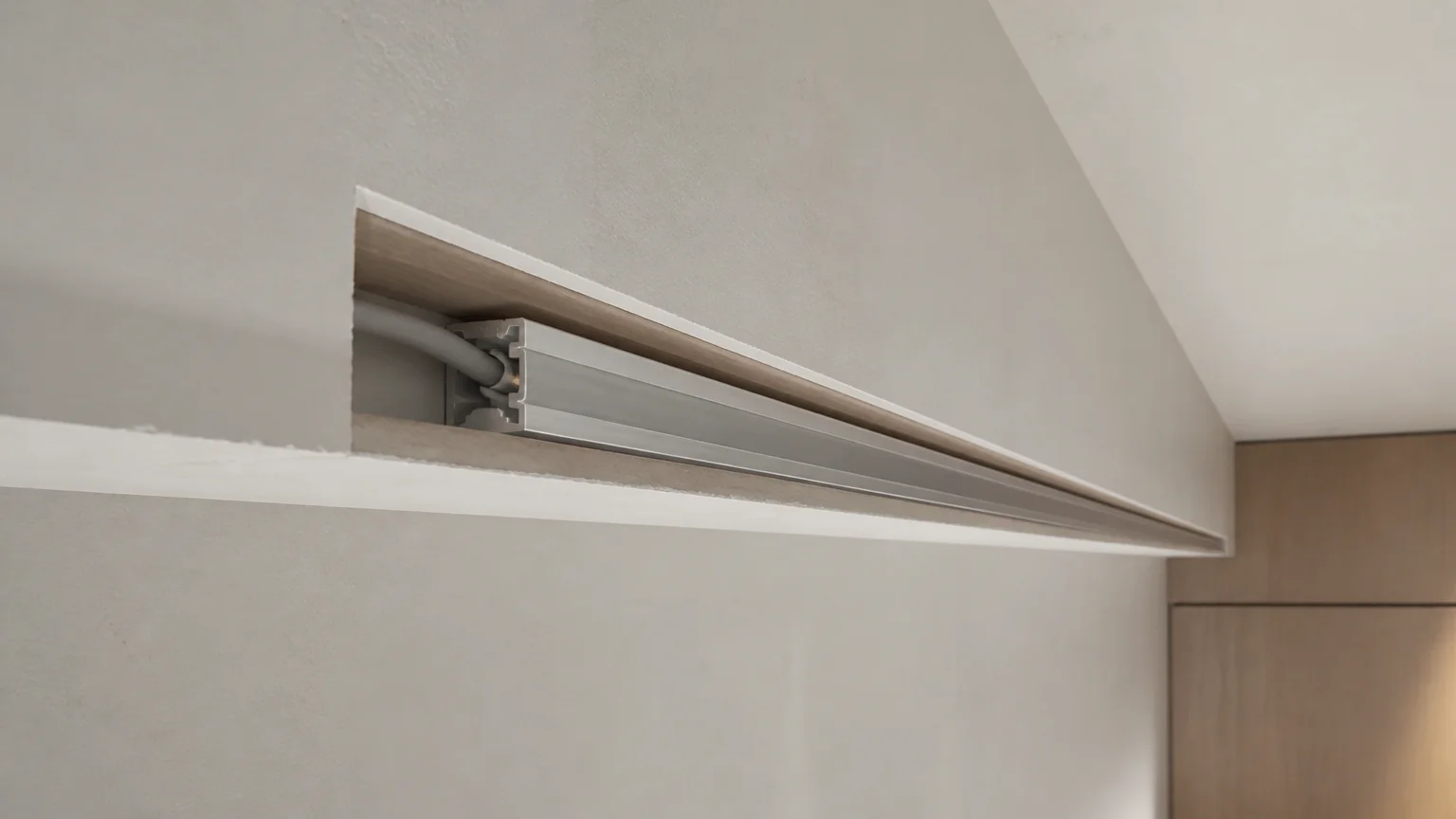
Three parameters decide the result, and they interact. The first is the setback: the horizontal distance from the source to the edge of the rebate that hides it. Set the source too close to the lip and it becomes visible from the low angles a guest actually occupies, particularly from the pillow. Set it too far forward inside the void and the light is thrown so far up the plane that the wash becomes a narrow band at the top with a hard boundary, which reads as a defect rather than a design decision.
The second is the distance from the source to the surface being washed. This controls both the width and the evenness of the gradient. A cove with a generous vertical gap produces a soft transition; a cove squeezed into a shallow void produces a bright line and a fast falloff.
The third is the continuity of the run. A cove is read as one object, so any variation along its length is visible: a change in rebate depth where a bulkhead changes, a joint in the plaster that catches the grazing light, or a run of profile that stops short of a corner. In practice the most common cause of uneven output along a cove is not the lighting at all but joinery tolerance — the void is a few millimetres deeper at one end, and the gradient shows it.
Two details are worth fixing early. The first is the treatment at the end of the run. A cove that stops abruptly leaves a hard vertical edge of light on the wall; a cove that returns around a corner must be planned for, because the return is where the setback changes and the gradient breaks. The second is access. A cove whose diffuser cannot be removed by one person without dismantling the ceiling finish will be cleaned rarely and disturbed eventually, and the usual symptom in year three is an uneven run caused by a service visit that was never documented.
04Wash: Grazing a Surface Instead of Flooding It
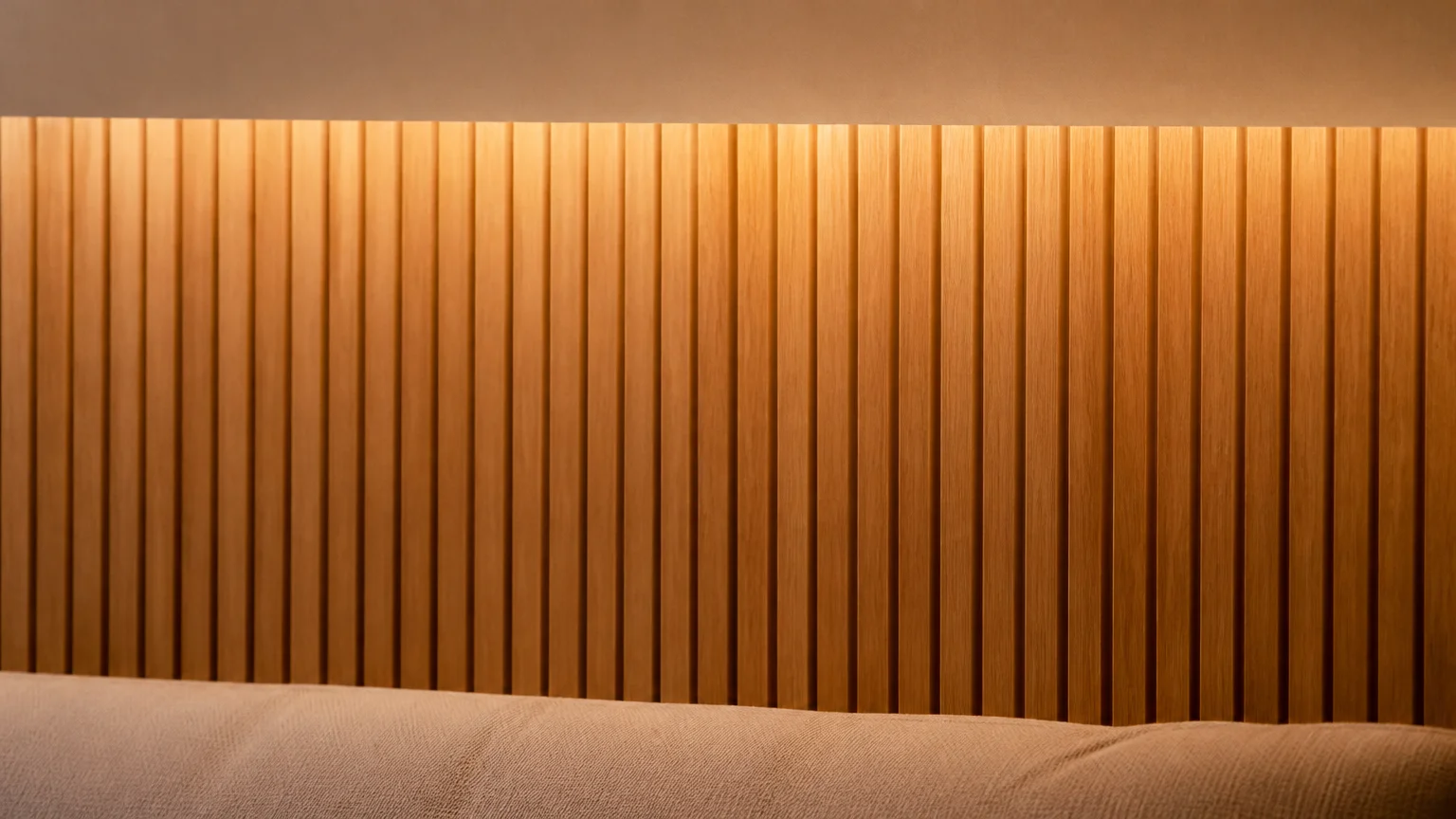
A wall wash is a different optical job from a cove even when the hardware looks identical. A cove sends light onto a plane and lets it fall from above. A wash grazes a vertical surface at a shallow angle so that the surface’s own relief produces the visual interest.
That has three consequences for a guestroom specification.
The first is that the finish schedule belongs in the lighting submittal. A wash that reads beautifully on a matt, medium-toned timber reads as a set of hard horizontal stripes on a high-gloss lacquer, and the fitting is not at fault. Where the finish has not been fixed when the lighting is specified, the wash detail should be marked conditional rather than approved, and re-reviewed when the sample is available.
The second is that vertical distribution matters more than output. Wall-washing optics differ in how they spread light down the surface: some deliver a narrow band near the top, others an even gradient over the full height. The difference is invisible on a product photograph. For a guestroom where the wash defines a headboard panel, the requirement should be stated as a performance — a gradient that reaches the bottom of the panel without scalloping and without a visible division between adjacent units — rather than left to product selection.
The third is that the concealment must be checked from the positions guests occupy. Where the wash is above a bed, a guest’s eye at pillow level sits below the source. A sightline verified standing up in the room is not the same as a sightline verified lying down, and the difference is exactly the sort of thing that survives a drawing review and fails the first night.
One further point is worth making about surfaces. Because the wash exists to reveal a material, it is the technique most sensitive to what happens around the panel. Adjacent glossy surfaces will pick up the source as a reflected streak; a mirror opposite a wash will produce a double image of the gradient; and a change from plaster to a stone surround inside the washed area will create an abrupt change in brightness that no adjustment can remove. These belong in the design review before the wall is built, not in a snagging list afterwards.
05Bounce: The Large-Surface Technique
The third technique is the least controlled and the most often over-claimed. Bounce lighting puts light onto a large surface so that the surface itself becomes the visible emitter. Nothing about the fixture matters to the guest, only the plane it lights.
Its advantages in a guestroom are genuine. Because the visible emitter is a whole surface, luminance at any point is low, glare is intrinsically limited, and light arrives from a large area rather than a small one, which is what makes a space read as soft. It is also the technique that survives being dimmed a long way down, because the eye is reading a graded field rather than a point.
Its limits are equally real, and they explain why bounce is rarely used alone.
- Direction is weak. Because the light comes from a large area, it models form poorly. A room lit only by bounce reads flat, and cues such as the edge of a step or the profile of a chair disappear.
- Efficacy is low. Light has to be reflected before it reaches the eye, and loses output at every surface it touches. A bounce scheme needs more installed output than a direct scheme for the same read at the eye.
- It depends on a surface you do not control. The bounce layer’s colour and brightness are functions of the reflectance of the plane it uses. A change of finish late in the project quietly changes the room, and nobody notices until the mock-up.
- It cannot be tuned after handover. Cove and wash layers can be corrected to a degree by adjusting setback, shielding or output at snagging stage. A bounce layer whose receiving surface is wrong can only be corrected by changing the surface.
That combination is why the technique is best used as the base layer of a layered scheme rather than as the scheme itself: bounce owns the ambient floor of the room, the cove above the bed gives it structure, and direct light handles reading and vanity tasks where a defined working plane is needed. Written that way, each layer has an identifiable job and an identifiable acceptance test.
06Geometry: Setback, Depth, Throw, Spacing
Because two of the three techniques are geometry problems, the drawing that matters most is a section. A plan view shows where a run starts and ends; a section shows whether it will work.
Four dimensions belong on that section, and the specification should require them explicitly rather than leave them to site.
- Setback — the horizontal distance from the source to the concealing lip. This decides whether the source is visible from the guest’s eye at pillow level and whether the wash begins immediately or after a gap.
- Rebate depth and lip profile — the vertical depth of the void and the shape of the return. A deeper rebate with a defined lip conceals more, at the cost of a tighter sightline into the void for service.
- Throw distance — the distance from the source to the receiving surface. This sets the width and softness of the gradient; too short and the run reads as a bright band with a boundary.
- Run length and returns — where the layer starts, stops and turns. Terminations are where gradients break and where the careful detailing usually stops.
Where the source is a continuous linear type rather than a discrete unit, one more variable enters: spacing discipline between the emitter and any diffusion layer, and between repeated units in a run. Pushing a source close to a diffuser without enough separation is the usual cause of lobing, in which a continuous strip reads to the eye as a series of brighter patches. The cure is nearly always geometric — more distance, or a better diffusion layer — not more output.
The practical rule is that an indirect detail should be reviewed at the same time as the joinery, because the person who decides the rebate depth is usually not the person who chose the fitting. Where those two decisions are made in different meetings, the result is decided by whoever builds first.
Two of the dimensions above are also the ones that get value-engineered. Reducing the void depth saves labour in the ceiling build and is invisible on a drawing; the effect appears only when the room is lit. A specification that names the setback and the throw, and states that they are performance requirements rather than nominal ones, is much harder to value-engineer than one that describes a “concealed cove”.
07Surfaces: Reflectance, Texture and Finish
Indirect layers are the only part of a lighting package that is specified partly in the decorator’s document. That makes the surface schedule a lighting input, and the three properties that matter are reflectance, texture and sheen.
Reflectance sets how much of the light comes back into the room. A pale matt plaster is close to an ideal receiver for a cove or a bounce layer. A dark or highly saturated finish absorbs most of what reaches it, which means the same fixtures produce a visibly dimmer room. This is not a small effect, and it is the reason two guestrooms with identical lighting packages and different wall colours can feel entirely different in quality.
Texture decides whether a grazing wash is an asset or a liability. Long relief — battens, ribbed panels, stone with a deep grain — benefits from close-to-parallel light and produces long soft shadows that read as depth. Even surfaces benefit from a gentler angle and more diffusion. Surfaces with inconsistent texture, such as hand-applied plaster with variable trowel depth, will show every inconsistency once washed, which is either the point or a problem depending on the intent.
Sheen governs whether the guest sees the source reflected. A wash or cove aimed at a matt surface produces a gradient; aimed at a semi-gloss or polished surface it produces a bright patch and often a visible reflection of the emitter itself. Where a polished surface is unavoidable — and in bathrooms it often is — the choice is to keep the indirect layer away from it, or to accept a different effect deliberately and adjust the geometric detail accordingly.
Because these three properties interact with the geometry, the sensible order of work is to fix the surface first and then detail the light, not the reverse. Where the surface is genuinely undecided at the point when lighting has to be specified, the honest approach is a conditional approval: the detail is released on the basis of a named sample, and re-checked in the finished room at mock-up before the order is confirmed. Our guide to hotel lighting materials and finishes covers the finish side of that review.
08The Bottom End: Behaviour When Dimmed Low
An indirect layer spends more of its working life near the bottom of its range than anywhere else. In the evening, the ambient wash is usually the last thing running and the dimmest thing in the room, which makes the quality of the low end a first-order specification item and not a detail.
Three properties matter at the bottom of the range. The first is that the layer reaches a genuinely low output without stepping, flickering or dropping out. The second is that its colour holds as it dims: a layer that shifts noticeably toward a different hue at low output will be obvious in exactly the situation it is used most. The third is that the dimming curve is smooth enough for a scene to cross slowly from one level to another without a visible jump.
These behaviours are decided by the interaction between driver, dimming technology, load and scene programming, not by the light fitting alone. That has two consequences for the specification. The first is that a dimming claim should be offered with evidence: a compatibility list, a wiring diagram and a record of the low-end test carried out on the actual installation rather than on a datasheet. The second is that the room must be tested as a room. A driver may dim smoothly on a bench and behave differently at the end of a long run, on a shared circuit, or with a control system whose minimum has been set in software rather than measured at the surface. The wider question of what a control layer can be asked to do is covered in our guide to guestroom lighting controls, and the narrower problem of matching drivers to dimmers in dimming compatibility.
There is also a maintenance dimension. The usable minimum of a circuit changes when a driver or a lamp is replaced with a different unit, or when a diffuser is refitted a millimetre differently. Recording the scene levels, the settings and the components at handover is the only reliable way to keep an indirect layer behaving as approved. How those settings translate into the room’s other scenes is covered in hotel lighting controls explained. Where a concealed element is hard to match later, that is the argument for holding spares of the specific type, because a substituted part is exactly the change that turns a smooth ambient state into something with a visible step in it.
09Reading the Defect: What Each Flaw Tells You
Indirect lighting failures are readable. Each visible fault points to a specific parameter, which means the diagnosis can be made on site rather than debated.
| What the guest sees | What it usually means | What actually fixes it |
|---|---|---|
| A bright band with a hard boundary at the top of the washed surface | Too much setback, or a throw distance too short for the surface width | Geometry: reduce setback or increase the distance to the receiving surface |
| A line of individual bright patches instead of one gradient | Source too close to the receiving surface, or insufficient diffusion or spacing between repeated units | Geometry and diffusion, not output |
| The source itself visible from the pillow | Insufficient setback, or a sightline checked standing up rather than from bed | Increase setback or deepen the concealing lip; re-verify from the occupied position |
| A flat, uniform panel with no relief | The wash arrived too square to the surface, so no grazing angle was established | Move the source closer to parallel to the surface, or accept that this surface suits a cove instead |
| Hard horizontal stripes on a glossy panel | Sheen, not the fitting: light is reflecting rather than grazing | Change the finish, or change the technique for that wall |
| Output that changes along the run | Joinery tolerance: rebate depth or source alignment varies | Workshop and site tolerance, recorded against a section drawing |
| A visible step or colour shift when dimming down | Driver, control minimum or load interaction, or a substituted component after a repair | Driver and control engineering, plus recorded settings and matched spares |
| An abrupt vertical edge of light on a wall | Run termination not detailed; the return or end condition changes the setback | Detail the termination in the section, not on site |
Read as a group, these faults share one characteristic: almost none of them can be corrected by increasing or decreasing output, and almost all of them are cheap to prevent and expensive to repair. That is the argument for putting the geometry on the drawing and reviewing it at mock-up in the finished room at night, from the positions guests actually occupy, rather than approving a detail from a photograph taken under a work light.
10Specifying an Indirect Layer as Performance
An indirect layer can be specified almost entirely in terms of things that can be observed and recorded, without naming a product. That is the most commercially useful way to write it, because it leaves the means open to the supplier while making the outcome non-negotiable.
Five requirements cover most of the ground.
- No visible source from any occupied position. State the positions: standing at the doorway, seated at the desk, lying at pillow level. Concealment is verified at all three.
- A continuous gradient with no lobing and no boundary. State where the gradient must reach — the bottom of the panel, the adjacent wall return, the end of the run — and that the transition is to be even along the length.
- A stated low end. Define the dimmest state the layer must hold smoothly and in colour, and require that the figure be recorded on the actual installation rather than taken from a datasheet.
- A section drawing in the submittal. Setback, rebate depth, throw distance and run termination, co-ordinated with the joinery and the finish schedule.
- A maintenance path. State that the concealed elements can be reached and replaced by one person without dismantling the finished surface, and that matched spares are held for the elements hardest to match.
Two of those items carry disproportionate weight. The section drawing is what prevents the assumptions that produce a bad wash, because it lets the geometry be checked before anything is fabricated. The recorded low end is what prevents a room that is excellent at handover and unusable two years later, after a repair nobody documented. Scene values that hold up in practice are set out in scene design by the numbers.
Set out that way, indirect lighting stops being a matter of taste and becomes a specification with verifiable properties. That is also what makes it possible to write an indirect layer into a brand’s design language and still deliver it consistently across a hundred-room order: the criteria are the same in every room, and the section drawing travels with the project.
Source note: the technical statements in this article about optical behaviour, geometry and dimming describe general industry practice and are given as experience-based guidance rather than as requirements of any standard; where a project is subject to a named regulatory regime, the applicable requirements must be confirmed with its own consultant and authority having jurisdiction. References to industry commentary and to supplier-authored practice are summarised on a de-branded basis. This article contains no product, brand or project endorsement.
Frequently Asked Questions
Is cove lighting the same as indirect lighting?
No. A cove is one of three techniques that are all described as indirect because the source is concealed. A cove washes a plane from a hidden linear source, a wall wash grazes a vertical surface so its texture produces the interest, and a bounce layer uses a large surface as the visible emitter. Each has different geometry, different failure modes and a different acceptance test, and specifying “indirect” without saying which one is the most common cause of a disappointing room.
Why does my cove light look like a bright band instead of a soft wash?
Almost always geometry. If the receiving surface is too close to the source, or the throw is too short for the width of plane you want covered, the light concentrates in a narrow band with a visible boundary. Moving the source further from the surface spreads the same output over a larger area and softens the transition. Increasing output makes the band brighter without making it softer.
What causes the individual bright patches in a linear indirect run?
Lobing, which normally comes from mounting the emitter too close to the receiving surface without enough diffusion or separation between repeated units. It is a spacing and diffusion problem rather than an output problem, and it is much cheaper to correct in the section drawing than after the ceiling is closed.
Can a bounce layer light a guestroom on its own?
It can make a room legible, but not legible well. Bounce light arrives from a large area, so it models form poorly and the room reads flat; the edges of steps, the profile of furniture and the depth of a recess all lose definition. Reflected light also loses output at every surface it touches, so more installed output is needed for the same brightness at eye level. The workable arrangement is a bounce layer as the ambient base with a cove for structure and direct light for reading and vanity tasks.
Why does the same lighting package feel different in two rooms with the same plan?
Because indirect light is partly defined by the surfaces it uses. Reflectance decides how much light returns to the room, texture decides whether a grazing wash reads as depth or as noise, and sheen decides whether the guest sees a gradient or a reflection of the source. Two rooms with identical fittings and different finish schedules are genuinely different lighting installations, which is why the finish schedule belongs in the lighting submittal.
Specifying an Indirect Layer for a Guestroom?
Send us the section drawing for the concealed detail, the finish schedule for the surfaces being washed, the sightlines from the positions guests occupy, and the dimmest scene you intend to use. We will tell you which rebate geometry will produce an even gradient, which finishes will show a hard edge, how the runs should terminate, and what the usable minimum of the layer is likely to be before anything is built.
Our guides to writing an indirect lighting specification and to the six lighting layers of a hotel are the practical companions to this article.


