
A lead time is not a promise about when a fixture will be hanging. It describes one specific segment of the project, measured from one specific moment, and ends at a place most buyers are not thinking about. Reading the number correctly is the difference between a schedule that holds and a fortnight of avoidable chasing.
01What the Quoted Window Actually Measures
Custom decorative lighting from China is commonly quoted with a production window in the order of twenty to twenty-five days, with a separate sampling stage of roughly fifteen days ahead of it. Source type: production windows published by suppliers in this trade; treat the figures as a description of prevailing practice rather than as a guarantee, since the window that governs any specific order is the one on that order’s own confirmation.
The single most useful thing to understand about that window is where it ends. It generally ends when the goods are packed and released to the forwarder — that is, when they leave the factory. It does not include ocean transit, destination port handling, customs clearance, delivery to site, or installation. A buyer who reads twenty-five days as a delivery date will build a schedule that is a month and a half wrong. A buyer who reads it as “leaves the factory in twenty-five days” now has a number they can actually plan against.
The second useful thing is what the clock is waiting for. The window conventionally begins at order confirmation rather than at the date of the enquiry, and confirmation is generally taken to mean three things arriving together: the final model list, the surface finishes, and the deposit. Any of those three still open means the clock has not started, even if the purchase order number has been issued and the buyer feels the order has been placed.
Those two facts explain most of the frustration that surrounds lead times. A project that believes it has been waiting five weeks for a four-week window is usually looking at two decisions that were settled a week late, not at a factory that ran over.
02The Five Stages Inside the Window
Inside the window, production runs through five recognisable stages. Each one has its own dependencies, and the sequence is not compressible by adding labour, because each stage has to finish before the next can start in any meaningful way.
| Stage | What happens | Typical dependency |
|---|---|---|
| Material preparation | Metals, glass, stone and electrical components are drawn from stock or ordered against the job | Final model list and quantities |
| Forming | Metal is spun, cut and welded; glass is formed or pressed; stone or alabaster is cut and dressed | Tooling or moulds existing for that model |
| Finishing | Plating, lacquering, patina work, polishing and any hand detailing | A finishing batch with enough work in it to run |
| Assembly and wiring | Frames, shades and electrical components are brought together, wired and checked | All finished parts present at the bench |
| Inspection and packing | Electrical testing, visual inspection against the approved reference, protection, cartoning | Inspection standard agreed in advance |
Assembly is the stage buyers most often imagine when they think about production, and it is rarely the stage that determines the date. Assembly is broadly proportional to quantity and can be resourced. Forming and finishing are the stages where a single missing element — a form that has to be made, a batch that has to fill, a finish that has to be developed — moves the whole window rather than a portion of it.
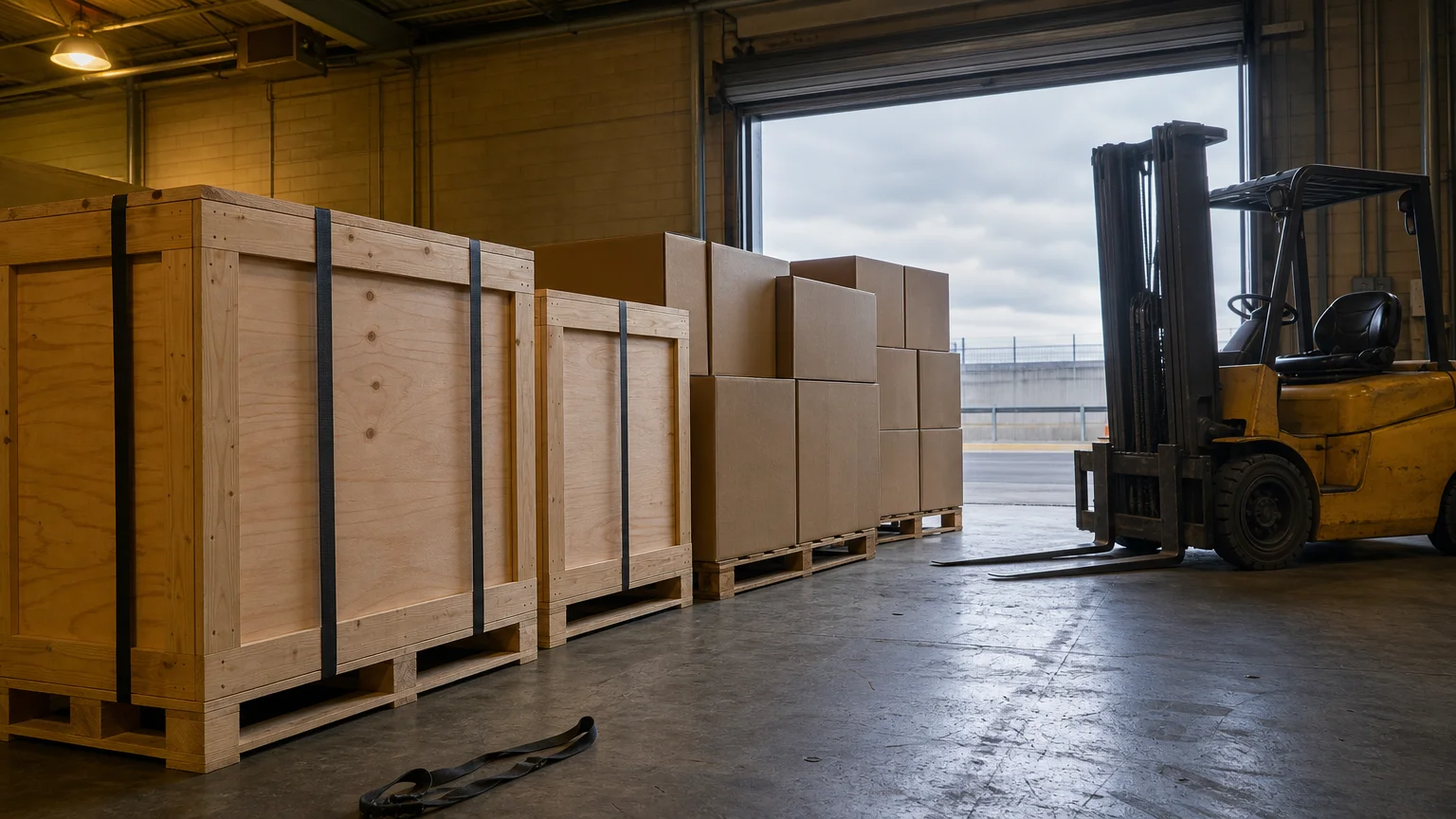
Packing deserves a note of its own because it is where quality is either protected or lost. A well-run operation photographs each model before it is closed up, keeps a record of what went into which carton, and matches the packing method to the fixture rather than to a house style. Small sconces can travel in a stack of cartons; a large frame travels in a timber crate with bracing, and that crate is itself a production item with a lead time.
03What the Window Does Not Cover
The exclusions are more important than the inclusions, because every one of them is a place where a project schedule can quietly fall apart. Five items sit outside a production window as it is normally quoted.
- The time spent deciding what to order. This is the largest hidden item in most projects, and the only one that is entirely within the buyer’s control. Choosing models, finishes and quantities across a dozen rooms is design work, and it takes as long as it takes.
- Sampling. Where a sample is required or wanted, it runs on its own cycle ahead of the batch. It is discussed separately below because it is the exclusion most often mistaken for part of the main window.
- New tooling or a new finish formulation. A new profile, a new cast or pressed mould, or a bespoke surface finish developed to match a reference all require work before forming can begin.
- Safety certification arranged for that order. Certification for a specific model and destination market is a separate workstream with its own schedule, and it can be the longest single item on a first project in a new market.
- Freight, clearance and site delivery. Ocean transit, port handling, customs clearance and onward delivery sit entirely outside the production window, as does anything that happens on site.
Two of these deserve more weight than their line in the list suggests. The first is certification, because it is the exclusion that most often surprises buyers entering a regulated market for the first time. It has a schedule that runs alongside production rather than inside it, and it is far cheaper to start early than to discover late. The second is ocean freight, simply because of its scale: a long transit adds time nobody can compress, and the buffer has to exist in the schedule rather than in the hope that the vessel is fast.

04When the Clock Starts, and Why It Stops
Because the window starts at confirmation, the practical question is what confirmation means. In most quotations it means a final model list, agreed surface finishes, and the deposit — all three present. Until then, the order is a quotation under discussion, whatever the paperwork says.
The order can also effectively stop, and this is the mechanism behind most “late” deliveries. When something changes after confirmation, the affected part of production has to wait for the change to be settled, and everything behind it queues. A revision to a finish after forming has begun means parts already made may have to be reworked or remade. A revision to a dimension late in the programme means new tooling at the point where the schedule had the least slack.
| Change requested | What it means in the workshop | Effect on the schedule |
|---|---|---|
| Longer or shorter suspension | Rod, chain or cable cut to a new length; same body and same canopy | Usually minimal — a cutting-list change, confirmed on paper |
| A finish the factory already runs | Absorbed into an existing finishing batch | Usually minimal, provided the batch has not already run |
| A new finish developed to a reference | Formulation tried on test panels, then a batch sample for approval | One development round plus one approval round |
| A different diameter or a different number of arms | New forming tooling for the metal frame; possibly a new glass mould | Tooling time before forming, plus mould time if glass changes |
| A different glass shape or colour | Hand-formed glass can often be re-shaped; pressed glass needs a new mould | Depends on the forming route; ask before assuming |
| A different lamp holder or wiring for a new market | Component sourcing plus a check against the destination requirements | Small if the component is held in stock; longer if it is ordered in |
A pattern runs through the table: anything that can be cut to size, or that uses a finish the factory already runs, costs almost nothing in time. Anything that needs a new tool, a new mould or a new formulation adds a stage before forming starts. Buyers who understand that pattern can predict the schedule consequence of a late change before asking, which makes the conversation about whether the change is worth it far shorter.
The discipline that protects a date is therefore a change log rather than a promise. Every revision after confirmation should be recorded with the date it arrived and the date it was settled, so that when the schedule moves, everyone can see what moved it. A project that keeps that log almost never has an argument about responsibility, because the record answers the question before anyone asks it.
05The Sample Sits Before the Window
Where a sample, mock-up or first-article piece is required, it runs on its own shorter cycle — commonly in the region of a fortnight — and it sits ahead of the production window rather than inside it. That distinction matters for scheduling, because it means the two periods add rather than overlap.
Sampling is also where a project can buy time rather than lose it. A physical sample settles questions that drawings and photographs cannot: how a finish reads under real light, how a glass diffuses, how heavy a frame feels, whether a proportion that looked right in a rendering still reads right in a room. Every question settled at the sample is a question that will not become a revision during production, and revisions during production are what move dates.
Where a sample is expected, the useful discipline is to define its purpose before it is made. A sample that nobody has agreed how to evaluate will be approved or rejected on taste, and the batch will then be judged against an evolving idea of the original. Deciding in advance what is being checked — proportions, finish, light output, construction — and keeping the approved piece as the reference for the production run converts a courtesy into a control.
For projects with several room types, sampling also has a commercial dimension worth raising early rather than late, since a sample is a production event with its own cost and its own position in the queue. Whether a sample is charged, and whether it is credited against the production order, should be settled at the same time as the main quotation rather than after the sample has been made.
06The Six Things That Add Time
Delays in this trade are rarely caused by one dramatic event. They are caused by a short list of ordinary ones, and the list is short enough to plan against.
- Late decisions. The largest single contributor, and the only one entirely within the buyer’s control. Every open question about models, finishes or quantities keeps the clock from starting.
- Changes after confirmation. Each change consumes slack at the point in the programme where the change lands, which is usually later and tighter than the point at which it was imagined.
- New tooling, moulds or finish development. A stage that has to happen before forming, and therefore ahead of everything downstream of it.
- Waiting for a finishing batch to fill. A small quantity in an unusual finish may have to wait for enough work to justify loading the line.
- Components sourced for a specific market. Lamp holders, wiring and control gear differ between regions; an item not held in stock adds procurement time to the front of the programme.
- Seasonal pressure. Production capacity across the industry tightens ahead of major holidays and in the run-up to peak shipping periods, and a window quoted in a quiet month may not hold in a busy one.
Two of these are worth separating out for attention. New tooling and new finish development are the items most often underestimated, because they do not look like production and are therefore not visible on a schedule that a buyer sketches from memory. Seasonal pressure is the item most often overlooked in planning, because it is not a property of the order at all — it is a property of the month.
07Six Questions That Predict Your Date
Six questions, asked at quotation stage, will predict a delivery date more reliably than any single promised number.
- Which stage does the clock start at? Ask specifically whether the window starts at order confirmation, and what that requires.
- Is sampling required, and does it sit before the window? Establish whether the sample period adds to the schedule or overlaps it — in practice it adds.
- Which items in this specification need new tooling or a new finish? Ask for a list rather than a yes or no, since the answer is per model.
- Does the order need safety certification for the destination market, and what is its schedule? Treat this as a parallel workstream with its own dates, not as a line on the production plan.
- Where exactly does the window end? Confirm the endpoint in words: goods released to the forwarder, or delivered to a named place.
- What is the change rule? Ask how a revision after confirmation is handled, what it costs and what it does to the date, so the rule is known before it is needed.
The answers to those six questions can be turned into a date with far more confidence than a single quoted window, because each one addresses a different way the window can fail. A project that has asked all six knows which of its dependencies are external and which are its own.
08The Buyer’s Levers
Most of the time in a lighting programme is controlled by the buyer, not the factory. Four levers matter, and all four are available before the order is placed.
Freeze the workable brief early. A supplier cannot start against a brief that is still moving, and pretending otherwise only defers the problem. The right sequence is to finish the design decisions, confirm them in the specification, and then start the clock — not to start the clock and finish the design in parallel.
Raise certification at the first conversation. Where a project needs safety certification for its destination market, that work has its own schedule and should begin alongside the enquiry rather than after the production order.
Separate the sample decision from the production decision in time. Sampling before the batch is what prevents the batch from becoming a sample, and it is the cheapest point in the whole programme at which to change a mind.
Reserve the installation and commissioning window separately. Goods leaving a factory is a milestone, not the end of the project. The receiving end needs temporary storage, lifting access and protection, and the commissioning stage needs its own time for aiming, dimming checks and scene approval. Folding those into a notional buffer is how a project that ran to schedule still opens late.
Read as a whole, a lead time is a description of a sequence with the buyer at both ends: the front end is deciding what to order, and the back end is receiving and commissioning it. The twenty to twenty-five days in the middle is the part the factory owns, and it is usually the part that behaves most predictably of the three. Projects that run late mostly run late at the ends.
Frequently Asked Questions
Does the production window include shipping?
No. A production window typically ends when the goods are packed and released to the forwarder. Ocean transit, port handling, customs clearance and delivery to site all sit outside it, and so does installation. Treating the quoted window as a delivery date is the most common single misunderstanding in project scheduling.
When does the lead time actually start?
At order confirmation rather than at the date of the enquiry or the purchase order. Confirmation is generally taken to mean the final model list, the agreed surface finishes and the deposit all being in place. Until all three are settled, the clock has not started, even if the paperwork has been issued.
Is the sampling period inside or outside the production window?
Outside, and ahead of it. Sampling usually runs on a shorter cycle in the region of a fortnight, and it precedes the production window rather than running concurrently with it, so the two periods add together. Planning a sample inside the production window is a reliable way to miss a date.
What is the most common cause of a late order?
Decisions that were not frozen. Changes after confirmation consume whatever slack exists at the point they land, which is normally later and tighter than where the change was first imagined. Keeping a dated change log makes the cause visible and usually prevents the change from being made without a decision about the consequence.
Will paying a rush premium shorten the window?
Only where the constraint is bench time, and that is rarely the binding constraint. Where the Schedule is limited by a finishing batch, new tooling or a certification workstream, additional money does not compress the sequence. The useful question is which stage is the constraint, and the answer is available at quotation stage.
How should a schedule be built for a multi-room project?
From the commissioning date backwards, with separate allowances for sampling, production, freight, site delivery and installation and commissioning, and with the design freeze treated as the first milestone rather than as a preliminary. Splitting the buffer across those stages, rather than applying one percentage to the whole programme, shows which stage is actually at risk.
Working Backwards From an Opening Date?
Send us the models, the finishes, the quantities, the destination market and the date by which the goods need to leave the factory. We will map the programme stage by stage, tell you where sampling and certification sit relative to production, and flag any change that would move the date before it is made. Our guide to briefing a custom lighting manufacturer covers the information that produces a quotable, schedulable order, and our notes on evaluating samples and mock-ups explain how to get the most out of the stage that sits ahead of the window.
For what happens after the goods are released, our guide to shipping and installing custom chandeliers covers the transit and site stages, and pre-shipment inspection sets out the checks that should happen before packing. The commissioning guide covers the final stage that a production window never includes, and the companion question of what a minimum order quantity is really measuring explains the quantity side of the same commercial conversation. To work through a specific programme, our project team can review a set of dates against a specification.


