
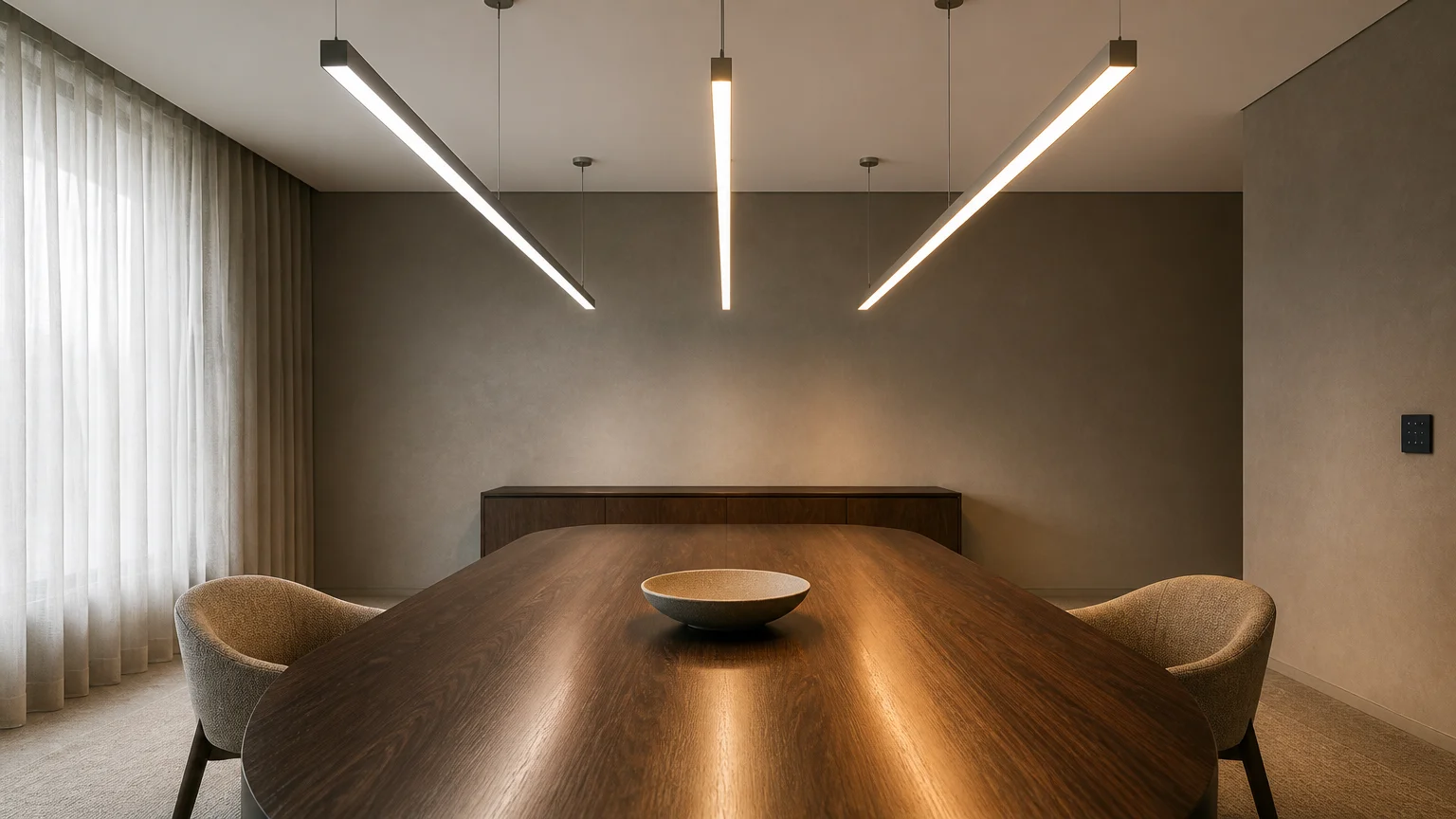
Tunable white is sold as a colour feature and bought as a control problem. On a hotel project the question is rarely which colour temperature looks right — it is how many devices the bus can address, whether the driver and the control gear agree on what a colour point means, and whether an operator can still change a scene two years after handover. This guide deals with that layer: the protocol and the device that executes it.
Most colour control failures are not design failures. The intent is approved from a mock-up or a rendering, the schedule carries the words “tunable white” in a single cell, the fixtures arrive with gear that dims smoothly but steps audibly between colour points, and the commissioning engineer discovers late in the programme that the scene list assumes addresses the installation cannot provide. Every step in that sequence is reasonable on its own. The gap is that the only document able to close it — the specification — described an effect rather than a device.
This article works from the device upwards. It fixes the vocabulary that protocol documents use, explains what the second generation of an established digital standard changed for project teams, sets out the difference between two-channel white and full colour as procurement targets, and finishes with the fields a specification needs so that the colour approved in a mock-up is the colour installed in the building. Two companion articles take the neighbouring positions: our masterclass on colour temperature covers what the colour should be, and our explanation of lighting controls covers what control does for a building. This piece covers the ground between them.
- 01Colour is a control decision before it is a design decision
- 02The vocabulary: addresses, device types and colour modes
- 03What the second generation of the digital standard changed
- 04Two-channel white or full colour: choosing the target
- 05The fixture-side constraints that decide the outcome
- 06Commissioning colour control without losing the scene list
- 07Evidence: what to ask a supplier to hand over
- 08A specification sheet for colour control
01Colour Is a Control Decision Before It Is a Design Decision
Begin with what tunable white actually asks the installation to do. A fixed white fixture receives power and produces light. A tunable white fixture receives power and an instruction, and the instruction has to survive a chain: the control head generates it, the bus carries it, the gear in the fixture interprets it, and the light source renders it. Each link has its own failure mode, and the failures look identical from below a ceiling at handover — the light is the wrong colour, or it moves between colours in visible jumps.
The chain explains why a schedule cell reading “tunable white, 2700–4000K” is not a specification. It describes a range of outcomes. It does not say how the instruction travels, whether the gear can hold a colour point without drifting, whether all fittings will step through the range identically, or who re-addresses the ceiling when a fixture is replaced. Those are procurement questions with procurement answers, and they are settled before the order rather than during commissioning.
Three project types run into this in different ways, and it is worth naming them because the answer differs:
- The decorative statement fixture — a chandelier, a sculptural pendant or a cluster over a bar, where colour is used to shift the mood of one room. Here the device count is small, the fittings are visible, and the risk is aesthetic: a ceiling of twenty lamps that do not move together reads as a fault rather than a feature.
- The repeated architectural fixture — downlights, linear coves and wash grazers in corridors, ballrooms and meeting floors, where colour is part of an operator’s scene strategy. Here the device count is high and the risk is systemic: address capacity, group structure and load per bus line determine what the scene list can actually do.
- The heritage or retrofit installation — where the control layer has to be added to fixtures whose wiring predates any digital bus. Here the risk is one of reversibility and containment, and the fitting that carries the control gear is the wrong place to discover a constraint.
In all three cases the technical question is the same: what device sits inside the fixture, what does that device understand, and how is it addressed. Everything else — the colour rendering, the beam angle, the finish of the housing — is decided at a different level of the same document. Our notes on writing a dimming specification for a custom fixture cover the fixture-side fields for single-channel dimming; the fields below extend that list to colour.
02The Vocabulary: Addresses, Device Types and Colour Modes
Colour control is difficult to specify when the words are loose, because the same phrase can describe three different technical arrangements. Fixing the vocabulary removes most of the ambiguity.
Analog or mains-level dimming. A phase-cut dimmer or a 0–10V signal is a single command on a wire. It can adjust intensity, and it can adjust two channels separately for a warm and a cool cell, but it cannot tell one fixture apart from another. A corridor of twenty fixtures on one 0–10V signal is one logical device. That is acceptable where all twenty must behave identically, and unacceptable where a scene requires a subset.
An addressable digital bus. A digital protocol gives every device on the line its own short address, and organises those addresses into groups. The long-standing baseline of the established digital lighting protocol is that a bus line carries up to 64 individually addressable devices, sixteen groups and sixteen scenes. That is the arithmetic that decides whether a scene list is achievable: a floor with three hundred fixtures on one line will not have a unique address per fixture, and the designer needs to know that at schedule stage rather than at commissioning.
Device types. Within the addressable protocol, the behaviour of the gear is described by device types. This is the point that most often goes missing in a specification, because the words on the schedule do not distinguish between them:
| Device type | What it controls | What it will not do |
|---|---|---|
| Single-channel LED gear | Intensity on one output — the standard arrangement for architectural white | Change colour temperature; it has one channel and one output |
| Colour-temperature gear | Mixed white from two or more white channels, so the light can be swept warm to cool on a defined curve | Render saturated colour; it produces white only, at whatever colour point the mixing curve defines |
| Full-colour gear | Multiple primary channels, producing white and saturated colour from the same fixture | Match the efficacy and the colour consistency of a dedicated two-channel white fixture at the same output |
Colour modes. Even within colour-temperature gear there are two ways to issue a command, and they behave differently. In one, the request is a colour temperature and the gear works out the channel mix internally. In the other, the request is a level for each primary channel and the controller works out the mix. The first is simpler to commission and easier to keep consistent; the second gives a designer access to a wider working range and puts more responsibility on the scene-setting process. A specification should state which one is expected, because the answer decides whether the scene values can be copied between projects or have to be re-derived.
Colour consistency across a batch. Two fixtures can both be “3000K” and still not match each other. Manufactured white cells are sorted into bins, and the practical question is not the nominal colour temperature but the tolerance around it. On a hotel ceiling where thirty fixtures are visible in one view, that tolerance is a specification value: state it, and ask for the bin or the step between adjacent fixtures to be declared on the datasheet.
03What the Second Generation of the Digital Standard Changed
The addressable protocol described above has existed in a stable form for years. The change that matters to project teams is not in the dimming behaviour of luminaires — that has been routine for a long time — but in what can be brought onto the bus and certified as interoperable.
In the original generation, the conformance programme focused on control gear: the part inside the luminaire that receives commands. Everything upstream — the application controller running the scenes, the sensors reporting daylight and occupancy, the input panels on the wall — sat outside that framework. A project could specify conforming gear and still assemble a system whose controller, sensors and panels had never been tested against each other.
The second generation extended the programme to those upstream devices, and to the way they interact with control gear. Three consequences follow for a specification:
- Control devices can carry evidence too. An application controller or an input device that has been tested under the extended programme can be named in the specification with the same expectation of evidence as the gear. This shifts the weakest link in a project from the controller to whatever was not tested.
- Multi-master operation becomes normal. Systems where more than one device can originate commands — a room panel, a central controller and an automation layer — are better defined than they were, which is what makes a hotel’s scene strategy workable across floors that are commissioned at different times.
- Instance-level information is available. Devices can expose more than one logical function, and the extended framework describes how those functions are found and addressed. For a project this is mostly a commissioning convenience, but it affects the address arithmetic in section 02 and therefore the scene strategy.
The practical instruction is straightforward: state the generation of the standard, not just the protocol name, and require the conformance evidence to be tied to the exact model of gear, controller, sensor and panel being supplied. A general statement that a supplier “works with the protocol” is not the same claim as a device that appears in a public conformance database with its model number.
One caution about the evidence itself. Conformance is demonstrated against the standard, by a testing programme that maintains a public register. The useful habit is to ask for the model designation and then verify it in that register rather than to accept a certificate-shaped document. Where a controller or a sensor is supplied by a different party from the fixtures, the same rule applies to it — and it is precisely here that projects lose time, because the party holding the evidence is not the party holding the fixture order. Our guide to how certification and listing evidence works on hotel lighting packages describes the same discipline for safety marks.
04Two-Channel White or Full Colour: Choosing the Target
The most expensive mistake in colour control is buying full colour where tunable white was wanted, or the reverse. The two arrangements differ in output, in consistency, in the number of channels the gear must drive, and in how much of the scene work falls to the commissioning team.
Two-channel white mixes two white cells — typically a warm and a cool — along a curve that runs between the two endpoints. It is the arrangement to choose when the requirement is a warm evening setting and a neutral working setting in the same room. Its advantages are practical: the fixture stays efficient because it is not paying for saturated channels it never uses, colour consistency is easier to hold because only two bins are involved, and the dimming curve at low levels can be specified as a single behaviour. Its limitation is a fixed track: the light is always on the warm-to-cool line, never off it.
Full colour drives several primary channels, which lets a fixture produce saturated colour as well as white. On hotel projects this is usually a feature for one or two rooms — a bar, a spa, a ballroom used for events — rather than for the guest-room ceiling. Three costs come with it: the loss of efficacy that results from mixing primaries to produce white, the extra channel count (which multiplies the gear and the wiring), and the fact that a “white” produced by mixing primaries has to be checked against the whites produced by the fixtures next to it.
| Requirement | Two-channel white | Full colour |
|---|---|---|
| Warm-to-neutral sweep in guest rooms, corridors and lobbies | Standard choice | Available, at a cost in output and channels |
| Saturated colour for an event or bar setting | Not achievable | Only route |
| Colour rendering of the light sources on site | Both channels are white cells; rendering is straightforward to state | White is a mixed result; the rendering figure depends on the mixing |
| Consistency between thirty visible fixtures | Two bins to control | Five channels to control, each binned separately |
| Efficiency at the same delivered output | Higher | Lower, because white is produced by mixing |
| Quantity of gear and cable per fixture | Lower | Higher, and it changes the load calculation |
A useful discipline at schedule stage is to allocate the arrangement per zone rather than per project. Guest floors, back-of-house circulation and meeting corridors are almost always tunable white. A ballroom may need full colour for events and tunable white for the everyday condition — in which case the schedule should say so per fixture group, not in a note. That single decision changes the gear order, the bus load and the scene list, and it is far cheaper to make on paper than in a variation.
05The Fixture-Side Constraints That Decide the Outcome
The control layer is only half of the arrangement. Whatever the bus asks for, the fixture has to deliver it, and four fixture-side properties decide whether it can.
The driver and the gear have to match the protocol the project actually runs. A fixture can be built with dimmable gear that accepts a phase-cut or 0–10V signal, or with a module that speaks the digital protocol. Those are different products, not different settings, and the choice is made when the fixture is specified. Where a project intends to run scenes from a central controller, the fixture needs the addressable option; where each fixture simply follows a wall dimmer, the simpler gear is both adequate and cheaper. Mixing the two on one floor — some fixtures addressable, some not — is the most common source of a scene that will not execute.
The minimum level and the dimming curve have to be stated. Two behaviours are routinely discovered only on site. The first is the low end: a fixture that is specified to dim to a very low percentage may actually hold a clean low level, may flicker, or may drop out entirely, and the point at which it does so depends on the driver rather than on the protocol. The second is the shape of the curve — whether commanded steps map linearly to perceived light or are shaped to suit the eye. Our analysis of why fixtures flicker at the low end covers that failure in detail; the point here is that the specification should state the minimum level to be demonstrated, and the demonstration should happen on a delivered sample rather than on a promise.
Channel load and inrush have to be added up. Colour gear drives more channels than single-channel gear, so the load per device is higher and the arithmetic per bus line changes. Inrush — the brief current spike when drivers and their internal supplies charge — also multiplies with channel count. A line that was comfortably inside its limit as single-channel dimming may not be inside it once every fixture carries colour gear. The count belongs in the schedule, and the supplier should be asked for the per-device figures rather than for an assurance that the line will be fine.
Colour consistency has to survive the batch. A mock-up validates one fixture. A hotel installs dozens of the same type, and the visible question is whether the last one produced matches the first. The controls available at specification stage are to state a colour tolerance, to require the same production batch for one room, and to fix the colour point as a reference that is held in the scene values rather than reset by eye on site. Where the refresh is decorative rather than functional the accepted tolerance can be wider, but it should be chosen deliberately rather than discovered.

06Commissioning Colour Control Without Losing the Scene List
Commissioning is where a colour-control specification is either confirmed or quietly abandoned. Three tasks decide the outcome, and all three can be written into the handover.
Addressing and grouping. Before a single scene is set, the ceiling has to be addressed and grouped, and the grouping has to survive a fixture replacement. The practical requirement is a written address schedule: which device sits on which line, in which group, against which physical position on the drawing. Without it, a failed fixture is replaced by a technician who re-addresses the new device arbitrarily, and the fault moves to whichever scene depended on the old address. Ask for the schedule as a deliverable, not as a working document that goes home with the commissioning engineer.
Scene values recorded as data, not as a look. A scene that was set by eye and never written down cannot be restored after a controller replacement. The handover should include the scene table with the actual values — the levels and the colour points by group — so that the state can be rebuilt, and so that a second property in the same portfolio can start from the first one’s numbers. This is also the point at which the interplay between colour and dimming becomes visible: a scene that reads correctly at full output may look wrong at a low evening level if the two halves of the fixture shift at different rates. Our notes on designing scenes by the numbers treat the scene table as the deliverable it is.
Low-end and colour-point verification, per group. Acceptance should test what the operator will actually use: each scene triggered from the interface the staff will touch, the dimming floor demonstrated, and the colour points compared between adjacent fixtures rather than only against a reference photo. Where a project has a mock-up room, the colour points approved there should be the reference against which the installed floor is judged, and the mock-up record should name the fixture, the gear and the operating conditions under which the approval was given. Our guide to lighting commissioning and handover sets out the wider sign-off sequence that this sits inside.
One boundary is worth stating plainly, because it is a recurring misunderstanding: a control system that carries scenes does not carry life safety. Emergency illumination is a separate, code-driven layer with its own circuits or batteries, and it is monitored by the control system rather than delivered by it. Our article on smart controls and the safety layer explains where that boundary sits.
07Evidence: What to Ask a Supplier to Hand Over
Colour control lends itself to confident claims, because the difference between conforming and non-conforming gear is invisible from the floor. The remedy is the same as elsewhere in a lighting package: ask for documents that name the model, and read them.
- A datasheet for the gear, not for the range. The sheet should state the protocol generation, the device type, the colour mode supported, the channel count and the load per channel. A range-level brochure that describes the family is not a substitute for the figures belonging to the part number being ordered.
- A colour tolerance, stated numerically. Ask for the bin or the step that will be held within one production batch and across the batches of one order, and ask which reference the colour points are defined against.
- Minimum dimming level with the test conditions. A figure without the conditions is not evidence. The useful answer names the level, the load the fixture was tested at and how the measurement was taken.
- Conformance listing evidence tied to the model for the gear, and for the controller, sensors and panels if they are part of the package.
- A scene and address table as a handover deliverable, agreed before commissioning begins rather than produced afterwards.
Two other items belong in the same request even though they are not about colour. The first is the replacement path: which components inside the fixture are field-replaceable, and what the supplier’s spares position is for the gear specifically, since control modules age differently from the light source. Our checklist for designing fixtures for maintenance covers that question in full. The second is the interaction with the building: if the colour layer is expected to feed a higher-level system, the specification should name the interface rather than leaving it to be negotiated after the fixtures arrive.

08A Specification Sheet for Colour Control
The following fields are enough to describe a colour-control requirement completely, and short enough to sit on one page of a fixture schedule. They are written here as a table because that is how they should reach the supplier.
| Field | What to state |
|---|---|
| Control layer | Analog signal, addressable digital bus, or a wireless mesh; and, for a digital bus, the generation of the standard being specified |
| Requirement per zone | Tunable white or full colour, allocated zone by zone rather than as a project note |
| Colour range and mode | The endpoints of the white sweep or the colour gamut required, and whether commands are issued as a colour temperature or as channel levels |
| Consistency | The colour tolerance to be held within a batch and across the order, with the reference against which it is defined |
| Dimming | Minimum level to be demonstrated, curve expectation, and whether the low end has to be verified per group |
| Load per device | Channel count, load and inrush figures per fixture, and the resulting device count per bus line |
| Addressing | Required group structure, and the address schedule as a contractual deliverable |
| Handover | Scene table with recorded values, commissioning record, and the interface to any higher-level system |
| Evidence | Datasheet by part number, conformance listing by model, and the replacement path for the gear |
A final note on scope. None of the above determines the standard, the wiring method or the approval pathway that applies to a particular building; those are fixed by the destination market and confirmed by the project’s own electrical engineer and, where relevant, the authority that inspects the installation. A supplier’s job is to provide equipment and evidence that meet the requirement, and to say clearly where a proposed arrangement will not. The higher-level system integration, the network configuration and the final scene programming are project deliverables in their own right, and our notes on adding control inside a decorative fixture describe the fixture-level version of that conversation.
Source type: the protocol behaviour, device-type descriptions and addressing limits above reflect published control-protocol documentation, the public conformance registers maintained for those protocols, and general trade practice among lighting suppliers serving hospitality projects. Specific capabilities, channel counts, load figures and tolerances vary by control gear and must be confirmed against the datasheet for the exact part number, and against the requirements of the destination market.
Frequently Asked Questions
Is tunable white the same as dimming to warm?
No, and the difference is practical rather than semantic. Dimming to warm means decreasing the output and shifting the colour point on a fixed relationship as the level falls. Tunable white means holding the requested colour point independently of the level, so the room can be neutral at low output or warm at high output. A fixture that only dims to warm cannot produce a neutral evening setting, and a specification should say which behaviour is required.
How many fixtures can share one control line?
The long-standing baseline of the established digital lighting protocol is 64 individually addressable devices on a line, organised into sixteen groups and sixteen scenes. That ceiling is easy to reach on a hotel floor, which is why the group structure has to be designed rather than assumed. A room that needs individual control of forty fixtures needs more than one line, and the schedule should say so.
Should a hotel specify full colour anywhere?
Usually in one or two spaces — a bar, a spa, an event room — and rarely on a guest-room ceiling. Full colour costs output and channel count, and a white produced by mixing primaries has to be compared against the whites next to it. Where event flexibility is the requirement, the cleaner arrangement is often tunable white for the everyday condition plus a small number of full-colour fixtures for effects.
What does the second generation of the standard add for a project team?
It extends the conformance programme beyond luminaire control gear to the controllers, sensors and panels upstream of it. That matters because a project can otherwise assemble individually conforming gear and an untested set of devices driving it. For the specification, the practical effect is that those devices can now be named with the same expectation of model-level evidence as the gear.
Why do tunable white fixtures look mismatched when they are all the same model?
Because nominal colour temperature is not a tight specification. White cells are sorted into bins, and two fixtures both labelled 3000K can sit at different points within the tolerance around that label. Where a number of fixtures are visible together, the tolerance has to be stated as a value and the same production batch required for the fixtures in one view.
Can the colour layer be added to an existing decorative fixture?
Often, provided the fixture has the internal volume and the electrical arrangement to accept the gear, and provided the intervention is reversible where the building requires it. The constraints are heat, space and the existing wiring rather than the protocol. Our notes on fitting a control module inside a decorative fixture set out what to check before committing.
Who owns the colour control once the building opens?
The operator does, which is why the handover matters. Address schedules, scene tables with recorded values and the interface documentation are what allow an operator to change a scene, replace a fixture or add a room without rebuilding the system from scratch. A scene that exists only in a controller and a commissioning engineer’s memory is not an asset.
Specifying Colour Control on a Hotel Project?
Send us the fixture schedule with the control layer marked zone by zone, the colour range you expect in each space, and the names of the controller and accessories already selected. We will tell you where the gear you have specified can deliver it, which lines will exceed their address or load arithmetic, and which fields the schedule still leaves open — so the colour approved in the mock-up is the colour commissioned in the building.
Two companion pieces sit alongside this one. Our masterclass on colour temperature explains what the light should be in each space, and our guide to lighting controls covers the building-level systems this layer feeds into. Where the fixtures themselves are custom, our notes on dimming specifications for custom chandeliers and on retrofitting controls into existing hotels cover the two ends of the same conversation. Talk to our team about the control layer of your project.


