
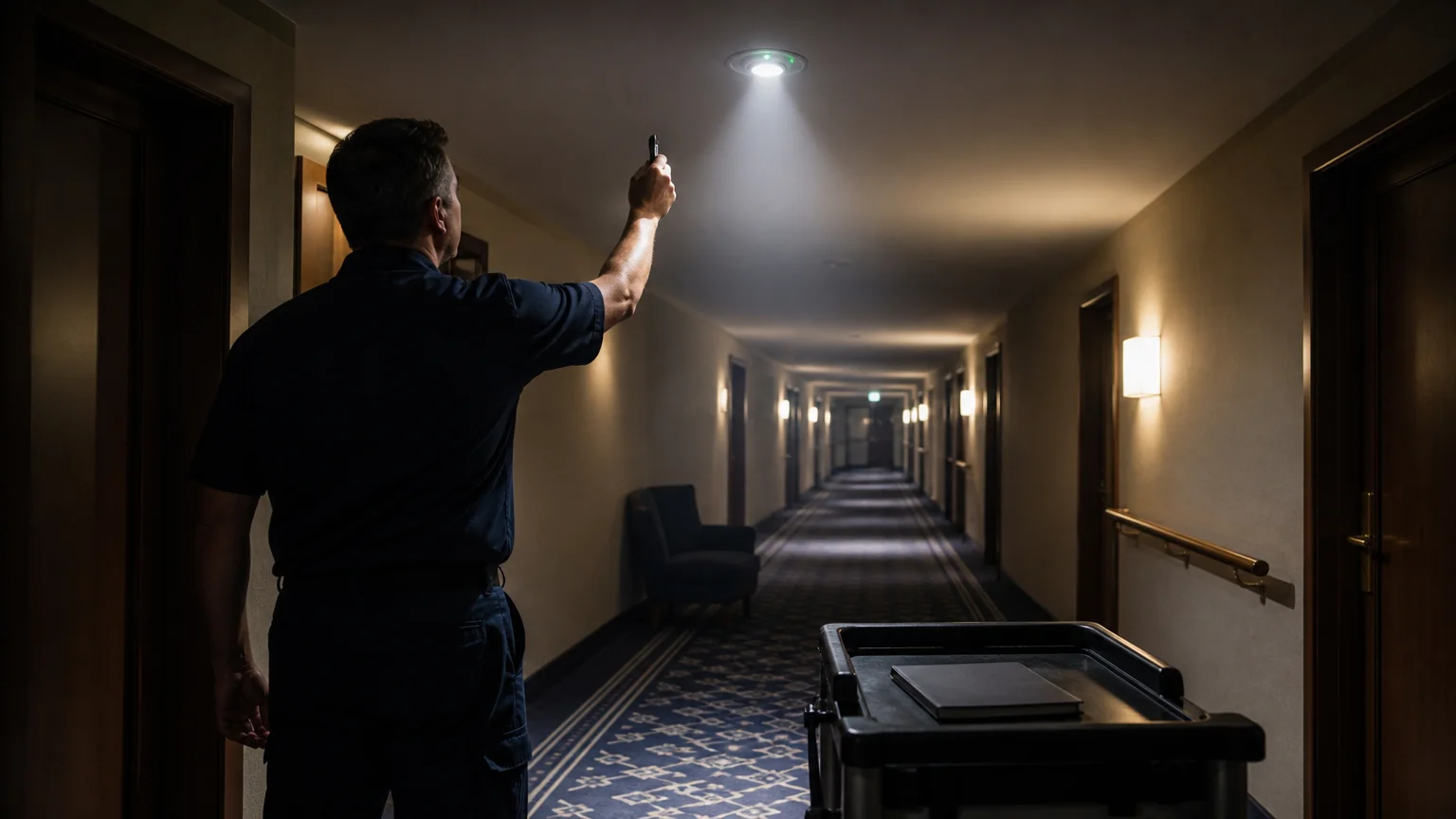
Emergency lighting is the only system in a hotel that is judged entirely on the day it is needed, which is also the day nobody can fix it. That is why the useful question is not whether the installation was correct at handover, but what routine keeps it correct five years later. This guide covers the testing regime itself: what each type of test actually proves, what automation does and does not replace, and how to keep records that survive a change of facilities contractor.
There is a particular failure pattern in emergency lighting, and it is common enough to be worth naming. The system is installed, tested and signed off. The operator’s compliance calendar is set up. Two years pass, during which a refurbishment replaces a section of corridor ceiling, a controller is swapped without exporting its configuration, and a number of battery packs quietly reach the end of their service life in a void that runs warmer than anyone assumed. Nothing has been neglected in an obvious way. The scheme has simply drifted out of the condition in which it was approved, and the first indication is a test that fails or an inspection that finds it.
This article deals with the regime that prevents that drift. It sets out what the two basic test types prove, why automated self-testing changes the labour equation without removing the operator’s obligations, what a workable schedule looks like in a hotel, and which failure modes the routine exists to catch. It follows our guide to emergency lighting requirements by market and our product guide to emergency fittings, and it sits alongside our comparison of central and self-contained arrangements, because the topology chosen determines how a test is carried out and how much of the building it affects.
- 01Testing is a regime, not an event
- 02What a functional test proves, and what it does not
- 03The duration test and what it stresses
- 04Self-testing: what it automates and what stays manual
- 05A practical schedule for a hotel
- 06The failure modes the regime exists to catch
- 07Spares, batteries and the maintenance rhythm
- 08Writing testing into the specification and the handover
01Testing Is a Regime, Not an Event
Commissioning is the moment a system is proved to work; testing is the process that keeps that proof current. The two are often conflated, which is how buildings acquire a complete set of commissioning certificates and no testing history. Our guide to commissioning and handover covers the first of those; this article covers the second.
What makes a regime rather than an event is that it has four properties, and a scheme missing any one of them tends to fail quietly:
- It has a rhythm. Tests happen on a schedule that is short enough to catch degradation and long enough to be sustainable. A scheme that is tested once a year in a concentrated effort behaves differently from one tested in rolling areas throughout the year, even when the annual count is the same.
- It has an owner. Someone is named as responsible, and it is not the same thing as the party who performs the work physically. On many hotel projects the operator owns the obligation while a contractor performs the tests; the record has to make that division clear.
- It produces records. A result that exists only in a technician’s memory is not evidence. The record needs the unit, the test type, the date, the outcome and the action taken.
- It closes the loop. A fault is not a test result; it is a work order. The regime is only complete when a failed unit enters a repair track with a completion date, and the most common weakness in hotel schemes is that failures are recorded faithfully and repaired slowly.
Two structural features of emergency lighting make this discipline harder than it looks. The first is that the equipment is distributed across a building that is in revenue service, so any test is also a logistics exercise. The second is that the equipment is designed to be unobtrusive: a failed unit looks like a healthy one, and a fitting that has been removed during a refurbishment leaves no visible gap once the ceiling is closed. Both features push the operator towards relying on automation, which is why the next three sections separate what each test type actually establishes.
02What a Functional Test Proves, and What It Does Not
A functional test is the short test. The supply to the emergency lighting is interrupted, each unit is observed, and the test confirms that the fitting transfers to its stored energy and illuminates. It is quick, it can be done area by area without closing the building, and it is the test that catches the largest number of day-to-day failures: a dead battery, a failed charger that has left the battery flat, a lamp or light source that has reached the end of its life, a fitting that has lost its supply because of unrelated building work.
Its limits are equally clear, and they are worth stating because a functional test is often treated as sufficient. It proves that the unit works now. It does not prove that the unit will still work for the full required duration, because a battery that has lost most of its capacity will happily illuminate a fitting for a minute. It does not prove that the light reaching the escape route is adequate, because that depends on the position and condition of the fitting, on the cleanliness of its diffuser and on the geometry of the space. And it does not prove that the right units are in the right places, because a fitting that was never installed passes no test at all — the omission is invisible.
The third of those points is the reason the visual element of a test round cannot be dropped even where testing is automated. A walk-through confirms things no electrical measurement covers: that each unit is present, that it is not obscured by a new sign or a plant or a linen trolley normally parked beneath it, that its diffuser is not discoloured or painted over, that no later building work has boxed it in, and that escape signage along the route is legible and correctly aimed. These are observations, not tests, and they remain the operator’s.
03The Duration Test and What It Stresses
The duration test is the one that matters to the battery and the one that cannot be shortened. The unit is discharged for the full rated period the building requires, and the question being answered is whether the installation still delivers the required autonomy at its current state of health — not whether it did so when it was new.
Three properties of the test shape how it is planned:
- It takes time in real hours. A duration test occupies the whole emergency period, so it affects the building while it runs. On a distributed scheme it can be staged area by area, which is one of the practical advantages of self-contained units. On a central system the shared battery is discharged, so the coverage of the circuit it feeds is affected together, and temporary provision may be needed. This is a planning question with a fixed answer dictated by the topology.
- It is a stress test, and it finds weak units. A battery near the end of its service life may pass a functional test repeatedly and fail the first duration test it meets. A positive reading of that outcome is that the test worked; the practical consequence is that a duration test should be scheduled so that the resulting repair work can be absorbed, not discovered on the eve of an inspection.
- Its result is about retained capacity, not about the label. The relevant figure is the autonomy the system delivers now, at the ambient temperature it actually operates in, against the autonomy the building is required to provide. That is why the required duration should be recorded at handover together with the design margin, so that a later test can be interpreted against the original intent.
A duration test also has a documentation obligation that a functional test does not, because it is the point at which the health of the energy store is assessed. The record should say which units were discharged, for how long, what the outcome was per unit or per circuit, and what action followed. Where a handful of units fail, the useful question is not only whether they are replaced, but whether they share a characteristic — a production batch, a location, a ceiling void that runs hot, a circuit that was disturbed by later work. A pattern is a design or an environmental finding; a single failure is a maintenance event.

04Self-Testing: What It Automates and What Stays Manual
Self-testing addresses the labour problem directly. Circuitry inside each unit, or in the control layer serving it, exercises the fitting on a schedule and reports the outcome, so that a monthly round of several hundred fittings becomes an exception report listing the units that failed. On a large hotel estate this changes the economics of the regime substantially, and it produces a digital record as a by-product rather than as a separate administrative task.
It is important to be precise about what has changed. Automation moves the performance of the test from a person to the equipment. It does not move the obligation, which remains with the operator, and it does not cover the observations described in section 02. Three further properties of self-testing deserve attention at specification stage:
| Aspect | What self-testing handles | What still requires a person |
|---|---|---|
| Functional testing | Automatic, scheduled, per unit, with results reported | Confirming the report has been read and acted on |
| Duration testing | Automatic discharge to the required period, where the system supports it | Scheduling the test so that the reduced coverage is acceptable, especially on a shared supply |
| Fault classification | Distinguishing battery, lamp and circuit faults at the unit | Distinguishing a failed unit from an installed one that is blocked, dirty or wrongly aimed |
| Records | Exportable history of results by unit and date | Retaining the records, and keeping them readable across contractor changes |
| Coverage gaps | Nothing — a unit that was never installed cannot report | Periodic visual verification of the scheme against the drawing |
Two practical conditions decide whether the automation delivers. The first is where the results go: a system that reports only to a local panel reproduces the original problem in a new form, because someone still has to look at the panel. The second is the longevity of the data. Test histories that live inside a piece of equipment or an application that changes hands are fragile; the specification should require an export path, so that the record belongs to the building rather than to the device. Where the emergency layer is monitored through a lighting control network, that network is an overlay on the safety system rather than its substitute, as our analysis of control and the safety layer explains.
05A Practical Schedule for a Hotel
The intervals a building has to meet come from the code or the national guidance that applies to it, and those documents, not this article, set the obligation. What follows is the operational shape a hotel normally gives that obligation, so that the regime is financeable and sustainable rather than aspirational. The exact rhythm should be confirmed against the applicable requirement for the property.
| Activity | Usual rhythm | Who performs it | What it produces |
|---|---|---|---|
| Functional test — each unit illuminated briefly from its stored energy | Monthly, or automatically on an equivalent schedule | Facilities technician, or the self-test function | Exception list of units that failed to illuminate |
| Duration test — discharge for the full required period | Annually in most regimes, or as the applicable requirement states | Competent person, often a specialist contractor on a large estate | Per-unit or per-circuit autonomy result, with the action taken |
| Visual verification — presence, condition, cleanliness, signage, alignment with the drawing | With each functional test, and after any building work in the area | Facilities technician or housekeeping supervisor briefed for the purpose | Snag list fed into the repair track |
| Signage check — legibility, direction, illumination of each exit sign | Monthly, and after any change of layout or wayfinding | Facilities technician | Recorded confirmation or a defect |
| Record review — open failures, repeat failures, patterns by location | Quarterly | Facilities manager or responsible person | Work orders, and a note of any recurring pattern |
| Post-works re-verification — after refurbishment, re-planning or any ceiling intervention | On completion of the work | Facilities technician with the contractor | Confirmation that the scheme still matches the drawing |
Two rows in that table are the ones hotels most often omit, and both concern events rather than intervals. The first is post-works re-verification: any intervention that removes a ceiling, moves a partition or changes a corridor’s use is an opportunity for a fitting to be lost, covered or rendered pointless, and the correct moment to check is before the area reopens. The second is the record review, which is not a test at all. It exists because the useful signal in a testing history is the pattern — a run of failures on one floor, a group of batteries all reaching end of life in the same quarter, a set of units on one circuit that keep returning to the exception list.
Housekeeping has a role that is easy to overlook and cheap to establish. The people who see corridors at every hour are the first to notice a fitting that stays dark, a sign that has been knocked out of alignment or a diffuser that has been painted over during redecoration. A one-page briefing that tells them what to report and to whom turns an invisible failure into a routine maintenance ticket, which is exactly what the regime needs.
06The Failure Modes the Regime Exists to Catch
A testing regime is easier to defend when it is designed against named failures rather than against a generalised idea of degradation. The following list covers the ones that appear repeatedly in hotel properties, together with the part of the routine that catches each.
- End of battery service life. Capacity falls gradually and then crosses the point at which the required autonomy is no longer met. A functional test does not see this; the duration test does. Where batteries sit in warm ceiling voids or in an unconditioned riser, the decline is faster than the datasheet figure suggests, which is why patterns by location matter.
- Failed charger, flat battery. The unit looks healthy and is not, because nothing has kept the battery charged. Caught by the functional test, and by self-testing where faults are classified by cause rather than merely reported as failures.
- Light source at end of life. Common in fittings that also serve as ordinary lighting, where the source runs far more hours than the emergency duty alone would imply. Caught by the functional test; prevented by replacing sources on a planned basis rather than on failure, which is the same argument set out in our notes on reading lifetime claims carefully.
- Circuit disturbance by later work. A fitting isolated during a refurbishment and never reconnected is invisible to every test, because it is not there to fail. Caught only by visual verification against the drawing, and by post-works re-verification.
- Loss of configuration after equipment is replaced. Where the scheme depends on addressing, grouping or scene data held in a controller, a swap can quietly remove the emergency monitoring path. Caught by confirming the monitoring layer after any change to the control equipment — the same discipline that applies to colour and scene configuration elsewhere in the scheme.
- Optical degradation and obstruction. A discoloured diffuser, a dust film, a new plant fixed to the wall beneath a unit, a laundry trolley parked in the same place every night. Invisible to electrical testing; caught by the visual round.
- Signage faults. An exit sign that is dim, wrongly aimed, obscured by a new decorative element or inconsistent with a changed circulation route. Caught by the signage check and by the post-works review.
- Loss of documentation continuity. Not a component failure, but the failure that makes every other one unmanageable: records held by a contractor who has been replaced, with no export taken. Caught only by designing the record to belong to the building.
Reading that list together produces a useful conclusion for anyone writing a specification. Automated testing and manual observation are not competing approaches, and neither is sufficient. The equipment can prove that it works; only a person can confirm that it is where the drawing says, that it is doing what the space needs and that the building around it has not changed in a way the equipment cannot detect.
07Spares, Batteries and the Maintenance Rhythm
Testing generates repair work, and repair work needs parts. A regime that reliably finds failures but cannot replace them turns a compliant installation into a well-documented non-compliance, so the spares position belongs in the same conversation as the test schedule.
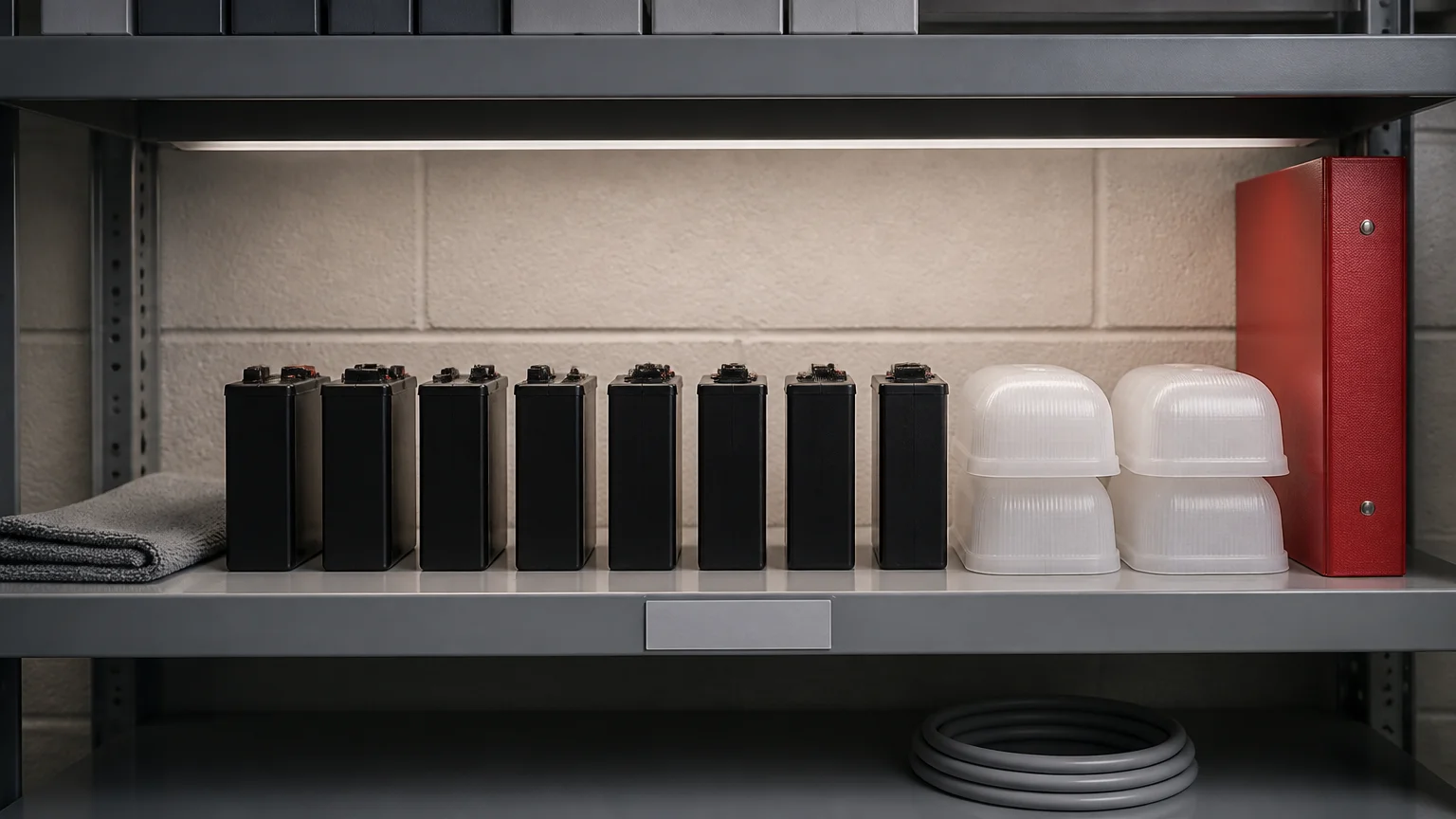
Three categories of spare matter. The first is the energy store: the correct battery type for each fitting family on site, held in a quantity that reflects the replacement rate the duration tests are revealing, and stored in conditions that do not degrade it. The second is the light source and its replaceable components, particularly for fittings that also serve as ordinary lighting and therefore accumulate hours quickly. The third is the fixing and cover components that a maintenance visit disturbs — diffusers, trims, retaining clips — because a fitting that cannot be reassembled after a battery change will be left incomplete.
Two planning habits make the rhythm manageable. The first is to replace batteries by group rather than by individual failure once the estate reaches a certain age: where a batch of units was installed together, in the same environment, the sensible moment to replace them is when the first few begin to fail duration tests, because the labour of repeated visits to the same ceiling outweighs the residual life of the surviving cells. The second is to record where each fitting family is installed, so that a spares order can be scoped by location rather than by part number count alone.
Both habits depend on the same underlying asset: a scheme that was designed to be maintained. A fitting whose battery cannot be reached without dismantling it, or whose diffuser is held by clips that break on removal, will be maintained late or badly whatever the schedule says. That is a specification issue rather than an operational one, and our checklist for designing fixtures for maintenance sets out what to require. The wider maintenance picture — cleaning cycles, finishes and the care of decorative fittings — is covered in our hotel lighting maintenance guide.
08Writing Testing into the Specification and the Handover
Testing obligations are usually created at the operator’s end of a project, but the ability to meet them is created much earlier. Four items in the lighting specification determine how easy the regime will be.
- An explicit testing provision. State whether the scheme is to be self-tested, manually tested, or monitored through a control layer, and how the results are to be retrieved. A scheme supplied without a stated test method is tested by whatever the first contractor happens to do.
- An export path for records. Require that test histories can be exported in a readable format, so that the record survives a change of contractor, a replacement controller or a change of software.
- Serviceability of the fittings themselves. Require field-replaceable energy stores and light sources, and internal access that does not require dismantling the fitting.
- A handover file that supports the regime. The scheme drawing marked with unit positions and addresses, the required duration recorded as a design value with any margin, isolation procedures for any shared supply, the spares list with suppliers, and a test schedule template the operator can start using immediately.
That file is the difference between a scheme the operator can run and a scheme they have to reverse-engineer. It is also, in practice, the item most often requested after the order has closed, which is why our notes on building a specification checklist for a lighting tender treat handover documents as part of the requirement rather than as an administrative afterthought. Verification earlier in the process follows the same principle: what is checked before shipment is what gets documented, as our guide to pre-shipment inspection explains.
One boundary is worth restating, because it determines where responsibility sits. The intervals, the test methods and the records required for a particular building are fixed by the code or national guidance applicable to that building and by the authority that inspects it. Neither a supplier nor a contractor can substitute a different rhythm. What a supplier can do is make the regime feasible: equipment that reports its own condition, fittings that can be serviced, and documentation that makes the operator’s obligations straightforward to meet.
Source type: the test types, automation behaviour and operational practices described above reflect published emergency-lighting standards and national codes, guidance issued by testing and certification bodies, and general facilities-management practice in hospitality properties. Required intervals, test durations, record retention periods and acceptance criteria differ between markets and are set by the applicable code and the authority having jurisdiction; confirm them for the specific building. Where a rhythm is described in this article it is common practice, not a stated requirement.
Frequently Asked Questions
How often should emergency lighting be tested?
The intervals are set by the code or national guidance that applies to the building, so the first step is to confirm what that requirement says. The common operating pattern in hotels is a short functional test at monthly intervals and a full duration test annually, with the results recorded. Where self-testing is installed, the equipment performs those exercises on a schedule and reports exceptions, but the operator still owns the obligation and the records.
What is the difference between a functional test and a duration test?
A functional test interrupts the normal supply briefly and confirms that each unit illuminates from its stored energy. A duration test discharges the unit for the full period the building is required to provide, which is the only test that establishes whether the installation still has enough retained capacity. A battery close to the end of its service life can pass functional tests repeatedly and fail the first duration test.
Does self-testing remove the need for a manual inspection?
No. Automation proves that the equipment works; it cannot see that a unit is missing, boxed in by later building work, obscured by a diffuser that has been painted, aimed at the wrong point, or accompanied by an exit sign that has been hidden behind a new partition. Visual verification and the signage check remain part of the routine.
Why did a duration test fail units that had passed every previous check?
Because a functional test only needs the battery to deliver a short burst of output. Capacity falls gradually with age, use and ambient temperature, and the point at which a unit can no longer sustain the full period arrives between one annual test and the next. That is a normal outcome of an effective duration test; the useful follow-up is to look for a pattern, such as one location, one circuit or one production batch.
What records should be kept?
For each test: the unit or circuit, the type of test, the date, the result and the action taken, together with the identity of the person who performed it. Reports from a self-testing system should be exported and retained with the same discipline. The purpose is not administrative tidiness: records are what allow a pattern of failures to be recognised, a repair to be traced, and the condition of the scheme to be demonstrated when it is inspected.
What happens to the testing regime when a corridor is refurbished?
It needs re-verification before the area reopens. Any work that opens a ceiling, moves a partition or changes how a corridor is used can leave a fitting disconnected, covered or pointless, and none of those conditions will be found by a test of the units that remain in place. Add the re-check to the refurbishment programme rather than to the following year’s test round.
Can a hotel rely solely on monitoring through the lighting control system?
Monitoring is an overlay on the safety layer, not a replacement for it. Emergency lighting has to work when the power and the network it depends on have failed, which is why it runs on dedicated circuits or stored energy of its own. A control system can supervise and report, and that reporting is valuable, but the safety function and the testing obligation remain with the emergency installation itself.
Setting Up an Emergency Lighting Test Regime?
Send us the scheme drawing with the emergency units marked, the topology you have chosen, the duration the building has to meet and whether the installation is to self-test. We will tell you which units will be hardest to service, what a duration test will cost you in coverage, and which handover documents your facilities team needs in order to run the regime without going back to the drawings.
Three companion pieces sit alongside this one. Our guide to emergency lighting requirements by market covers what has to be lit and for how long, our comparison of central and self-contained arrangements explains how the topology changes the way a test is carried out, and our product guide covers the fittings, signs and batteries themselves. For the maintenance side of the same problem, our hotel lighting maintenance guide covers cleaning and care, and our checklist for designing fixtures for maintenance sets out the access and spares provisions that make a regime affordable to run. Talk to our team about the safety layer of your project.


