
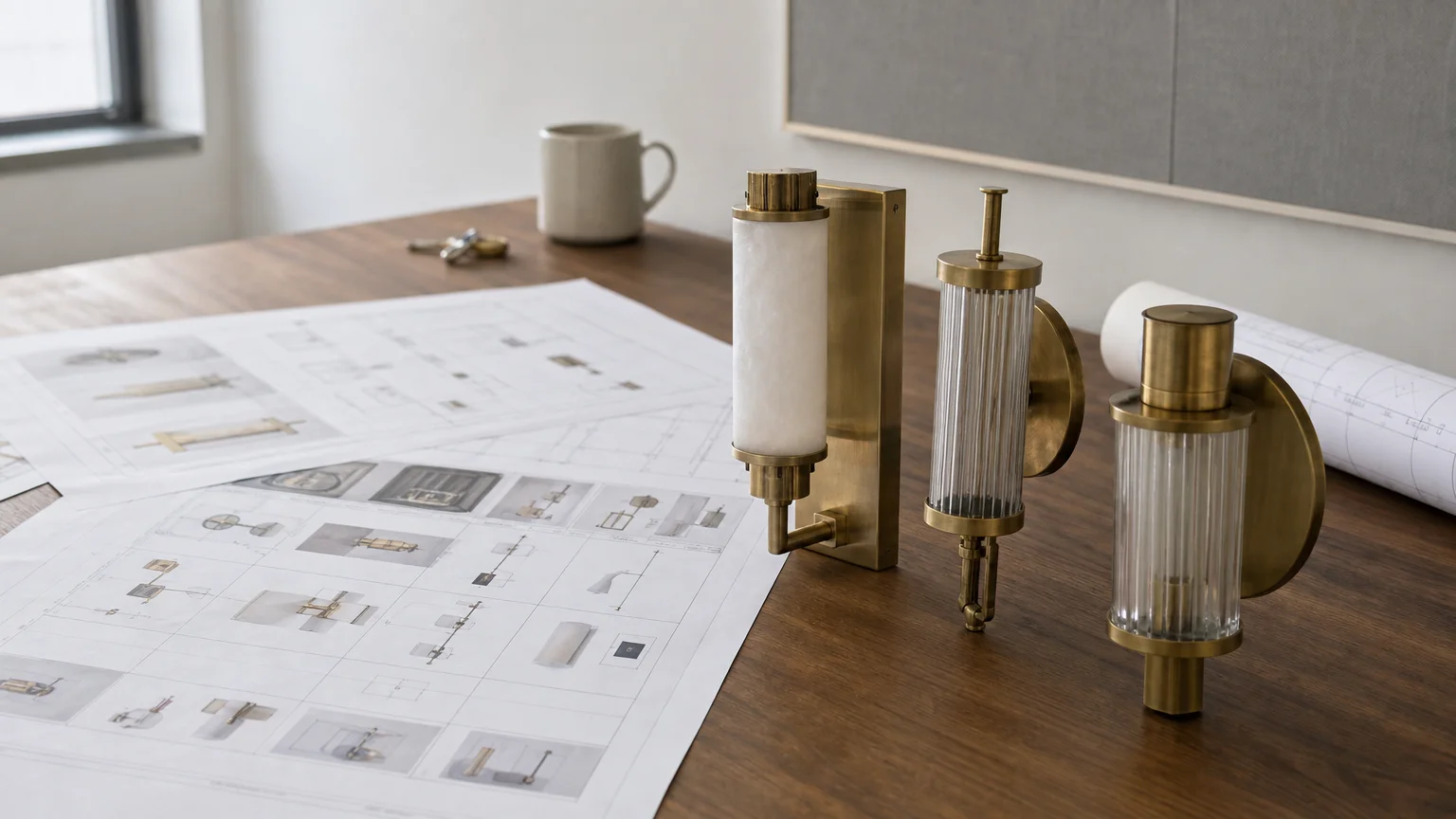
A hotel lighting package is not a larger version of a showroom order. It is the same design repeated across a building, tied to an opening date that was fixed before the fixtures were chosen.
That difference is why a plant can price a showroom order from a photograph and cannot price a hotel package from one. Seven fields close the gap, and the schedule is only the first of them.
- 01What a Hotel Package Actually Asks For
- 02Field One: The Schedule, Quantified by Room Type
- 03Fields Two and Three: Drawings, and the Destination Market
- 04Fields Four and Five: Mounting Heights and the Finish Reference
- 05Fields Six and Seven: Light Source, Dimming and the Calendar
- 06Why a Room-Type Breakdown Changes the Price
- 07Attic Stock: The Field Buyers Consistently Forget
- 08Provisional Lines, and What to Send First
01What a Hotel Package Actually Asks For
An FF&E lighting schedule is the document that tells the supply chain what is being bought, how many of each, where each one goes and when it has to arrive. The abbreviation stands for furniture, fixtures and equipment, and the lighting schedule is the part of that package a plant bids from.
What makes a hotel package different from a home order is repetition mixed with synchronisation. A showroom buys many designs in small numbers. A hotel buys one design many times, then another design many times, and every line has to be steady with its siblings, compliant for the market it is installed in, and present on site in the right sequence.
A single decor chandelier in a lobby is one making event. Three hundred guest-room sconces are a production programme, and a programme has costs a single piece does not.
Three consequences follow, and they are worth stating plainly because they explain why the fields below are structured the way they are.
Evenness across a batch. A plating line runs a batch. Every piece in that batch shares the same chemistry, the same current and the same operator. If guest-room sconces are built as one batch, the finish across three hundred pieces is genuinely continuous.
If the same fixtures are split into ten small runs interleaved with other work, ten finishing events occur, and the tenth will not match the first as closely as a single batch would. Batch planning is not a courtesy the plant extends; it is a consequence of how the schedule was written.
Documentation that arrives before the inspector does. Where a project needs a safety mark, the mark applies to a specific model, for a specific market, and it is arranged as a separate item on a quotation.
A schedule that names the destination market on the first line gives the plant time to put that work on the calendar. A buy order that names it three weeks before shipping does not.
Replacements in year three. Hotels get damaged. A lamp is broken by a guest, a sconce is scratched during refurbishment, a glass shade is cracked by a housekeeper’s trolley. The replacement ordered two years later should match the installed fixtures rather than resemble them.
That is achievable when the original order included spares from the same finishing batch, and possible-but-approximate when it relied on a plant re-deriving a recipe from a photograph. The difference is decided at the quotation stage, not at the replacement stage.
None of this needs unusual sourcing skill. It needs seven categories of information supplied together rather than gradually.
02Field One: The Schedule, Quantified by Room Type
The first field is the fixture schedule itself, and the way it is quantified is the single most common cause of an unusable quotation.
A total is not a schedule. “Several hundred fixtures” conveys no information a plant can plan from. What is needed is the building’s own structure expressed as lighting: king rooms, twin rooms, suites, corridor per floor, lobby, restaurant, bar, spa, and any other distinct zone.
Each line then carries the fixture type, the quantity per room and the number of rooms of that type.
The distinction matters because the two quantities do different work. Quantity per room tells the plant what the unit is. Number of rooms tells it the size of the batch.
Multiplied together they give the run length for that line, and the run length is what determines whether a line is worth setting up, which finishes can be consolidated, and how the order is sequenced through the workshop.
| Schedule line | What it should state | What it enables |
|---|---|---|
| Guest room, typical | Fixture type, pieces per room, number of rooms of that type | One long finishing batch instead of many short ones |
| Suite and villa | Same structure, listed separately from the typical room | Separate tooling and quantity planning where the design differs |
| Corridor, per floor | Type, count per floor, number of floors, mounting height | Even spacing plan and a steady mounting datum |
| Lobby and lounge | Type, count, ceiling height at the fixing point | Suspension length cut before dispatch rather than on site |
| Restaurant and bar | Type, count, height above each table, dimming intent | Determines whether a lowering mechanism is needed |
| Spa, pool, bathrooms | Type, count, position class for each point | Identifies which points need a damp or wet construction |
| Covered terrace | Type, count, exposure of each point | Confirms which models can genuinely go outdoors |
Two practical points sit behind that table. First, not every model in a decor catalogue is intended for outdoor or wet service — the proportion that is tends to be small, and it is worth confirming early rather than after the spec is issued.
Second, a room-type breakdown is what allows a small number of statement pieces to travel in the same order as a large number of guest-room pieces, so the lobby chandelier does not have to be bought separately at a worse price.

03Fields Two and Three: Drawings, and the Destination Market
The second field is a reference for each line: the maker’s model number where a catalogue design is being used, or the designer’s own drawing where it is not. Either is workable.
What is not workable is a line that carries only a description, because “a long brass pendant” resolves to a family of quite different objects, and the price for the smallest of them is not a useful guide to the price of the largest.
Where a drawing is supplied, the useful drawing states dimensions in millimetres, the mounting method, the lamp holder type and the material thicknesses that matter. Those four items are what a workshop reads first. A rendering without dimensions does not shorten anything, because the plant still has to ask.
The third field is the destination market, and it is the one buyers most often defer on the grounds that it can be settled later. It cannot, because one country name fixes three separate things at once.
- Supply voltage. This determines the lamp holder and the wiring spec, and it is settled per order rather than per catalogue.
- Lamp holder standard. North America conventionally uses E26; Europe and much of Asia use E27; smaller decor fixtures commonly use candelabra holders or G9 capsules. If the operator holds stock of a particular lamp, matching the holder to that stock is a real operating gain.
- The safety mark the spec or the inspector needs. In the United States, safety marks for luminaires are issued by nationally recognised testing laboratories, and a mark applies to a specific model rather than to a company. Testing runs on a calendar measured in weeks or months, which is why the market belongs in the first enquiry rather than on the buy order.
A related point is worth flagging because it surprises buyers comparing catalogues. Catalogue spec tables for decor lighting usually state the holder type and the number of lamps, and usually do not state voltage, maximum wattage or dimming protocol, because all three are determined by the order and the destination.
Their absence from the catalogue is not an omission; it is a signal that they are conversation items. If the project uses an built-in LED module rather than replaceable lamps, or must work with a particular dimming system, both belong in the enquiry, because driver selection is made per order and changes both price and the scope of any certification.
04Fields Four and Five: Mounting Heights and the Finish Reference
The fourth field describes every position where a fixture will hang or be fixed. “Chandelier, dining room, quantity 4” is not sufficient.
The plant needs the ceiling height above each table, the height at which the designer wants the bottom of the fixture to sit, and the construction of the ceiling — solid slab, suspended ceiling, or exposed services.
With those three facts, the rod, chain or cable can be cut to length during production rather than by an electrician on a ladder. That is not only a labour saving; it is a quality saving, because a chain cut on site is cut without a reference to the batch and often without deburring.
Two locations deserve special mention. In a double-height lobby or an atrium, the relevant dimension is the floor-to-ceiling height measured at the fixing point, not the room’s nominal height. In a stairwell, it is the height at the topmost tread.
If a structural engineer has set a load limit at the fixing point, that limit should be supplied, and so should the fixture’s own weight, which is not printed on every spec sheet.
For wall fitted fixtures, the mounting height and the position of the electrical box relative to the centre of the fixture are both needed, because on many decor designs the optical centre and the backplate centre are not the same point. Final positions always depend on site conditions and local needs, and structural safety should be confirmed by a qualified engineer.
The fifth field is the finish reference, and it is where hotel projects succeed or fail at the visual level. Naming a finish is not the same as specifying one.
In the decor lighting trade, the words used for finishes — antique brass, aged bronze, brushed gold — describe a family of surfaces rather than a single colour, because each is the product of a base metal, a plating or a raw metal surface, a hand-applied patina and a protective lacquer or wax. Two plants can both supply something honestly called antique brass and deliver visibly different metal.
The way to remove that ambiguity is a physical reference: a colour chip, a previously approved sample, or a part the buyer already has in service.
Alongside the reference, name a single person authorised to sign off the sample. A finish approved by a committee of three people who did not compare notes is a finish that will be disputed at delivery.
Three materials carry inherent variation that should be agreed rather than discovered. Hand-blown glass varies slightly in wall thickness and form. Crackle or split-surface glass breaks differently on every shade, so no two are identical. Stone such as alabaster is cut from a block, so grain and translucency differ from piece to piece — a row of alabaster pendants over a bar will not read as a row of identical stones.
None of these is a defect. Each turns a defect when the project manager was not told in advance, and each is so worth a sentence in the spec stating how much variation the designer accepts.
05Fields Six and Seven: Light Source, Dimming and the Calendar
The sixth field is the light source and the dimming intent. Three questions cover it: are the lamps replaceable or is the fixture built-in LED; are the lamps supplied with the fixture or bought locally by the operator; and what dimming system will the fixtures connect to.
The third question is the one that most often goes unanswered and most often causes trouble, because a fixture that dims smoothly on a test bench may behave differently on a project dimmer, and compatibility is a site of the mix rather than of the lamp.
Answering it early has a second gain. If the project intends to use a specific control protocol, the driver selection can be made once, correctly, instead of being revisited after the fixtures arrive.
Where the intent is not yet decided, saying so is more useful than leaving the field blank, because it tells the plant which parts of the quotation are provisional.
The seventh field is the project calendar: the date the sample is needed, the date the mock-up room must be finished, and the date the fixtures must be on site. Supplying all three lets production be scheduled backwards from a real constraint rather than forwards from whenever the order happens to be released.
| Date to supply | What it drives |
|---|---|
| Sample required | Places the sample in the production queue ahead of the batch |
| Mock-up room complete | Sets the deadline for finish sign-off before the main batch enters finishing |
| Fixtures required on site | Sets the dispatch date once transit time is known |
| Phase one / phase two split | Determines whether one shipment or several are built |
Calendar facts are best read with their edges intact. Production windows published by suppliers in this trade usually cover forming, finishing, assembly, wiring, inspection and packing, and they usually start when the order is confirmed — models chosen, finishes agreed and deposit received — not when the first enquiry is sent.
They usually end when the goods are packed and handed to the forwarder, and they usually exclude the sample stage, any new tooling or new finish recipe, per-order safety certification and sea transit.
A quotation that states a production window without stating these exclusions is not wrong; it is incomplete, and the exclusions are where schedules fail. Where a project needs certainty, the production window, the certification lead time and the transit estimate should each be quoted as separate lines and compared against the opening date.
When the calendar permits it, a single mock-up room is the cheapest insurance in the programme. One complete set of guest-room fixtures is installed and signed off before the main batch enters finishing. Any disagreement about finish, scale or light level is then resolved on one room rather than on three hundred fixtures that are already packed.
Alongside the mock-up, two packaging disciplines are worth adopting as standard: photographing every model before it is packed, and providing carton dimensions and loading quantities before freight is booked. Both are cheap, and both prevent arguments that are otherwise settled by memory.
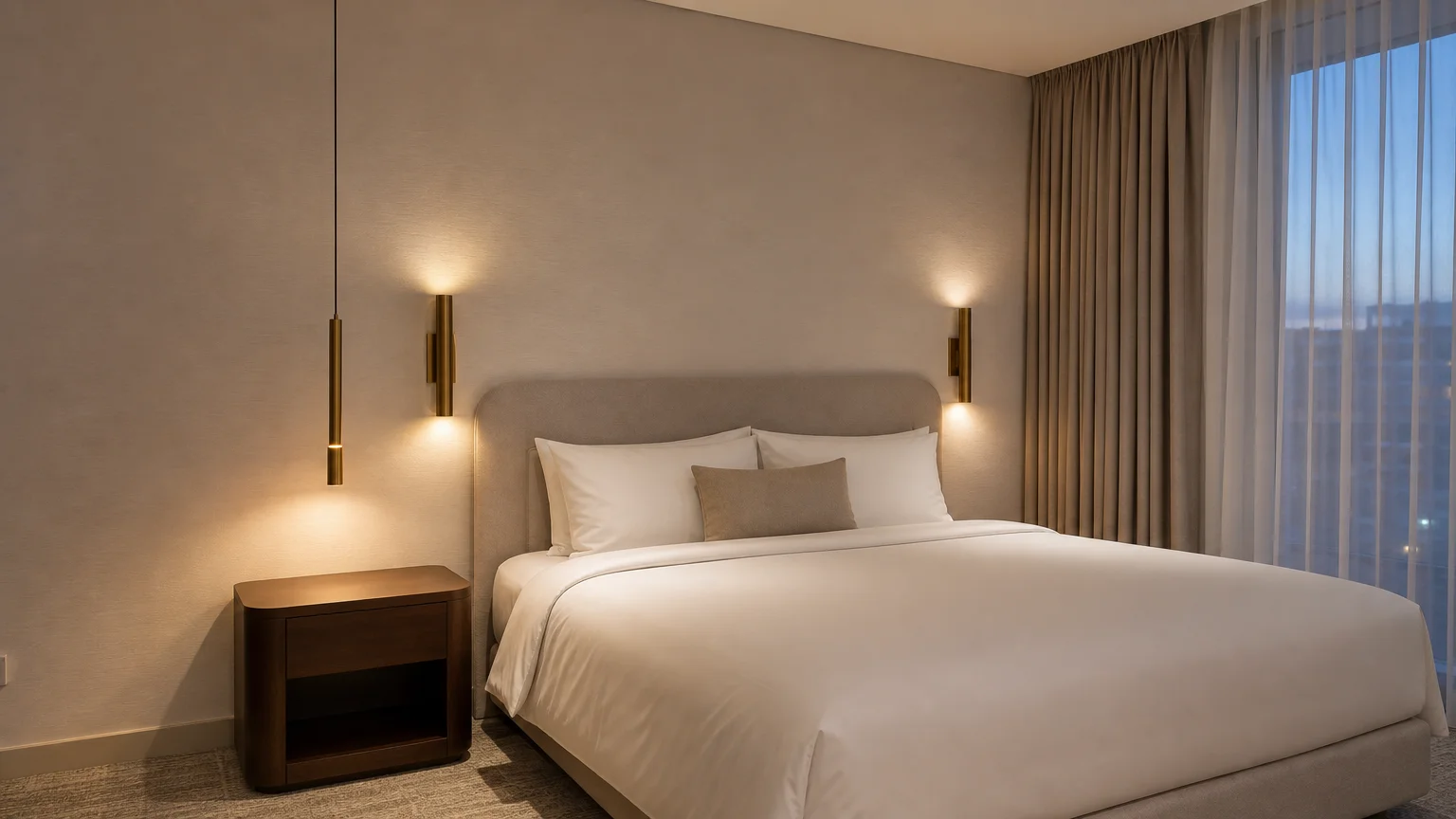
06Why a Room-Type Breakdown Changes the Price
Buyers sometimes assume the room-type structure is an administrative convenience for the project team, and that the plant would rather have a single total. The opposite is true, and understanding why makes the schedule cheaper to write than to argue about.
Every distinct model in a lighting package needs its own set-up before production: a form on a lathe for a spun shade, jigs for a welded frame, a mould or a forming pattern for a glass shade.
A first-off piece that is inspected before the batch is counted as production. That preparation takes roughly the same shift whether five pieces or five hundred follow it. It is a fixed cost per model, and it is shared across but many units that model runs to.
Surface finishing behaves differently again. Plating, lacquering and patina work run in batches rather than piece by piece, because a plating barrel or a tank is loaded when there is enough work to justify it.
Where finishing is carried out in a workshop that specialises in it, the plant quoting the order inherits that workshop’s own batch minimum, and the inherited number frequently turns the floor the buyer sees.
Set against those two facts, the room-type breakdown is an instruction about how to group the work. Presenting guest-room sconces as one line of three hundred and twenty pieces tells the plant that a single forming run, a single finishing batch and a single inspection pass are on hand.
Presenting the same fixtures as six lines for six room types, without a stated total, invites six smaller runs and six finishing events. The unit price moves for a reason that has nothing to do with quantity in the abstract and everything to do with batches in practice.
| How the schedule is written | How production is likely to group it | Effect on finish evenness |
|---|---|---|
| One line per model, with a total quantity | One forming run and one finishing batch per model | Strongest: the whole quantity shares one batch |
| One line per model, per room type, totalled | Same as above if the total is visible | Strong, gave finishing is scheduled together |
| Separate lines without a total | May be treated as independent runs | Weaker: several finishing events, later ones drift |
| A single narrative describing the package | Cannot be grouped at all before clarification | Unknown until the schedule is rewritten |
The practical instruction that follows is short: give the breakdown, and give the total for each model as well. The breakdown lets the plant plan positions and quantities by zone; the total lets it plan batches.
Schedules that supply both are priced faster and priced more accurately, and they are far less likely to generate a follow-up round of questions that costs a working day per exchange across time zones.
One more distinction belongs here, because it is commonly blurred. A minimum order quantity and a pack quantity are different things. The first is a trade floor; the second is a logistics fact about how many units fit in a carton.
A plant that packs in cartons of four will still accept an order of ten, but it will not split a carton, so ten pieces travel as twelve with two spare or as eight with two missing from the plan.
Where a minimum and a carton size interact, the practical order quantity is the next multiple above the minimum, and establishing that before the order is placed is easier than explaining it afterwards.
07Attic Stock: The Field Buyers Consistently Forget
Attic stock is the spare set kept for a building: usually a small percentage of the installed quantity, held in the owner’s store rather than installed on day one.
It is standard practice in hotel FF&E packages and it is routinely omitted from the lighting schedule sent to a plant, which means it is priced later, separately, and at the worst possible moment.
Three reasons make it worth including in the first schedule.
Same-batch evenness. Spares ordered with the main batch are produced from the same material, finished in the same plating or patina run and packed in the same way. They are not merely the same model; they are the same production event.
A single replacement ordered two years later is the same design and, if the plant retains the finish recipe, close to the original, but it is not the same batch. The difference is visible when the two are side by side.
Cost and disruption. A handful of extra pieces added to a run of several hundred shares the set-up cost of that run.
The same handful ordered later is a small production event in its own right, with its own set-up, its own finishing batch and its own documentation, and it may fall below a minimum that the original order comfortably exceeded.
Storage is easier than sourcing. Spare fixtures are compact relative to their replacement cost, and they can be stored with the same care as the original packaging. The alternative is a room that stays out of service while a replacement is identified, quoted, produced and shipped.
The quantity to hold is a project decision rather than a tech one, and it is normally a small percentage of installed units, weighted towards the fixtures most exposed to damage: sconces in guest rooms, table and floor lamps that guests move, and anything in a public area where housekeeping equipment passes.
Whatever percentage is chosen, the schedule is the place to state it, because the schedule is the document the plant prices from.
08Provisional Lines, and What to Send First
Few projects can supply all seven fields in a single message on day one, and no project gains from waiting until they can. The productive approach is to send what exists and mark clearly what does not.
- No destination market yet. The fixtures can be quoted, with certification carried as a separate provisional item to be confirmed.
- No ceiling heights yet. The fixtures can be quoted at a standard suspension length, with the length noted as provisional until drawings are issued.
- No approved finish sample yet. The fixtures can be quoted in the nearest standard finish, with that line marked provisional until the sample is approved.
- No final quantities yet. The schedule can be quoted at planning quantities, with the note that unit prices will be restated once the room count is fixed.
Provisional lines are not a weakness in the enquiry; they are an honest description of where the project stands. They are also, in practice, the mechanism by which a hotel lighting budget moves after a contract is awarded.
An item left provisional at tender is priced at what it actually costs once the detail exists, and if the detail does not exist until late, the movement is discovered late. Marking provisional lines explicitly at the start converts an unpleasant surprise into a scheduled conversation.
Read as a whole, the seven fields describe one thing: the information a workshop needs in order to plan batches, cut metal to length, finish consistently, wire for a market and dispatch against a date.
A complete schedule does not make a project simple, but it makes the quotation comparable with the others on the buyer’s desk, which is the point. A quotation produced without these fields is not a price; it is an estimate of a different project.
Source type: the seven-field structure and the batch behaviour described above reflect published guidance and general trade practice among decor lighting suppliers serving hospitality projects. Where a figure or a window is quoted in this article it is indicative, not an offer. Production windows, sample cycles, minimum quantities, payment terms and certification arrangements are confirmed in a formal quotation and are governed by the terms of the order.
Frequently Asked Questions
What is an FF&E lighting schedule?
It is the lighting section of a furniture, fixtures and equipment package: a line-by-line list of every fixture in the project, with the quantity per room, the number of rooms of each type, the location, the mounting height and the finish reference.
Plants price a hotel package from this document, and its completeness determines whether the quotation that comes back is usable.
Why is a total quantity not enough?
Because a total cannot be grouped into batches. Three hundred and twenty guest-room sconces produced as one run share a single forming set-up and a single finishing batch.
The same fixtures produced as six unconnected runs do not, and the later batches will not match the first as closely. The room-type breakdown is what allows the plant to group the work, so it is a trade document as much as a design one.
Which lamp holder will my fixtures use?
That is determined by the destination market and by the fixture size rather than by the catalogue. North America conventionally uses E26; Europe and much of Asia use E27; smaller decor fixtures commonly use candelabra holders or G9 capsules.
If the operator holds stock of a particular lamp, matching the holder to that stock is worth stating in the enquiry.
Do I need to name the destination country before I can get a price?
You can get an indicative price without it, but not a final one, because the market fixes the supply voltage, the lamp holder and the wiring spec, and it determines whether a safety mark is required for a specific model.
The cleanest approach is to name the market in the first enquiry and let certification be quoted as its own line.
How much spare stock should I hold?
It is a project decision rather than a fixed rule, and it is usually a small percentage of installed units, weighted towards fixtures that are most exposed to damage.
The key thing is to include it in the schedule sent to the plant, because spares ordered with the main batch share its material, its finishing run and its documentation, while spares ordered later are a separate production event.
Can a project be quoted before every dimension is known?
Yes, gave the gaps are marked. Quoting with the missing items carried as provisional lines produces a document the project team can work with. Quoting while pretending the gaps do not exist produces a number that will move later, and the movement is usually discovered at the worst moment.
What should be supplied with the first enquiry?
The schedule by room type with quantities per model, a model number or a drawing for each line, the destination market, the mounting height at each position, a finish reference and a nominated person to sign off the sample, the light source and dimming intent.
The project dates for sample, mock-up and delivery. Send what exists, mark what does not, and state the spares need on the same document.
Building a Schedule for a Hotel Lighting Package?
Send us the room-type breakdown, the models or drawings, the quantities per line, the finish reference and the destination market.
We will tell you which lines can be grouped into one production run, where the schedule leaves something open, and which items need to be settled before the batch enters finishing — so the price you receive is comparable with the rest of the tender.
Two companion pieces are worth reading alongside this one. Our guide to the spec checklist for a lighting tender covers what a project spec should contain before it reaches a supplier, and our notes on briefing a lighting maker set out the enquiry structure that produces a usable quotation on the first attempt.
Where the schedule will be priced against a programme, our breakdown of what a production window does and does not cover explains which stages sit inside the quoted dates and which sit outside them.
For projects where the finishes are the risk rather than the quantities, our guide to evaluating samples and mock-ups describes how to approve a finish once and hold it, and our notes on pre-shipment inspection cover what to check before a batch leaves.
Where branding is part of the package, custom lighting with OEM branding explains how the packaging decision interacts with the fixture order. Our project team can review a schedule line by line and tell you where it will be read differently from how it was written.


