
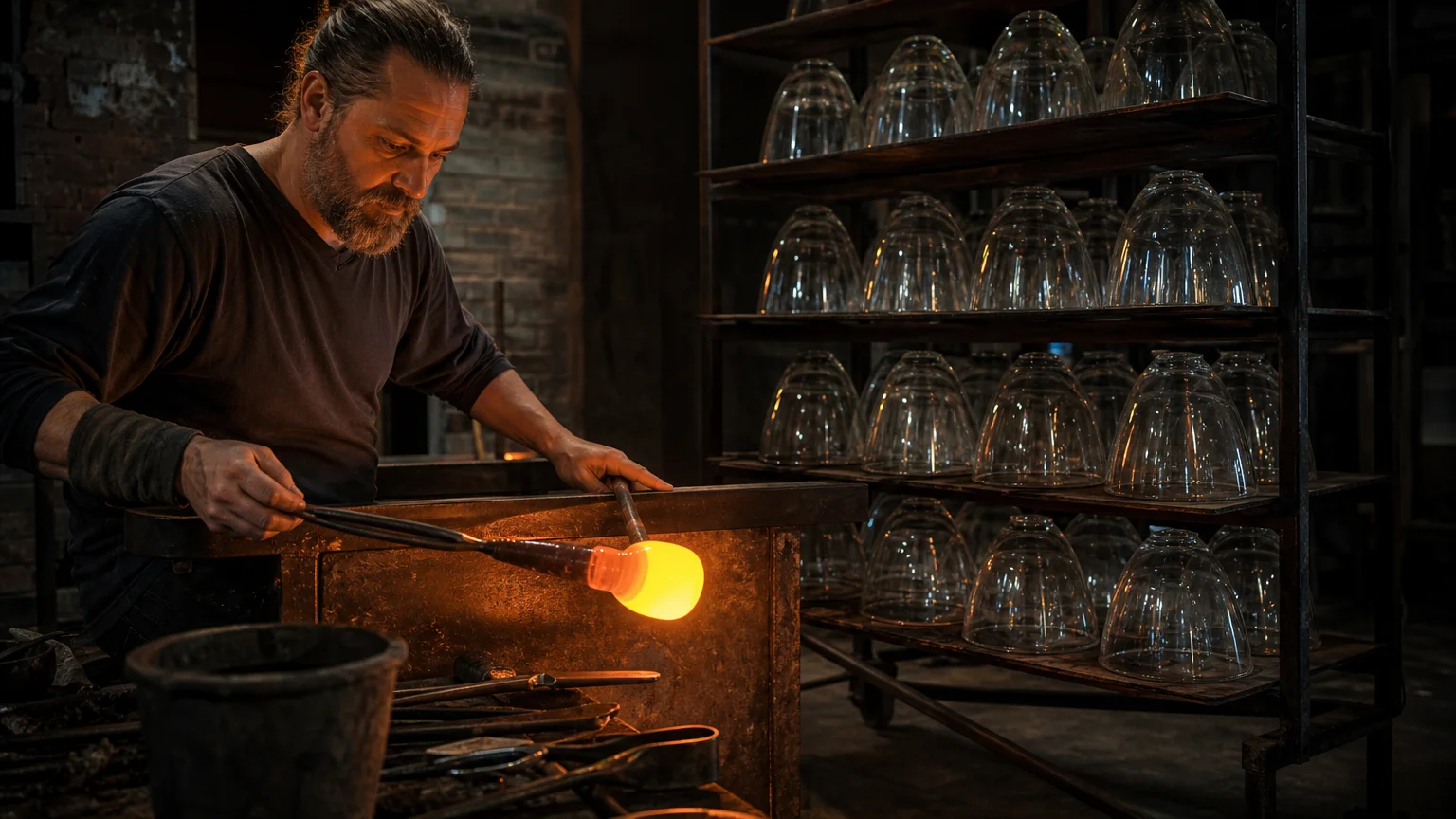
The words “handmade glass” on a specification are a promise about one component and a fog around everything else. They usually mean the shade was formed by a glassworker rather than stamped by a plunger in a mould. They do not mean the metalwork is hand-made, they do not guarantee the pieces will match, and in several common project situations a pressed shade is the better engineering answer. Here is what each route actually delivers.
- 01What “Handmade Glass” Actually Covers
- 02Four Visible Differences, and Three You May Not Want
- 03Why Hand-Formed Pieces Cost More
- 04Six Situations Where Pressed Glass Wins
- 05The Batch Colour Problem
- 06Tolerances, Matching and Replacements
- 07Writing an Acceptance Standard That Works
- 08What to Settle Before the Batch Is Made
01What “Handmade Glass” Actually Covers
The phrase appears in specification columns, on product pages and in quotations, and it is worth unpacking because it is doing less work than most buyers assume. On a line that reads something like brass and handmade glass, the word applies to the glass element only. The brass body, the arms, the canopy and the suspension are machined, spun, cast and pressed by normal metalworking methods, and they repeat to normal metalworking tolerances. What varies between two otherwise identical fixtures is the glass.
Even within the glass, “handmade” is a category rather than a single process. Three routes sit inside it, and they are not equivalent:
- Free-blown. The glassworker gathers molten glass on a blowing iron and shapes the bubble using air, gravity, rotation and hand tools. The result is the most individual of the three, with the widest natural variation in profile and wall thickness.
- Mould-blown. The bubble is blown into a shaping form, then usually finished by hand away from the mould. This constrains the overall form more tightly than free-blowing while leaving the surface and thickness individual.
- Thermally shocked or crackled. Formed glass is quenched so that it fractures internally, producing a craze pattern through the body rather than on the surface. Optically it behaves closer to a diffuser than to a lens.
A mechanically pressed shade is none of these. A plunger forces hot glass into a split steel mould, and the mould decides the shape. Every piece from that mould is the same shape to the same limits, and the cost sits in the tooling rather than in the individual piece.
There is one visible clue that buyers lean on and should not. A mould seam proves that a mould was involved; it does not prove the shade was pressed, because glass blown into a shaping form also leaves a seam. Seams are a starting point for a question, never an answer. The only reliable statement is the supplier’s written declaration of which route was used, and the sample that follows it.
02Four Visible Differences, and Three You May Not Want
The differences between hand-formed and pressed glass are genuine and consistent. What buyers frequently miss is that three of the four are, from a project point of view, defects unless they have been deliberately accepted.
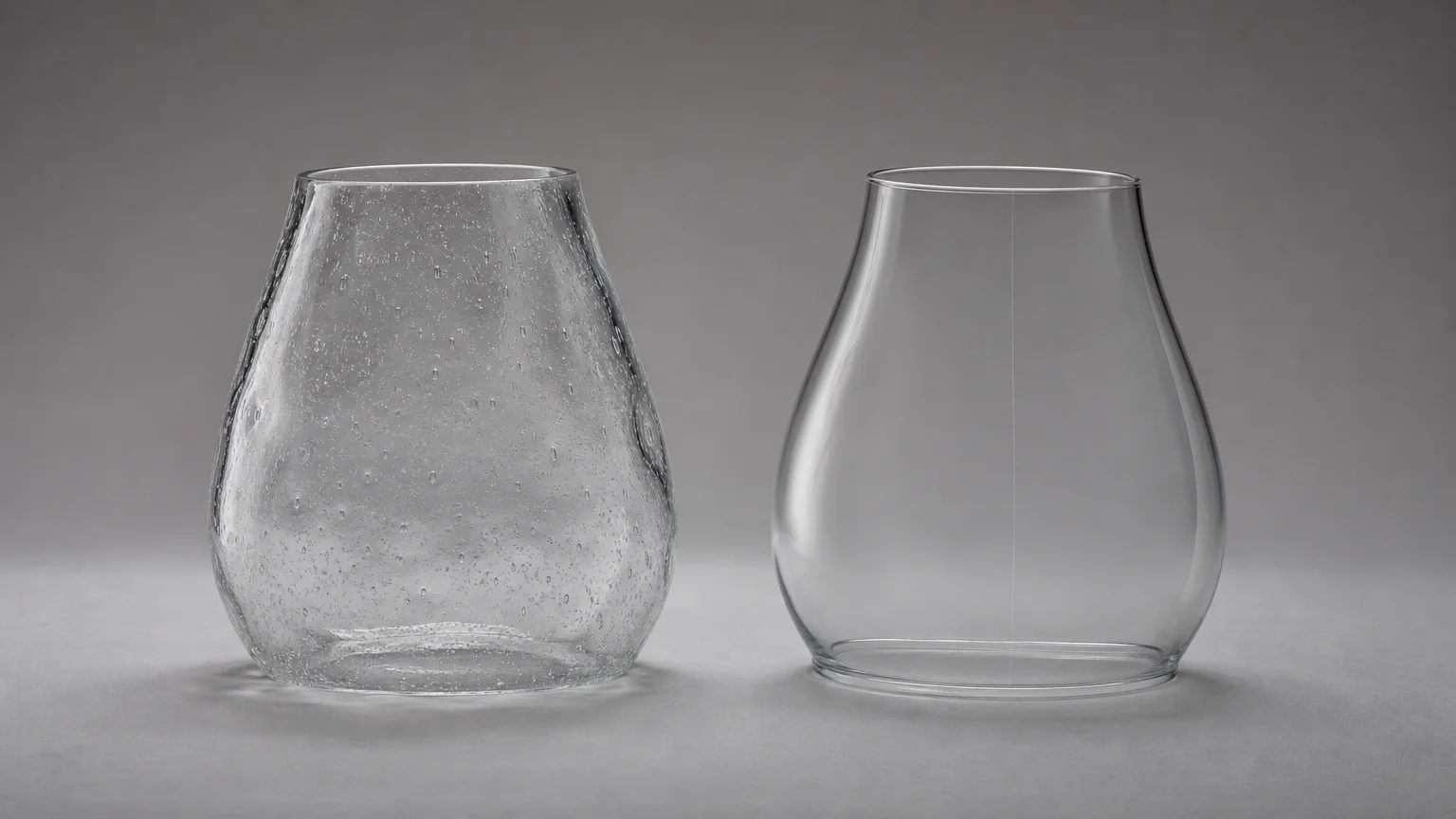
Seams. A pressed shade comes out of a split steel mould and carries a seam line. Good pressed glass has that seam fire-polished flat; inexpensive pressed glass leaves a ridge you can feel with a fingernail. A blown shade has no seam, but it has a finished rim and, depending on the form, marks left where the piece was held during working. Neither is automatically cleaner than the other; the question is what the order says about the seam.
Bubbles and cords. Hand-blown glass contains small bubbles and occasionally a faint cord, the swirl left in the body from gathering the glass. In a design that uses bubble or crackle glass these are the reason for the material. In a plain opal or clear shade they are inclusions the customer has to be willing to accept, because removing them would mean not making the piece that way. A specification that says “no visible inclusions” is a specification for pressed glass, and issuing it against a hand-formed order guarantees a rejection argument.
Wall thickness. A pressed shade is close to uniform in thickness and therefore lights evenly around its circumference. A blown shade varies, and that variation shows up as a soft undulation in brightness. In coloured glass it also shows up as darker areas where the glass is thicker. Some buyers pay specifically for that effect; others open the carton and complain about it. The decision belongs in the design phase, not in the receiving inspection.
Batch colour. This is the difference that causes real commercial damage, and it is treated separately below because no amount of process discipline removes it.
03Why Hand-Formed Pieces Cost More
The premium on hand-formed glass is usually presented as a positioning decision. It is not, or at least not only. Three cost lines explain it, and all three are structural.
The first is yield. A spoiled pressed shade is a machine setting that went wrong and gets corrected. A spoiled blown shade is a lost piece, because glass that has been formed cannot be reworked once it has cooled and annealed — it becomes cullet. Hand-forming yields are therefore lower than pressing, and lower again for more demanding shapes. Suppliers who publish a single yield percentage across a range of shapes are describing an average that applies to none of them, which is a reason to be cautious about any tolerance or yield figure offered without a stated basis.
The second is cycle time and rework. Every blown shade is individually gathered, formed, rimmed and annealed. Pressing runs a repeatable machine cycle. There is no way to batch a hand-formed operation to pressed economics without turning it into a pressed operation.
The third is inspection. Because every hand-formed shade is different, every one is examined individually. Pressed glass can be approved on a first-article basis and then sampled, because the mould guarantees the repeat. That difference is invisible on a quotation and entirely real on the shop floor.
None of this makes hand-forming better or worse. It means the premium is buying a specific kind of variation, and a buyer who does not want that variation is paying for something they will then reject. That is the trade-off our companion piece on textured glass profiles runs into from the other direction, because groove depth and pitch are fixed by the mould in one route and vary piece to piece in the other.
04Six Situations Where Pressed Glass Wins
Pressed glass is not the budget fallback. In six recognisable project situations it is the correct specification, and choosing it is a sign of a well-considered order rather than a compromise.
- Volume and consistency. Hotels, serviced apartments and multi-unit residential work require every room to look the same, and frequently require a later phase to match an earlier one. A mould guarantees that; hand-forming does not.
- Close-tolerance mechanical assembly. Where a shade sits inside a machined recess, behind a retaining ring or within a joinery aperture, the glass must hold its dimensions. Hand-formed shades should not be designed into tight fits; the correct response is clearance, and if clearance is not available, the pressed route is the answer.
- Long-term spares. A client who expects to be able to replace a shade in five years is best served by a mould that is still in use. This is the only honest route to a matched replacement.
- Even light distribution. Task lighting, vanity lighting and any position where uneven brightness would be read as a fault rather than as character.
- Damp and wet areas. The environmental rating of a fixture is a property of the assembly, and hand-formed decorative glass tends to be offered in dry-location fittings. Where a project needs a rated assembly, the options are usually narrower, and pressed glass is where most of them live.
- Budget-led specifications. Where price decides the specification, pressing wins and there is nothing to argue about.
The counter-case is equally clear, and it is about the object rather than the schedule. When the fixture itself is the thing being looked at, and the client is specifically not asking for “the same as the next one” — a bubble pendant, a crackled drop, a coloured shade, a sculptural blown form — hand-forming is what the material is for. That is the territory covered in our guide to sculptural glass statement lighting, where variation is part of the composition rather than a departure from it.
05The Batch Colour Problem
Coloured glass is melted in batches, and two batches of the same nominal colour do not match perfectly. This is not a quality failure and it is not a discipline problem; it is a consequence of making coloured glass by melting. But it has a specific and expensive consequence for staged projects: where a job ships in two phases, the second delivery can be visibly different from the first, and the difference will be noticed by the client even when the specification has been met by both.
There is no craft solution at project scale, which is the part that buyers find hardest to accept. The solution is commercial, and it is decided at the order stage rather than at the delivery stage:
- Order the full quantity in one batch. Where the project can take the whole requirement at once, the batch question largely disappears.
- Buy spares from the same batch. Spare shades ordered later are made to the same specification and will not necessarily match the installed glass. Spares belong in the original order, in the same melting run.
- Where splitting is unavoidable, say so in the contract. Declare the split at the enquiry, agree a colour tolerance against physical samples, and hold approved references from the first batch so the second can be judged against them rather than against a photograph.
The same logic applies to any natural or colour-variable material used in lighting, which is why our comparison of stone materials treats batch variation as a commercial planning item rather than a sourcing risk to be eliminated.
06Tolerances, Matching and Replacements
Dimensional drawings show nominal catalogue sizes. Metal components made by machining, spinning and pressing land very close to those nominal figures. Blown glass does not, and the practical difference shows up in three places.
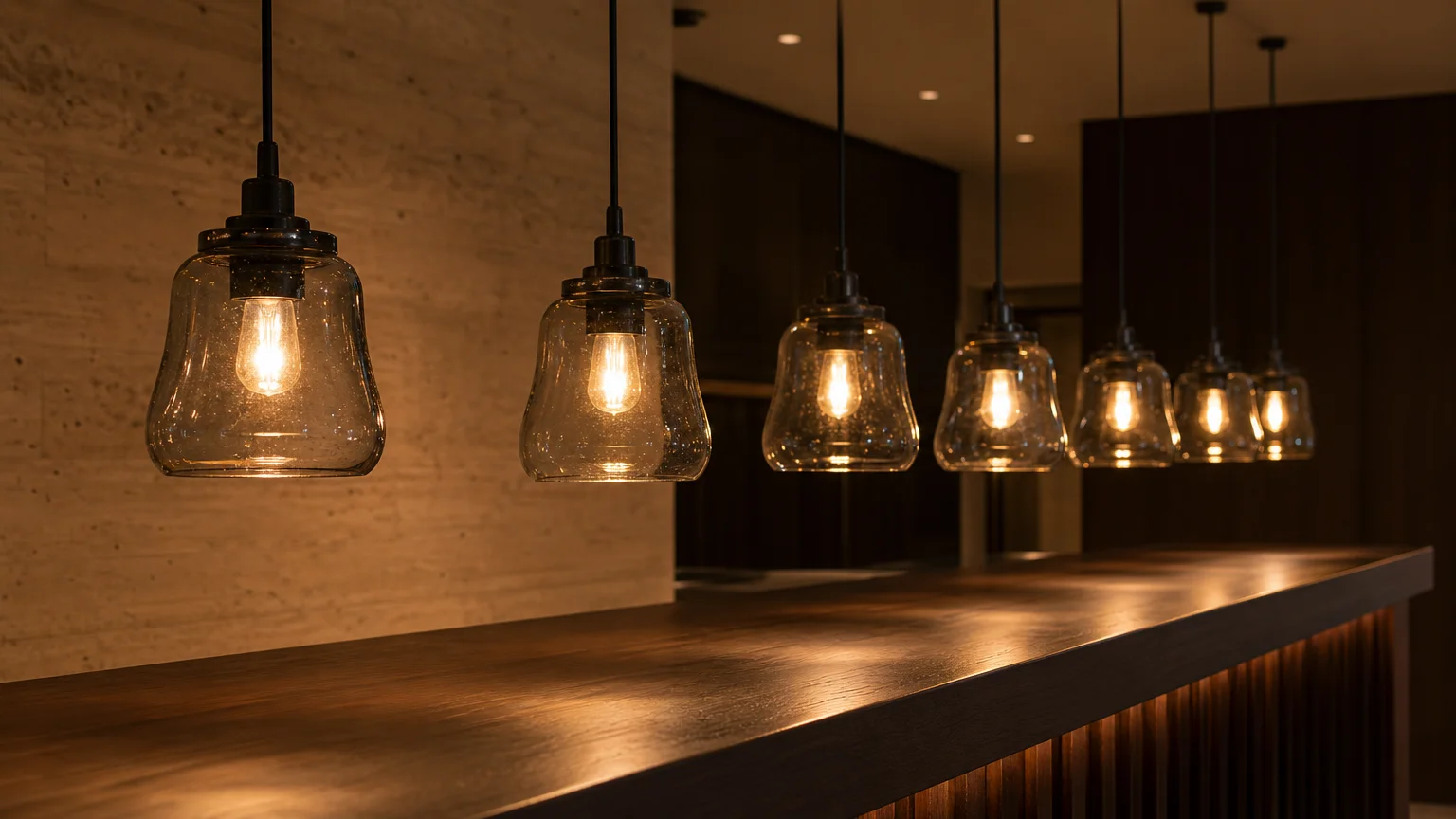
The first is a row of “matching” pendants over an island or a bar. The shades will not be identical. Hung at consistent height and spaced apart, the eye is forgiving; hung almost touching, the differences become the subject of the composition. Spacing is a design decision that can absorb a material property, and it is cheaper than a tolerance argument.
The second is the fit question. Because hand-formed shades vary, they should not be designed into tight recesses or apertures. The design should provide clearance and the drawing should show it. Where the design cannot provide clearance, the glass route has to change rather than the tolerance being demanded.
The third is replacement. A single replacement shade ordered later comes from a new batch, fits the same frame, and may not match its neighbours. Clients should be told this at handover rather than discovering it at the first breakage, and the mitigation is spare stock from the original run.
One further trap sits in multi-size families. A family with several suffix variants often comprises separate moulds and separate shade sizes rather than one shade scaled up and down, so the exact suffix has to appear on the order. Treating the family as a single product with a size option is a common and avoidable error, and it belongs in the same review discipline as the rest of the submittal, which is the subject of our guide to reading a chandelier specification.
07Writing an Acceptance Standard That Works
Because the differences are real and legitimate, the acceptance standard has to be written before the batch is made. A standard written afterwards is a negotiation; a standard written beforehand is a specification. Six items belong in it.
- State the route. Free-blown, mould-blown, crackled or pressed, recorded in writing and confirmed against a sample. Not a description of the look.
- State what variation is acceptable. Bubble size, cord visibility and wall-thickness spread should be bounded, with reference to a physical approved sample rather than to adjectives.
- State what is not acceptable. Directional colour shift, unintended haze, distortion at the rim and inclusions above a stated size are typical exclusions, and they need to be listed explicitly.
- State the viewing condition. A glass family approved under one light source may not read the same under another. The assessment should record the light source, colour temperature and whether the pieces were viewed singly or as a group.
- State the physical envelope. The visual approval must not override the dimensions the glass must hold to fit its frame. Both belong in the same document.
- State the escalation rule. Define what happens when the same deviation appears repeatedly in the same direction — typically a review of the whole batch rather than piece-by-piece replacement.
That last item is the one that saves projects. Piece-by-piece replacement against a systemic batch deviation consumes time, freight and goodwill while delivering the same defect repeatedly. Agreeing in advance that three instances of the same directional deviation trigger a batch review converts a long argument into a single decision.
08What to Settle Before the Batch Is Made
Six questions, all answerable before production, remove essentially all of the risk in this decision.
- Which forming route is being quoted? Ask for it in writing, as a route rather than as an adjective.
- What environment is the assembled fixture suitable for? The answer is a property of the fitting, not of the glass, and it may narrow the choice of glass.
- Will every shade in this project come from one batch? If not, how is the colour difference to be handled and who approves the tolerance?
- Are spare shades included in the same batch? They should be, and the quantity should be agreed now rather than after the first breakage.
- What lamp will be used? A clear filament lamp through a bubble shade is a different composition from the same shade with an opal lamp, and the glass order should follow the lamp decision.
- What is the programme? Hand-formed glass adds time in a way pressed glass does not, and that has to be reflected in the schedule rather than absorbed by the factory at the end.
None of this argues against hand-formed glass. It argues for choosing it deliberately, for a reason, with the consequences priced in and the acceptance criteria written down. A project that does that gets the variation it paid for and none of the disputes it did not want, and the same discipline carries straight through to the maintenance regime that the finished fixture will need — which is the subject of our checklist for designing statement fixtures for maintenance.
Frequently Asked Questions
Does “handmade glass” mean the whole light fitting is hand-made?
No. It describes the glass shade only. Metal components are machined, spun, cast and pressed to normal metalworking tolerances and repeat consistently. The element that varies between two otherwise identical fixtures is the glass.
Is machine-pressed glass lower quality than hand-blown?
It is a different process, not a lower grade. Pressed glass gives identical pieces, even wall thickness and reliable replacements, which is exactly what volume hospitality work needs. Hand-blowing gives individual pieces, which is exactly what a sculptural feature fixture needs.
Can I ask for hand-blown glass with no visible bubbles?
You can ask, but the two requirements conflict. Bubbles and faint cords are inherent to gathering and blowing glass by hand. A specification that excludes all visible inclusions is a specification for pressed glass, and issuing it against a hand-formed order guarantees a rejection.
Why do replacement shades not match the originals?
Because coloured glass is melted in batches, and a later batch will not be an exact colour match to an earlier one. The reliable mitigation is to order the full project quantity plus spares in a single batch, and to tell the client at handover that later replacements may differ.
Can I get a dimensional tolerance figure for hand-blown shades?
Treat any single figure with caution. The variation differs by shape and by batch, so a single number across a range is an average that applies to none of them. A better route is a physical approved sample, a stated clearance in the design, and an acceptance standard agreed before the batch is formed.
Which route should I choose for a hotel with several hundred rooms?
Pressed glass, in almost every case. Room-to-room consistency, even light distribution across a large number of identical fittings, and the ability to replace a shade years later all point to a mould. Hand-forming is for fixtures that are meant to be looked at individually.
Choosing Glass for a Multi-Room or Multi-Phase Project?
Send us the number of shades, the rooms they are going into, the lamp you plan to use and whether the project may ship in phases. We will tell you which forming route suits the quantity, what the batch question means for your programme, and what an acceptance standard for the glass should contain before the first piece is made. Our notes on ribbed, reeded and fluted profiles cover the optical side of the same decision.
Where the fixtures are bespoke, our guide to briefing a custom lighting manufacturer sets out the information that lets a factory quote accurately the first time, and our project team can take a glass enquiry from sample request through to production release.


