
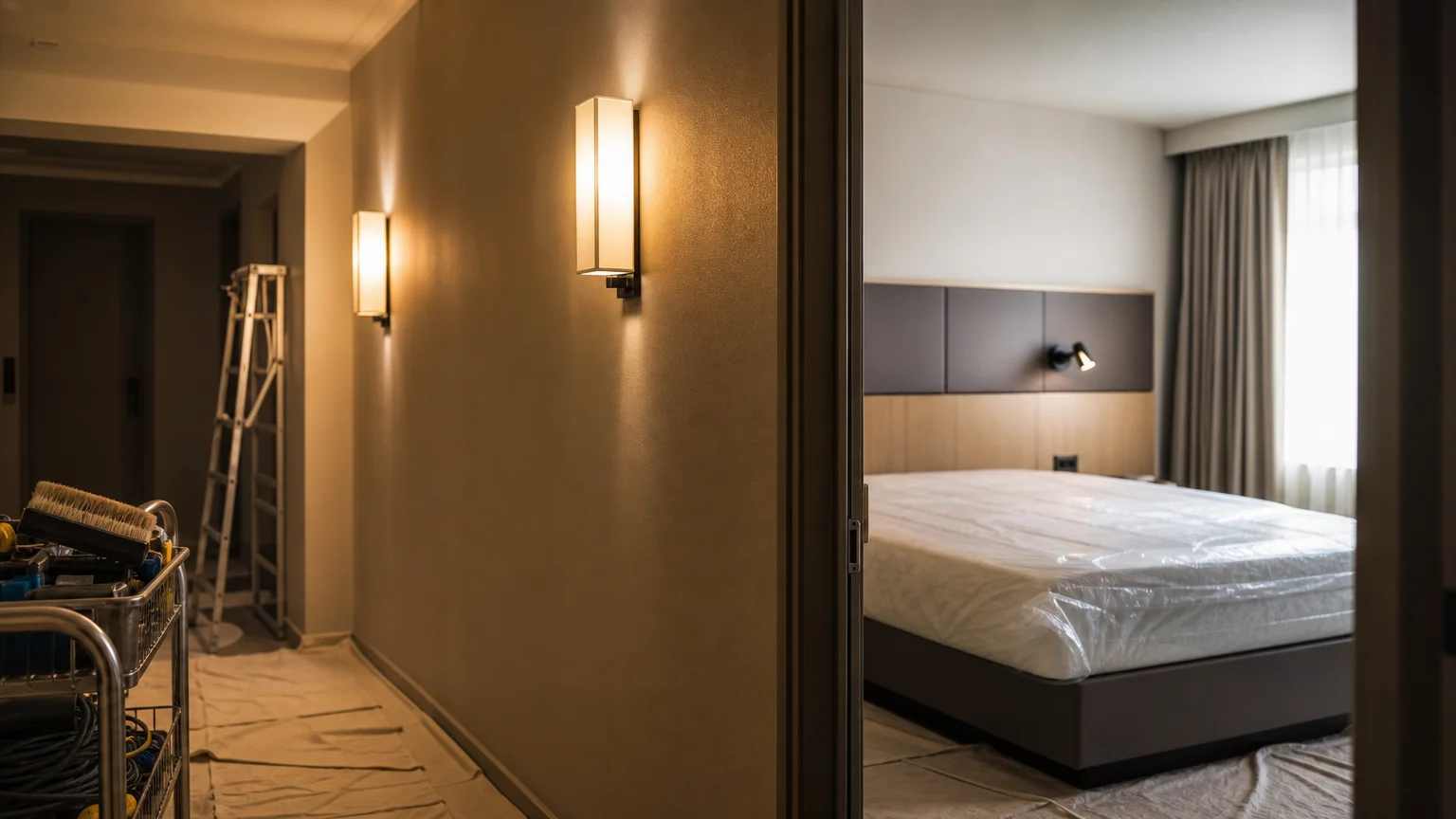
Hotel replacement demand is usually described with one word, renovation, and that word hides the distinction that matters most to lighting buyers. A renovation replaces what has worn out. A conversion replaces what no longer complies with the flag, because an incoming brand standard re-specifies the guestroom fittings, the control layer and the emergency scheme as one interdependent package. One is a trickle of like-for-like orders; the other is a known quantity, against a document, on a fixed date.
This article treats conversion as a procurement event: what the pipeline figures for the second quarter of 2026 show, what a brand standard changes in a specification, and what a buyer should put in front of a supplier.
- 01Conversion Is Not a Larger Renovation
- 02What the Pipeline Data Shows About Conversion Demand
- 03The Same Signal in a Smaller Market
- 04Why a Brand Standard Rewrites the Whole Specification
- 05What a Conversion Rewrites, Layer by Layer
- 06What Public Reporting Shows About Conversion Scope
- 07Lead Times, Batch Sizes and a Predictable Demand Stream
- 08Buying for a Conversion: What the Package Has to Carry
01Conversion Is Not a Larger Renovation
Pipeline research separates replacement activity into two lines: renovation, and conversion combined with rebranding. The split matters, because the two have different triggers, budgets and order shapes.
A renovation is condition-driven. The trigger is a soft-goods cycle or a room block failing guest expectations, and the scope is discovered rather than issued: someone walks the property, lists what is degraded, and buys against that list. The purchase is like-for-like, because the aim is to restore a standard the building already met.
A conversion is standard-driven. The trigger is a flag change, and the incoming standard is a document written for the brand rather than the building: fixture families, finishes, mounting positions, scene behaviour, control topology and the emergency provision behind the same ceiling. The scheme is measured against it, and anything not on the approved list goes out. Serviceable fittings are not a defence: a fitting that works is still replaced if it is not the type the brand requires.
The scope is therefore knowable before anyone orders, homogenised across rooms of the same class, and tied to an external deadline — the rebranding date. A conversion belongs in a capital project with a fixture schedule and a mock-up room, and its opening document is a structured brief rather than a catalogue, as our notes on briefing lighting against a brand standard explain.
02What the Pipeline Data Shows About Conversion Demand
Lodging Econometrics published its Asia Pacific hotel construction pipeline report, excluding China, on August 6, 2026, covering the close of the second quarter of 2026. The regional total stood at 2,506 projects and 452,972 rooms, up 17% in projects and 11% in rooms year on year.
| Stage, end of Q2 2026 | Projects | Rooms |
|---|---|---|
| Total pipeline | 2,506 | 452,972 |
| Under construction | 989 | 199,362 |
| Starts within 12 months | 398 | 72,213 |
| Early planning (record level, 45% of the pipeline) | 1,119 | 181,397 |
| New announcements in Q2 2026 | 217 | 34,938 |
| Conversion and rebranding (record level) | 346 | 58,429 |
The conversion line matters most to lighting procurement: 346 projects and 58,429 rooms, a record for the region, up 36% in projects and 25% in rooms year on year. Early planning is also at a record 1,119 projects and 181,397 rooms, equal to 45% of the pipeline and up 26% in projects and 25% in rooms, and 217 projects with 34,938 rooms were announced during the quarter.
Replacement work is growing faster than the pipeline as a whole, and faster in projects than in rooms, so the average conversion property is smaller than the average new-build — yet it still converts to a full brand standard, so the lighting content per project does not fall with the room count. Most of the volume sits in the tiers where a standard is most prescriptive:
- Luxury: 432 projects and 79,928 rooms.
- Upper upscale: 435 projects and 91,231 rooms.
- Upscale: 658 projects and 121,365 rooms.
- Upper midscale: 423 projects and 75,866 rooms.
- Midscale: 310 projects and 39,113 rooms.
Upper upscale and upscale together account for 44% of the projects and 42% of the rooms in the regional pipeline — the tiers where a standard typically fixes a scene sequence, a reading position at the bedside and a documented control arrangement rather than merely naming a fixture. Opening figures cross-check the timing rather than the volume: 148 projects with 20,594 rooms opened in the first half of 2026, and Lodging Econometrics forecasts 236 projects and 41,217 rooms opening in the third and fourth quarters of 2026, projects 374 hotels with 68,396 rooms opening in 2027, and, in its first forecast for 2028, 363 hotels and 59,659 rooms.
03The Same Signal in a Smaller Market
The second report, published by Lodging Econometrics on July 30, 2026 and also covering the close of the second quarter of 2026, places the Latin America pipeline at 759 projects and 111,340 rooms, with conversion and rebranding at 159 projects and 27,763 rooms — the highest rebranding volume the firm has recorded.
Geographic concentration is unusually clear. Mexico accounts for 234 projects and 33,131 rooms, or 31% of the region’s project count; Brazil has 140 projects and 20,181 rooms, and the Dominican Republic 85 projects and 17,085 rooms. Together the three hold 61% of the projects and 63% of the rooms.
That concentration helps a buyer twice: the same standard is applied repeatedly inside the same jurisdictions, so local compliance and on-site maintenance questions are answered once and reused, and a multi-country programme can be consolidated into one production run where the specification is genuinely identical. Deviations come from local code and market practice rather than the standard, and are worth identifying early because they break the single-type assumption that makes a conversion order efficient. Set beside the Asia Pacific figures, record conversion levels in the second quarter of 2026 are therefore not a single-market anomaly, which makes conversion a recurring category rather than a temporary distortion.
04Why a Brand Standard Rewrites the Whole Specification
A brand standard describes a room rather than a fitting. It normally fixes the entry or ceiling element, the wall-mounted fitting beside the bed, the reading light or its equivalent, the mirror and bathroom provision, and the decorative element carrying the brand’s identity in the room.
Attached to those are finishes, mounting heights, the light distribution expected at the bedside and the position of the reading output relative to a seated guest; then the behaviour, in the form of a scene sequence the guest operates from the entrance panel or the bedside, a night path, a housekeeping setting and, increasingly, a documented requirement for the colour and quality of the room’s light.
Then add what sits behind the ceiling: the switching arrangement, the position of back boxes, the wiring provision a change of control topology implies, and the emergency layer that has to work when everything above it has failed. Each layer constrains the next: a new scene list generally requires a different control device, which brings a different mounting depth and wiring provision, and a change in how an emergency fitting is monitored changes what the contractor installs and what the operator must test.
A conversion specification is therefore issued as a package with a defined quantity, not assembled as a hunt for the nearest match to what is already on the wall. It is quoted against the standard, and tolerance for substitution is low, because the approving party is the brand rather than the building’s owner. A supplier’s useful contribution is mapping and confirmation, which is also why a mock-up room approved before the production order is released is worth more on a conversion than elsewhere.
05What a Conversion Rewrites, Layer by Layer
The table below contrasts what a renovation typically touches with what a conversion typically requires, in the sequence in which a specification should be frozen.
| Layer | Typical renovation | Typical conversion |
|---|---|---|
| Guestroom fixture types | Replace what is damaged or dated; keep serviceable families | Replace with the types named in the standard, working or not |
| Light source and quality | Match, or upgrade like-for-like | Re-specified as a requirement of the room |
| Control layer and scenes | Swap failed devices; leave the sequence as commissioned | Re-sequence to the brand’s scene list, changing device and topology |
| Switching, boxes and wiring | Reuse existing positions and provisions | Re-planned around the new control arrangement before ceilings close |
| Emergency lighting and monitoring | Maintain and repair the existing scheme | Re-provisioned inside the package, monitoring path confirmed at handover |
| Corridor and public areas | Address failed or worn units by area | Brought into line across the guest journey, not only the room |
| Documentation and approvals | Maintenance history and a spares list | Compliance record against the standard, plus the operator’s schedules |
Read down the third column and the commercial shape of a conversion becomes obvious: almost every row ends in a document requirement, and almost every row changes the quantity of something. One consequence arrives later than buyers expect: the decision constraining the most work is the earliest one — control behaviour and emergency provision — while the visible fixture is the last to settle and the easiest to change.
06What Public Reporting Shows About Conversion Scope
The pipeline reports describe the size of the stream; public reporting on individual completed properties describes what the work covers. The examples below are summarised from public industry reporting on recent completions in the United States.
The first is a 523-room downtown hotel that completed the first phase of a multi-million-dollar full-property renovation. Phase one covered all guestrooms and suites together with the top-floor executive lounge, and a second phase covering the lobby, restaurant and meeting space is projected to begin in the first quarter of 2027. The room design is described as using LED lighting and appliances carrying a recognised energy-efficiency certification. The second is a 484-room downtown hotel that completed a full renovation covering all guestrooms and suites plus 21,000 square feet of meeting and banquet pre-function space, described in the publication’s own wording as “refreshed finishes, enhanced lighting”.
Two observations belong in a specification. The first is that lighting appears in the summary sentence as a headline deliverable, listed alongside finishes rather than buried in a maintenance schedule. The second is the phase structure: a 523-room property splits its work into a rooms-and-lounge phase and a later public-area phase, so the lighting package arrives in waves and the schedule should be built to be repeatable. Both accounts cover all guestrooms and suites rather than a room block: a renovation rarely covers every key in one action, while a conversion has no reason to stop short.

One caution belongs here. A press summary describes a result, not a requirement; the brand standard and the property improvement programme attached to it remain the governing documents.
07Lead Times, Batch Sizes and a Predictable Demand Stream
Conversion is the only replacement stream whose quantity is known before the order is placed. A lifecycle renovation buys like-for-like lines in mixed part numbers and rolling quantities. A brand conversion buys a batch against an approved-type list, one type per room class, protected by an early freeze of the control and emergency layers. Where the conversion sits inside a regional programme, the batches repeat across properties and are protected by forward capacity booking and a nominated finishing specification.
Two habits make such a programme easier to deliver than its size suggests. The first is to nominate a single finishing specification before the first batch is released: where a wave is delivered in phases, a finishing process repeated later may not reproduce the first result exactly, and a room converted in the first phase can end up visibly different from one converted in the second. That decision belongs at specification stage, and it follows the logic set out in our breakdown of how lead time accumulates on a custom lighting package sets out.
The second is to keep the approved mock-up room as a physical reference for the rest of the programme. One asymmetry is worth stating plainly: conversions are predictable in quantity and composition but not in date, because the date is owned by the rebranding rather than the building. Items with the longest production path — anything made to a non-standard size, finish or output — should therefore be identified when the standard is first interpreted, while there is still time to place them.
08Buying for a Conversion: What the Package Has to Carry
A conversion enquiry that arrives as a room count and a photograph of the existing fitting will be quoted on assumptions, and those assumptions are usually wrong in the expensive direction. What a supplier needs in order to price a brand-standard package is:
- The standard, or the approved-type list, with which types are already approved and whether substitution is permitted at all.
- Room typologies and their quantities, since keys per room type are the quantity breakdown.
- Mounting positions and dimensional constraints, including heights at the bedside, distance to the mirror and ceiling conditions.
- A finish schedule and material references, since finishes most easily lose consistency between phases.
- The control narrative and scene list: what the guest operates and the device and topology the standard expects.
- The emergency provision and its monitoring path, confirmed inside the same package rather than added after the ceiling is closed.
- The phase plan with reopening dates, so deliveries are sized to the site programme.
- Mock-up, packing and identification, plus the spares position the operator keeps after handover.
Two conditions decide whether that package is workable: when the specification is frozen, because a standard still moving cannot be priced or produced, and who owns the substitution decision, which on a brand-standard project sits outside the project team. Where a fixture schedule is being built for the first time, the cleanest way to expose those gaps is to complete every field rather than accept a partly populated document — the discipline set out in our guide to the fields a light fixture schedule should carry.
Set against the pipeline figures, the direction of travel is clear: replacement activity reached record levels in the second quarter of 2026 in both reports reviewed above, and a conversion carries a specification written by someone else and applied to every key. That is not a harder version of a renovation; it is a different purchasing event, with a knowable quantity, a fixed date and a document at the centre of it.
Source note: the pipeline figures are drawn from Lodging Econometrics reports on the Asia Pacific pipeline excluding China (published August 6, 2026) and the Latin America pipeline (published July 30, 2026), both covering the close of the second quarter of 2026; the 2027 and 2028 opening figures are forecasts. Property descriptions are summarised from public industry reporting, and nothing here states any brand’s current standard.
Frequently Asked Questions
How is a conversion different from a renovation for lighting procurement?
A renovation is triggered by condition and buys like-for-like lines against a list of what has worn out. A conversion is triggered by a flag change and buys against a document: the incoming brand standard re-specifies the guestroom fittings, the control behaviour and the emergency provision as one package. Serviceable fittings are not a reason to keep them, because the standard, not the condition of the building, decides what is acceptable.
How large is the conversion stream at the moment?
In the Asia Pacific pipeline excluding China, conversion and rebranding reached 346 projects and 58,429 rooms at the close of the second quarter of 2026, a record for the region and up 36% in projects and 25% in rooms year on year. In Latin America the same line stood at 159 projects and 27,763 rooms, with rebranding volume at the highest level the research house has recorded.
Does every fitting really have to be replaced?
Where the incoming standard names approved types, anything not on that list goes out, whether or not it still works. That is the structural difference from a renovation, and the main reason the lighting content per key is higher. Occasionally a standard is silent on an element, but silence is an invitation to propose rather than a licence to retain.
How early should a conversion lighting package be placed?
Early enough that the layers constraining everything else — control arrangement and emergency provision — are frozen before ceilings are closed, and early enough that any item needing a non-standard size, finish or output is identified while the site programme can still accommodate it. A conversion date is set by the rebranding rather than the building.
Can the same fitting be used across every property in a wave?
Where the standard and the room types are genuinely identical, yes, and that is what makes the stream efficient. Deviations generally come from local code and market practice rather than from the brand, so they should be mapped before the first batch is released. Finish consistency across phases deserves particular attention, since a finishing process repeated later may not reproduce the earlier result exactly.
Planning Lighting for a Brand Conversion?
Send us the standard you are working to, the room typologies and their quantities, the phase plan with reopening dates, and the control arrangement you intend to use. We will tell you which clauses are open to interpretation and how the package should be split by phase.
Our breakdown of how hotel lighting lead times are set and protected is the companion piece to this one, and the renovation side of the same problem is covered in our guide to guestroom lighting in hotel renovation projects.


