
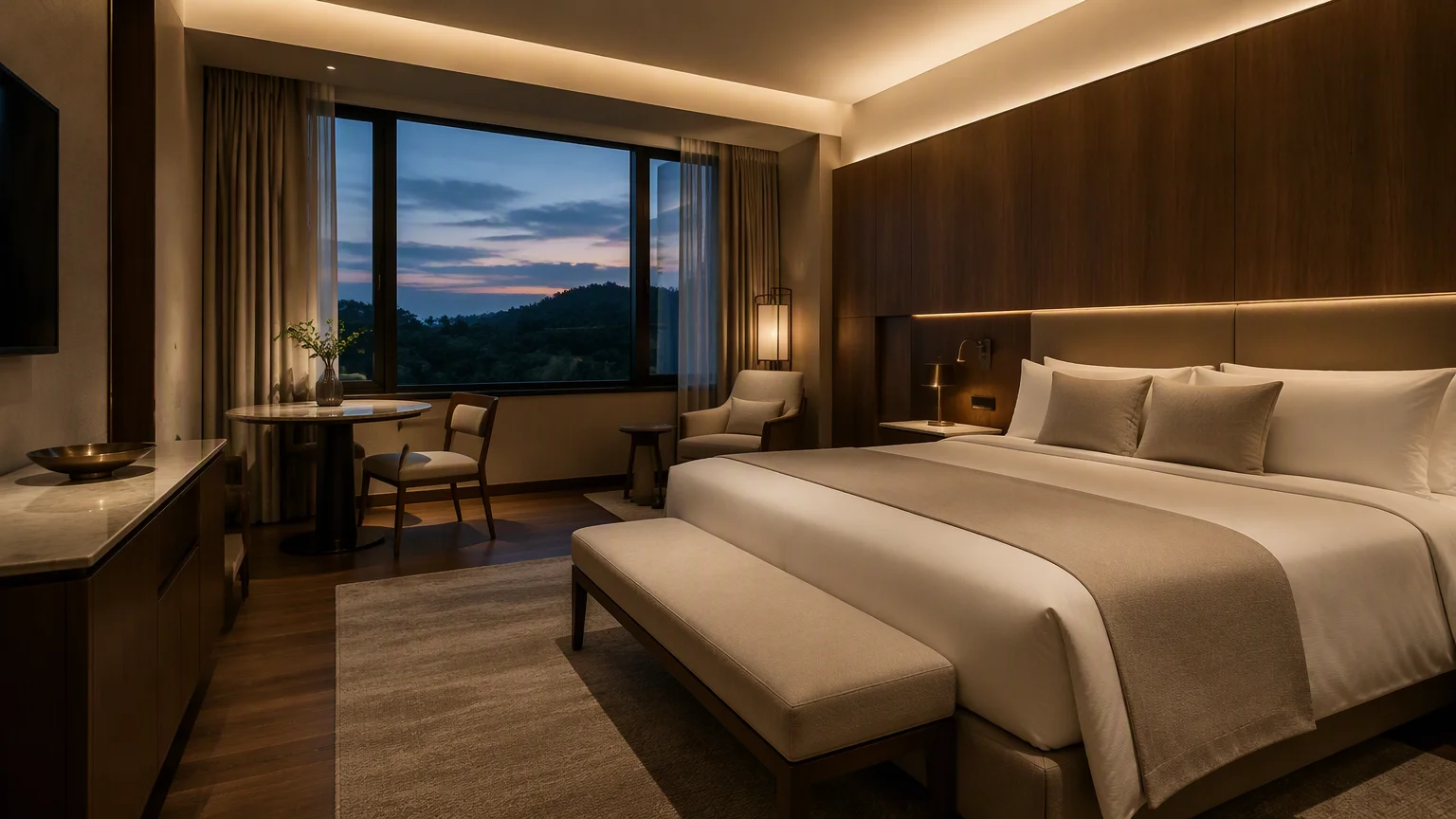
A hotel group publishes a prototype for a fully electric, near-zero operating emissions hotel, opens the design package to any owner who wants it, and lists LED lighting among the measures that make the numbers work. Nothing about the fixtures changed that week. What changed is who is allowed to decide.
For most of the last decade, lighting was a design discipline with an energy consequence. A brand standard said how a guestroom should look and behave, an energy consultant produced a model, and the two documents were reconciled late, usually by whoever was holding the value engineering sheet. What is new is that the sequence has reversed. In a growing number of brand programmes, the energy outcome is published first and the specification is expected to deliver it. Lighting is no longer a line item that contributes to a sustainability story after the fact; it is a line item in the model, with a number attached and a review attached to the number.
That shift is easy to read as good news for anyone selling LED fixtures. It is more accurate to read it as a change in what a quote has to prove. When energy performance is written into a brand’s prototype rather than into a project’s aspiration, the fixture package acquires an obligation it did not previously carry: it has to be defensible against a model built by somebody else, using assumptions the supplier never saw, and tested by a brand team that has already published its position.
This article sets out what such a prototype actually contains, why lighting appears on the checklist at all, what changes in the guestroom specification when energy becomes an acceptance item rather than a preference, and what a supplier should have ready before quoting into that environment. It looks at the problem from the factory side, because that is where the specification either survives contact with procurement or quietly dissolves into a cheaper substitute.
- 01What the Prototype Actually Says
- 02Why Lighting Appears on a Sustainability Checklist
- 03From Preference to Acceptance Item
- 04Lighting Power Density and the Whole-Building Model
- 05Controls Stop Being Optional
- 06The Spares and Replacement Question
- 07What the Prototype Does Not Tell You
- 08Writing an LED Guestroom Spec That Survives Review
- 09The Owner’s Side: Utility Cost and Payback Logic
- 10What to Ask Before You Quote
01What the Prototype Actually Says
The document that triggered this article is a design prototype issued by an international hotel group for a fully electric hotel with near-zero operational emissions. It is offered as an option rather than a mandate: owners and developers building new properties in the United States can adopt the prototype package instead of developing their own approach. That matters, because a prototype that owners are invited to take up has to be simple enough to be adopted by teams who are not energy specialists.
The published claims are projections from a model, not measured results, and they should be read that way. The group states that the design was modelled across thirteen United States cities, and that under that modelling it is expected to improve energy efficiency by around thirty percent, to reduce annual energy costs by a range of roughly eighteen to forty percent depending on location and operating assumptions, and to avoid on the order of four hundred and forty metric tons of operational carbon relative to a comparable conventional build. Those are the group’s own modelled expectations for its own prototype. They are not an industry benchmark, they are not a guarantee for any individual property, and they are not a claim that any single measure delivers them.
Set against that, the background figure is the more interesting one. The same body of work cites a utility cost increase across United States hotels of roughly twenty-eight percent over five years. That number is not a projection; it is a description of what has already happened to operating accounts. It explains why a brand would publish an all-electric prototype at all, and why it would publish it as a standard package rather than as a research project. When operating cost moves like that, the argument for a design standard stops being about marketing and starts being about the owner’s profit and loss statement.
The sustainable measures list attached to the prototype is where lighting enters. Alongside building envelope performance, roof and landscape strategy, water efficiency and a set of appliance and equipment selections, the list names LED lighting. It is one item among many, phrased without qualification, and that is precisely the point. LED lighting is not presented as an initiative or an upgrade. It is presented as part of the default condition of a hotel that works financially.
The rest of the commercial context is worth keeping in proportion. The brand in question operates several hundred properties of the prototype’s type with a comparable number in development, and its parent group operates several thousand hotels worldwide. A prototype offered at that scale is not an experiment; it is a template that will be copied into a large number of projects over a short period. Any supplier who wants to be in those projects is being asked to meet a standard that was written before they arrived.
02Why Lighting Appears on a Sustainability Checklist
Lighting is an unusual item to find next to a roof specification or a landscaping strategy, and it is worth understanding why it survives the editing process that every sustainability list goes through.
The first reason is arithmetic. In a guestroom, lighting is one of the few energy end uses that the design team controls completely and can measure independently of guest behaviour. Heating and cooling depend on weather, occupancy and how far a guest pushes a thermostat. Hot water depends on how long somebody stands in the shower. Lighting depends on the fixture schedule, the control strategy and the hours the space is used — all three of which are design decisions. When a model has to demonstrate a percentage reduction, it needs end uses whose consumption is a function of design rather than of luck, and lighting is the most predictable of them.
The second reason is that lighting is unusually easy to specify at the right time. A more efficient envelope is a change to the building; a different glazing specification is a change to the facade; both are expensive to revisit. A more efficient lighting package is a change to a schedule that is still being drafted. If a team wants to buy back some of the performance lost elsewhere in the model, the lighting schedule is one of the few places where that can still be done without reopening the architecture.
The third reason is visibility. A sustainability claim that a guest can perceive is worth more commercially than one they cannot. Efficient lighting is the measure a guest actually encounters, in the room where they spend the night. That is a legitimate driver, and it is why the lighting line on a checklist tends to be written plainly rather than buried in a footnote about equipment efficiency.
There is a fourth reason that suppliers tend to underestimate. Lighting is also a maintenance and replacement cost, and a brand publishing a prototype is thinking about the whole life of the building, not just the day it opens. A lighting package that reduces energy consumption but increases the frequency of replacement has moved cost from one column to another rather than removing it. Once a brand starts modelling operating cost over time, that distinction starts to appear in the questions its reviewers ask.
The practical consequence is that the lighting schedule is now read by two different audiences. The design team reads it for appearance, performance and coherence with the interior. The brand’s technical review reads it for energy consequence, controllability, serviceability and repeatability across a portfolio. A package that satisfies the first and ignores the second is the package that gets value-engineered at the last stage, and the substitution is usually not an aesthetic one — it is a functional one, in the driver, the dimming range or the construction.
03From Preference to Acceptance Item
The important change is not the presence of an energy target. Energy targets have existed in hotel briefs for years. The change is the transition from preference to acceptance item, and the two behave very differently in procurement.
A preference is satisfied by a proposal. If a brief says that energy efficiency is desirable, a supplier satisfies it by offering an efficient product, and the conversation ends when the efficiency is plausible. Ambiguity is tolerable because the requirement was never sharp. An acceptance item is satisfied by evidence. If the same requirement is an acceptance item, the supplier is expected to demonstrate something specific about the product, in a form the buyer can file, and the review process has a step whose purpose is to check that the demonstration exists.
In practice, four things move from the design conversation into the product conversation when this happens.
Connected load becomes a specified quantity. A preference treats the wattage of a fixture as an attribute. An acceptance item treats the total connected load of the guestroom lighting package as a figure that the package is expected to meet, and the reviewer will add it up. What matters to a supplier is that the figure is met by the standard product, not by a specially selected sample. A range with a low-power option for the tender and a higher-power equivalent for production is the single most common way a package fails at this stage.
Dimming behaviour becomes verifiable. It is one thing to state that a fixture dims; it is another to state down to what level, with what curve, and how the light behaves in the bottom third of its range. Once a control strategy is part of the energy story, the behaviour of the fixture at low output is part of the package’s performance, not a matter of taste. The subject is treated in more depth in our guide to dimming behaviour in the guestroom and in scene design by the numbers.
Colour temperature becomes a design decision with a performance consequence. A warm room is not merely atmospheric once the lighting package is being reviewed as part of a model. Efficiency and warmth pull against each other in most real ranges, and a specification that promises one without acknowledging the other produces either a room that is warmer than intended or a package that is less efficient than quoted. The trade-off is set out in our guide to colour temperature in hotel lighting.
Serviceability becomes part of the argument. If the justification for a lighting package is an operating cost outcome over time, then the package has to stay in the state it was commissioned in. A fixture whose driver cannot be replaced without removing the ceiling has an operating cost that appears later and does not appear in the model. Reviewers who have been through one bad service experience ask about this, and suppliers who have an answer are at an advantage.
None of these four is a new requirement invented by a brand. Each is the ordinary product consequence of a target that now has to be defended. The suppliers who struggle are not the ones whose products are inefficient; they are the ones whose documentation does not answer the question that has been asked.
04Lighting Power Density and the Whole-Building Model
The mechanism through which a prototype reaches the fixture schedule is almost always a power allowance rather than a product requirement. The model allocates a budget of electrical power to each area of the building, and the lighting design has to fit inside its share of that budget. Lighting power per unit of floor area is the usual form, sometimes expressed as a target for the building and sometimes as a set of area-specific allowances that differ between guestrooms, corridors, back-of-house and the public areas.
An allowance of that kind is a different kind of requirement from a product specification, and it changes what a supplier should be able to say. The buyer is not asking whether a fixture is efficient; the buyer is asking whether a schedule of fixtures, in the quantities the design calls for, will fit. That question cannot be answered by any single product datasheet. It can only be answered by a complete package: the quantity of each type, the wattage of each type, and the way the control strategy reduces the hours at full output.
Three practical consequences follow, and all three are matters of how a quotation is assembled rather than how a fixture is designed.
First, the package has to be quotable as a package. A supplier responding to a power allowance with a set of individual product options has handed the buyer an integration problem. A supplier responding with a schedule showing the total connected load of the guestroom set, per room and per room type, has answered the question that was actually asked. This is a small amount of work and it is disproportionately persuasive, because it is the form in which the reviewer needs the answer.
Second, the headroom has to be honest. Every lighting package contains a few fixtures whose contribution is optical rather than functional — a deep graze, a wall wash, a decorative element in the entry. These are the fixtures that make the room feel designed, and they are also the ones whose wattage is easiest to understate in an early draft. A package that meets its allowance only by assuming optimistic figures for the decorative layer will fail the review, and it will fail late, after the design is politically committed. Filling in the hard numbers during the specification phase, even when they are unflattering, is cheaper than defending them later.
Third, the relationship between the lighting allowance and the rest of the model has to be respected. In a design where the envelope performs better than the baseline, the lighting allowance may be generous; in a design where the glazing or orientation is difficult, the lighting allowance absorbs some of the shortfall. A supplier who understands where their package sits in that balance can propose a reduction in the right place at the right moment. A supplier who treats the allowance as a fixed given can only offer to make things cheaper, which is a much weaker position.
There is a subtler point about the whole-building model that is worth raising with owners early. A model that treats lighting as a single figure rewards the average rather than the room. Guestrooms, corridors and public areas have very different load profiles and very different occupancy hours, and a lighting design that is efficient in the spaces that are occupied all night matters more to the outcome than one that is efficient in a space that is empty. Suppliers who can talk about where the hours actually are — corridors, back-of-house circulation, night-time guestroom use — are contributing to the model rather than reacting to it.
05Controls Stop Being Optional
The single largest difference between a lighting package that meets an energy target and one that does not is almost never the lamp. It is the control strategy, and in a prototype-driven project the control strategy stops being a comfort feature and becomes part of the compliance package.
This has an uncomfortable consequence for the way guestroom lighting is usually specified. A conventional guestroom specification describes fixtures and leaves control to a separate scope, often owned by the building management or room control contractor. When energy performance is an acceptance item, that separation becomes a liability, because the fixture has to be built to accept the control that the other scope will impose. A fixture that cannot be dimmed to the required floor, or that behaves badly at the bottom of its range, is a defect in the lighting package even though the control decision was made elsewhere.
Four control behaviours recur in this context, and each places a demand on the fixture rather than on the control system.
The dimming floor. Many control strategies rely on the ability to hold a room at a low output for long periods, particularly overnight in corridors and at late hours in guestrooms. The relevant property of the fixture is not its nominal dimming range but whether the light remains usable and colour-stable near the bottom of that range. A fixture specified as dimmable that turns green, flickers or drops out below a certain level will force the control strategy to be rewritten, which is a schedule problem, not a product problem.
The curve. Perceived dimming is not linear in electrical terms, and a control system configured for one dimming curve will behave differently with a driver configured for another. This is the most common cause of a room that feels wrong after commissioning despite everything testing correctly in isolation. The subject is covered in our guides to guestroom lighting controls and to the types of control available; the point here is that the fixture and the controller have to be specified as one system.
The off state. A control strategy that switches a circuit off must leave the room in a state a guest can recover from without help. For the lighting package this means that the fixture’s driver has to start reliably and at a predictable level after a clean power interruption, and that any fixture intended to hold a memory of its last state does so consistently. Inconsistent behaviour after a switch-off was one of the most common complaints in the generation of hotel rooms that introduced aggressive key-card control without coordinating it with the lighting specification.
The interface. Whether the guest operates the lighting through a wall panel, a bedside keypad, a scene button or the room control platform, the fixture sits at the end of a command chain. What the fixture needs is a defined input and a documented behaviour for each input. What it does not need is to be the place where an unresolved interface question gets discovered, which is what happens when the control scope is awarded after the lighting package has been frozen.
The general principle is worth stating plainly because it is so often violated. In a project where lighting is part of an energy commitment, control is not a separate scope. It is a property of the fixtures, and it should be specified with them, quoted with them, and handed over with them. A prototype-driven project has already accepted that logic; a supplier who has not will find the gap at commissioning.
06The Spares and Replacement Question
A sustainability prototype is a statement about a portfolio over time, and that is why the spares question arrives earlier than it used to. A brand publishing an all-electric design is not only describing a building; it is describing a maintenance regime across many buildings of the same type, and the lighting package is one of the components that regime has to cover.
The issue is structural rather than financial. An efficient lighting package is usually a tightly specified one: a small number of fixture types, a specific output, a specific colour temperature, a specific driver. That tightness is exactly what makes the package efficient, and it is also what makes substitution difficult. When a component is replaced in year four by an equivalent that is close but not identical, the guestroom drifts. Five years later, a corridor of rooms has three subtly different whites, and the property has an appearance problem that no amount of cleaning will fix.
Three practices reduce that risk, and all three are the supplier’s to propose.
Batch identity. Where a fixture uses a component whose appearance or output can vary between production batches — and this is the normal case for light sources and for any material that transmits light — the spares held for a project should come from the same batch as the installed units. This is a manufacturing and logistics commitment, not a design one, and it is cheapest to make at the time of the order.
A stated substitution rule. The property manager needs to know what may be replaced with what. A short document that names, for each fixture type, the properties that must match for a replacement to be acceptable, is more useful than a promise that parts will be available. The distinction matters because a promise that cannot be kept becomes a dispute, while a rule can be applied by whoever is standing in the corridor.
Access designed in. The most efficient fixture in the world is not efficient if the ceiling has to be opened to change a driver. Where a lighting package is justified on operating cost, the access route for maintenance is part of the cost. The subject is dealt with in more detail in our guide to cleaning and access routes, and it applies to recessed guestroom fittings just as much as to a lobby installation.
There is a wider point about the relationship between efficiency and durability that suppliers should be prepared to discuss honestly. Pushing a light source harder to reach an output target from a smaller package tends to shorten its life and increase the heat it produces, which is a maintenance cost later. There is nothing wrong with designing for a shorter service interval if that interval is stated and the property has planned for it, but it must not be discovered by the maintenance team. Reviewers who have been through one round of unexpected replacement ask about this directly.
07What the Prototype Does Not Tell You
It is as important to be clear about the limits of a prototype document as about its contents, because treating a prototype as a complete specification is a reliable way to lose a project.
A prototype is a design package for a building type. It is not a room schedule, it is not an interior design, and it is not a brands’ guest-experience standard. The lighting measures it names are the ones that affect its modelled outcome. The measures that affect how a room feels — the layering, the graze, the warmth of the surface the light lands on, the relationship between the fixtures and the joinery — are left entirely to the project. Those are the decisions the interior design team owns, and they are the decisions that determine whether the finished room reads as the brand intended.
That division has a practical consequence for how a supplier should read the document. The prototype tells you the envelope within which the lighting design must fit. It does not tell you what to design. A supplier who arrives with a solution already shaped by the prototype’s efficiency language, and no response to the interior brief, has answered the easier half of the question.
The second thing a prototype does not do is describe local conditions. A package modelled across a set of cities is by definition a package of averages. The actual project has a specific orientation, a specific climate, a specific utility tariff and a specific guest mix. Those are the variables that determine which part of a modelled range a given property will land in, and they are the ones an owner’s team will ask about. A supplier who can hold a conversation about the difference between a north-facing room in one city and a west-facing room in another is more useful to that owner than one who repeats the headline numbers.
The third thing a prototype does not do is bind the project’s procurement. A brand may publish an energy position and still accept a package that approaches it differently, provided the approach is explicable. What a prototype does is establish the terms of the argument: what has to be measured, what has to be documented, and who has to be satisfied. Suppliers who lose projects against a prototype usually lose them at the documentation stage rather than at the product stage.
The last limit is the most easily overlooked. A prototype describes a new-build or major-redevelopment condition. Most of the hotel rooms that will be lit in the coming decade are not new. They are refurbishments of existing buildings, and the relevant question there is not how to meet a modelled target from a blank sheet but how to replace what is there without reopening the walls. That is a different engineering problem, and it is dealt with in our guide to what actually gets replaced in a retrofit.
08Writing an LED Guestroom Spec That Survives Review
Everything above describes an environment. This section describes the document that operates in it. A guestroom lighting specification written for a prototype-driven project looks different from one written for a project where lighting is purely a design matter, and the differences are structural rather than stylistic.
State the allowance the package must meet, in the unit the model uses. If the project is modelled on power per unit of area, the specification should say so and should give the package’s total in the same unit. If it is modelled on hours of operation at a given output, the specification should describe the control strategy that produces those hours. A specification written in a different unit from the model is a specification that cannot be checked, and an uncheckable specification gets replaced by whatever is easiest to check.
Separate the fixed from the negotiable, in writing. A reviewer under time pressure will optimise whatever is not explicitly protected. The specification should therefore name the properties that are load-bearing for the energy outcome — the input power, the dimming floor and curve, the control input, the maintenance access — and identify the properties that may reasonably vary. This is the same discipline described in our guide to reading a design brief as a factory does, applied to the technical half of the package rather than the visual half.
Describe the two states of every material that transmits light. Where the package includes a stone, glass or fabric diffuser, the specification should describe its appearance both lit and unlit. This is not primarily an energy requirement, but it is the property most often discovered late, and a package revised after the interior has been photographed is an expensive package. The same principle is covered in our guide to the indirect lighting specification.
Define the guest’s minimum. A specification that pursues efficiency without stating a floor for what the guest must be able to do in the room will be optimised until it fails. The floor is simple to state: a usable reading condition at the bed, a safe path from the bed to the bathroom at night, and a way to hold the room at a low level without the guest searching for a switch. Once stated, those three items constrain the package in ways that are easy to check and hard to argue with.
Price the specification, not the options. A quotation that presents three grades and invites the buyer to choose is not a quotation for a project with an acceptance item. It is a menu, and menus get resolved by whoever has the least information. A specification-supported quotation presents the package that meets the requirement, with the figures that demonstrate it, and a clearly marked alternative that meets it differently.
Two habits distinguish suppliers who work well in this environment from those who do not. The first is producing the compliance evidence without being asked, in the first response. The second is naming the one thing in the package that is most likely to change before the order, and offering to resolve it early. Both are cheap. Both are remembered, because both reduce the reviewer’s workload.
09The Owner’s Side: Utility Cost and Payback Logic
Energy performance in a prototype protects the brand’s position. What protects the owner’s position is the operating account, and the two are not always served by the same decisions. A supplier who can speak to both is more useful in the room where the decision is actually made.
The relevant fact is the one cited on the prototype’s own background page. Utility costs for United States hotels rose by roughly twenty-eight percent over a five-year period. That is a movement in the cost of operating a building, and it changes the arithmetic of every choice in the lighting package, including the ones that look like small savings.
The consequence for lighting is that the interesting question is no longer the first cost. It is the shape of the cost over the period the owner expects to hold the asset. A package that costs slightly more and consumes less is easy to justify in that frame; a package that costs slightly less and consumes more is not, once the owner’s finance team has done the arithmetic on a rise of that magnitude. What suppliers should be ready to produce in that conversation is a simple, honest comparison: the annual difference in consumption, priced at the property’s actual tariff, and the number of years it takes for the difference to recover the incremental first cost.
That comparison is more persuasive when it is built from the owner’s numbers rather than from average ones. A hotel in one market pays a materially different rate from a hotel in another, and a hotel with high public-area occupancy has a different consumption profile from one that is largely a sleeping product. Asking for the tariff and the occupancy assumption before producing the comparison costs one email and changes the quality of the answer.
There are also two costs that owners routinely omit and suppliers can name. The first is the cost of the replacement cycle, which appears in year three or four and is invisible in a first-cost comparison. The second is the cost of a specification change after the order, whether because the interior has been revised or because a control requirement surfaced late. Both are predictable, both are affected by decisions in the lighting package, and both are easier to discuss before the order than after it.
Finally, it is worth being clear about what a lighting package cannot claim. A prototype may reduce energy costs by a modelled range across many buildings; an individual fixture package is not entitled to a share of that headline. The defensible statement is the modest one: this package consumes this much, the alternative consumes that much, the difference is this many units of energy per year, and at the property’s tariff that is this much money. That statement survives scrutiny. The inflated version of it does not, and it damages the supplier who makes it.
10What to Ask Before You Quote
Most of the avoidable difficulty in a prototype-driven lighting package can be removed by six questions asked before the quotation is written. They are worth listing because they can be sent in a single message, and because the answers determine the shape of everything that follows.
What is the power allowance, and in what unit is it expressed? Knowing whether the project is modelled on connected load, on power per unit of area, or on hours of operation at a given output determines how the quotation should be structured. Without this, the supplier is guessing at the reviewer’s test.
What control strategy is assumed, and who owns the control scope? If the control strategy was assumed by the energy model and the control scope belongs to another package, the fixture has an obligation it has not been told about. Resolving the ownership of that interface early is the single highest-value question in the list.
What are the dimming floor and the intended curve? These determine whether a candidate fixture actually qualifies, and they are usually answerable in one line by whoever wrote the control specification.
What is the access route for maintenance, and who is expected to service the fixtures? The answer determines whether a recessed fitting can be specified at all, and it determines the spares and substitution strategy.
What is the property’s utility tariff and expected holding period? These turn an efficiency claim into a financial one, and they make the difference between a quotation that participates in the owner’s decision and one that sits beside it.
Which parts of the design are already fixed? A fixture position that cannot move, a ceiling construction that cannot be opened, a material that has already been specified next to the light — each of these constrains the package more than any efficiency target does, and each is cheaper to learn now than later.
A supplier who asks those six questions has done something more useful than demonstrating efficiency. They have demonstrated that they understand what the project is being asked to prove. In a market where brands are publishing energy prototypes and handing them to owners as a template, that understanding is the scarce commodity. The fixtures are available from many factories. The ability to make a lighting package defensible is not.
For the sequence that follows once those answers exist — drawing, sample, approval, production — our guide to taking a fixture from sketch to sign-off sets out the stages, and structuring a lighting RFQ brief covers the information a supplier needs at the enquiry stage. This article has been concerned with the step before both: understanding what the energy commitment makes the fixture package responsible for.
Source note: the technical statements in this article about power allowances, dimming behaviour, control interfaces, serviceability and operating cost describe general industry practice and are given as experience-based guidance rather than as requirements of any standard; where a project is subject to a named regulatory regime, the applicable requirements must be confirmed with its own consultant and authority having jurisdiction. The prototype referred to is summarised on a de-branded basis, and the performance figures quoted are that programme’s own modelled projections rather than measured results or industry benchmarks. Property and market references are given at country or region level only. This article contains no product, brand or project endorsement.
Frequently Asked Questions
Does an energy prototype change the fixtures a hotel can use?
Not directly. A prototype typically reaches the guestroom specification as a power allowance and a set of control behaviours rather than as a list of approved products. What it changes is the evidence that accompanies a quotation. A fixture package that meets an allowance on paper but cannot demonstrate it in the format the reviewer uses will be substituted regardless of how good the hardware is.
Why is the control strategy more important than the lamp for meeting an energy target?
Because consumption is a function of output multiplied by time, and the control strategy is what governs the second half of that product. A marginally less efficient package that holds low output for long unoccupied periods frequently outperforms a marginally more efficient one that runs at full output. This is also why control cannot be treated as a separate scope from the fixtures: the fixtures have to be built to accept it.
What is the most common reason a lighting package fails a brand’s technical review?
Missing documentation rather than poor hardware. Reviews ask for connected load in a specific unit, a stated dimming floor and curve, a maintenance access route and a substitution rule. Packages that reduce to a set of product options, without a schedule total or a behaviour statement, tend to be returned for information and then quietly optimised by someone else.
Should spares be specified at the time of order?
Yes, where the appearance or output of a component can vary between production batches. Holding spares from the same batch as the installed units is the only reliable way to keep a corridor or a room type visually consistent across the life of the property. It is also cheapest to arrange at the point of order rather than afterwards.
Can a prototype’s headline savings be quoted for an individual hotel?
No. A prototype’s figures are modelled projections across a set of locations and operating assumptions, published for the programme as a whole. An individual property can only be discussed in terms of its own connected load, its own control strategy, its own utility tariff and its own occupancy pattern. Substituting a headline percentage for that calculation is the fastest way to lose credibility with an owner’s finance team.
Specifying Lighting Into an Energy Commitment?
Send us the power allowance and the unit it is expressed in, the control strategy the model assumes, the dimming floor and curve required, the ceiling construction and maintenance access route, and the fixture positions that cannot move. We will return a guestroom package with its connected load stated in your unit, a behaviour statement for the dimming and control inputs, a service and substitution note, and a clearly marked alternative that meets the requirement differently.
Our guides to lighting to a brand standard during conversion and to pipeline timing cover the surrounding procurement sequence.


