
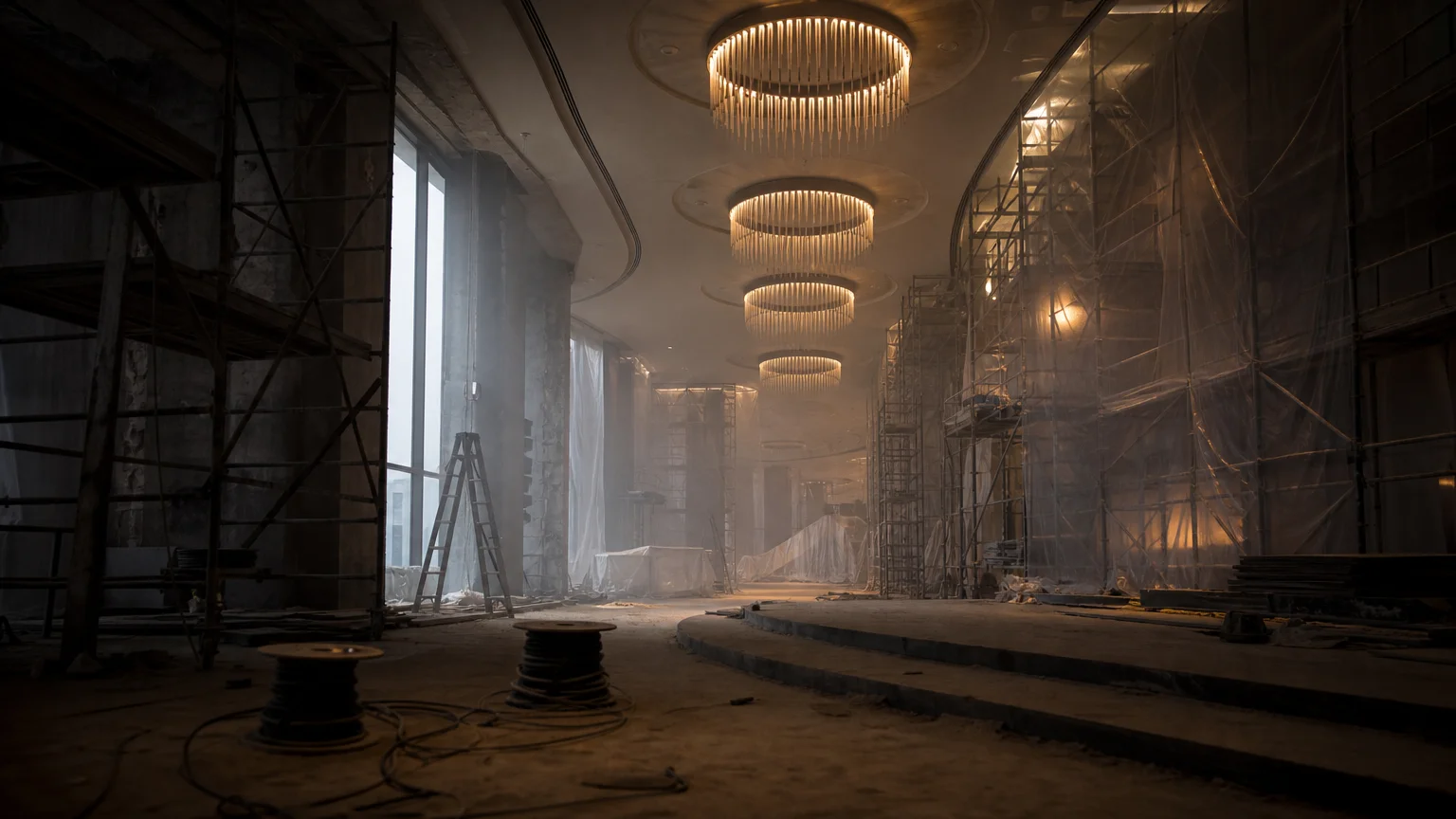
A hotel pipeline is usually read as a market signal. Read properly, it is a calendar. The published totals say far less than the way they split across project stages, because each stage sits at a different distance from an order and calls for a different action this month.
Most suppliers read pipeline data the wrong way round: they note that a market is growing and carry on quoting whatever arrives in the inbox. A total of several hundred thousand rooms spread across projects that will not break ground for three years is a future workload, not a schedule that can be staffed today. What converts the statistic into an operating plan is the split by stage.
The second reason to work from stage rather than from total is that almost every avoidable problem in hotel lighting is a timing problem rather than a technical one. A scheme specified late is bought on whatever lead time is left, and a mock-up built after the ceiling grid is fixed can be judged on finish but not on beam. Those are calendar failures, and they surface in pipeline data long before anyone places an order.
- 01Why pipeline data works as a procurement calendar
- 02Window one: early planning, before the design is fixed
- 03Window two: under construction, coordination and the mock-up
- 04Window three: scheduled to start within twelve months
- 05Window four: renovation and brand conversion, block by block
- 06The four windows side by side
- 07What the Q3 2026 forecasts say about the 2027 load
- 08Reading the data without overreading it
01Why Pipeline Data Works as a Procurement Calendar
A hotel construction pipeline is reported in three stages that together account for the whole of the reported total. Early planning covers projects still being designed and financed; scheduled to start within twelve months covers projects with a start date; under construction covers projects that have broken ground, and renovation and brand conversion is reported separately because it behaves differently. Those stages are defined by milestones, and the milestones — design freeze, mock-up, ceiling closure, handover — are the joints at which a lighting package either fits the programme or bends it.
| Pipeline stage | Asia Pacific excluding China (Q2 2026) | Latin America (Q2 2026) | What it means for a fixture order |
|---|---|---|---|
| Total pipeline | 2,506 projects / 452,972 rooms, up 17% in projects and 11% in rooms year on year | 759 projects / 111,340 rooms | Market size only, not a workload |
| Early planning | 1,119 projects / 181,397 rooms, up 26% in projects and 25% in rooms | 303 projects / 40,351 rooms, up 22% in projects and 17% in rooms | Specification influence and budget allowances; no order is placed here |
| Scheduled to start within 12 months | 398 projects / 72,213 rooms | 172 projects / 27,149 rooms | Specification lock, mock-up scheduling, RFQ briefs, lead-time confirmation |
| Under construction | 989 projects / 199,362 rooms | 284 projects / 43,840 rooms | Live orders, submittals, mock-up approval, sequenced delivery |
| Renovation and brand conversion | 346 projects / 58,429 rooms, up 36% in projects and 25% in rooms | 159 projects / 27,763 rooms, with conversion volume at a record high | Fast-cycle replacement demand, phased by block |
Two features of that data change how a supplier should use it. The pipeline is growing but top-heavy: early planning holds 1,119 projects and 181,397 rooms in Asia Pacific excluding China, 45 per cent of the whole and a record share, while the stage closest to an order is a quarter of its size. And replacement work is expanding faster than new build, with renovation and brand conversion up 36 per cent in projects in Asia Pacific excluding China.
02Window One: Early Planning, Before the Design Is Fixed
Early planning is the window most suppliers skip and the one where participation costs least. The design is still developing, the schedule is incomplete, and the decisions that later become expensive — one colour temperature or two, an integrated or a surface-mounted reading light, a continuous cove or a regular fitting rhythm — are still open. Nothing can be sold here; everything can be influenced here.
The case for working this stage is arithmetic. A project that leaves it with a buildable concept, a priceable schedule and an allowance that reflects the specified performance reaches the twelve-month window with a tender that can be run normally; one that leaves with an aspirational concept and no allowance arrives in a hurry, which is when substitution pressure begins.
- Build the schedule structure early. Define each fixture by the fields a supplier needs to price and build — application, mounting, dimensions, finish, output, colour temperature, control. Our note on the seven fields a fixture schedule needs sets out the minimum.
- Discuss lead-time drivers at concept stage. Lead time is a budget input, not a delivery detail: it decides how many sample rounds fit before the ceiling closes.
- Fix the lighting identity early. Colour temperature consistency across guestroom, corridor and public areas narrows the supplier field and the price band together.
- Set an allowance that reflects performance, and note when a mock-up room could realistically be built.
The characteristic failure is impatience: waiting for a tender document, then competing on price against a document someone else helped write.
03Window Two: Under Construction, Coordination and the Mock-Up
Under construction converts a pipeline entry into an order, and it is the largest block of near-term demand: 989 projects and 199,362 rooms in Asia Pacific excluding China, and 284 projects and 43,840 rooms in Latin America at the close of the second quarter of 2026. Those packages are being ordered, approved and delivered against a programme already running, so the questions here are about sequence.
Three activities define the window. The mock-up room is where the scheme stops being a drawing. Services coordination matters because the guestroom ceiling void is shared with ductwork, sprinkler and drainage runs and access panels, and a fixture designed for a deeper void is not a minor variation. And the submittal cycle is where programmes run long, since it depends on two parties who are not on the same site.
Treat the mock-up as a test of the specification, not a sample of the product. It should settle beam behaviour at the real bed, desk and wall positions; colour temperature consistency between guestroom and corridor, which only becomes visible when both are installed together; finish against the actual joinery and textiles; void depth and the maintenance route, since the party who services a fitting is not the party who installs it; and dimming behaviour at the wall plate.
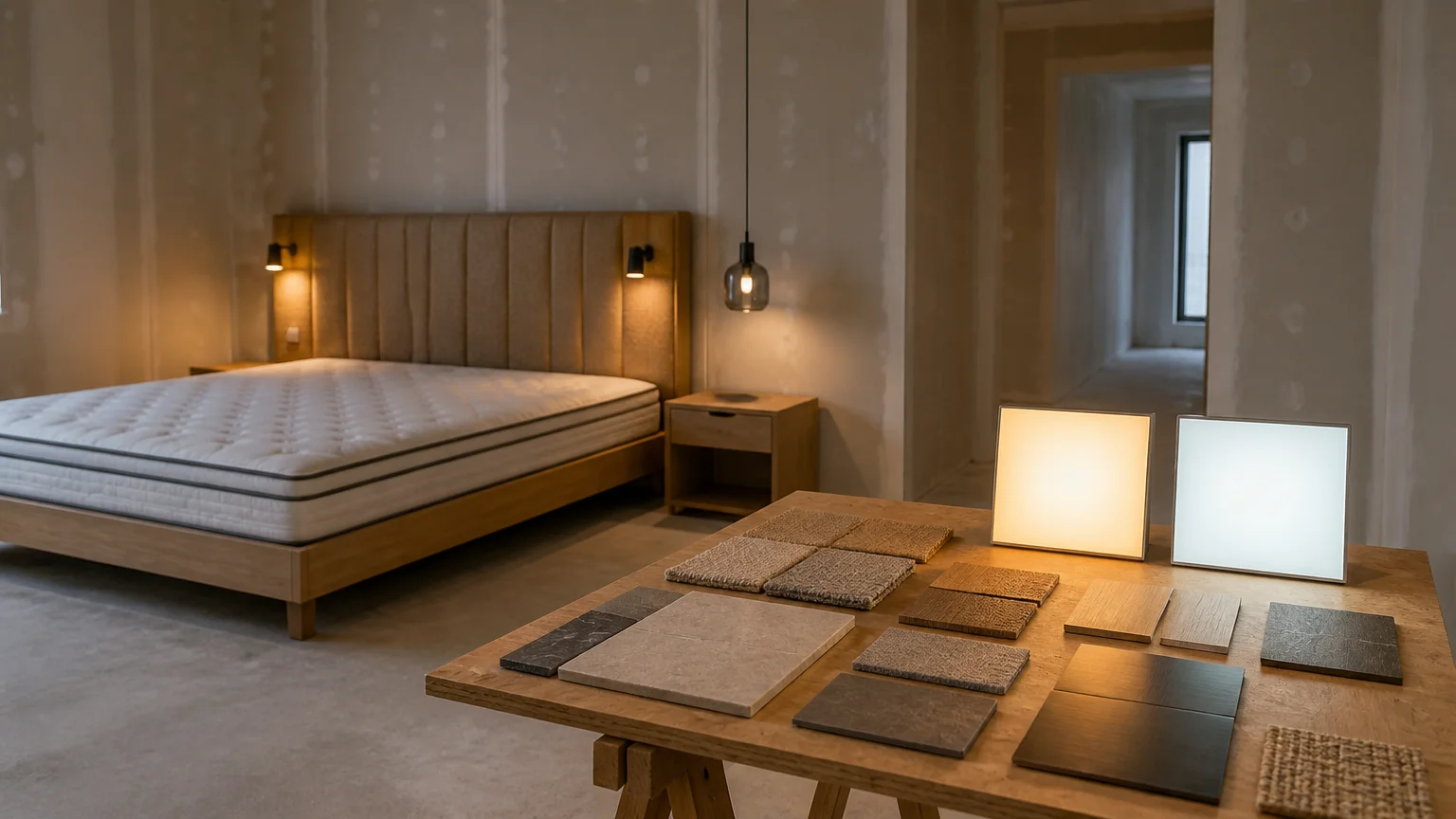
The mock-up is also a gate, and gates consume programme float: our guide to evaluating samples and mock-up rooms covers how to structure the assessment so the room produces decisions rather than impressions.
Production planning then follows, and this is where hospitality lighting project timing is either honest or decorative. A guestroom floor is a delivery sequence, not a single shipment: fittings are released in batches that match the finishing trades, and nothing arrives after the ceiling is closed. The approval chain must close before production starts, and the manufacturing calendar includes the annual pause around Lunar New Year, which falls in the first quarter of 2027. Our note on supply planning around Chinese New Year 2027 explains how that pause moves the order cut-off.
04Window Three: Scheduled to Start Within Twelve Months
The twelve-month group is the most commercially significant stage in the pipeline and the most often misread. At the close of the second quarter of 2026 it held 398 projects and 72,213 rooms in Asia Pacific excluding China, and 172 projects and 27,149 rooms in Latin America. The design is largely complete, a start date exists, and the order has not been placed.
The mistake is reading a twelve-month start date as available time. There is time for the building; there is much less for the lighting, because the lighting clock starts earlier: a package installed in month fourteen is normally ordered in month two. By the time a project in this stage breaks ground, the specification, the sample references and the budget have usually been shaped around one supplier’s product. By then the hotel FF&E procurement timeline has almost no slack left in it.
- Lock the specification while alternatives are still cheap. At concept stage a substitution is a line in a schedule; at this stage it is a variation.
- Issue a brief that can be priced, with quantities by type, the performance criteria that matter, finishes, mounting constraints and site location. Our RFQ brief guide sets out what to include.
- Schedule the mock-up before the tender closes, so visual approval and commercial evaluation run together rather than in sequence.
- Confirm the lead-time drivers rather than a lead-time number, and decide whether delivery is floor by floor or a single release. Our explanation of how hotel lighting lead times are built up covers the sequence behind the figure.

05Window Four: Renovation and Brand Conversion, Block by Block
Renovation and brand conversion is the least understood window, because it does not behave like construction. In Asia Pacific excluding China it reached 346 projects and 58,429 rooms at the close of the second quarter of 2026, up 36 per cent in projects and 25 per cent in rooms year on year; in Latin America, 159 projects and 27,763 rooms. Separately, a published news headline indicates that the Gulf Cooperation Council region is reported to be adding close to 126,000 hotel rooms by 2030, taking total supply to 616,000 keys; that figure comes from the headline of a published report rather than from a verified report body, and is cited only as an indication of scale.
Two things make this window structurally different. The property is usually trading, so work is phased by block or wing and the package arrives in tranches rather than in one release. And the specification often starts from a brand standard applied to an existing building, with existing ceiling heights, void depths and electrical positions, so feasibility is settled before aesthetics, which is why the hotel renovation pipeline 2027 load is planned differently.
- Quote per tranche. Establish how many blocks will close and in what order, and size the first release to the first block; a quotation built on the whole property is unusable if the operator intends to buy in four parts.
- Audit the existing conditions that constrain fit — void depth, ceiling construction, cut-outs, switching and service positions — before any fixture family is proposed.
- Standardise the guestroom arrangement and repeat it. Our guide to guestroom lighting in renovations sets out what should be identical in every room and what may vary.
- Keep corridor and guestroom in one package, and hold a spares allowance from the first tranche, because the fittings installed first will need replacements before the last block is complete.
06The Four Windows Side by Side
| Timing window | Pipeline stage (Q2 2026) | What the supplier should be doing now | The common failure |
|---|---|---|---|
| Window one — early planning | Early planning: 1,119 projects / 181,397 rooms in Asia Pacific excluding China; 303 / 40,351 in Latin America | Shape the schedule and the allowance, argue for buildable performance | Waiting for the tender, then competing on price against a document someone else wrote |
| Window two — under construction | Under construction: 989 / 199,362 in Asia Pacific excluding China; 284 / 43,840 in Latin America | Run the mock-up as a technical gate, coordinate void and mounting, sequence delivery | Treating the mock-up as a style review, and meeting the void after ceiling closure |
| Window three — start within twelve months | Scheduled to start within 12 months: 398 / 72,213 in Asia Pacific excluding China; 172 / 27,149 in Latin America | Lock the specification, issue a priceable brief, run the mock-up alongside evaluation | Mistaking a twelve-month start date for available time |
| Window four — renovation and conversion | Renovation and brand conversion: 346 / 58,429 in Asia Pacific excluding China; 159 / 27,763 in Latin America | Quote per tranche, audit existing voids and positions, standardise the guestroom arrangement | Planning one large shipment for a programme bought block by block |
07What the Q3 2026 Forecasts Say About the 2027 Load
Pipeline stages describe projects; forecasts describe the trading conditions those projects open into. The Q3 2026 global market forecast assumptions published by CoStar and STR on 31 August 2026 cover 59 markets across Europe, the Middle East and Asia Pacific for the period 2026 to 2030. Across the 31 European markets covered, revenue per available room is forecast to grow 1.2 per cent in 2026, driven mainly by a 0.8 per cent average daily rate, with aggregated occupancy expected to be flat; for 2027 the Q3 edition cut its forecast to −0.1 per cent, from +0.2 per cent in the May edition.
Forecast supply growth across those markets averages 2.3 per cent in 2027 — the highest since 2022, when it was 2.4 per cent — and the range runs from close to 0.0 per cent in Barcelona to 8.1 per cent in Dublin. Fifteen markets are projected to add supply at more than 2 per cent, and 10 of those are also expected to see occupancy decline. Aggregated occupancy across the 31 markets is expected to hold at 76 per cent in 2027, with Frankfurt the lowest at 62.8 per cent and Gatwick the highest at 86.7 per cent.
Across 16 Asia Pacific markets, the 2026 revenue-per-available-room outlook was cut from +4.4 per cent to +3.9 per cent, all of it coming from occupancy at +0.7 per cent, while the average daily rate forecast was raised to +3.2 per cent; 2027 growth is forecast at 2.7 per cent, matching the 2.7 per cent projected across the six mainland China markets covered. In the Middle East, Jeddah is forecast at −4.9 per cent for 2026, largely attributed to supply rising 7.2 per cent in the second half of the year, with more than 2,300 new rooms expected there next year, while Riyadh is forecast at +18.6 per cent; for 2027, Abu Dhabi is projected at 75.4 per cent occupancy and Dubai at 72.4 per cent.
| Year | Openings expected, Asia Pacific excluding China | Openings expected, Latin America | What it says about the near-term load |
|---|---|---|---|
| 2026 | 148 projects / 20,594 rooms opened in the first half, with a further 236 projects / 41,217 rooms expected in the third and fourth quarters | 104 projects / 16,920 rooms across the full year | Committed and largely ordered; the remaining work is delivery |
| 2027 | 374 projects / 68,396 rooms | 114 projects / 16,516 rooms | The order book being written now sits mainly in this year |
| 2028 | 363 projects / 59,659 rooms, first forecast | 123 projects / 15,607 rooms | Early planning flows into this year; participation now is influence, not orders |
08Reading the Data Without Overreading It
- Keep the source and the measurement date attached. The pipeline figures above come from Lodging Econometrics, published on 6 August 2026 for Asia Pacific excluding China and on 30 July 2026 for Latin America, both measured at the close of the second quarter of 2026; the forecasts come from the CoStar and STR assumptions for the third quarter of 2026, published on 31 August 2026.
- Never present a forecast as an outcome. Projected supply growth of 2.3 per cent across European markets in 2027 is a forecast, and the same publisher cut its own 2027 European revenue-per-available-room figure from +0.2 per cent to −0.1 per cent between two editions of the same document.
- Label anything taken from a headline, as with the Gulf Cooperation Council figure above, which is reported only as a published headline.
Frequently Asked Questions
What are the four timing windows in a hotel lighting project?
The stages a project passes through, drawn from the way pipeline data is reported: early planning before the design is fixed; under construction, where the mock-up and services coordination happen; scheduled to start within twelve months, the specification-lock and sample window; and renovation or brand conversion, which runs block by block in a trading building.
Which window matters most commercially?
The twelve-month group, because the design is largely complete and the order has not been placed: 398 projects and 72,213 rooms in Asia Pacific excluding China, and 172 projects and 27,149 rooms in Latin America in the second quarter of 2026.
Why does early planning matter if no orders are placed there?
Because it is where the decisions that constrain everything later are still open. The stage reached 1,119 projects and 181,397 rooms in Asia Pacific excluding China, 45 per cent of that pipeline and a record share, and 303 projects and 40,351 rooms in Latin America.
Why is renovation and brand conversion treated separately?
Because the building is usually trading, so the package arrives in tranches; because the specification often starts from a brand standard applied to an existing building; and because the timetable is fixed by an agreed date rather than a construction start. The segment reached 346 projects and 58,429 rooms in Asia Pacific excluding China and 159 projects and 27,763 rooms in Latin America.
How reliable are hotel market forecasts for procurement planning?
They are directional. The Q3 2026 CoStar and STR assumptions published on 31 August 2026 forecast 2.3 per cent supply growth across 31 European markets in 2027, the highest since 2022, and cut their 2027 European revenue-per-available-room figure from +0.2 per cent to −0.1 per cent against the May edition. Use pipeline data for timing and forecasts for market conditions.
Working on a Project That Is Somewhere on This Calendar?
Tell us which window the project is really in — early planning, start within twelve months, on site or a phased renovation — with the fixture schedule, the room count by type and the date the ceiling is due to close. Our RFQ brief guide covers what to send so the first reply is a real answer rather than a request for more information.


