
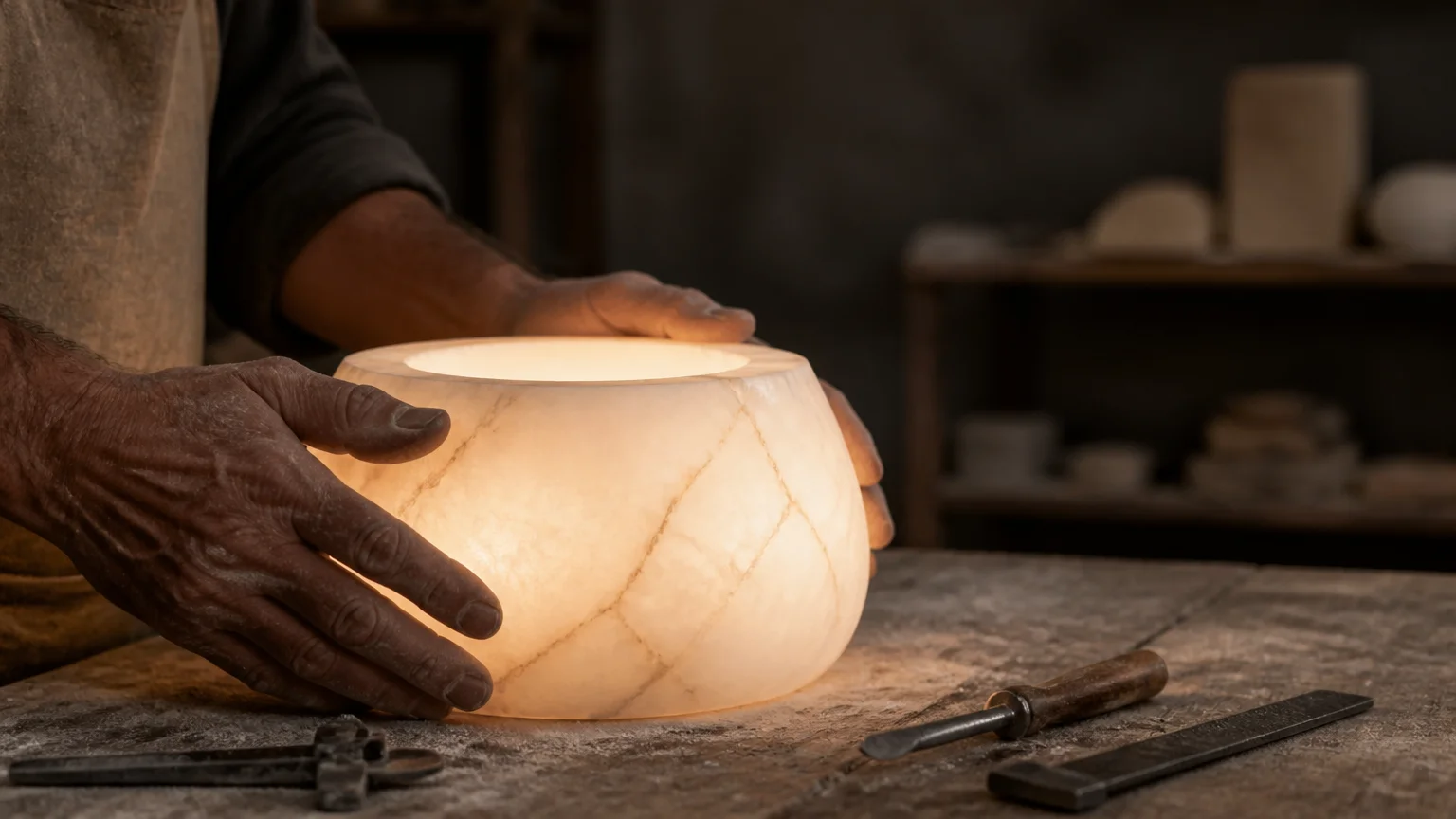
A stone lamp starts as a block of rock that may or may not want to become a lamp. Everything after that — which block, how thin, how lit, how framed, how packed — is decided against the stone’s own terms rather than against a drawing. That is the part of the process most quotations never explain.
Most decorative lighting is a manufacturing exercise with a design on top. A metal body is drawn, cut, formed and finished; a glass element is moulded or blown to a pattern; an acrylic diffuser is extruded. Tolerances are set, the first article is measured, and the thousandth unit matches the first. Specifications can therefore be written as numbers on a page and verified with a caliper.
Natural translucent stone does not work that way. A block of stone arrives with its own internal structure: bands of denser material, veins of softer mineral, pockets that will read dark and patches that will read bright. The block is not a blank sheet. It is a material with opinions, and the manufacturing sequence is largely a negotiation with those opinions.
This article follows one stone lamp from the block to the moment it is switched on, and explains what each stage does to the finished object. It is written for the people who have to buy it, inspect it and approve it: procurement teams assembling a guestroom package, designers writing a material specification, and project managers who will be asked why two units of the same model look slightly different. The emphasis is on why the stone decides, and on the questions that turn that fact into a workable purchase order.
For readers who want the workshop sequence itself — the eight production stages common to custom hotel lighting — our walkthrough of the journey of a hotel lamp through the workshop covers it separately. This piece stays on the material: what the stone permits, what it refuses, and what each of those decisions costs.
- 01Why a Stone Fixture Cannot Be Specified Like a Metal One
- 02Selecting the Block: Three Properties That Have to Hold Together
- 03Cutting and Carving: Why Two Units of the Same Model Differ
- 04Thickness Is the Decision That Cannot Be Reversed
- 05The Stone and the Light Source Are One Design Problem
- 06What Weight and Brittleness Ask of the Internal Frame
- 07Surface Finishing Decides the Light That Leaves the Stone
- 08Packaging, Spares and Batch Identity
- 09Judging a Stone Prototype: Look at It Switched On
- 10What to Confirm Before a Quotation Is Accepted
01Why a Stone Fixture Cannot Be Specified Like a Metal One
The first thing a project team notices about stone lighting is that the specification language has to change. A painted steel body is described by its dimensions, its coating system and its colour reference. A stone body cannot be described that way, because the material’s contribution to the finished object is not a constant. Two carved shades from the same block, worked to the same profile, will glow differently where the local structure differs.
That is not a defect in the process. It is the reason the material is chosen. A synthetic diffuser is valued for producing an identical result every time; a natural translucent stone is valued for producing a result that is specific to the piece. The buyer is not purchasing a perfectly repeatable component. The buyer is purchasing a controlled range of naturally varying ones, and the whole point of a written specification is to define that range.
Practically, this shifts the burden of proof. Where a metal fixture is verified by measurement against a drawing, a stone fixture is verified by comparison against an approved reference piece. The approved sample, held by both parties, is the real specification. Drawings still matter — they control geometry, mounting points, electrical information and clearances — but they cannot control appearance. This split is worth stating explicitly in a purchase order, because disputes about stone almost always originate in a document that tried to do both jobs at once.
There is a second structural difference, and it is easier to miss. Metal and glass components can be sourced, refined and replaced against a known grade. Natural stone is quarried material. A block that was available when the reference sample was approved may not be available when the production run starts, and a substitute block will not be identical. This is why the discipline that matters most is not tolerance-setting but batch planning: deciding early how much material must come from one source, and holding the reserve before it is needed rather than after.
The consequence for programme management is a longer front end and a shorter tail. Stone work rewards early decisions. A project that locks its material direction, its approved reference and its reserve stock before the specification is frozen will move through production smoothly. A project that leaves material approval until after production begins will spend its contingency on remaking carved parts, which is the most expensive kind of rework in decorative lighting.
None of this makes stone an unreliable material. It makes it a material with a schedule of its own, and the suppliers who handle it best are the ones who say so at the enquiry stage rather than at the delivery stage.
02Selecting the Block: Three Properties That Have to Hold Together
Selection begins before any drawing is useful. The question is not whether a block is attractive in a photograph; it is whether the block can do the three things a lampshade has to do at once.
Light transmission. A stone that is opaque in section will never glow, no matter how bright the source inside it. The material has to pass enough light through the section thickness the design calls for, and it has to pass it evenly. A block can be translucent overall and still contain regions that block light almost completely, which appear as dark patches the moment the lamp is switched on. Those regions are invisible in the warehouse and unmistakable on the wall.
Structural integrity. The lamp is not only decorative. The stone has to survive being cut, drilled, mounted, transported, installed and cleaned. Blocks that contain fine internal fractures may cut cleanly and then fail during handling, or may hold at one thickness and split when worked thinner. This is not a question of hardness; it is a question of how the material behaves as a section, and it is answered by working samples rather than by looking at a surface.
Consistency across the required quantity. This is the property that most often decides a project. A single lamp can be made from almost any suitable block. Thirty corridor sconces, or a hundred and fifty guestroom bedside lamps, cannot. The material has to be available in sufficient quantity from one source, of one character, so that the installed result reads as a family. Where that is impossible, the project has to decide in advance whether variation should be distributed evenly across the floor or confined to a zone where it reads as intention.
These three requirements pull against each other, which is why selection is a skilled judgement rather than a filter. A block that transmits light extremely well may be structurally delicate. A block that is robust and economical may be too dense to glow at the thickness required. The commercially relevant blocks are the ones that satisfy all three at a level appropriate to the project — and in practice only a fraction of available material does.
Two clarifications are worth making here, because they recur in buyer questions and both are frequently mishandled.
The first concerns what the material actually is. Stone sold and specified as translucent lamp stone is a fine-grained material that transmits light, and it belongs to mineral families with meaningfully different working properties; a fine-grained gypsum class is one commonly used type, and a calcite class is another, with different hardness and different behaviour in the presence of moisture. Buyers should treat the family as a question for the supplier’s material documentation rather than as something settled by the trade name on a quotation, and any project in a damp or high-traffic location should have that answer in writing before approval.
The second concerns origin. Spanish material is a common high-end choice in this category, and our note on why designers pair Spanish stone with lighting fixtures discusses the design reasoning. Statements about specific quarry districts differ between sources and should be treated as commercial claims rather than technical ones; where origin matters to a project, the supplier’s material documentation is the document to rely on.
One further rule of selection is worth recording. Grade the material for the function, not for the catalogue. A dense, heavily patterned block that makes a spectacular single pendant may be the wrong choice for a repeated sconce, where consistency at the wall matters more than individual character. The correct block for a project is the one that satisfies the tightest constraint in that project, not the one that looks best in isolation.
03Cutting and Carving: Why Two Units of the Same Model Differ
Once a block is accepted, the first operation is opening it. Where the block is cut determines which face becomes the visible surface, and that decision is made by the maker rather than by the drawing. The same block cut on two different planes produces two different panels, with different veining directions and different gradations of transmission.
From that point on, hand work takes over. In a carved stone shade, the profile is not produced by a mould. It is formed by removing material in stages, and the maker reads the stone continuously: where it is sound, where it is stubborn, where a vein runs close to the surface that would thin the wall dangerously if followed literally. The result is a piece whose overall form matches the approved sample while its surface carries the trace of how it was made.
This is why two units of the same model are not identical, and why the honest description of the process is resemblance rather than replication. The difference is usually structural rather than cosmetic. Because the wall thickness varies slightly across a hand-worked shade, the light passing through it also varies, and the finished lamp glows a little more strongly where the wall is thinnest and a little more fully where the material is more generously translucent. A moulded diffuser made to the same drawing would be even, and would also be less interesting to look at.
The practical implication for a project with repeated units is that consistency is managed by selection and pairing, not by demanding identical output. A useful working method is to lay the finished units out together while they are still in the workshop and arrange them into the groups that will be installed together, balancing the more characterful pieces against the quieter ones. A corridor receives its sconces as a set; a guestroom receives its two bedside lamps as a matched pair. Making that arrangement explicitly is far cheaper than attempting to make every unit identical.
There is a second consequence, less often discussed. Hand-worked stone surfaces do not carry the perfect symmetry of a machined profile, and in a wall-washing stone sconce the surface itself becomes the optical element that shapes the light. A carved surface spreads light differently depending on the direction of the grooves and the depth of the relief. That is a design resource rather than an imperfection, but it does mean that the sample approved by a designer should be judged with the lamp switched on, and judged as the optical element it will become in service. The distinction between a material approval and a performance approval matters here more than anywhere else in the process.
The same reasoning explains why the visual difference between a heavily worked and a lightly worked shade is disproportionate to the amount of material removed. A shallow relief catches the internal light only slightly; a deeper carved pattern redistributes it markedly across the surface. Two designs that look similar in a line drawing can therefore perform quite differently on a wall, which is one more reason for evaluating stone designs from working prototypes.
04Thickness Is the Decision That Cannot Be Reversed

Of all the decisions in stone lamp making, the one with the least tolerance for revision is section thickness. Material can be removed; it cannot be added. Every thickness chosen is therefore a permanent commitment, and it has to be right for two different reasons that are in direct opposition.
The first reason is strength. Thinner sections are more fragile, not only during handling but during service. A shade that is worked very thin will transmit light beautifully and will also be the part most likely to suffer in transit or to crack when a maintenance team cleans it. The wall thickness that reads as elegance in a showroom is not automatically the wall thickness that will survive ten years in a hotel corridor.
The second reason is optical. Thicker sections do not simply transmit less light; they change its character. Where a section is thin, the stone behaves as a translucent filter and the light emerges spread across the whole surface, producing a continuous glow rather than a highlighted point. Where the section is thicker, less light escapes through the face and more is concentrated at the open ends or the edges, so the light reads as a pool above and below the fixture with a solid, less luminous body between them. Neither result is better. They are different design intentions, and the difference is largely set by thickness before any lighting decision is made.
This produces the single most useful question a buyer can ask about a stone fixture: is the intention a body that glows through its whole surface, or a body that stays solid while light is concentrated above and below it? Most disagreements between a designer and a factory about a stone sample are actually disagreements about which of these two things was wanted, and neither party has stated it.
Once that question is answered, the thickness follows, and so do the constraints on the rest of the design. A shade intended to glow throughout has to be thin enough to transmit, which means the internal structure has to be designed so that the thin shell is never carrying the whole load of the fixture. A shade intended to read solid permits a heavier section and a simpler internal arrangement, but requires the light to be directed deliberately rather than allowed to fall where it will.
There is a related point about the relationship between thickness and pattern. Where the stone carries veining, a thin section reveals it as a soft internal pattern that shifts as the viewer moves; a heavier section can obscure it entirely. Buyers who approve a material sample in a warehouse, laid flat and viewed from directly above, frequently approve the wrong reading. The sample has to be held up against a light and viewed from the angle at which the finished lamp will actually be seen.
05The Stone and the Light Source Are One Design Problem
A conventional fixture allows the light source and the housing to be developed separately. A diffuser is specified to a standard, a lamp or LED module is selected to a standard, and the two are brought together at the end, with the assumption that the diffuser will handle whatever the source emits. Stone resists that sequence completely, because the stone is not a diffuser applied over a source. It is the optical body of the lamp, and what it does with the light depends on where the light sits inside it.
The governing objective, in almost every stone design worth specifying, is that no individual bright point should be visible through the material. A buyer should be able to look at a lit stone lamp from any normal viewing angle and see a glow, not a lamp. Whether that is achieved depends on a small set of decisions taken together: how far the source sits from the inner surface, how many separate sources are used and how they are arranged, how the light is spread or reflected once it is inside the cavity, and how the heat it generates is removed from a material that will not tolerate being cooked.
Separation distance is the least intuitive of these. Place the source too close to the inner face and the stone transmits a bright local hotspot; place it too far and the cavity absorbs light that should have reached the surface, so the lamp reads dim and the design demands a higher output to compensate. The correct distance is a function of the section thickness, the transmission character of the particular block, and the shape of the cavity — which is why it is settled during prototyping rather than calculated from a table.
Arrangement matters as much as distance once the fixture is more than a simple enclosed form. An elongated shade lit from a single point at one end will brighten at that end and fade toward the other. The remedy is a distributed arrangement of smaller sources rather than one larger source, which produces a more even result and also reduces the local heat load. The same logic applies to ring and disc forms, where a continuous arrangement following the perimeter reads more evenly than a central cluster.
Internal reflection is the third variable, and it is where a factory’s accumulated experience shows. Light inside a stone cavity is not all radiated straight out. A proportion of it is reflected internally before it escapes, and the character of the inner surfaces therefore affects the final evenness. Linings and internal finishes that look like an invisible detail in a workshop actually determine whether the glow is uniform or streaky, and they are one of the reasons two visually identical shades from different makers can perform quite differently.
Heat is the fourth, and it constrains the other three. Any source inside a closed stone body raises the temperature of the material around it, and stone is not a good conductor. A design that produces a beautiful even glow while running the material hot is not a design that will survive. The practical answer in modern specification is to work with sources that produce less heat for the output required, to keep the heat path away from the thinnest stone, and to avoid enclosing the driver with the source in a sealed cavity. The material should be protected by design rather than by a note in the manual.
Because these four variables interact, stone lighting is one of the few categories where a working prototype is not a formality. Our note on specifying stone lighting for hotels and luxury interiors covers the approval and variation-control side of that process; the point to carry into a manufacturing conversation is that the stone and the source cannot be developed on separate tracks and reconciled at the end.
The commercial consequence is straightforward and worth stating plainly to a value engineering team. A stone fixture can almost always be made cheaper by reducing the number of sources or changing their arrangement. The saving is real, and so is the change in the light: hotspots, uneven glow, or a body that is bright at one end. Those are not cosmetic differences that can be corrected later. They are the design.
06What Weight and Brittleness Ask of the Internal Frame
To anyone who has handled a stone shade, the defining physical impression is not weight alone but concentrated weight in a material that will not bend. Metal can be persuaded. Glass can be supported at a few points and left otherwise free. Stone is heavy, and it fails suddenly rather than gradually, which changes how the entire fixture has to be built.
The immediate consequence is that the visible stone is rarely the structural member. In a well-engineered stone lamp, an internal frame carries the loads, and the stone is mounted to that frame through fittings designed to spread the load rather than concentrate it. This is the opposite of a metal fixture, where the visible body often is the structure. Buyers reviewing a shop drawing for a stone fixture should therefore look for the frame as a separate, described component with its own material and its own connection details — not as an implied assumption.
The second consequence is that attachment points are the weak link. A cantilevered stone form, with its mass held away from the wall or the ceiling on a narrow neck, puts predictable stress at the joint. Designs that look elegant in a rendering can be difficult to make robust in this geometry, and the honest answer from a manufacturer is often that the form has to change slightly — a wider bearing surface, a deeper bracket, a concealed saddle — rather than that the fixing can be made arbitrarily strong. That is a conversation worth having at the sketch stage, because it is cheap then and expensive later.
The third consequence concerns maintenance and access. A stone body usually has to be handled as a heavy, brittle object during servicing, which means the maintenance procedure is a design input rather than an afterthought. If a driver or a source module sits inside the cavity, the design has to define how the cavity is opened, how the stone part is supported while it is open, and how it is replaced without introducing a crack. Fixtures that look identical from the outside can differ enormously in this respect, and the difference only becomes visible after the first failure.
Practical specification consequences follow. Weight should be stated in the drawings and carried into the delivery documentation, because the receiving project team has to plan lifting and installation. Mounting conditions should be confirmed against the actual wall or ceiling construction rather than against a general assumption, and where a project requires a structural check, the check belongs to the project’s own engineer rather than to the lighting supplier. For larger stone compositions the same discipline applies as for any heavy decorative fixture, which is covered in our guide to the engineering of large custom chandeliers.
Finally, brittleness has a commercial face. Stone parts are not interchangeable with metal parts in a spares strategy, because a replacement has to match an appearance and cannot simply be a functional substitute. That point is developed in section eight, but it begins here: the fixture’s engineering determines how many stone parts there are, how exposed they are, and therefore how much of the spares question is a design outcome rather than a purchasing decision.
07Surface Finishing Decides the Light That Leaves the Stone
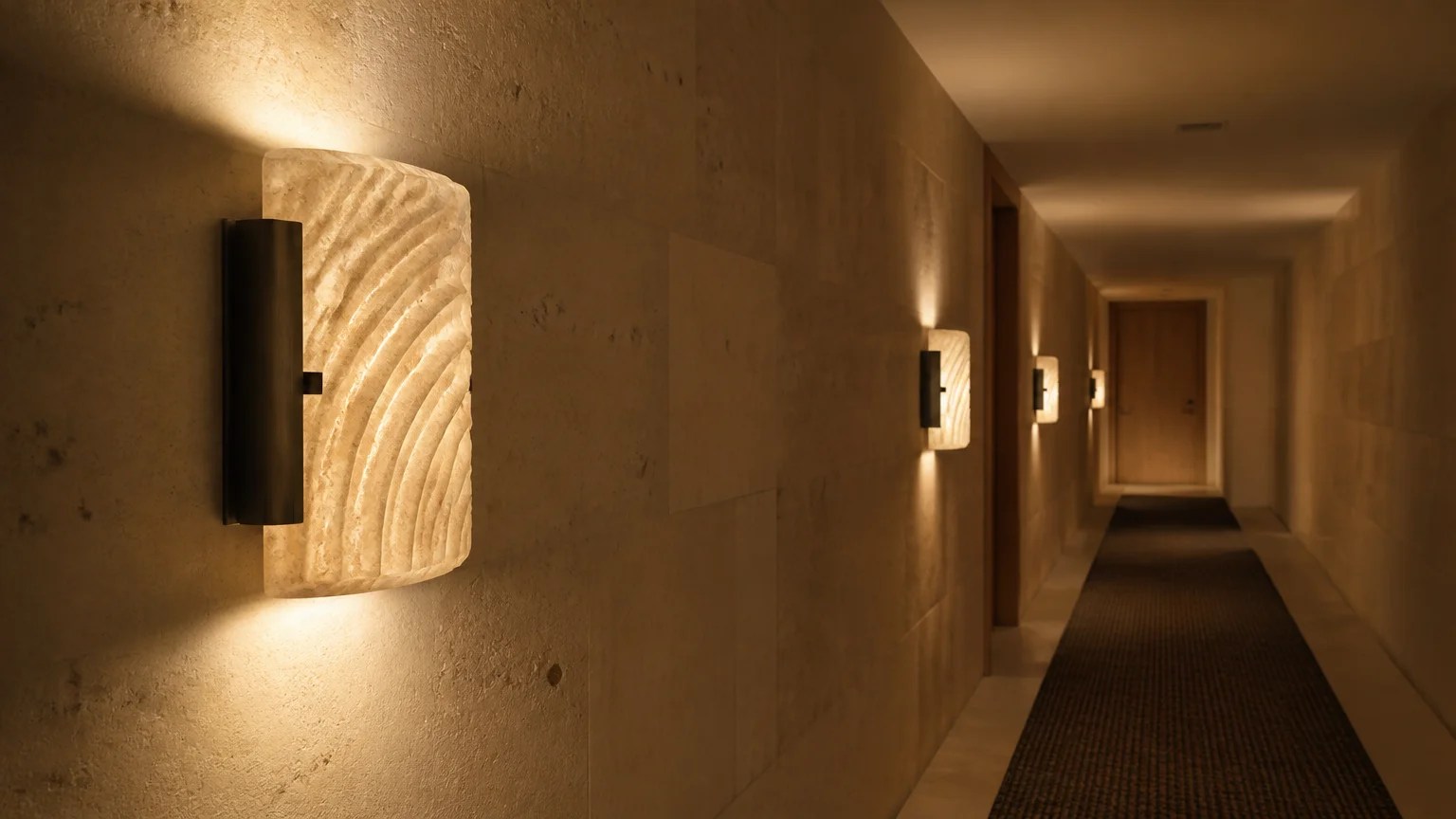
Surface treatment is often treated as the last cosmetic step in the process. In stone lighting it is a functional decision, because the surface is where the light leaving the material is finally shaped.
A polished face behaves quite differently from a matte one. Polishing reduces the surface’s scattering effect, so more of the light that reaches the face passes through in a more directed way, and more of the light arriving from outside is reflected rather than absorbed. A polished stone body therefore reads crisper, with a more defined edge and a certain reflective sheen on the unlit side; it also shows handling marks and dust more readily. A honed or matte face scatters more, producing a softer and more diffuse glow, hiding minor surface marks better, and reading as a solid object with a calm interior light.
Neither finish is more authentic than the other, and neither is more durable in every sense. What matters is that the finish is specified in the same document as the appearance reference, because the two are inseparable. A reference sample supplied as a polished piece cannot be used to approve a production run delivered honed, and buyers who accept a polish sample and receive a honed delivery are, in effect, receiving a different product. Where the finish is critical, the approved sample should be finished exactly as production will be, and the finish should be named in words that the factory uses internally rather than in general terms such as smooth or natural.
Surface treatment also interacts with the carved geometry discussed earlier. On a relief surface, the direction of the tooling determines where light gathers and where it falls away, and a change in finish changes that reading. This is the reason a stone relief can look flat in one finish and distinctly dimensional in another, and why switching finish late in a project is a visual change rather than a technical formality. Where a designer has approved a carved sample in one finish, the finish is part of what was approved.
Two smaller practical points belong here as well. First, finishing affects how the material ages in service: a smoother surface is generally easier to clean but more revealing of any scratching, while a more textured surface is more forgiving of marks and harder to clean thoroughly. Projects should choose with the actual maintenance regime in mind, and hospitality projects in particular should decide who will clean the fixture and with what, before the finish is fixed. This is treated in more depth in our materials and finishes guide for hospitality lighting materials and finishes.
Second, finishing is inseparable from the metal components. A carved stone body on a brushed metal bracket is one object visually, and the relationship between the two surfaces — how reflective each is, how warm each reads, how each looks when the lamp is off — is decided at the point of approval. Since the finish and the stone have to be approved together, the practical rule is to approve assemblies. A stone sample on its own, or a metal finish chip on its own, tells the buyer less than a mounted assembly does, and the gap between the two readings is where most late-stage arguments about appearance originate.
08Packaging, Spares and Batch Identity
Packaging is generally treated as logistics. In stone lighting it is part of the manufacturing design, because the way components are packed determines how the fixture is divided into modules, and that decision has to be made before production rather than after.
The physical reason is that stone parts are heavy and brittle at the same time, which is the worst combination for transport. Protective packaging for stone has to support the whole form rather than a few points, keep components from moving inside the carton, and prevent one piece from loading another. That in turn encourages designs where stone elements are separately cased and separately numbered rather than assembled into a large unit for shipping. On a multi-part fixture, this is genuinely a design decision: a lamp that ships as a small number of large assemblies is easy to pack and hard to repair; one that ships as many small numbered elements is easy to repair and requires disciplined identification on site.
Numbering is where packaging and spares meet. If stone elements are cased separately, each one has to be identifiable, because a replacement has to reach the right position on the right fixture in a project with dozens of them. The practical result is that the delivery documentation carries a component identity for every stone part, and the maintenance team can name the part that failed instead of describing the symptom. Projects that skip this step discover its value when the first damaged piece has to be replaced from a photograph.
Spares policy follows directly from the material rather than from a general rule. A stone part cannot be sourced later from stock, because it has to match material that was selected for the project. The consequence is that the only reliable moment to set aside matching material is at the time of order, drawn from the same selection as the production units. Attempting to add replacements a year later means sourcing from a different block, and the difference will be visible. This is a purchase order line, not an afterthought, and it should be sized to the risk of the specific installation — a single decorative piece in a low-traffic location and a hundred repeated fixtures in a public corridor do not carry the same exposure.
There is a related discipline about the metal components. Frames, brackets and decorative metal parts can usually be re-made, but not necessarily to a matching finish, particularly where a hand-finished or aged effect is involved. Where the metal finish is a controlled appearance, the reference for it should be retained with the project documentation so that a later replacement can be compared against it rather than described from memory.
One element of packaging is easy to overlook and expensive to omit: the installation information should travel with the goods rather than in email. A component list that matches the carton numbering, positions tied to a drawing, and a stated assembly order turn a difficult site task into an ordinary one. The most common installation failures in stone lighting are not electrical; they are a heavy part fitted to the wrong position or a stone element lifted without the support the design assumed.
09Judging a Stone Prototype: Look at It Switched On
Because stone behaves differently when it is transmitting light than when it is simply reflecting it, judging a stone sample switched off tells the buyer only part of what they need to know. The material that looks most attractive on a bench may be the one that glows least evenly, and the reverse is equally common.
A useful prototype assessment therefore has two states, and both should be recorded. In the unlit state, the buyer is assessing the object: form, proportion, the character of the veining, the quality of the carving, the finish, and the relationship between the stone and the metal. In the lit state, the buyer is assessing the light: whether a continuous glow is achieved or whether hotspots are visible, whether the brightness is even across the surface, whether the edges are handled well, and whether the colour of the light is what the project intended. Photographs of a lit stone fixture are unreliable in both directions, because a camera’s exposure compensation tends to flatten the very gradients the buyer is looking for. The assessment has to be made in person.
The comparison should also be made at the intended viewing distance and angle. A sconce washed up a wall and viewed from three metres away is a different object from a shade examined at arm’s length on a bench, and the defects that matter at one distance are invisible at the other. For repeated installations, the most informative test is to place three or four finished units side by side and view them together, which is the only way to see whether the batch reads as a family.
Two further checks are worth building into any stone prototype review. The first is thermal: after the fixture has been running for a representative period, the temperature of the stone around the source should be checked, and the design should be confirmed as offering a sensible heat path. The second is mechanical: the fixture should be handled the way an installer will handle it, including a dry assembly of the parts, so that any awkward weight distribution or fragile moment is found in the workshop rather than on site.
Finally, the review should record what was approved and against what. Stone approvals are inherently sample-based, so the document that matters is not a photograph but a signed reference piece, retained by both parties, together with a written note of the finish, the light output setting and the viewing condition under which it was accepted. Everything later in the project is a comparison against that record. Getting this right once removes almost all of the arguments that otherwise appear at delivery.
10What to Confirm Before a Quotation Is Accepted
By this point in the process, the questions a buyer needs answered are specific, and they are all answerable by a manufacturer who genuinely works with the material. The purpose of asking them is not to test the supplier but to close the gaps that would otherwise be discovered during production.
On material, the buyer needs to know the mineral family in writing, the intended section thickness in relation to the desired glow, whether the required quantity can be drawn from one selection, and how much reserve material will be held. On appearance, the buyer needs an approved reference piece in both states, a named finish, and a stated policy for acceptable variation between units. On light, the buyer needs the number and arrangement of sources, the intended output, and a working statement of how evenness is achieved. On engineering, the buyer needs the internal frame described, the mounting details resolved against the actual building condition, the weight stated, and the maintenance route defined. On logistics and lifetime, the buyer needs the module breakdown, the identification scheme, the spares position agreed at order, and the installation documentation.
Two of these deserve particular emphasis, because they are the ones most often left implicit. The first is the glow intention, which should be written as a short plain statement rather than inferred from a drawing. The second is the spares position, which should be a specific quantity agreed at order rather than a general promise of availability.
It is also worth deciding, at this stage, which of the two parties holds the approved reference and how it will be used. In practice the most workable arrangement is one reference held by the manufacturer as the production standard and one retained by the buyer or the project, with both recorded as being of the same origin. That arrangement costs very little and removes the single largest source of late-stage dispute in this category.
A stone lamp is therefore not a difficult purchase, provided the buyer accepts that the material is a participant in the design rather than a finish applied at the end. The projects that go smoothly are the ones that decided early what the stone was for, approved a reference that showed both states of the fixture, and treated material reserve and spares as part of the order. The projects that go badly are the ones that asked a block of rock to behave like a moulded part. Our guide to structuring a custom lighting brief and to taking a fixture from sketch to sign-off covers the surrounding documentation sequence; the stone-specific decisions above sit on top of it.
Source note: the technical statements in this article about material selection, section thickness, light diffusion, internal reflection, heat, structural support, surface finishing and packaging describe general industry practice and are given as experience-based guidance rather than as requirements of any standard. No density, hardness or transmission values are quoted, because such figures vary between sources and must be confirmed against the supplier’s own material documentation. Statements about the mineral family and about origin are commercial claims to be verified in writing with the supplier for each project, and no quarry, region, brand or project is endorsed here. Work involving electrical connections, heavy lifting and structural fixing must be carried out by suitably qualified personnel, with structural adequacy confirmed by the project’s own engineer to the applicable local requirements. This article contains no product, brand or project endorsement.
Frequently Asked Questions
Why do two lamps from the same model look slightly different?
Because the material is quarried rather than manufactured. Veining, local translucency and the exact thickness left by hand work differ from piece to piece, so the glow differs too. That variation is controlled by selecting and pairing finished units into the groups that will be installed together, and by agreeing in advance how much variation is acceptable — not by demanding identical output.
Is a thinner body always better for the glow?
No. Thickness chooses between two different results rather than between good and bad. A thin section lets light pass through the whole body, producing a continuous glow. A heavier section concentrates the light at the open edges, so the fixture reads as a solid object with a pool of light above and below it. The design has to state which of the two is wanted before the thickness is fixed, because material can be removed but never added.
Can a stone lamp be repaired if a part is damaged?
It can be replaced rather than repaired, and only with a matching part. Because a later replacement cannot be sourced from a different selection without the difference being visible, the practical approach is to set aside matching material from the same selection at the time of order, and to identify every stone component so that the correct piece can be supplied. This is why the spares position belongs in the purchase order.
Does the light source matter as much as the stone?
It matters equally, and the two cannot be developed separately. The objective is a glow rather than a visible bright point, and achieving it depends on how far the sources sit from the inner surface, how many there are, how the light is distributed inside the cavity and how the heat is removed. A change to any of these changes the appearance of the finished fixture.
Should the sample be approved with the lamp switched on?
It should be approved in both states. Switched off, the buyer is approving the object: form, carving, finish and material character. Switched on, the buyer is approving the light: evenness, the absence of hotspots and the colour. A sample approved only in the switched-off state has not been approved as a lighting product, and photographs are not a substitute because a camera flattens exactly the gradients that matter.
Working on a Stone Fixture Specification?
Send us the intended installation positions and quantity, the effect you are trying to achieve — a body that glows throughout, or a solid form with light concentrated above and below — the mounting surface and its construction, the maintenance route available on site, and the finish direction. We will return a material and construction proposal with the internal frame described, the source arrangement and heat path set out, the module and identification scheme for shipping, and a spares position drawn from the same material selection as the production units.
Our article on alabaster pendant lighting covers the suspended variants of these fixtures, and our comparison of translucent stone and marble in lighting explains why the two materials perform differently in the same application.


