
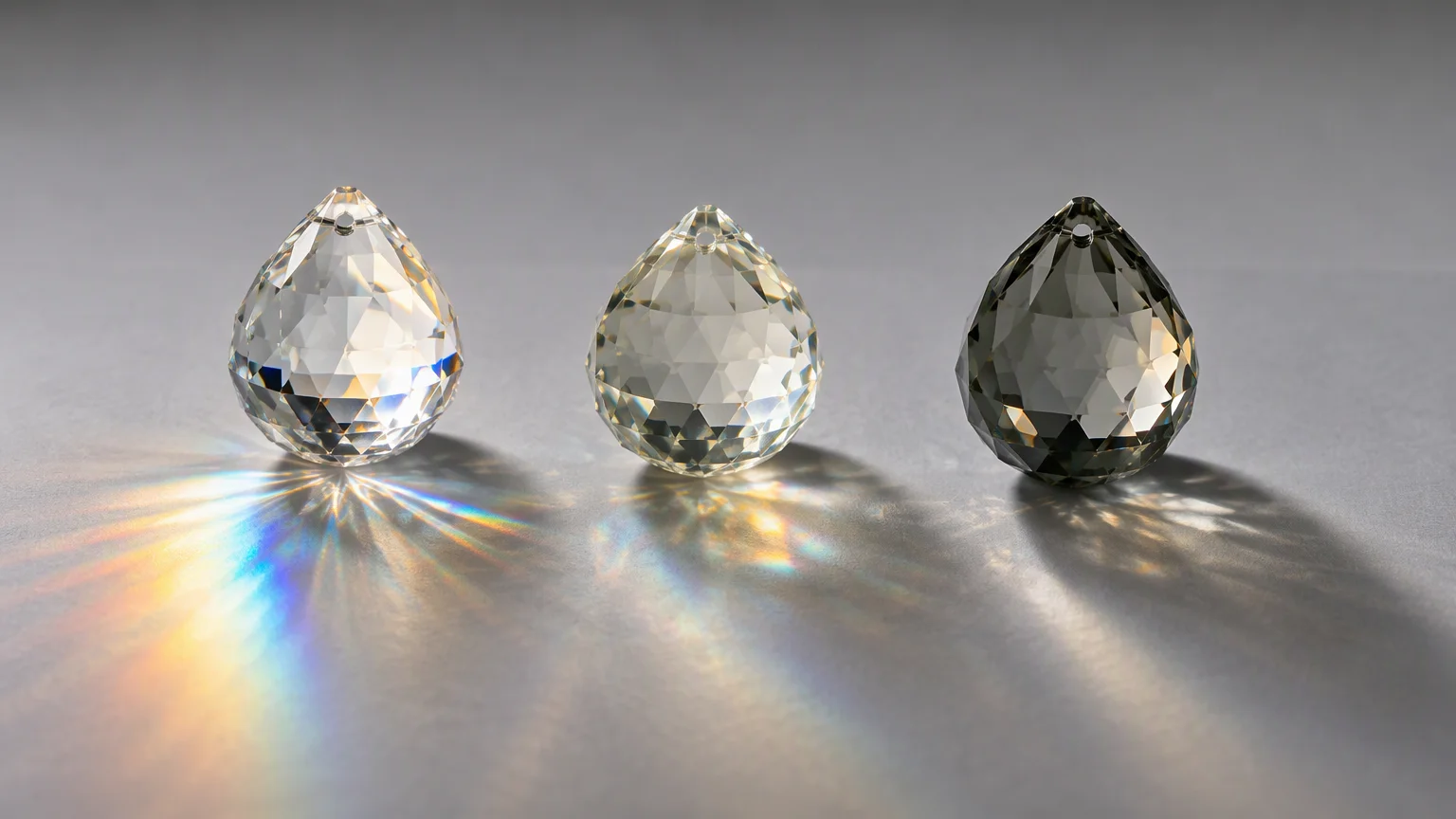
Three labels appear side by side on real chandelier quotations: lead crystal, lead-free crystal and K9. They look like three grades of the same thing. They are not. They are three different kinds of statement, they are verified in three different ways, and the reason quotations go wrong is almost always that the three have been treated as points on one scale.
Crystal specification is one of the few areas of decorative lighting where the buyer is asked to accept a word instead of a measurement. A brass component can be described by its substrate and its finish, a glass shade by its forming route and its surface treatment, a fitting by its material and its dimensions. A crystal element is often described by a single term whose meaning varies between suppliers, between markets and between the documents that accompany the same order.
This article takes the three most common labels apart and shows what each one is actually claiming, what evidence belongs to it, and what can and cannot be settled by inspection. It is written for the people who have to write the specification, compare the quotations and accept or hold the delivery: procurement teams building a fixture schedule, designers approving a sample, and project managers who will be asked why two pendants from the same order do not match. It gives no manufacturer names and no composition figures, because the useful conclusion is not a ranking of materials but a list of documents, and that list is the same whichever supplier you buy from.
A companion article covers the wider comparison — how crystal, glass and metal divide the work in a fixture and why the material label alone is an incomplete specification. If you are new to the category, read our guide to statement chandelier materials first and come back for the part-level detail.
- 01Three Labels, Three Different Kinds of Claim
- 02What the Word “Crystal” Is and Is Not
- 03Lead Crystal: The Composition Condition Behind the Name
- 04Lead-Free Crystal: What the Alternative Actually Changes
- 05K9: A Workshop Shorthand, Not a Grade
- 06Six Axes for Comparing the Three Side by Side
- 07Why Composition Cannot Be Proved by Eye
- 08The Documents to Request Before You Order
- 09Batches, Spares and the Continuity Question
- 10Matching the Label to the Project Commitment
01Three Labels, Three Different Kinds of Claim
The first step in reading a crystal specification is to sort the label into the kind of statement it is. There are three kinds, and they need different evidence.
A composition claim says something about what the material is made of. It is a statement about chemistry, it can be tested, and the evidence that belongs to it is a document from the maker of the material identifying the composition, the parts it covers and the production range it applies to. A composition claim is not approved by looking at a sample, and it is not disproved by looking at one either.
An appearance standard says something about what the finished part looks like and how it behaves under light: its clarity, its cutting, its colour and the consistency between one part and the next. The evidence that belongs to it is an approved reference piece, viewed under agreed conditions, plus a defined method for comparing production parts against that reference. An appearance standard is not established by a composition document, and a certificate of composition tells you nothing about whether the facets are cleanly cut or the colour is consistent across a batch.
An identity claim says that the part comes from a particular named source. Identity is a legitimate thing to specify when the name is part of the design intent, but the name only has force when it can be tied to the actual components on the fixture. A brand word on a quotation and a specific pendant on a specific arm are two different facts, and the gap between them is where disputes live. In practice, an identity claim is only worth writing into a specification if the buyer is prepared to require part-level evidence and to hold a delivery that does not match.
The failure mode that follows from confusing the three is predictable, and it runs in both directions. A buyer who accepts a composition statement as though it were an appearance approval will receive material that is exactly as declared and does not match the sample the designer approved. A buyer who accepts a careful description of an approved sample as though it settled composition will be unable to answer a compliance question about the project later on. Both mistakes are common, both are expensive to unwind, and both are avoided by asking, at the top of the specification, which kind of claim each line is making. The discipline of separating these three classes runs through every other technical document in this category, and it is the same principle that underlies reading a fixture specification as an engineer would.
02What the Word “Crystal” Is and Is Not
In the decorative lighting trade, “crystal” is not the name of one material. It is a commercial word that has been applied for more than a century to a family of clear, highly refractive glasses, and the family contains genuinely different things.
Part of the difficulty is that in some markets the term is tied to composition conditions, with categories defined by what the material contains and verified by laboratory methods rather than by inspection. In other contexts the same word is used descriptively, as a way of saying that a part is clear, bright and heavily cut. The two usages coexist in the same catalogue, sometimes on the same page, and neither the buyer nor the seller is necessarily being careless: they are simply using the word in different registers. The practical rule is that the word alone never settles anything, and the questions that do settle it are asked about a specific part rather than about a material in general.
There is a second reason the word is unstable, and it is geological rather than commercial. A translucent decorative element can be made from a manufactured glass, or from a natural crystalline material cut and polished from stone. Both are sold in fixtures, both can be described as crystal in ordinary speech, and they have almost nothing in common in terms of production, consistency, replacement or cost. The trade has separate names for them, and those names are the ones worth using in a specification, because a natural part and a manufactured part fail, match and replace in completely different ways.
The consequence for a buyer is a change of habit. Stop reading the word as a statement about quality and start reading it as a pointer to a question. If the part is described as crystal, the useful follow-up is: which part exactly, made from what, by which route, and what evidence will come with the delivery. Those four questions convert a commercial word into a specification line, and they work regardless of which register the supplier was using when the word was written down.
One further caution belongs here. The word carries an implication of consistency that the material does not always deliver. Crystal elements are produced in repeating shapes and sizes, and buyers reasonably expect that two pendants of the same nominal type will look the same. Whether they do depends on the cutting route, the polishing, the material and the batch discipline of the maker — not on the word. That is a production question rather than a naming question, and our comparison of hand-formed and machine-formed glass shows how much of the visible result is decided by the forming route rather than by the material name.
03Lead Crystal: The Composition Condition Behind the Name
The oldest of the three labels points to a composition family rather than to a quality tier. In this family, part of the metallic content of the glass is a heavy metal oxide, and the presence of that oxide changes the physical behaviour of the material in several ways at once.
The most obvious change is optical. The added oxide raises the refractive index of the glass, which is why light passing through a faceted part of this material is bent more strongly and separated into its component colours more visibly. This is the effect that gives the material its characteristic fire, and it is a property of the composition rather than of the cutting, although the cutting is what lets it be seen.
The second change is physical, and it is the one that matters most to the engineer rather than to the designer. The material is denser than an ordinary clear glass, so an element of the same size weighs more. In a fixture with a few large pendants this is a minor consideration; in a large multi-tier fixture with hundreds of small elements, it becomes a load calculation. Weight carries through the pendants, the pins, the arms, the frame and finally the ceiling fixing, and it also carries through the person who will have to clean and service the fixture. A specification that names the material without considering the load path has named a preference, not a requirement.
The third change is in working. Material of this kind is generally worked at temperatures and with handling practices that differ from ordinary glass, and it cuts differently, which is one reason an experienced cutting shop is difficult to substitute. It also responds differently to repair: a chipped or cracked part in this family is normally replaced rather than reworked.
None of this makes the material better or worse than the alternatives, and it is worth saying plainly that no honest specification should present it as the higher grade of the three labels. What is true is that a heavier, more highly dispersive material answers a particular design intention — a classic, formal, highly faceted fixture with a substantial visual weight — and that the consequences of choosing it are real: more load, a narrower field of suppliers who can work it well, and a compliance picture that varies by destination market and must be confirmed for the project rather than assumed from the label.
There is a trap here that is worth naming, because it appears in every material category. The label names the composition, and buyers habitually read it as a description of the finish. The two are independent. A part can be made in this family and still be poorly cut, badly polished, or inconsistent from batch to batch; and the same is true in the other direction. Judging a component from its material label is the same error as judging a metal component from the colour of its plating rather than from its substrate, which is exactly the distinction set out in our note on aged and unlacquered brass finishes: the substrate and the visible finish are two facts, and they are recorded, approved and replaced separately.
04Lead-Free Crystal: What the Alternative Actually Changes
The second label describes a family designed to deliver a similar visual result without the heavy metal oxide. In practice this is achieved by combining other oxides to raise the refractive index and to stabilise the glass, and by refining the melting and working process. The result is a genuine category rather than a marketing term, and in many projects it is the right choice. But it changes several things, and the changes run in both directions.
The clearest change is weight. Material made this way is generally lighter than the traditional composition, which reduces the load through the fixture, simplifies handling and installation, reduces the demand on the fixing, and makes maintenance easier. In a very large fixture, or in a building whose structure is unhelpful, this can be decisive. In a small fixture where the visual weight is part of the design, the same property can read as a loss, because the substantial presence that buyers associate with a classic chandelier is partly a physical impression rather than a purely visual one.
The second change is optical, and it is more subtle than it sounds. Dispersion and clarity can be achieved to a high standard, but the exact way a part behaves under a given light will not be identical to the traditional material, and the colour cast of one batch against another can differ where the raw materials differ. This is why composition documents never approve appearance. Two materials can both be genuinely of this family and still look different side by side under the same light, and the buyer who has approved a sample has approved one of them.
The third change is the compliance picture, and this is where a careless reading of the label is most likely to cause trouble. A lead-free claim is not a single fact. It is a family of claims about the composition, and each of them needs to be tied to something specific: which formulation, which parts of the fixture, which production range and which stock; how the statement relates to the rules of the destination market; what the optical consequence is at the sample level; and how continuity is maintained so that parts bought later are covered by the same declaration rather than by a similar-sounding one. Our guide to materials and finishes in lighting treats these as four separate review gates rather than as one approval.
Two practical consequences follow. First, a statement that a material is lead-free should never be written as a ranking statement — it is a description of composition and not a claim of superiority, and buyers who pressure suppliers to describe it as “better” are making their own specification harder to defend. Second, the declaration must be scoped. A declaration that covers a formulation but not the specific component on your fixture, or that covers a historical production range rather than the one shipping, does not do the work it was asked to do. The question to ask is not whether the material is lead-free but whether the document covers the parts in the boxes.
05K9: A Workshop Shorthand, Not a Grade
The third label is the one most often misread, because it looks like a standard and is not one. In practice K9 functions as a supplier shorthand for a clear optical-type glass that is widely used for decorative pendants and beads. It is a working word in the trade, not a controlled definition, and that single fact explains almost every problem that arises around it.
The first consequence is that the same word covers a range of material. Because the term is not governed by a fixed specification, two suppliers can both describe their product with it and deliver glasses that differ in clarity, in colour and in how they cut. This does not mean that one of them is misusing the word; it means the word does not carry the information a specification needs. The second consequence follows directly: the word cannot be used as a quality grade. There is good material sold under this shorthand and poor material sold under the same shorthand, and the label gives the buyer no way to tell which one is in the quotation.
The third consequence is the one that costs the most, and it is about verification. Because the term is commercial rather than regulated, the questions it raises are about the specific part rather than about the class: what is this element made from, how is it cut, how consistent is it from piece to piece, and what happens when a spare is needed two years later. Those questions have answers, and they are answered by documents and samples, not by the label. Our explainer on what the term means on a fixture covers the same point from the buyer’s side.
The practical remedy is to convert the label into a specification line rather than to argue about it. A useful line contains six parts: the supplier’s material declaration and material code; the part dimensions; the cut or form of the element; the colour expectation under a named viewing condition; the condition of the edges; and an approved sample identifier with the acceptance rule that will be applied to production batches. A quotation that answers those six points is a specification. A quotation that repeats the trade word is a description, and it will not survive a delivery argument.
Two further points are worth writing down because they recur in buyer questions. The word is frequently used loosely to cover several adjacent glass types, so enquiry wording should ask about the specific part rather than about the material in the abstract. And the word says nothing at all about ageing. A clear glass element can still develop a film, lose its sparkle through accumulated residue, or chip at an edge, and none of that is a function of its composition. Material condition and surface condition are separate maintenance questions.
06Six Axes for Comparing the Three Side by Side
Once the three labels are understood as different kinds of claim rather than as three grades, the comparison can be done properly. What follows is a set of axes. Each axis answers a different question, and the reason a single ranking of the three is misleading is that they do not all point the same way.
Optics. The relevant questions are clarity, how strongly the material separates light into colour, and how consistent those are from piece to piece. This axis is the one buyers care about most and the one they can least judge from a label, because the visible result depends on the cutting and polishing as much as on the material. It is settled by a sample viewed under the light it will actually be seen in.
Weight and its structural consequences. Density determines the load through pendants, pins, arms, frame and fixing, and it also determines how demanding the fixture is to install and clean. This axis favours the lighter material in engineering terms and the heavier one in terms of the visual impression of mass that many traditional designs are built around. Neither is a defect; the two simply oblige you to specify differently.
Working and cutting. How difficult the material is to cut cleanly, how narrow the field of suppliers who can work it well, and how much of the visual result depends on that skill. On this axis, the material matters less than the workshop, which is why our comparison of hand-formed and machine-formed glass is the more useful reference for an appearance specification.
Durability and ageing. Resistance to chipping and scratching, and how the part behaves over years of cleaning. A material that holds a sharp edge well may also be the one that shows a film first, because a heavily faceted surface offers more places for residue to sit. This axis belongs with maintenance planning rather than with procurement, and the relevant question is who will clean the fixture and with what.
Compliance and disposal. Whether the composition raises obligations for the destination market, and how the piece is handled at end of life. This axis is the reason a material decision cannot be made on appearance alone, and it is the reason the composition declaration belongs in the file for the life of the project rather than in a drawer.
Cost structure. Where the money goes: into raw material, into cutting and polishing time, into consistency control, into scrap rates, or into batch-matching. Two quotations at the same price can be built from completely different cost structures, and that difference is what predicts whether the second order will match the first. Our guide to what drives cost in a custom fixture sets out how to read a price against the work it represents.
Read across the six axes and a pattern emerges. The three labels do not form a ladder, and no single one of them dominates. The useful output of the comparison is not a winner but a set of consequences: how much load the design has to carry, how narrow the supply base is, how much of the result depends on the sample, and what the project will need in the way of documents. The buyer who knows those four things before the order is placed is in a position to hold the delivery to something specific.
07Why Composition Cannot Be Proved by Eye

Inspection is essential, and it has a hard boundary. Visual examination of a crystal element can do three things and cannot do a fourth. It can confirm that a delivery matches an approved reference. It can identify whether an observed problem is confined to a traceable range — a carton, a batch, a shipment — so that the right material is held while the question is resolved. And it can generate the list of properties that have to be referred onward to documents because they cannot be established by looking. What it cannot do is grade the material or prove its composition.
The reason is simple: the properties that separate one glass from another are largely invisible. Clarity, edges and cutting can be seen; refractive behaviour can be inferred from how light separates; but the composition, and any claim about what the material contains, is established by testing rather than by appearance. A clear, brightly cut part can be made from several different materials, and a part that looks dull can be a well-made example of a good material that has simply accumulated a film. Appearance and composition are different questions with different evidence, and neither answers the other.
Observation is still worth doing properly, and doing it properly means making it reproducible. Four things should be recorded for every inspection: the approved reference against which the delivery is being compared; the direction of the light; the angle and distance from which the part was viewed; and the background and orientation of the part. Without those four, two observers looking at the same delivery can reach opposite conclusions in good faith. Diffuse light is better for seeing haze, colour cast and uneven brightness; raking light is better for seeing surface defects and internal features. Choosing the light to suit the question being asked, and writing down which was used, is the difference between an inspection and an opinion.
Two specific habits are worth adopting. The first concerns internal features. Bubbles and fine internal striae are not automatically rejects; they should be described, in terms of where they are and how dense they are, and then compared against the reference and the agreed tolerance. Describing them is useful. Diagnosing their cause is not, because the cause cannot be established by eye. The second concerns surface condition. A hazy, slightly dull surface may be a composition issue, or it may be the residue of a cleaning method that was not right for the part. On a heavily faceted component, an unsuitable cleaning agent can leave a film that reads as a materials fault. That is a maintenance question, not a materials one, and the appropriate response is to test a small area with the recommended method before concluding anything about the batch.
The practical output of an inspection is therefore a short, quiet document rather than a verdict: the reference used, the observations recorded, an objective description, the range of material affected, and the documents being requested from the supplier. That package is what protects both sides, because it converts a disagreement about quality into a question about evidence, which is a question that can actually be answered.
08The Documents to Request Before You Order
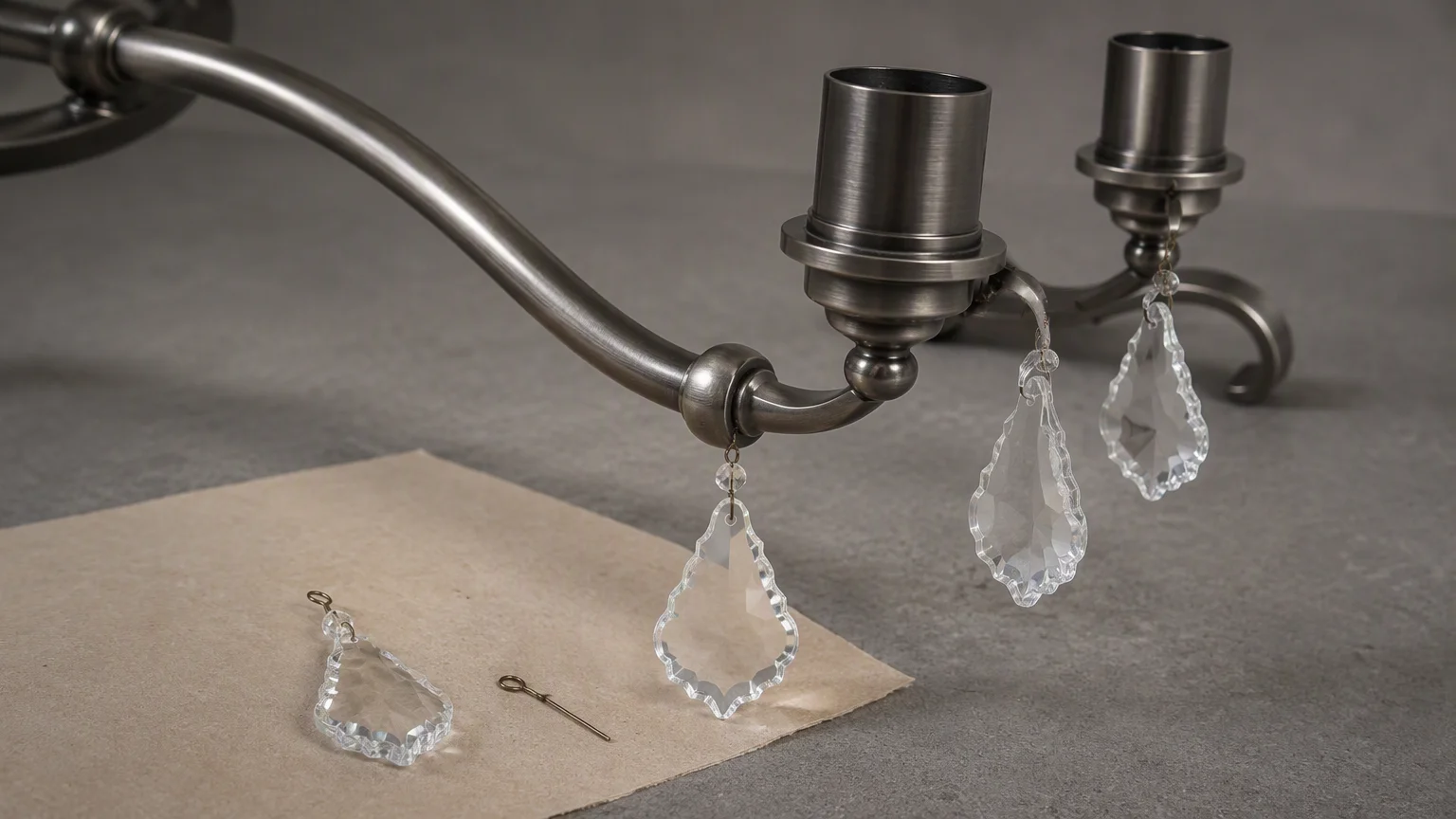
Everything in the preceding sections points to the same practical conclusion: the evidence that settles a crystal specification is documentary, and it should be requested before the order is placed rather than after the delivery. Three documents do most of the work, and a fourth — the sample regime — is what makes them enforceable.
The first is a material declaration. It should identify the material by code rather than only by trade name, state which parts of the fixture it covers, name the party issuing it, carry a revision and a date, and specify the production range or batch to which it applies. The scoping matters as much as the content: a declaration that covers a formulation but not the component in your boxes does not answer the question, and one that covers an older production range does not answer it either. The point of listing the covered parts, the issuer and the revision is that a declaration with those fields can be checked later, when a spare is needed, whereas a general statement cannot.
The second is a part schedule. This is the document that turns the specification from a description into something that can be inspected against. Each line covers one component — a pendant, a bead, a prism, a pin — and carries the drawing or part code, the evidence route that applies to it, the approved reference, and the acceptance check that will be applied on delivery: which batch, at what point in the process, under which conditions, and what happens to any part that cannot be traced. Schedules are where the identity route and the specification route are separated, and they are the reason a fixture can be delivered in pieces by several suppliers without the whole thing becoming unverifiable.
The third is a continuity and spares statement. It states how many spare elements are being supplied, from which production run, and by what rule a later replacement will be matched. This document is the one most often omitted and the one most often needed. A fixture with several hundred small elements will lose a few over its life, and a replacement that does not match is visible from across the room. Asking for the rule at the time of order is cheap; asking for it three years later is not.
The fourth element is not a document but a regime, and it is what makes the other three mean something: an approved reference for each part, recorded with the viewing conditions under which it was approved, and a procedure for comparing production against it using grouped samples rather than a single hand-picked piece. One careful sample proves nothing about a run of several hundred parts, and the language to request this is simply that the pilot or pre-production pieces be presented as a group for approval against the reference. Anyone writing a brief for the first time will find the structure familiar from our guide to structuring a custom lighting brief; the crystal schedule is a specialised section within it.
09Batches, Spares and the Continuity Question
The first order is the easy part. The risk in crystal specification is almost entirely in the second order, and it arrives years later, when nobody who placed the first one is still involved and the only thing available is the paperwork.
The underlying reason is that both colour and cut vary, and they vary for ordinary manufacturing reasons rather than because anyone is being careless. Raw materials differ slightly between batches; the working conditions in a glass shop differ from day to day; the polishers differ; and the measuring and matching discipline differs between suppliers. A part that was perfectly acceptable when it was made alongside several hundred others of the same run may be noticeably different when made alone, in a different month, against a colour memory rather than a physical reference. Two suppliers making a nominally identical element can differ more than two batches from one supplier, which is why the material declaration and the sample reference have to be kept together.
The practical consequences are three. First, colour and cut consistency is a supply-chain property rather than a product property, so the question to ask is not whether the material is good but how consistently it is produced. Second, the spares quantity is a project decision that should be taken deliberately rather than inherited from a default, and it should be expressed as a proportion of the installed quantity with the reasoning written down: a fixture in a public space with heavy cleaning traffic needs more than one in a private room, and a fixture with many small identical elements needs more than one with a few large distinct ones. Third, the declaration has to cover installed parts and spares together, so that a spare cannot be refused on the grounds that it falls outside the scope of what was approved.
There is a maintenance dimension to continuity that is worth planning at the same time, because it affects the spares decision. Replacing a crystal element normally means reaching the fixture, which on a large installation is a project in itself, and the access arrangements determine how often the work is realistic. Designers who plan the access route at the same time as the spares quantity usually arrive at a more generous spares allowance and a simpler fixture, and both decisions are cheaper before the fixture is built than after. Our guide to maintenance access for statement fixtures covers the access side.
One final point about continuity is easy to state and easy to forget: the record has to be findable. A declaration, a schedule, a sample reference and a spares rule that sit in an email thread from three years ago have the same practical value as no documents at all. They belong in the project file with the drawing set, and they should say, in plain language, what the finish and the part were approved as.
10Matching the Label to the Project Commitment
The three labels are not a hierarchy, and choosing between them is not a matter of taste. It is a question of which commitment the project cannot afford to break, and there are two legitimate answers.
The first is the identity route. Here the named source of the component is part of the design promise, and the buyer wants a specific part from a specific maker for reasons that are about design rather than about optics. This is a perfectly defensible route in the right project. What it requires is part-level evidence: documentation from that source, a verification method that applies to that source’s components, and a sample reference that is tied to the same part. Without those, the name is doing no work, because a name that cannot be tied to a component on the fixture cannot resolve any dispute about it.
The second is the specification route. Here the requirement is a repeatable appearance standard: a stated material class, a stated cut and form, a stated colour expectation under named viewing conditions, a stated edge condition, an approved sample, and a batch acceptance rule. This route is the right one whenever the fixture is large, repeated across several locations, or likely to need spares over a long service life, because consistency is the requirement rather than provenance.
Most projects need an explicit combination of the two, and that combination is where the specification most often fails. The classic example is a line that permits the supplier to provide one named component or an equivalent. Written as a single undifferentiated line, that clause has no acceptance rule, because the two branches have different evidence routes, different samples and different standards. The workable version splits the line into two branches with their own references and their own acceptance rules, so that a delivery either matches the named branch or matches the specification branch, and anything that matches neither can be held without argument. Splitting one line into two is the cheapest correction available in this category, and it removes most of the disputes that arise at delivery.
Two closing observations. First, the parts of a fixture other than the crystal deserve the same treatment, because the crystal is rarely what causes trouble over time. Frames carry the load, finishes determine how the piece ages, and electrical components determine whether it works; a thorough specification covers all of them, and our guide to engineering large custom fixtures sets out how the structural side is documented. Second, retrofitting an existing fixture is a specification exercise in its own right rather than an afterthought: matching new components to an old frame raises questions of weight, finish and matching that a new build does not, and our note on retrofitting antique and crystal fixtures covers the practical sequence.
Source note: the statements in this article about composition categories, lead-free alternatives, trade shorthand for clear decorative glass, inspection limits, batch variation and documentation practice describe general industry practice and are given as experience-based guidance rather than as requirements of any standard. No brand names, composition percentages, refractive figures or manufacturer data are quoted, because such figures vary between suppliers and formulations and must be confirmed in writing against the supplier’s own material documentation for the specific component on your fixture. Category definitions for crystal glass differ between markets; the definition that applies is the one in force in the destination market for the project, and that must be confirmed for each project rather than assumed from a trade term. Visual inspection cannot establish composition, and no statement here should be read as doing so. This article endorses no brand, supplier or project.
Frequently Asked Questions
Is a clearer, brighter part always the better one?
No. Brightness and clarity are produced by the material and the cutting together, and a very bright part can be poorly made while a duller one can be well made and simply in need of cleaning. More importantly, the three common labels do not describe three grades of the same material, so “better” only has meaning once you have said better for what: less weight on the frame, greater visual mass, wider supply, easier matching, or simpler compliance.
Does a heavier element mean a better material?
Weight is a property of density, not of quality, and it is a legitimate specification point for a reason that has nothing to do with how good the material is: a heavier part increases the load through the pendants, arms, frame and fixing, and it changes how the fixture is installed and cleaned. Treat weight as an engineering input, and where two materials differ in density, write the load consequence into the specification rather than turning the difference into a quality claim.
Can I check the material by tapping or weighing a pendant?
Those observations are useful as pointers and useless as proofs. Sound and weight do distinguish broad families of clear material, and a fixed reference sample makes the comparison reproducible, which is worth doing. But neither establishes composition or a category claim, because several different materials can sound and weigh alike, and a well-cut part can be lighter than a heavier, poorly-cut one for reasons that have nothing to do with what it is made from.
What should I ask for before approving a crystal schedule?
Four things: a material declaration with a material code, the parts it covers and the production range it applies to; a part schedule giving the code, evidence route, approved reference and acceptance check for each component; a spares and continuity statement giving the quantity, the run it comes from and the rule for matching later replacements; and an approved reference sample for each part, recorded with the viewing conditions under which it was accepted, together with a procedure for comparing production against it as a group.
Does the trade name on the quotation mean anything?
It means something, but less than buyers usually assume. Trade names in this category vary between suppliers and between markets, they are sometimes used descriptively and sometimes as composition terms, and the same word can appear on two quotations for genuinely different materials. The name is a useful pointer to the questions to ask. The answers are what the specification is built on.
Specifying Crystal Elements for a Fixture?
Send the fixture type and the number of elements, the visual result you are aiming for, the destination market, the fixing conditions including any structural limit, and the cleaning and maintenance route that will actually be available on site. We will return the part schedule with the material class and cut set out for each component, the sample regime and reference conditions, the spares quantity and continuity rule, and the documents that will accompany the delivery, so that the specification can be approved and inspected against rather than described.
Our guide to crystal, glass and metal in statement fixtures explains how the material choices divide the work in the same fixture, and the article on what the common trade shorthand means on a chandelier sets out what that label does and does not tell you.


