
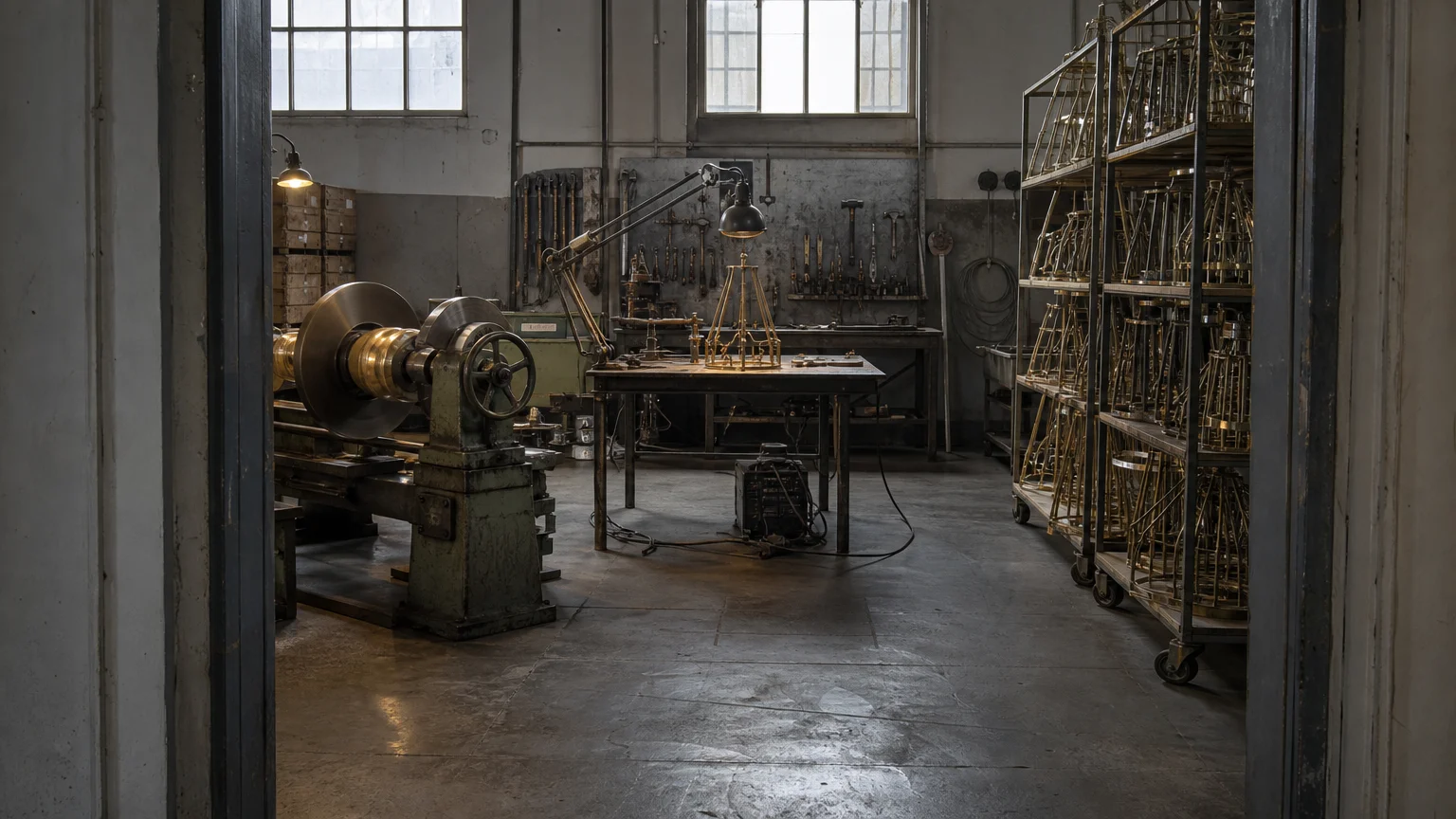
The question every buyer asks first is the one that produces the least information. Asking a supplier whether they are a factory is like asking a restaurant whether the food is fresh: the answer is always yes, and it tells you nothing about what happens in the kitchen. What separates a manufacturer from a reseller is not a self-description but a specific kind of knowledge — the kind that only exists inside a building where the work is actually done.
- 01Why the Obvious Question Fails
- 02Signal One: A Structural Change, Not a Cosmetic One
- 03Signal Two: Sample Turnaround, and Where the Sample Is Made
- 04Signal Three: A Live Call on a Named Process
- 05Signal Four: The Multi-Category Catalogue Paradox
- 06Signal Five: How Minimums and Certification Are Discussed
- 07Three Tests to Run Before You Discuss Price
- 08When a Trading Company Is the Better Answer
01Why the Obvious Question Fails
A trading company sells what other people make. A factory sells what its own machines and hands can produce. That difference is real and it matters, but it is not visible from the outside, because almost everything a buyer can inspect can be borrowed. Supplier badges can be registered. Factory photographs can be taken at a partner’s premises. A walkthrough video can be recorded once and reused for years.
There are also entirely legitimate reasons for the line to blur. Some genuine manufacturers rent a small assembly room to make a technical claim defensible. Some buy in components — lamp holders, drivers, moulded glass — because on a given project the bought-in part is genuinely the right part. A workshop that owns its metalwork and finishing may still purchase a machine-pressed glass shade, and saying so is not an admission of weakness but a description of a supply chain.
So the useful question is not whether someone is a factory. It is which parts of this product they actually make, whether they can show you, and whether their answers come from the floor or from a message they are waiting on. Five signals and three tests are enough to establish that, and none of them requires you to visit China.
02Signal One: A Structural Change, Not a Cosmetic One
Anyone can relay a question about colour. “Could this be made in black instead of brass?” is a question about a finish, and a reseller can pass it along and receive an answer without understanding anything about how the fixture is built.
Ask for a structural change instead: shorten the body, lengthen the drop, increase the diameter proportionally, or replace the glass form with a different one. The answers are diagnostic because they are about capacity rather than preference. A workshop will answer in terms of its own equipment — what the spinning lathe can clamp, whether a new glass mould is required, how large a component the plating tank will take. Those are the sentences of someone standing next to the machine. A reseller has to forward the question, and the reply arrives a few days later, is usually a vague affirmative, and typically carries no price.
There is a sharper version of the same test. Ask the supplier to describe the envelope of what it can build — the smallest and largest diameters it can produce in a given category, and how those limits are set by tooling rather than by marketing. A manufacturer can answer from a category list it measures itself. A reseller has to go and read someone else’s specification, and the answer will arrive without any indication of where the boundary comes from.
The single most useful version of this request is a straightforward one: ask for a dimensional data table covering several categories, with the sample count behind each figure and an honest range rather than a round number. Any real producer can generate that from its own catalogue in a short time. A supplier who cannot, or who replies with suspiciously neat figures, has told you something important without meaning to.
03Signal Two: Sample Turnaround, and Where the Sample Is Made
The second signal is time, and specifically the ratio between the sample and the production run. A sample made on the same line that will make the order has to pass through the same stages as the order — glass forming, metal spinning, welding, finishing, assembly — just with one piece instead of a batch. That takes real time, though less than production. A sample that arrives disproportionately quickly, or disproportionately slowly, is telling you where it came from.
Two extremes are worth distrusting. A sample that can be produced “tomorrow” is usually stock drawn from a shelf, and stock cannot show you what your production order will look like, because it was not made under your specification. A standard catalogue item quoted at a very long sample lead time usually means the seller has to find someone to make it first, and the clock only starts once they have.
The diagnostic question is not only how long, but who and where. Ask directly: who is making this sample, and will the production order run on the same line? A manufacturer answers immediately and in the first person. A reseller’s answer will be about a partner, and the partner’s name may change between the sample and the order.
| What you observe | What it suggests | What to ask next |
|---|---|---|
| Sample in a day or two | Stock being drawn from a shelf | Is this made to my specification, and on which line will my order run? |
| Standard catalogue item quoted at a long sample lead time | The seller has to source production first | Who produces this model, and are they already running it? |
| Sample lead time proportionate to production, with a clear sequence | Same-line production | Can you walk me through the stages the sample passes through? |
| Sample cost, credit policy and approval process stated up front | An established process | Does the sample credit against the production order? |
04Signal Three: A Live Call on a Named Process
The third signal is the hardest to fake and the easiest to request. Ask for a live video call, during working hours, and direct the camera yourself at a process you name in advance. If the catalogue claims hand-formed glass, ask to see the glass station. If the finish is a hand-applied patina, ask to see where the patina is applied and by whom.
A pre-recorded factory tour film proves nothing, because that genre of footage is widely reused and occasionally borrowed entirely. A live call in which the person holding the phone walks where you tell them to is a different kind of evidence, and there are two details that give it away.
The first is scheduling. A workshop can usually arrange a walkthrough within a day or two, because the floor is downstairs. A reseller needs a partner to cooperate, and the delay is often measured in a week or more.
The second is the behaviour of the person holding the camera. Someone who works in that building will walk straight to the station you named, without pausing to orient themselves, and will be comfortable showing the details that matter: a work order on a bench, a nameplate on a machine, a rack of parts in progress. Someone borrowing a partner’s floor hesitates at doorways, films from the entrance, and steers away from close-ups of documentation.
Finish is the process most worth inspecting this way, because it is the stage where quality is easiest to lose and hardest to recover. Where finishing is carried out in-house, it is because the alternative — sending plating and patina work out to whoever is cheapest that month — is the fastest way to lose consistency between batches. A supplier who can explain that trade-off in their own words is describing their own process rather than reciting a brochure.
05Signal Four: The Multi-Category Catalogue Paradox
The fourth signal requires no conversation at all. Look at what the supplier claims to sell.
A company offering lighting, furniture, mirrors and rugs under one roof is almost certainly a trading company, because no single building runs a glass furnace, an upholstery line and a carpet loom side by side. That is not a criticism; it is arithmetic. The paradox also holds inside the lighting category, where it is subtler and more useful.
A real producer’s catalogue tends to be wide in designs and narrow in processes. Hundreds of shapes, but a small family of techniques behind them: metal forming, welding, plating, patina work, glass work, assembly. The diversity is in the configuration, not in the underlying craft. A catalogue where every product appears to come from a different planet usually does come from different planets.
Read a catalogue this way and a second pattern appears. A genuine manufacturer can usually tell you which designs are the backbone of its production — the models it has made repeatedly for years — and will steer a buyer towards them where they fit the brief. A reseller has no backbone to point at, because it has no production history of its own.

06Signal Five: How Minimums and Certification Are Discussed
The fifth signal is in the commercial conversation, and it concerns two subjects where vagueness is most revealing.
Minimums. A minimum order quantity exists to cover a small number of real costs: changing a production line over to a new model, the print-run minimum on custom packaging, and the batch minimum of a surface finishing process. Because those costs are concrete, a manufacturer can point to the specific operation that sets the number. Ask why the minimum is what it is, and a workshop will name a stage. Ask a reseller the same question and the reason tends to evaporate, because the number is whatever their supplier imposed.
Distrust in both directions is warranted. An unusually low minimum on a product with elaborate finishing can indicate that the stock already exists somewhere and is being resold. An unusually high minimum on a simple product can indicate that the buyer is absorbing someone else’s inventory problem.
Certification. Safety certification applies to a specific model, for a specific market, and is arranged as a separate item. It is not a property of a company. A supplier who responds to a certification question with a general assurance that “everything is certified” — without naming a model, a mark or a cost — is describing a marketing position rather than a test programme. The productive request is narrow: for this model, for my market, which mark applies, and what does it cost as a line item. Where the mark is issued by a nationally recognised testing laboratory, the certificate or report number refers to the model it was issued for, and it is worth asking to see the document rather than the sentence.
Payment terms belong in the same conversation. In this trade, the common arrangement is a deposit at order confirmation with the balance due before shipment, remitted to a company bank account. Two patterns are worth treating as warnings: a request to pay a personal account, and a supplier content to begin “production” with no deposit at all, which usually indicates that goods already exist rather than that manufacturing is about to start.
| Subject | Answer that suggests a manufacturer | Answer that suggests a reseller |
|---|---|---|
| Why this minimum? | Names the operation that sets it | Reason disappears under questioning |
| Certification | Per model, per market, quoted as a line | “Everything is certified”, no model named |
| Payment | Company account, standard deposit terms | Personal account, or no deposit required |
| Structural changes | Answered with capacity limits and prices | Forwarded, then answered vaguely |
07Three Tests to Run Before You Discuss Price
Signals are read; tests are performed. The three below take a fortnight at most and are worth completing before price becomes the subject of the conversation, because a supplier who fails them will not become easier to manage once an order exists.
Test one: walk the floor live. Direct a video call through the route your product would take: incoming material, metal or glass forming, welding, surface finishing, assembly, packing. If you are buying glass pendants, look at the glass area. If you are buying patinated brass, look at where the patina is applied. Prefer a call where you choose the shots.
Test two: ask what is made in-house and expect a qualified answer. Every factory outsources something, and a straightforward answer will volunteer which parts without being pushed. The warning sign is an instant and total “we do everything”. Follow up with a question that a catalogue cannot answer: how is patina consistency held between batches, and who carries out the wiring, to which standard. You are not checking whether the answer is correct; you are listening for whether it comes from experience or from a pause while someone messages the actual producer.
Test three: buy the sample of the model you intend to order, then measure it. Not the display unit, and not whatever is closest to hand — the specific model you plan to buy. When it arrives, check it against its own specification: diameter, drop, weight, cable quality, finish coverage inside joints, and the finish on the mounting plate where nobody looks until installation. Then keep it. A sample is a quality agreement, and production should be compared against it rather than against a photograph. Samples routed through an intermediary tend to take noticeably longer, because they pass through an extra pair of hands in each direction.
A short enquiry makes all three tests faster. Six questions cover most of what matters: which parts are made in-house and which are bought in; whether the drop, diameter or glass form can be changed and at what cost; how long the sample takes and whether it is made on the production line; whether a live video call to a named station is possible during working hours; what drives the minimum quantity; and which certification mark applies to this model for this market and what it costs.

08When a Trading Company Is the Better Answer
None of the above makes trading companies the wrong choice. A good one earns its margin in three ways, and for some buyers those three ways are worth more than direct access.
Consolidation. If an order contains forty lights, six mirrors and two console tables for a single container, no single factory will fill it. A trading company will, and it will present the result as one shipment and one set of documents.
Access. Many excellent small workshops have no export function, no English-language correspondence and no interest in acquiring either. A trading company is genuinely the only door to that capacity, and the buyer who insists on dealing directly with a producer may simply be excluding good producers from consideration.
Coordination. Dealing with five suppliers means five points of contact, five contracts, five sets of quality records and five potential excuses. A trading company collapses that into one, and for smaller buyers that service is the product.
Direct manufacturing wins on depth rather than breadth. Structural customisation answered by the people who will make it, a finish held consistent across repeat orders, certification arranged per model rather than asserted in general, and one fewer layer in the price. Where lighting is the core of what you buy and how it is made is the thing you care about, the three tests above will find the right partner for it. Where the order is genuinely mixed and the priority is a single container leaving on time, the trading route is not a compromise — it is a different and often better answer.
Source type: the signals and tests described here reflect general trade practice in the decorative lighting industry and published guidance from suppliers working in it. No supplier, factory or brand is identified or compared in this article. Certification requirements vary by market, by model and by project, and are confirmed in a formal quotation together with the applicable certificate or test report; minimum quantities, sample lead times, payment terms and production windows are indicative until confirmed in an order.
Frequently Asked Questions
How can I tell whether a lighting supplier is a factory or a trading company?
Ask questions only a workshop can answer from its own floor: what structural changes are possible and why, how long a sample takes and where it is made, whether a live video call can show a named process, and what specific operation sets the minimum quantity. Answers that arrive promptly in the first person, with capacity limits and costs attached, come from a manufacturer. Answers that must be forwarded, and return vague and unpriced, do not.
Is buying from a trading company a mistake?
No. A good trading company consolidates mixed orders that no single factory could fill, provides access to small workshops with no export function, and replaces five supplier relationships with one. The mistake is not knowing which kind of business you are negotiating with, because the expectations you should hold differ for each.
Why does a structural change request reveal so much?
Because it is a question about capacity rather than taste. A workshop answers in terms of what its own equipment can do — what a spinning lathe can clamp, whether a new glass mould is needed, how large a component the plating tank accepts. A reseller must relay the question and cannot explain the answer it receives.
What should I check on the sample when it arrives?
Measure it against its own specification: diameter, drop length, weight, cable quality, finish coverage inside joints, and the finish on the mounting plate. Order the model you actually intend to buy rather than a display unit, and keep the approved sample as the reference for production.
How should a supplier discuss safety certification?
Per model, per market, and as a separately quoted line. Certification attaches to specific products rather than to a company, so a general assurance that everything is certified is not a useful answer. Ask which mark applies to this model for your market and to see the certificate or report number that refers to it.
What payment terms are normal in this trade?
The most common arrangement is a deposit at order confirmation with the balance payable before shipment, sent to a company bank account. A request to pay a personal account, or a willingness to start production with no deposit at all, are both worth pausing over.
Do I need to visit in person?
Not always. A live video call in which you direct the camera at processes you name covers much of what an in-person visit reveals, and the three tests described above can be completed remotely in a couple of weeks. An in-person audit adds most value where the order is large enough to justify it and the finish is critical to the scheme.
Working Out Who You Are Actually Dealing With?
Send us the model or the drawing you are considering, the quantities and the destination market, and ask the questions above directly. We will answer them in terms of our own floor: which stages of the work we carry out, which parts we buy in because the bought-in part is the right one, how the finish is held consistent between batches, and what the sample and production windows would be for your specific order.
If you are still at the stage of mapping the trade, our notes on choosing a hotel lighting partner set out how the selection criteria change with project type, and our procurement FAQ collects the questions that come up most often before a first order. For the geography behind the supplier map, our guide to sourcing lighting in Zhongshan explains how the production cluster is organised. On the operational side, the stages a hotel lamp passes through shows what a production route looks like from the inside, and our notes on pre-shipment inspection cover what to verify before a batch is packed. If the finish is the part you cannot afford to get wrong twice, our guide to evaluating samples and mock-ups shows how to approve it once. Our project team will run the three tests with you on a specific order.


