
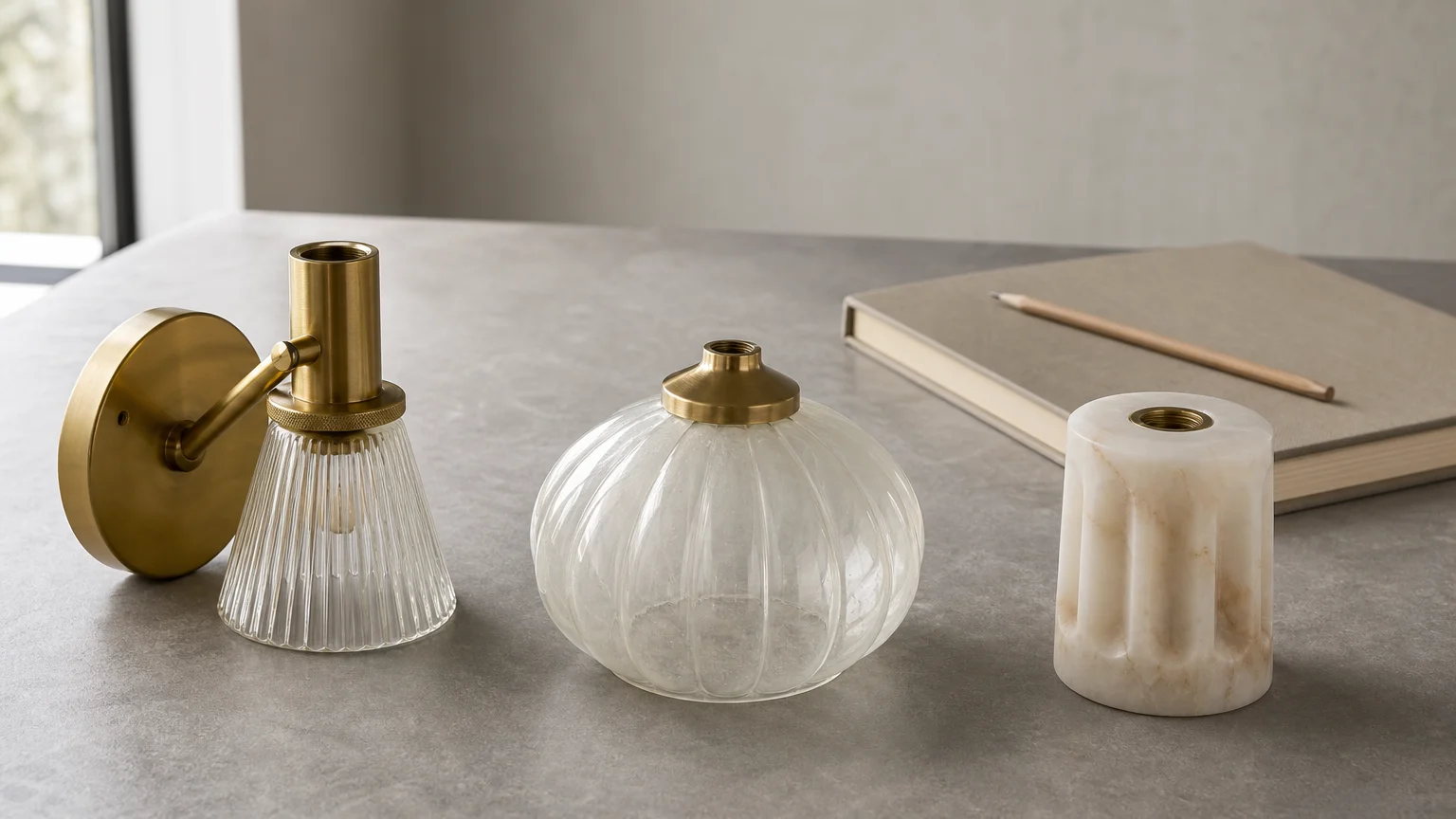
Every lighting budget begins with the same question, and it is usually asked in the wrong form. The wrong form is “what does a chandelier cost”.
The right form is “what band does this category sit in, and which of the visible features pushes a quotation from one band to the next”. A budget built from bands survives contact with a quotation. A budget built from a single number does not.
- 01Why a Band Beats a Price List
- 02What Actually Moves the Band
- 03Brass and Iron: The Wide Middle
- 04Crystal and Glass: Where the Ceiling Disappears
- 05Alabaster and Stone: The Upper Register
- 06Three Tiers: Entry, Project and Statement
- 07A Space-by-Category Cross-Reference
- 08Budgeting Discipline: Ranges, Exclusions, Quotation
01Why a Band Beats a Price List
Decor lighting resists list prices for a structural reason: almost every fixture in a project is configurable.
Diameter, drop length, finish, lamp holder, number of arms and the choice between replaceable lamps and an built-in LED module are all variable, and several of them are settled per order rather than per catalogue. A number printed once cannot describe a product whose spec changes with the project.
What a catalogue can describe, honestly, is a band: the range within which a category’s prices normally fall, and the features that determine where inside that range a specific spec lands.
That is a more useful instrument for budgeting than a single figure, because it lets a project team ask a precise question — does this line belong to the lower or the upper part of the band — and get an answer that a supplier can defend.
Three rules keep bands useful rather than decor.
Bands are ranges, not prices. A band describes where quotations cluster, not what a particular quotation will say. Any figure used before an order exists is indicative and subject to a formal quotation, which is the only document that carries a price.
Bands are per category, not per photograph. Two pendants that look similar in a rendering can sit in different bands because one is a spun metal shade and the other is a hand-formed glass shade, and the labour behind them differs by an order of magnitude.
Bands are anchored to the fixture, not to the room. What a space costs is the fixture band multiplied by quantity, plus fitting, freight and contingency. Confusing the two is the most common way a lighting budget is overstated in one room and understated in another.
Source type: the bands discussed in this article are indicative ranges drawn from publicly listed catalogue prices across suppliers in this trade, not a price list and not a quotation. Every figure is subject to a formal quotation, and to the spec, quantity, finish, destination and delivery terms of a specific order.
02What Actually Moves the Band
Four variables explain most of the movement between one band and the next. Understanding them is more valuable than memorising numbers, because they let a buyer predict the band before asking.
Material and how it is worked. This is the largest single factor. A fixture built from a spun or bent metal frame carries the cost of forming, welding, finishing and assembly, with material as a modest addition.
A fixture whose shade is hand-blown glass adds a furnace, an annealing cycle and a skilled hand at the pipe. A fixture cut from stone adds selection, cutting, turning and wet polishing, plus a material loss rate that rises with the size of the piece.
Scale. Cost does not track diameter linearly. A statement piece 1.4 metres across is not priced as a multiple of a 400 mm version, because the frame has to be engineered rather than bent, the drop has to be structurally planned.
The freight turns a project of its own with crating and handling. Scale is the main reason upper-band fixtures sit so far above mid-band ones.
Lamp source and driver. Replaceable lamps keep a fixture simple: a standard holder, a standard cable and no driver. An built-in LED module brings a driver, a thermal plan and a dimming compatibility question, all of which are settled per order by destination and by the control system in the building.
The difference is not large in the entry band and turns marked as the fixture grows, because a large built-in fixture may need driver selection engineered for its specific load.
Finish and quantity. Finish cost is mostly a batch cost rather than a per-piece cost, so it behaves in a way that surprises buyers. A finish the plant already runs adds little. A finish developed to a client’s reference adds a development cycle on test pieces before any production begins.
And within the decor trade, the finish is often a batch process, which is why quantity interacts with price in a stepped rather than smooth way: the same run, shared across more units, lowers the unit price without changing the process.
| Variable | Moves the band up when… | Moves it down when… |
|---|---|---|
| Material and process | Hand-formed glass, cut stone, large cast or fabricated frames | Spun or bent metal, standard pressed glass, stock parts |
| Scale | Diameter and drop both large; multi-tier or engineered suspension | Compact or single-tier; standard drop lengths |
| Lamp source | Built-in LED with a specified dimming protocol | Replaceable lamps on a standard holder |
| Finish | New recipe developed to a client reference | Finish already in routine production |
| Quantity | Small, dispersed runs; many models | One long run; few models; consolidated finish |

03Brass and Iron: The Wide Middle
Metal fixtures — brass above all, but also iron, steel and aluminium — occupy the widest part of the decor market and the widest band within it. That range is a function of scale and finish more than of material, because metalwork is the most configurable of the decor processes.
At the lower end sit compact fixtures: wall lights of modest width, small pendants, simple fixed ceiling fittings. These are built from tubing, rod and sheet, formed on a lathe or a bender, welded into a frame, finished and wired.
In published catalogue data across this trade, the majority of fixtures of this kind sit in the low hundreds to around a thousand US dollars, and a great many decor wall lights and small pendants sit below the middle of that range.
The middle of the band is where most project spec happens. A well-made wall sconce for a hotel guest room, a linear pendant over a bar, a mid-size pendant over a dining table — these are the fixtures that repeat across a building.
They usually occupy a band from roughly one thousand to several thousand US dollars per fixture, with position inside the band set by size, finish development and whether the light source is built-in. In this part of the market, quantity is the lever that matters most, because a single run of several hundred identical fixtures shares one set-up and one finishing batch.
The upper part of the metal band belongs to oversize and engineered pieces: long linear fixtures for a lobby, multi-arm chandeliers, custom frames that must be structurally planned before they can be made, and any piece whose suspension needs to be designed rather than chosen.
These enter the same range as large glass and crystal work, because at that scale the constraint is engineering rather than material.
One practical observation about metal worth carrying into a budget meeting: brass is more forgiving to specify than finishes suggest, and more costly to re-specify than buyers expect.
Committing to a finish the plant already runs keeps a fixture in the band it was budgeted in. Introducing a finish developed to a reference adds a development cycle and a sample stage, and both have to be paid for before the first production piece exists.
04Crystal and Glass: Where the Ceiling Disappears
Glass and crystal fixtures behave differently from metal, in a way that is easy to predict once seen. Their floor is higher and their ceiling is far higher, because both ends of the category exist.
At the lower end, a pressed-glass or simple blown-glass pendant is a manufactured object with a modest labour content per piece, and in published catalogue terms a large share of glass pendants sits in the same broad middle band as mid-range metalwork.
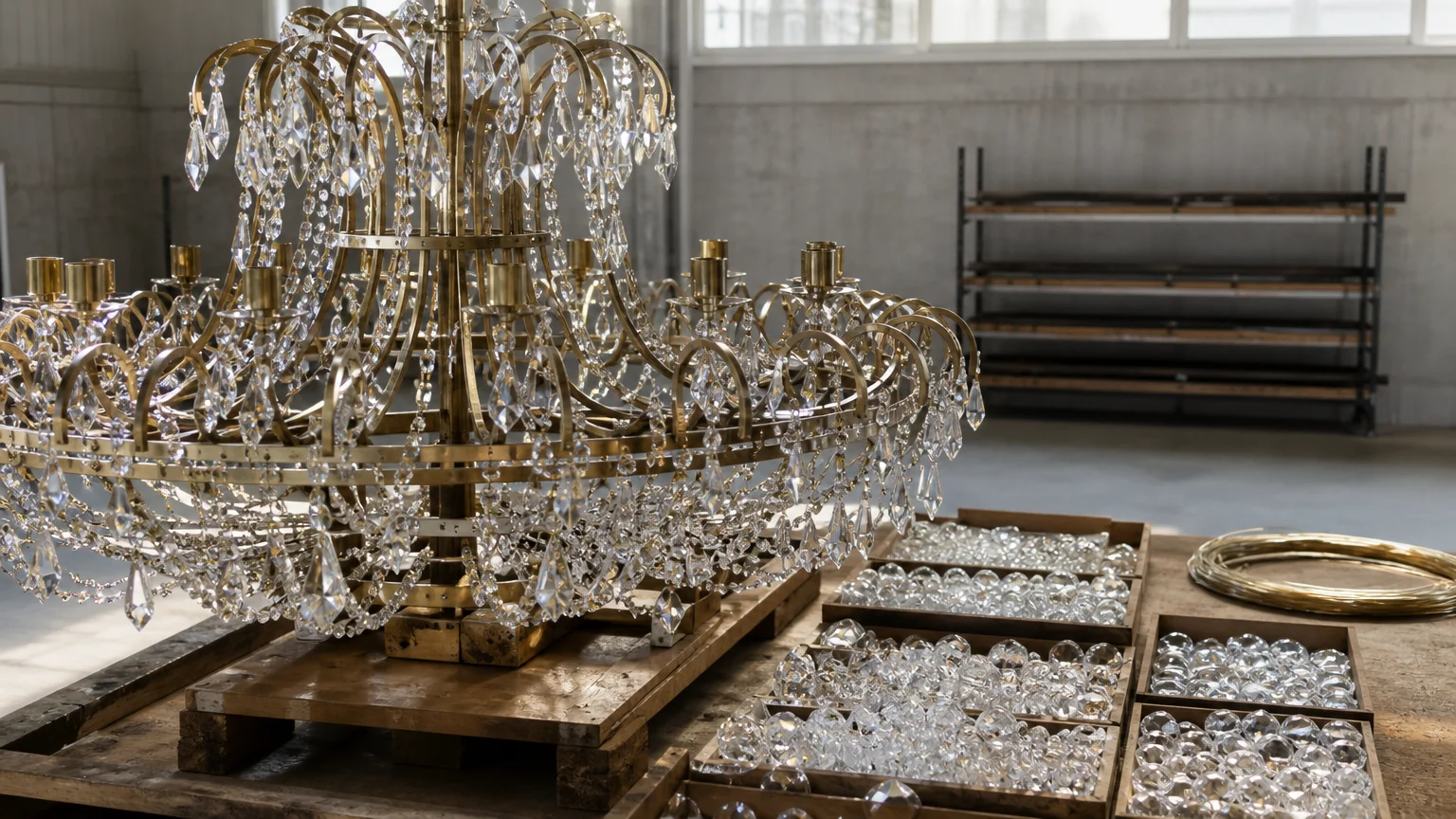
At the upper end, an art glass chandelier with hand-formed parts, or a crystal chandelier with several hundred cut parts, is a different kind of buy.
Published catalogue statistics in this trade place the middle of the crystal chandelier category around the upper four figures in US dollars, with art glass and large glass chandelier categories sitting close to it. The widest pieces quoted individually well above the band.
Three features drive the movement.
Part count and assembly. Crystal work is largely an assembly discipline. Several hundred cut pieces have to be threaded, balanced and hung so that the finished fixture sits level and reads evenly, and that labour is proportional to the number of parts rather than to the size of the frame.
Hand versus machine forming. Hand-blown glass varies slightly in wall thickness and form, is annealed over time, and carries a rejection rate that machine production does not. Moulded or pressed glass is more uniform and much faster to produce. The visual difference is real, and so is the price difference.
Packing and freight. Glass and crystal fixtures carry a disproportionate share of the freight cost, because crating has to protect fragile parts across a container journey. Where a fixture is both large and fragile, packing and handling can turn a visible line in a quotation rather than an overhead.
For budgeting purposes the useful summary is this: the entry into glass and crystal is not much above metal, but the category’s top end is essentially open, and a project that budgets one number for “the crystal fixtures” without a size ceiling has not yet budgeted them.
05Alabaster and Stone: The Upper Register
Stone and alabaster sit at the top of the decor bands, and for reasons that are physical rather than fashionable. In published catalogue data across this trade, alabaster lighting categories show the highest mid-band of the material groups, with chandeliers and pendants cut from stone occupying bands broadly comparable to high-end crystal work or above it.
Four factors explain the position.
Material selection and loss. Stone is cut from a block, and the block has to be chosen for grain and translucency before anything is made. Large pieces need large blocks, and the proportion of a block that survives into a finished shade falls as the piece grows.
Working time. Cutting, turning, shaping and wet polishing are sequential work, and wet polishing in particular is slow because the material has to be kept cool and worked evenly.
Drying and handling. Stone parts need care between stages; a shade that is machined too quickly or handled roughly at the wrong moment is a loss, and loss rates are built into the price of the category.
Uniqueness as a spec. Because every alabaster piece differs in grain and translucency, a matched row of stone pendants over a bar cannot be produced by selection alone. Projects that need a set to read as a set are specifying something harder than a single piece, and the band reflects that.
Two budget consequences follow. First, alabaster belongs in the band reserved for statement work rather than for repetition, although it is ever more used in wall lights and table lamps where small parts moderate the cost.
Second, where a scheme calls for a row of stone fixtures, the quantity should be fixed early, because the material has to be chosen against a known need rather than piece by piece as orders arrive.
06Three Tiers: Entry, Project and Statement
Categories are useful for comparison, but budgets are built in tiers. The three below describe how decor fixtures are actually specified on projects, and they cut across material groups.
| Tier | Typical feel | Indicative band per fixture (USD) | Where it appears |
|---|---|---|---|
| Entry | Compact metal or simple glass; replaceable lamps; standard finishes | Low hundreds to about 1,000 | Guest rooms, corridors, back-of-house, home |
| Project | Specified metal, glass or mixed construction; controlled finish; repeat across a building | About 1,000 to about 6,000 | Lobby, restaurant, bar, suites, feature corridors |
| Statement | Large or engineered; hand-formed glass, crystal, stone; individual quotation | About 6,000 upward, open-ended | Atrium, ballroom, lobby centrepiece, signature dining |
Indicative bands only, derived from publicly listed catalogue prices across this trade, and not a price list. Actual pricing depends on spec, quantity, finish, light source, destination market, certification and delivery terms, and is confirmed only in a formal quotation.
Read as a plan rather than as a table, the tiers show why lighting budgets drift. Most of a hotel’s fixture count sits in the entry tier, where small unit differences multiply into large total differences.
Most of a hotel’s visual budget sits in the statement tier, where a single change of scale can move a line by more than the entire entry-tier package. Neither is wrong, but they need to be managed with different discipline: quantity control for the first, early freeze for the second.
The tier structure also explains a common misreading of quotations. A supplier returning a price that looks high against a category band is usually pricing a different tier rather than a different margin. The two productive questions are which tier the quotation represents, and which specific feature put it there.
07A Space-by-Category Cross-Reference
Selection usually begins with a picture and ends with a spec. Reversing the order — fixing the tier first, then choosing the shape — keeps a scheme inside its budget without narrowing the design as much as designers expect.
The table below maps the spaces a hospitality project contains to the categories and tiers that normally serve them.
| Space | Categories normally used | Tier in most projects | Budget note |
|---|---|---|---|
| Guest room | Wall lights, bedside pendants, table lamps, ceiling or recessed fill | Entry | Highest unit count in the building; small unit savings dominate the total |
| Corridor | Wall lights, compact pendants, semi-flush fittings where ceiling height is limited | Entry to project | Spacing evenness matters more than per-piece spec |
| Lobby and lounge | Statement pendants and chandeliers, large linear fixtures, floor and table lamps | Project to statement | Freeze scale early; it is the single largest budget variable |
| Restaurant and bar | Pendants over tables, linear fixtures over bars, decor wall lights | Project | Height above the table and dimming intent affect spec |
| Ballroom and meeting space | Large chandeliers, linear and ring fixtures, controlled scene lighting | Statement | Often one of few individually quoted lines |
| Bathroom | Mirror and vanity wall lights, small pendants | Entry to project | Position class matters: confirm which points need a damp construction |
| Spa and pool | Wall lights, moisture-rated pendants, decor stone where used | Project | Confirm which models are suitable for the exposure before selection |
| Suite and villa | Mixed: repeat guest-room categories plus feature pieces | Project | Usually the main location of statement-tier spend outside public areas |
| Covered terrace | Outdoor-rated pendants and wall lights | Project | Only a share of a decor range suits outdoor service; confirm per model |
Two caveats belong with that table. Mounting heights, fixing methods and position classes are project-specific: final positions depend on site conditions and local needs, and structural safety should be confirmed by a qualified engineer.
And the table describes categories, not models — a wall light can sit in the entry tier or well into the project tier, and the difference will be visible in the spec long before it is visible in the price.
08Budgeting Discipline: Ranges, Exclusions, Quotation
A lighting budget that survives to the end of a project is built from five habits, none of them complicated.
- Budget in ranges, and carry the width. A line budgeted as “300 to 900 per fixture” behaves differently from one budgeted at 600, because the first tells the project team where the decision sits and the second hides it.
- Fix the tier before the shape. Deciding that lobby fixtures belong to the project tier, and that the atrium permits one statement piece, prevents a design conversation from quietly moving a line two bands upward.
- Separate the fixture from everything around it. Freight, crating, fitting labour, dimming equipment, spares and contingency are not part of the fixture band, and treating them as if they were produces a budget that looks generous until the first shipment is quoted.
- Hold spares in the first order. Spare fixtures ordered with the main run share its material, its finishing batch and its documentation. The same spares bought later are a separate production event, frequently at a worse price and never an exact batch match.
- Write down what is provisional. Where a market, a ceiling height or a finish is not yet fixed, marking the line provisional converts a late surprise into a scheduled conversation. Movement in hotel lighting budgets after award concentrates in exactly these lines.
Finally, treat the band as a diagnostic rather than a barrier. When a quotation arrives above the band a project expected, the useful question is not whether the supplier is costly but which of the four variables — material and process, scale, lamp source, finish development — moved the line.
In most cases the answer identifies a decision that can be revisited deliberately, at a moment when revisiting it is still cheap, rather than at a moment when the fixtures are already in finishing.
Every price reference in this article is indicative, is derived from publicly listed catalogue prices across this trade rather than from any single supplier, and does not constitute an offer. Prices, minimum quantities, lead times, payment terms, warranty and certification arrangements are governed by a formal quotation and the terms of the resulting order.
Frequently Asked Questions
Why won’t a supplier give me a fixed price list?
Because decor fixtures are configured per project. Diameter, drop, finish, lamp holder and the choice between replaceable lamps and an built-in LED module are all variables, and several are settled per order by destination and by the control system in the building.
A catalogue can describe a band honestly; it cannot print a single number that remains true across those variables.
Which fixture category is the most costly?
Stone and crystal categories generally occupy the highest bands, followed closely by large engineered metalwork. The more useful distinction is scale rather than material: a modest alabaster wall light can cost less than a large engineered brass pendant, because at the upper end the constraint turns engineering and handling rather than the raw material.
How much of a lighting budget should go to guest rooms?
Guest rooms carry the highest unit count in a hotel and usually the lowest unit value, so they consume a large share of the fixture count and a smaller share of the visual spend. That is why small per-unit savings in the guest-room package matter more to the total than larger savings on a single statement piece.
Does a larger order always cut the unit price?
It cuts it, but not smoothly, because parts of the cost behave in batches rather than per piece. Production set-up and surface finishing are fixed per model or per batch, so a longer run shares them across more units.
Assembly is broadly proportional. The result is a stepped improvement rather than a straight line, and consolidating models onto one finish often achieves more than simply adding quantity.
Why does an built-in LED fixture cost more than one with replaceable lamps?
Because an built-in fixture carries a driver, a thermal plan and a dimming compatibility question, all of which are resolved per order by destination and by the building’s control system. Replaceable lamps on a standard holder avoid all three. The difference is modest on small fixtures and turns marked as the fixture grows.
How should I budget for spares?
As part of the first order rather than as a later buy. Spares produced with the main run share its material, its finishing batch and its documentation, and they share its set-up cost. Weight the allowance towards the fixtures most exposed to damage and state the quantity on the schedule the plant prices from.
Are the bands in this article firm figures?
No. They are indicative ranges drawn from publicly listed catalogue prices across suppliers in this trade, intended to help a project team place a spec in the right part of the market. Actual pricing depends on spec, quantity, finish, light source, destination market, certification and delivery terms, and is confirmed only in a formal quotation.
Budgeting a Lighting Package and Not Sure Which Band You Are In?
Send us the spaces, the categories for each, the quantities and the finish direction.
We will tell you which lines sit in the entry, project or statement tier, which features are pushing them there, and where a small change to scale or finish would move a line without changing the design intent — so the budget you take to the client reflects a spec rather than a wish.
Two companion pieces help with the detail. Our breakdown of what drives custom chandelier cost covers the nine factors behind an individual quotation, which is the natural next step once a category band has been fixed.
Our guide to chandelier materials compares crystal, glass and metal construction in spec terms rather than in price terms, and our notes on materials and finishes explain why two fixtures at the same price can age very differently. Where light source and lamp holder are the variable, lamps, holders and sources sets out how that choice is made by market.
For the practicalities of ordering, our guide to the enquiry structure that produces a usable quotation on the first attempt covers the information a supplier needs, and our notes on shipping and installing custom fixtures deal with the costs that sit outside the fixture band. Our project team can review a schedule against the tiers and flag the lines that are most likely to move.


