
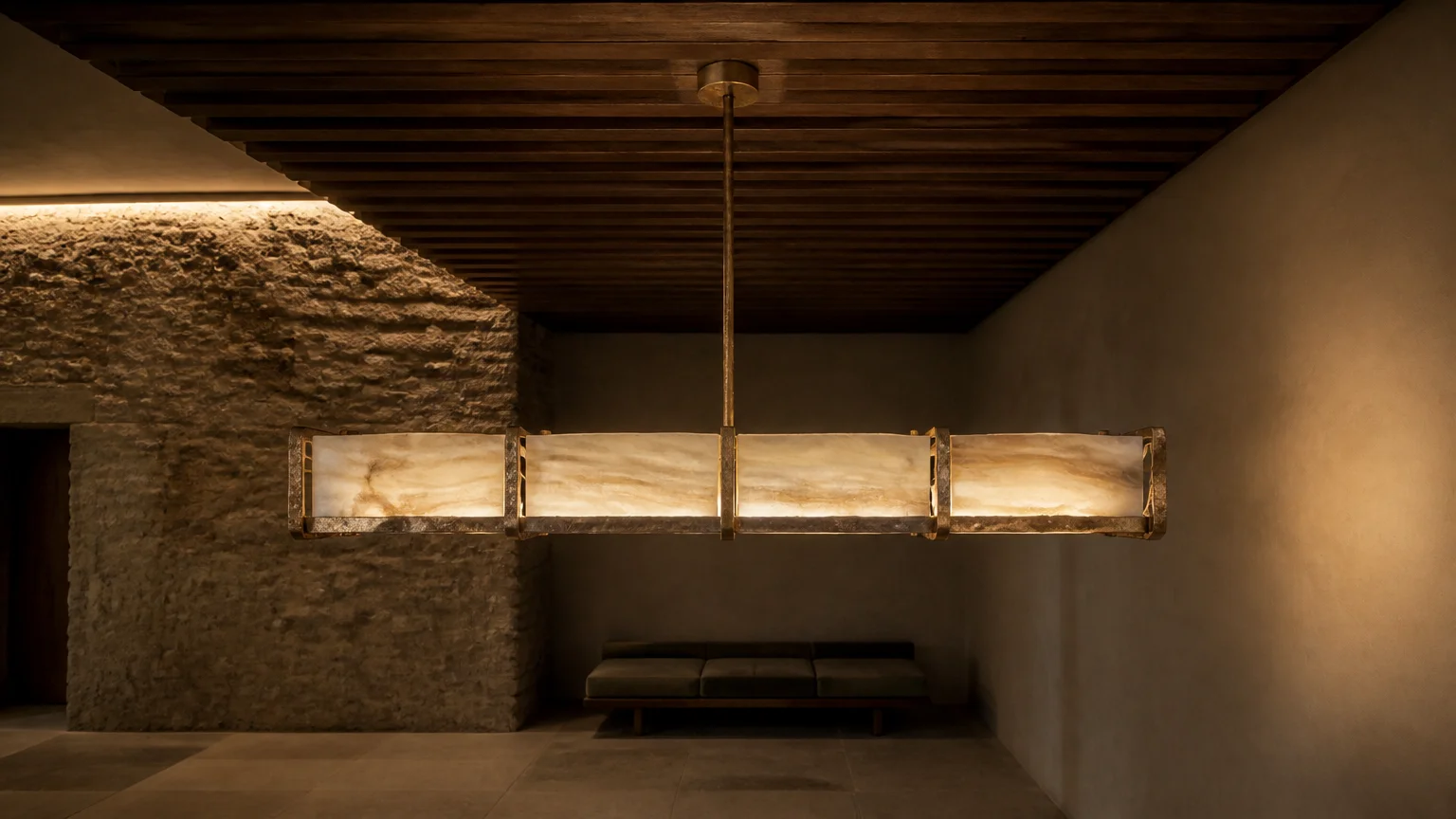
Regional identity is easy to claim and difficult to build. A fixture either carries the place in its material, its form and its light — or it wears the place as a graphic, and the difference is obvious the moment the room opens.
Hospitality design has spent the last several seasons moving away from decorative regionalism. The newer projects describe themselves differently. A property on the Niagara peninsula was presented not through wine-country iconography but through material, light, landscape and craftsmanship — sculptural form derived from the local escarpment, slender vertical timber echoing the rows of a vineyard, a palette of warm oak, natural stone and woven textile. A converted nineteenth-century tobacco and textile building in the North Carolina piedmont was explained through its own geology and its own industry: granite from the local quarry informing the hard surfaces in the public areas, and the building’s textile history informing layered fabric, archive-derived wallpaper patterns, and headboards that echo the wheels of textile production. In an eastern Chinese lakeside city, a new hotel drew on regional aesthetics and on full-height glazing that brings daylight into every room, with garden and water views carried into the interior.
Three projects, three regions, one shared method: the place enters the design through what the building and the landscape are made of, and through how people there actually live, rather than through a symbol applied to a surface. For a bespoke lighting brief, that method is both an opportunity and a trap. The opportunity is that local material and local craft give a fixture a reason to exist that a catalogued product cannot have. The trap is that the same words — authentic, rooted, of the place — are equally available to a design that has thought about it and one that has not.
This article sets out how regional identity actually gets into a fixture, what three common approaches fail at and why, and how to write the intent into a specification so that the story survives manufacture, installation and the third year of operation. The companion piece for the stage before this one — extracting buildable requirements from a designer’s mood board — is our guide to reading a lighting mood board the way a factory does.
- 01Why Place Keeps Reaching the Lighting Brief
- 02Three Ways a Fixture Can Carry a Place
- 03Counter-Example One: The Applied Symbol
- 04Counter-Example Two: Colour Without Reason
- 05Counter-Example Three: One Object, Repeated
- 06Material Sourced Locally: What It Changes
- 07Form From a Local Craft Vocabulary
- 08Light Behaviour That Belongs to the Place
- 09Specifying It Without Freezing the Story
- 10Keeping the Story After the Project
01Why Place Keeps Reaching the Lighting Brief
Two forces have pushed regional identity into the lighting package, and neither is primarily aesthetic.
The first is commercial. Conversion and adaptive reuse have become a large share of hospitality supply, and a building that already exists comes with its own material reality: a structural frame, a stone or brick envelope, a ceiling height, a window pattern, a set of constraints that no amount of design intent will remove. A fixture specified for a converted warehouse cannot behave like one specified for a new-build atrium, and designers have increasingly chosen to make that constraint visible rather than to hide it. The result is lighting that is asked to participate in a narrative about the building rather than to fill a standard specification line. The procurement logic behind this shift is set out in our guide to conversion lighting and brand standards.
The second is a change in what guests reward. When a traveller moves through a dozen properties with similar palettes and similar comfort, the thing that distinguishes one is specificity: a material that could only come from there, a light behaviour that belongs to that climate and that way of using a room. Lighting is unusually well placed to carry that, because a fixture is one of the few elements of an interior that is both looked at and looked by. It is an object when it is off and a source of atmosphere when it is on, and both states are read.
What follows from this is that “regional” cannot be a finish decision taken at the end of a project. It has to be established at the same time as the fixture’s form and its optics, because the three are dependent: a local material imposes a thickness, a thickness imposes an optical approach, and the optical approach determines the form the fixture can take. A project that treats the regional story as a decorative layer added after the fixture is resolved will end up with a fixture that is neither regional nor well resolved.
02Three Ways a Fixture Can Carry a Place
There are exactly three mechanisms by which a light fitting can belong to a location, and a strong project usually uses two of them. Anything else is styling.
Material that comes from there. The stone quarried within the region, the timber species that grows locally, the metal that the local industry works, the clay or plaster or fibre that the local building tradition uses. This is the most direct mechanism and also the most demanding, because local materials have their own behaviour: they carry variation, they limit thickness and span, they may not be available in the required quantity, and they often need to be finished in a way that respects their natural character rather than concealing it.
Form derived from a local craft or construction vocabulary. Not a local symbol, but a local way of making: how the region’s joinery resolves an edge, how its metalwork forms a bracket, how its masonry handles a corner, how a local boat or basket or loom puts a curve together. This mechanism is more transferable than material and it survives when the material has to change. It is also the one that most reliably reads as authentic, because a craft-derived form resolves loads and joints the way the local craft does, and that logic is visible.
Light behaviour that belongs to the way people there live. How a room is used in the evening, how bright it is expected to be, whether light comes from above or from the side, whether a space is occupied in the middle of the day or only after dusk, whether a culture gathers around a table, a hearth, a courtyard or a screen. This mechanism is the least discussed and often the most powerful, because a guest recognises the behaviour of a room before they can articulate anything about its design. Some of the practical side of this is treated in our guides to warm dimming as a guestroom amenity and to scene design by the numbers.
A project that uses material and behaviour together tends to be convincing even when its forms are simple. A project that uses none of the three and relies on graphics is the subject of the next three sections.
03Counter-Example One: The Applied Symbol
The first failure is the most common and the easiest to recognise: a motif taken from the region’s visual culture and applied to the surface of a fixture that would otherwise be identical anywhere in the world.
The pattern is familiar. A region has a well-known decorative tradition — a lattice, a tile geometry, a botanical motif, a historic ornament — and it is laser-cut into a metal screen, printed onto a shade, or etched into a glass panel. The fixture is then described as inspired by local heritage.
Three problems follow. The first is that the ornament is doing work that the fixture’s structure is not doing: the silhouette, the proportions and the light distribution remain generic, so the piece reads as a standard product wearing a costume. The second is that the motif is usually a form that originally belonged to a different material and a different method — a joinery pattern rendered in sheet metal, a textile geometry rendered in glass — and the translation loses the logic that made it meaningful. The third is that the motif is borrowed from a tradition that is not the project’s, which creates a cultural claim the project cannot support.
The alternative is not to design without ornament; it is to let a local method, rather than a local image, decide how the fixture resolves its parts. Ask what the region’s craft does at the point where two materials meet, how it terminates a line, how it deals with a joint, how it handles a corner under load. Answer those questions and the resulting detail will be specific to a place even though nothing on the fixture depicts it.
04Counter-Example Two: Colour and Pattern Without Reason
The second failure is subtler and it survives design review more easily, because it looks tasteful. A warm palette is assembled, some regional texture is introduced, and the resulting fixture is described as belonging to the location. But nothing in it could not have been assembled for a different location with different photographs on the mood board.
The tell is that the palette has no cause. A warm amber glow in a cold climate with long dark evenings and a tradition of gathering indoors is a different decision from the same amber glow in a hot climate where the room is used in the middle of the day and the architecture excludes sun. One is a behaviour; the other is an atmosphere. The same applies to level: a region whose domestic interiors are habitually brighter and more evenly lit will read a very dim, very contrasty scheme as inhospitable, while a region with a strong evening culture may find a bright, even room flat and clinical.
The cause does not have to be scientific to be real. What matters is that the decision can be explained in terms of how people live in that place and what the building does with daylight, rather than in terms of a colour family that appeared in a reference. A designer who can answer “why this colour temperature, in this room, in this climate, for this hour” has made a regional decision. A designer who can only answer “because it looked right” has made an aesthetic one, and it will not survive the first value-engineering conversation.
The practical way to test this before specification is to write one sentence per decision, in the form: the light behaves this way here because in this place the room is used like this. Where that sentence cannot be written, the decision is styling. The mechanics of building a defensible colour-temperature case are set out in our guide to colour temperature in hotel lighting.
05Counter-Example Three: One Object, Repeated
The third failure is the most recent, and it usually arrives with good intentions. A single strong regional object — a boat, a basket, a lantern, a tool, a musical instrument, a loom component — is selected and reproduced at scale. One becomes an installation, ten become a colonnade, a hundred become a ceiling.
At small repetition the approach can work. A single large piece that quotes a local object, carefully made and placed as an arrival statement, reads as a genuine gesture. At high repetition the mechanism inverts: the object stops being a reference and becomes a pattern, and a pattern of a specific object communicates merchandise rather than place. The more precisely the object is replicated, the stronger the effect, because replication removes exactly the handmade irregularity that made the original worth quoting.
There is also a cost dimension that projects discover late. A hundred reproduced sculptures multiply fixing points, driver locations, cleaning routes and replacement parts by a hundred, and each of those multiples is a maintenance obligation rather than a design feature. The access and cleaning consequences of a dense installation are treated in chandelier hoists and cleaning routes, and the structural arithmetic of large suspended pieces in engineering large custom fixtures.
The alternative keeps the gesture and drops the multiplication. Use the local object’s logic rather than its outline: how it is assembled, how it carries load, how it opens and closes, how it is repaired. A canopy derived from how a local boat is ribbed will read as belonging without being a boat, and it will be buildable, repeatable and serviceable as a lighting component rather than as a hundred copies of a souvenir.
06Material Sourced Locally: What It Actually Changes
Sourcing material locally is the most direct route to a regional fixture, and it changes more of the project than most designers expect.
It changes thickness and therefore optics. A local stone may be denser, softer, more fractured or more translucent than the imported material it replaces. Because a light-transmitting panel’s behaviour depends on thickness and internal structure rather than on colour, a substitution can turn an even glow into a mottled one or the reverse. The material has to be tested in the lit state before the design is frozen, not after.
It changes quantity. A local quarry or workshop delivers in batches whose size and consistency are set by its own process, not by the project’s schedule. Where the material is naturally variable, the design has to decide in advance whether variation is a feature of the scheme or a risk to be sorted out. That decision affects yields, cost and the number of components that have to be rejected.
It changes the finish strategy. Local materials often carry evidence of their making — saw marks, plane marks, hammer facets, quarry seams — and the most common error is to smooth them away in pursuit of consistency. Removing those marks usually removes the reason the material was specified. A better approach is to fix a range: what may remain, what must be removed, and how the boundary between the two is judged at inspection.
It changes ageing. A material from the region will typically be specified because it is expected to change well in that climate. That expectation needs to be written down, because the ageing behaviour determines maintenance intervals, cleaning methods and what a replacement component must look like in year five. A project that replaces a weathered local stone with a fresh one in the same position will show a patch, and that is a specification problem rather than a supply problem.
Two practical consequences follow for the lighting package. The first is that a local material should be approved in the lit state, in the room, at the operating colour temperature — not on a bench. The second is that a matched spares set should be drawn from the same batch as the installed material, because a second batch of a natural material is a second material.

07Form From a Local Craft Vocabulary
Form derived from local craft is the mechanism that survives when materials change, budgets shrink and a project is repeated in a second location. It is also the cheapest of the three to specify, because it lives in the drawing rather than in the supply chain.
The method is to look at how the region makes things, at the specific points where a maker has to solve a problem. Four questions usually produce usable answers.
- How does the local craft terminate a line? Whether an edge is folded, capped, rabbeted, bound, wrapped or simply left, and whether the end of a member is celebrated or concealed. A fixture whose ends resolve the way the region’s joinery resolves them reads as local even in a different material.
- How does it handle a joint between two materials? Is the transition abrupt, is it mediated by a third element, is it expressed as a deliberate reveal? This single decision shapes a fixture’s perceived quality more than its overall silhouette.
- What is the local ratio of structure to skin? Some building and craft traditions let the frame show and treat the panel as infill; others hide the frame entirely behind the surface. The choice determines whether a fixture reads as assembled or as moulded, which is a fundamentally regional reading.
- How does the local tradition handle irregularity? Whether variation is accommodated by flexible connections, by sorting, or by a design that expects it. A fixture built from a naturally variable local material will need one of these strategies, and choosing the one the local craft already uses makes the result read as native rather than as a compromise.
It is worth being explicit about what this method is not. It is not the adaptation of a historic ornament, and it is not an imitation of an antique. The reference is to a way of solving a problem, which is why the resulting fixture can be entirely contemporary and still unmistakably of its place. When the craft vocabulary is genuinely understood, the fixture will also tend to be more buildable, because craft-derived details are usually details that already work.
08Light Behaviour That Belongs to the Place
The third mechanism is the one least often written into a specification and the one a guest notices first. Light behaviour is how the room behaves at different hours: where the light comes from, how bright it is expected to be, how it changes through the evening, and what remains on after everything else has gone out.
Four behaviours carry a regional signature, and they can all be specified.
Direction. Whether a culture’s interiors are lit primarily from above, from the sides, at low level or from a source that is itself visible. A tradition in which a visible flame or lamp is the centre of a room produces a completely different optical brief from one in which light has always been architectural and concealed.
Level and contrast. How bright an interior is expected to be, and how much contrast it tolerates. This is a real cultural variable and it decides whether a scheme should be generously lit with soft gradients or concentrated into a few bright moments against deep shadow.
The evening curve. Whether light reduces gradually through the evening as an ambient process, or is switched in discrete steps by the people in the room. The first implies a control system and a designed night state; the second implies generous manual control at the point of use. Our guide to guestroom lighting controls sets out how the two are typically built.
What stays on. The residual layer after the room has wound down, which differs between places: a low path light, a grazed wall, a source left burning at a threshold. This is where the regional reading is strongest, because the residual layer is the one a guest encounters alone and at their most unguarded. The design of that state is treated in the six lighting layers of a hotel and, from the wellness perspective, in circadian and wellness lighting in hotels.
Writing the behaviour down does not require inventing a new document. It requires that the specification states, for each space, the direction of light, the intended level and contrast, the evening curve, and the residual state — and that these are treated as design decisions with a reason attached, rather than as consequences of whatever fittings happen to be scheduled.
09Specifying It Without Freezing the Story
The difficulty in writing regional identity into a specification is that identity depends on things that are hard to guarantee: a material’s actual character, a craft process, a variation that is desirable but not repeatable. Written badly, the specification either freezes a story that then cannot be delivered, or it specifies nothing at all and leaves the story to the contractor’s interpretation.
The workable approach is to specify each element at three levels: what is fixed, what is a range, and what is illustrative.
Fixed. The properties that must hold on every unit: material family, the structural logic, the light behaviour by space and hour, the maintenance access route, the safety and certification path, and the residual state. These are non-negotiable because a change to any of them changes the design.
A range. The properties where variation is expected and must be bounded: tone and variation of a natural material, the degree of visible making marks, patina development, the acceptable spread of colour across a batch. A range lets the material be itself while preventing the batch from looking accidental.
Illustrative. The reference material that explains intent without becoming a requirement: drawings, mood material, photographs of comparable work. Labeling these as illustrative is what allows a manufacturer to propose an alternative that serves the intent when the original is unavailable — and it is the difference between a supplier that solves a problem and one that reports a shortage.
Two further clauses do most of the work in practice. A substitution rule stating who may approve a change to a fixed item, what evidence that approval requires, and what re-check follows. And a record requirement: the low end actually achieved, the finishes approved on sample, the batch from which spares were drawn, and the state the room returns to. Both are inexpensive to write and both prevent the slow drift that turns a considered regional scheme into a collection of similar-looking parts. The parallel discipline on the procurement side is set out in taking a custom fixture from sketch to sign-off.
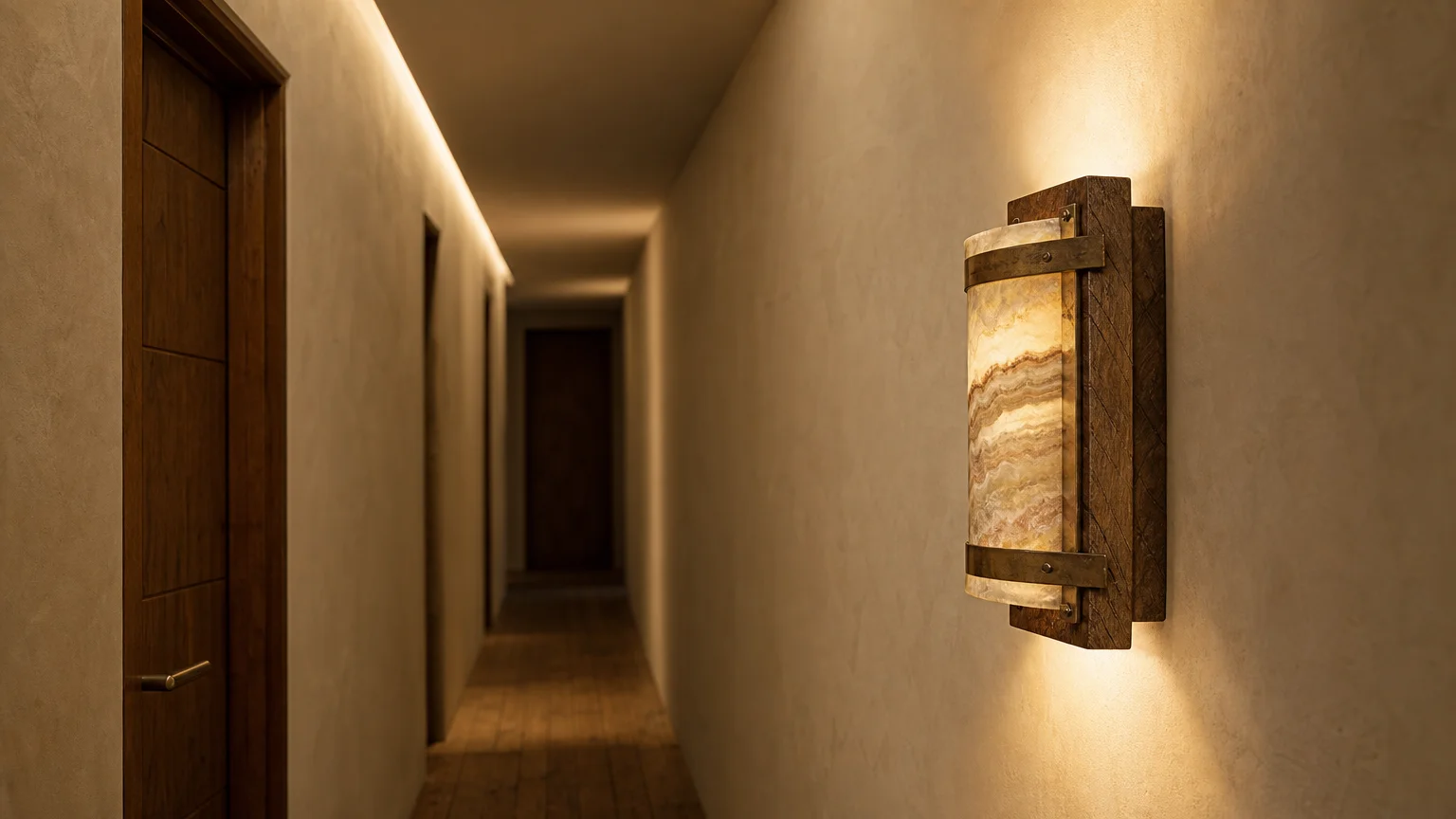
10Keeping the Story After the Project
A regional lighting scheme is unusually vulnerable to time, because the things that make it specific are the things that are hardest to replace identically. A natural material from a local source, a hand-worked finish, a warm light behaviour tuned in a particular room — each of these becomes a maintenance problem the moment the property has to make a substitution.
Four measures keep the story intact after handover, and all four belong in the closeout documentation rather than in the design.
A named residual state. The state the room returns to after a period of inactivity, recorded as an achieved setting on the installed room rather than as a datasheet value. Without it, the property’s default drifts towards whatever the last maintenance technician left behind.
A finish reference with as-built samples. The approved finish held physically, not only photographically, together with a note on the expected direction of change. A photograph cannot settle a dispute about a patina.
Matched spares held from the installed batch. For any natural or hand-finished component, spares drawn from a different batch are visually a different material. Holding them at handover is the only reliable moment to secure them.
An access and cleaning plan written for the people who will do the work. How each concealed element is reached, by how many people, with what equipment, and how often. A fixture that cannot be cleaned looks neglected within a year, and neglect reads as a failure of the design rather than of the schedule. The access side of this is covered in chandelier hoists and cleaning routes.
The wider point is that regional identity is not achieved at opening. It is achieved over the first several years, as materials age as they were expected to, as light behaviours hold from season to season, and as the property is maintained without visibly departing from what was approved. A scheme that tells a true story about its place and then loses that story to a sequence of near-miss replacements has, in the end, told a different one.
Source note: the technical statements in this article about material behaviour, optical performance, structure and maintenance describe general industry practice and are given as experience-based guidance rather than as requirements of any standard; where a project is subject to a named regulatory regime, the applicable requirements must be confirmed with its own consultant and authority having jurisdiction. Project references are given at city or region level only and are summarised on a de-branded basis, with no building, brand or design-firm attribution. This article contains no product, brand or project endorsement.
Frequently Asked Questions
Can a lighting fixture really express a place, or is that a marketing claim?
It can, through three mechanisms that are all verifiable in the finished object: material sourced from the region, form derived from the local craft’s way of solving joints and terminations, and light behaviour matched to how interiors in that place are used through the day. A fixture that shows none of the three and relies on a regional motif applied to a generic body is making a claim rather than a design.
What is wrong with using a well-known regional motif on a fixture?
Three things. The motif usually ends up doing work the silhouette and light distribution are not doing, so the fixture reads as a standard product in costume. The motif’s original material and method are normally lost in translation. And a motif borrowed from a tradition that is not the project’s makes a cultural claim the project cannot support. The alternative is to let a local manner of making decide how the fixture resolves edges and joints.
How do we specify a local material that varies from piece to piece?
By specifying at three levels: the properties that are fixed on every unit, the properties where variation is expected and must be bounded by an agreed range, and the reference material that is illustrative of intent only. Add a substitution rule naming who may approve a change and what re-check follows, and require matched spares to be drawn from the installed batch. That structure lets the material behave naturally without letting the installation look accidental.
Why does light behaviour matter more than the fixture itself?
Because a guest reads the room before they read any object in it. How bright an interior is expected to be, whether light comes from above or from the side, whether it reduces gradually through the evening or in deliberate steps, and what remains lit after everything else is off — these are the signals that make a space feel foreign or familiar. They are also perfectly specifiable, which means a regional brief can be delivered by behaviour even when the material has had to change.
How do we stop a regional scheme degrading after handover?
By treating the closeout as part of the design: record the achieved residual state on the installed room, hold physical as-built finish samples, secure matched spares from the installed batch at handover, and write an access and cleaning plan for the people who will actually carry it out. Most regional schemes fail not at specification but at the third replacement, and all four measures are aimed at that moment.
Building a Fixture Around a Place?
Send us the spatial plan with the fixture positions and viewing distances, the site conditions including daylight exposure and ceiling construction, the material you intend to source locally with its behaviour in both the lit and unlit state, and the light behaviour you want the space to have at different hours. We will tell you which parts of the intent can be fixed, which have to be written as a range, where a single local source of supply is a risk to the programme, and what has to be recorded at handover so the scheme still reads the same way in year three.
Our guides to reading a lighting mood board the way a factory does and to colour temperature in hotel lighting are the practical companions to this article.


