

Two marble fixtures leave the same workshop in the same crate, and a year later they no longer look related. One has kept its polish and its colour; the other has gone dull in the middle of a face, collected a grey ring where a wet glass stood beneath it, and carries a hairline that nobody can date. Nothing was done to either of them. That is the point: stone is not damaged by carelessness so much as by the absence of a decision about how it will be looked after.
Marble in a lighting fixture is a thin section of a material that spent a very long time being formed and is now being asked to hold a shape, pass or reflect light, and live in a room with heating, humidity, hands and dust. Care is the part of the specification that is written last and matters longest. It is also the part most often reduced to a single line in a handover pack, which is a pity, because care is where the buyer, the installer and the housekeeping team all have a stake and none of them owns it by default.
This article is about the care regime rather than the cleaning product. It separates three things that are usually muddled together — sealing, cleaning and repair — because they answer different questions, are done by different people, and fail in different ways. It assumes a stone fixture has been specified and installed, and asks what should happen next, in what order, and what should be written down.
It is written for the buyer and the facilities team rather than for the showroom. The recommendations are deliberately qualitative. Stone varies by block, by finish and by the room it lives in, and any care instruction that arrives as a fixed number — a frequency, a dilution, an interval — has usually been copied from somewhere else. What travels well between projects is the sequence and the judgement, not the number.
- 01Why Two Marble Fixtures Age Differently
- 02What Actually Damages Stone
- 03Sealing: The Promise and the Limit
- 04Cleaning: The Order of Operations
- 05Stone by Stone: Porous, Dense and Polished
- 06Repair in Three Levels
- 07The Room Works on the Fixture Too
- 08Dust, Height and Access
- 09What to Hand Over at Completion
- 10A Regime That Survives a Real Building
Why Two Marble Fixtures Age Differently
The first reason is the material itself. Marble is a metamorphic rock, and the word covers a wide range of behaviour. A white stone with a soft grey vein and an open, sugary surface behaves differently from a dense, hard, almost waxy stone with a bold pattern. One drinks a spill and keeps the memory of it; the other lets the same spill sit on the surface until somebody wipes it. The two are sold under the same category name and photographed the same way, but they do not age the same way, and a care regime that treats them identically will be either unnecessary on one or insufficient on the other.
The second reason is the finish. A polished face and a honed face made from the same block are two different products. Polish closes the surface and directs light back at the viewer, which is what gives marble its presence in a lit room; it also makes every fingerprint, every dry mark and every fine scratch legible, because the surface is behaving like a mirror rather than a scatterer. A honed or matte face breaks the light up and hides a great deal, which is why it is often specified for surfaces that will be touched. Neither is more durable in the abstract. They fail differently, and the care that keeps each of them presentable is different.
The third reason is the room. A fixture in a dry, stable interior with filtered air and a cleaning team that understands stone will look after itself for a long time. The same fixture in a lobby with a revolving door, a humid climate, a heating system that runs hard in winter and a service corridor that funnels warm air across the ceiling is being worked on continuously by its environment. The material has not changed. The conditions have.
The fourth reason is access. A stone chandelier that can be reached from a stepladder will be dusted. One that needs a scissor lift, a permit and a two-person team will be dusted when somebody remembers to book the lift. In practice, the largest single variable in how a stone fixture ages is not the cleaning product at all: it is how difficult the fixture is to reach, and whether anyone wrote down who is responsible for reaching it.
A care regime that ignores these four variables turns into a document that is filed and not used. A regime that starts from them is short, because most of the decisions have already been made by the specification: which stone, which finish, which room, which access. What is left is a sequence of actions and a named owner. That is achievable, and it is what the rest of this article is about.
What Actually Damages Stone
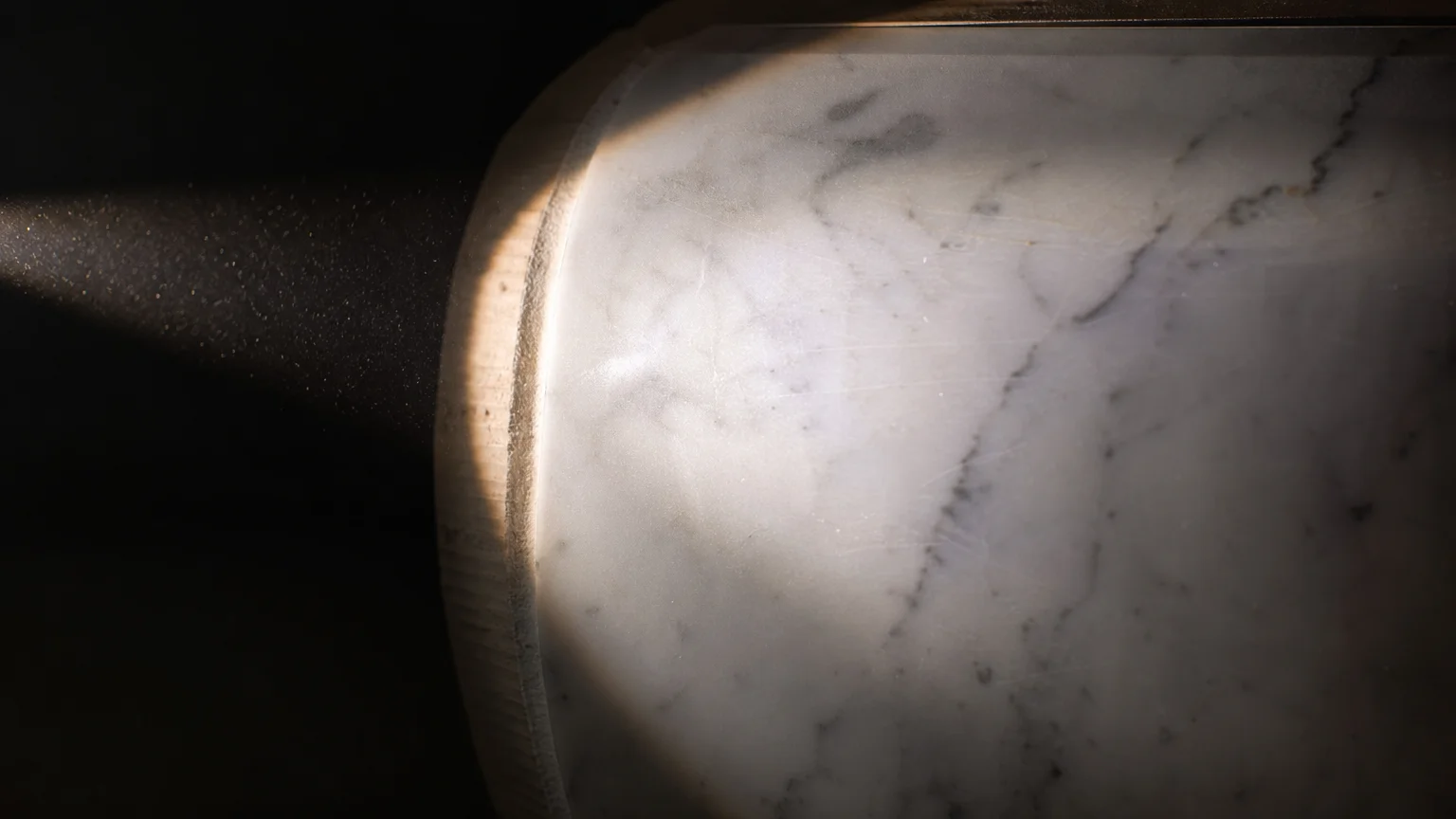
Almost all damage to a stone fixture falls into four mechanisms, and they are worth separating because each one calls for a different response. Confusing them is what produces the familiar sight of a fixture that has been cleaned hard, every week, and looks worse for it.
Dust is an abrasive, not a cosmetic problem. The grey film that settles on a horizontal stone surface is not only mineral dust; it carries grit, and grit on a cloth is sandpaper. Wiping a dusty polished face with a dry cloth drags that grit across the surface and produces the fine, uniform haze that reads as “tired” rather than “damaged”. The mechanism is slow and cumulative, which is exactly why it is missed: nothing happens on the day, and everything has happened after two seasons. The countermeasure is not a stronger cleaner but a lighter touch and a lift rather than a wipe — remove the dust before it is pressed into the surface.
Water does two things, and only one of them is obvious. Standing water on an absorbent stone is drawn inward, and what it carries inward with it stays there: dissolved minerals from a hard supply, soap residue, the salts in a cleaning solution. When the water leaves, the minerals do not, and the result is the pale ring or the dull patch that no amount of further cleaning removes, because the deposit is now inside the material rather than on it. The second effect is chemical: a prolonged wet contact on a calcium-based stone can etch the surface, taking the polish down in a soft-edged mark that looks like a watermark and behaves like a small crater. Both effects are about dwell time. A damp cloth that is followed immediately by a dry one is a different event from a wet cloth left to dry in place.
Chemistry is the fastest way to do permanent work. Acidic and strongly alkaline products attack the binder of the stone and the finish on the metal around it. Abrasive creams and pads remove the polish mechanically. Neither failure is reversible at the surface: once the polish has gone in a patch, the route back is repolishing, which is a workshop operation on a small part and a specialist operation on a large one. This is why the most useful sentence in any stone care instruction is not a recommendation but a prohibition, and why it belongs at the top of the card rather than the bottom.
Impact is the mechanism that gets blamed for everything else. A chip at an edge, a star at a fixing point, a crack that runs from a hole: these are mechanical, and they have three common causes. Handling without gloves transfers oils that later collect dust in a fingerprint-shaped pattern. Over-tightened fixings load the stone locally, and stone does not forgive a point load. And cleaning at height, with a pole and a heavy head, produces contact that nobody records. A crack near a fixing point should be read as a message about the fixing, not only about the crack.
Reading a stone face properly needs one cheap tool: a light held at a shallow angle so that it rakes across the surface rather than illuminating it. Straight-on light shows colour and hides topography. Raking light shows everything — undulations, the transition between a polished face and a sawn edge, filled pits, a repaired chip, the fine haze left by a dry wipe. Every care decision in this article is easier to make after thirty seconds with a torch at an angle, because the difference between a deposit, an etch and a scratch is visible there and invisible under a ceiling light.
Sealing: The Promise and the Limit
Sealing is the part of stone care most often sold as a solution and least often explained as a trade-off. A sealer is a treatment applied to the surface to slow the rate at which liquids are absorbed. It does not close the stone. It does not make the surface stain-proof. It buys time — the interval between a spill and a wipe, during which the spill has not yet become part of the material. On a horizontal surface in a busy room, that interval is the whole game. On a vertical face that nobody touches, it matters much less.
There are two broad families of product, and the difference is worth understanding before a specification names one. A penetrating sealer soaks into the pore structure near the surface and leaves the stone looking unchanged; it is the usual choice for a honed or matte finish, and for any stone whose appearance is the point. A film-forming or topical product sits on the surface as a thin coating; it can add a sheen and can be more resistant to a particular stain, but it is a coating, which means it can wear unevenly, show scratches of its own, and eventually needs stripping. On a lighting fixture, the second family deserves caution: a coating on a translucent panel changes the way light passes through it, and a coating on a polished face can read as a haze when the fixture is switched on.
For a lit stone component, the decision is not simply “seal or do not seal”. It is whether the treatment changes the optical result. A translucent stone shade or a backlit panel is a lens as well as a surface; anything applied to it has to be evaluated in the lit state, not only under a cloth. This is one of the few places where a stone fixture differs materially from a stone worktop, and it is why a care product chosen for the kitchen is not automatically right for the chandelier above it.
Testing whether a treatment is still doing its job is simpler than testing what it contains. Clean and dry a small, inconspicuous area, place a drop of water on it, and watch how the drop behaves: a surface that still beads and holds the drop is resisting; a surface that darkens and spreads within a short time has opened up. The test tells you about the surface, not about a product, and it can be repeated at each service visit without any equipment. What it cannot tell you is whether the stone needs sealing at all — a dense, polished stone in a dry room may go years without benefit, and treating it on a schedule borrowed from a porous stone is work without a purpose.
Two practical rules follow. First, the decision to seal belongs to whoever owns the appearance, and it should be recorded with the finish reference, because a sealer applied to one panel of a matched set and not to its neighbours will show under raking light and in the lit state. Second, the care card and the sealer should agree. A card that specifies a gentle pH-neutral wash and a surface that has been given a film-forming coating is an instruction set that will fight itself, and the person holding the cloth will be the one who discovers it.
Cleaning: The Order of Operations
Cleaning a stone fixture is mostly a matter of order, and the order is counter-intuitive because it begins with doing less. The sequence that protects the surface has four steps, and the first two are about removing material without moving it across the face.
Step one: lift the dust dry. Use a soft, clean, dry cloth or a soft brush, and lift rather than press. Work from the top of the fixture down, so that loosened material does not fall onto a surface that has already been cleaned. Support the component with the other hand where it is thin; a translucent panel is not a structural element and does not enjoy being pressed. If the dust is heavy, change the cloth rather than continuing with a loaded one — a cloth full of grit is the mechanism described in the previous section, arriving by the hand of the person trying to help.
Step two: work damp, briefly, and in small areas. A cloth that is damp rather than wet, a mild pH-neutral wash, and one panel at a time. The temptation is to spray the whole fixture and then wipe it, which is the single most common way a stone fixture acquires water marks: by the time the last panel is wiped, the first has been wet for minutes. Small areas also let you see what the cloth is picking up, which is the live feedback available during the job.
Step three: dry immediately and completely. A dry, soft, lint-free cloth, following the damp cloth closely. Not “left to air dry”, and not “dried later”. Edges, joints, the underside of a shade rim and the recess where stone meets metal all hold water; these are the places where a mark will appear first. Where a supply is hard, the final rinse benefits from water with fewer dissolved minerals, because the residue that remains after drying is exactly what the supply left behind.
Step four: inspect before switching on. A fixture that has just been cleaned and is then lit is being inspected under the least forgiving condition available: the light passes through the material and every residue, streak and missed patch is amplified. Walking around the fixture with the lamps on before the cloths are packed away costs a minute and catches most of what a housekeeping supervisor would otherwise find later.
The prohibitions belong with the sequence, not in a separate paragraph, because they are part of the method. No abrasive cream or pad on a polished face. No acidic or strongly alkaline product on stone or on the metal in contact with it. No soaking, no standing water, no wet cloth left folded against an edge. No scouring at a stain; a stain that resists a gentle wash is a decision for the person who owns the finish, not a reason to press harder. And no product applied to a lit panel without checking it first in the lit state.
One more discipline is worth adding for hotel work: the cloth that cleans the stone should not be the cloth that cleans the brass. Metal polishes and their residues are exactly the chemistry the stone does not want, and a single cloth carried around a fixture will transfer one to the other. Two cloths, two colours, and a rule that they do not swap.
Stone by Stone: Porous, Dense and Polished
The most useful thing a care card can do is stop treating “marble” as one material. Three broad behaviours cover most of what arrives in a lighting specification, and they lead to different priorities rather than different products.
The first is the open, porous white stone — the classic soft grey-veined material that most people picture when they hear the word. It is beautiful in exactly the way that makes it demanding: the pore structure accepts liquids readily, so a spill that sits for a few minutes leaves a mark. Its care priority is protection and speed — a maintained sealer, immediate blotting rather than wiping, and gentle cleaning with nothing abrasive, because the same openness that lets a stain in also lets an abrasive in. This is the family where sealing earns its keep.
The second is the dense, bright, boldly patterned stone. Higher density means it resists scratching better and absorbs more slowly; the same brightness that makes it striking means dust and dry marks are more visible on it than on a mid-tone stone. Its care priority is not protection but frequency: more, lighter cleaning, because the surface shows neglect early and punishes heavy-handed correction. A dense stone cleaned gently and often looks new for a long time. The same stone cleaned rarely and hard acquires a haze that reads as age.
The third is the highly polished, dramatic surface — often the most visually ambitious of the three, and the one with the least tolerance. Polished surfaces show scratches at an angle, hold fingerprints, and can be permanently marked by a single ill-judged product. Its care priority is discipline: the right cloth, the mildest chemistry, no scouring, and the acceptance that a polished face may eventually need a specialist polish rather than an ever-more-aggressive household remedy.
| Stone behaviour | What it does under use | What the care priority becomes |
|---|---|---|
| Open, porous, soft-veined white | Accepts liquids quickly; keeps the memory of a spill; responds well to a maintained sealer | Maintain the sealer; blot rather than wipe; nothing abrasive; treat any stain promptly |
| Dense, bright, boldly patterned | Resists scratching; absorbs slowly; shows dust and dry marks plainly because of the brightness | Clean more often and more lightly; avoid correction by pressure; keep the dry pass honest |
| Highly polished, dramatic surface | Shows fine scratches and fingerprints at an angle; vulnerable to aggressive products | Mildest chemistry; dedicated cloths; no scouring; plan for specialist repolishing rather than DIY repair |
| Translucent thin section (lit from within) | Behaves as a lens; any residue, coating or streak is amplified when the lamp is on | Inspect in the lit state; avoid film-forming treatments; dry completely at the rim and joints |
The fourth row of that table is the one specific to lighting, and it is easy to forget because it has no equivalent in a worktop. A thin stone section that is lit from behind or within is being asked to do two jobs: be a surface and be an optical element. A care regime borrowed from architectural stone will look after the surface and quietly ruin the light. The practical consequence is a single extra rule — whatever is applied to a lit panel gets evaluated with the fixture switched on — and it costs nothing to add to the card.
Where a project mixes two of these families in one room — a polished marble pendant over a table, a honed stone sconce on the wall behind it — the care card should say so explicitly, because the instinct of a cleaning team is to standardise. Standardising across stone families is the most efficient way to produce a set that no longer matches.
Repair in Three Levels
Repair is where a care regime either protects the asset or accelerates its decline. The useful framework is not a list of remedies but a classification: three levels of damage, three different decision-makers, three different routes. The value of the classification is that it converts an anxious question — “can this be fixed?” — into a procedural one: “who owns this decision, and what is the safe action until they decide?”
Level one is surface condition. Loss of gloss in a localised area, a faint haze, fine scratches that are visible only under raking light. Nothing structural has happened, and the fixture can stay in service. The route is a polish by someone competent, at a bench or in place, and the decision belongs to whoever owns the appearance standard. The mistake at this level is escalation: reaching for an abrasive to “bring the shine back”, which converts a polishable condition into a patch that needs repolishing.
Level two is local damage. A chip at an edge, a scratch that catches a fingernail, a filled pit that has opened. The material has been removed, and the repair is a fill and blend that has to match colour and texture. This is a specialist task, not because the technique is exotic but because matching is a skill and a bad match is permanent in a way that a bad polish is not. The decision at this level is commercial as well as technical: replace, repair, or accept with a note. What should not happen is a site-applied filler on a lit face, where the repair will read as a dark patch the moment the lamp is switched on.
Level three is structural. A crack that runs to an edge or through a fixing point, a deep chip that has removed section, a component that has separated at a joint. Here the question is not appearance but whether the part can carry what it is being asked to carry, and the answer is not available from a photograph. The component should come out of service, be supported safely, and be assessed by someone qualified to judge it, with the electrical and fixing implications considered together. A structural finding should be treated as a claim or an engineering question, not as a cosmetic touch-up.
| Level | What it looks like | Who decides | What to do until they do |
|---|---|---|---|
| Surface | Local loss of gloss; a haze; fine scratches visible only under raking light | The owner of the appearance standard, with a competent polisher | Keep in service; record the area and the date; do not escalate to abrasives |
| Local | Chip at an edge; a scratch that catches a nail; an opened fill | Facilities with the supplier, weighing repair against replacement | Photograph under raking light; protect the edge; hold any site-applied filler |
| Structural | Crack reaching an edge or a fixing point; deep loss of section; a separated joint | Someone qualified to judge structure, with the electrical scope included | Take out of service; support safely; treat as a claim or engineering question |
Two habits make this framework usable. The first is photographic: every finding is recorded under the same raking light, from the same angle, at the same distance, so that a comparison over time is possible. The second is a rule about who touches what. Cleaning staff clean; maintenance staff fix fixings and lamps; nobody at site level attempts to correct stone. That single boundary prevents most of the permanent damage that arrives at a workshop for assessment — and it is cheaper to write into a scope of works than to argue about afterwards.
It is also worth saying plainly that some change is not damage. Stone darkens, softens at the edges and loses a little of its first sharpness; a polished face develops a quieter sheen where hands and cloths have been. That is the material behaving as a material, and it is one of the reasons stone is chosen. The classification above exists to separate that from the three levels of real damage, so that a legitimate patina is not treated as a defect and a defect is not explained away as patina.
The Room Works on the Fixture Too
Every care regime assumes a stable environment, and most buildings do not provide one. Four environmental factors do steady work on a stone fixture, and each has a corresponding adjustment that belongs in the specification rather than in the cleaning cupboard.
Humidity swings are the most consequential. Stone responds to moisture by taking it in and giving it up, and it does so unevenly because a section is not uniform. A room that alternates between very dry heated air and humid air puts the material through a slow cycle of expansion and contraction. The visible results are not dramatic — a joint that opens slightly, a hairline that appears at a stress concentration, a face that reads differently in summer and winter. The management response is to reduce the swing rather than to treat the stone: stable air, no direct blower onto the fixture, and a note in the handover pack so that a future refurbishment does not site a diffuser above the chandelier. What happens to a stone fixture in a damp room is treated in more depth in our guide to stone fixtures in damp rooms.
Air movement matters more than most specifications allow for. A supply diffuser pointed at a fixture delivers a continuous stream of conditioned air at a different temperature and humidity from the room, which is a small, permanent, directional stress. It also deposits dust on the leading face and not on the other, which is why one side of a fixture can look older than the other. Moving a diffuser is a cheap intervention; discovering the cause after two years of polishing is not.
Heat from the lamp is the factor the lighting industry owns. A stone section around a lamp is being warmed from the inside, and the temperature it reaches depends on the lamp, the enclosure and the ventilation. This is a specification issue, not a maintenance one: the lamp type and rating the fixture was designed around are part of the product, and substituting a different lamp because it is brighter, or because it is what the stores had, changes the thermal condition the stone is living in. The same discipline applies to the driver and control gear, which are usually inside or immediately behind the stone and rely on the same air path. Our note on thin stone, thickness and light explains why the thermal and optical questions arrive together in these fixtures.
Sunlight is the slowest and least discussed. A fixture in front of a window accumulates a directional difference: the face toward the glass is warmer, drier and more exposed to ultraviolet than the face away from it. Over years this produces a visible asymmetry in tone, particularly on a porous light stone. Where the design puts a stone piece in direct sun, the care card should expect it rather than be surprised by it.
None of these four requires a specialist to manage, but all of them require someone to have thought about them before the room was finished. That is the argument for putting environmental notes in the lighting specification rather than in the cleaning contract: by the time the cleaning contract is written, the diffuser is already in the ceiling.
Dust, Height and Access
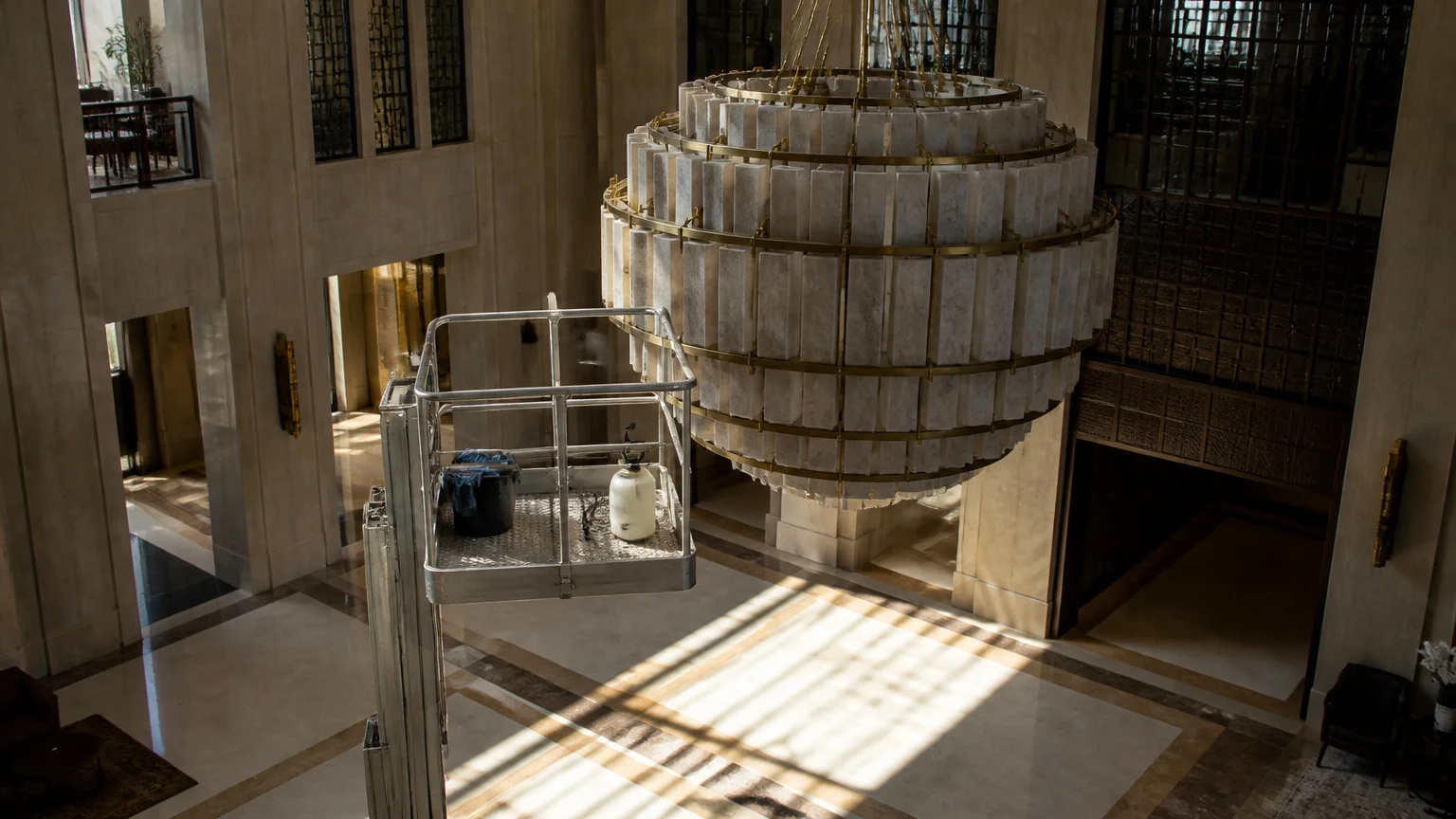
The atrium photograph above is the honest version of stone care. Everything in the previous sections is straightforward at bench height and becomes a project at ten metres. Access is the variable that decides whether a care regime is executed or merely approved, and it is decided at specification stage, long before anyone holds a cloth.
Dust does not distribute evenly with height. It settles most on horizontal surfaces that face upward, which on a chandelier means the top rings, the frame members, the upper faces of every stone element, and the canopy. Vertical faces collect far less, and the undersides collect almost nothing. This is useful, because it means the cleaning effort is concentrated in the part of the fixture that is hardest to see from the floor — and the part most likely to be missed by a cleaner working from below with a pole. A regime that only addresses what is visible from the ground floor addresses the least dusty surfaces on the object.
Three practical consequences follow. First, the access method should be named in the maintenance plan, with the equipment it requires and the person who can authorise it. A chandelier that needs a lift, a permit and two people has a different maintenance rhythm from one that needs a stepladder, and pretending otherwise produces a fixture that is cleaned rarely and inspected less. Second, the fixture should be designed to be reached: hoists, detachable elements and accessible fixings are maintenance features, and they are worth more over a decade than a marginal difference in appearance. Third, the inspection should happen at the same time as the cleaning, because the visit is the expensive part. The person at the top of the lift is the one person who will see the top of the frame.
There is a related point about lamp changes. A stone fixture at height with a lamp that requires a lift to replace is a fixture whose lamps will be replaced late, which means the thermal and optical condition will drift, which means the stone will be lit differently for a period of its life. Making the lamp reachable — from a platform, a hatch or a removable element — is a care feature in its own right. Our guide to chandelier hoists and cleaning access covers the hoist side of this in more detail.
The same logic scales down. A wall sconce at shoulder height in a corridor is cleaned by rote; one above a door in a double-height space is cleaned when the painters come. Both are stone, both appear in the same schedule, and only one of them will be looked after. The useful question at specification is therefore not “how often will this be cleaned?” but “who will physically reach it, with what, and how often will they realistically do so?” The answer usually changes the design.
What to Hand Over at Completion
Care fails at handover more often than at any other point, and the failure is documentary rather than technical. Four items close the gap, and none of them is long.
A care card, per material. Not one card for the project. A polished marble pendant, a honed stone sconce and a brass canopy have three different sets of prohibitions, and a combined card produces a cleaner who applies the strictest rule everywhere or, worse, the most convenient one. Each card should lead with what not to use, follow with the four-step sequence, and end with the two numbers that matter: who to call, and what not to attempt.
A finish and material reference. The approved sample, the finish name as it appears on the order, and the sealer decision if one was made. This is what makes a later repair possible: a polisher who knows the finish can match it; a polisher guessing at the finish will produce a patch. Where a set was matched from several blocks, the reference should record that too, because the set is the standard and the individual unit is not.
A maintenance log, started on day one. Date, action, area, finding, photograph reference, initials. The log’s value is not bureaucratic: it is the way to distinguish a condition that is stable from one that is progressing, and it is the document that turns a complaint into a decision. A log that begins after the first complaint has already lost the baseline that would have settled it.
A named owner for each of the three levels. Cleaning, fixing and stone repair sit with different people, and the handover pack should say who they are. Most disputes about a damaged fixture are, at bottom, disputes about who was supposed to have noticed. Writing the three names down costs a page and removes the dispute.
A fifth item is worth adding where the client will keep the building: a spare. A stone element cut later from a different block will not match an installed set, and a spare held on site is the difference between a repair and a re-selection. This is also why our receiving checklist for stone fixtures puts spares and set consistency in the same section as inspection: they are the same decision, made at different times.
A Regime That Survives a Real Building
A care regime that survives contact with a real building has five parts, in this order, and none of them is a schedule of intervals.
One: record the baseline. On the day the fixture is accepted, photograph it under raking light and in the lit state, and note the finish and the material. This takes twenty minutes and is the single most valuable action in the whole regime, because every later judgement is a comparison.
Two: define the actions, not the intervals. Dust when the surface reads dull under raking light; damp-clean when dust has been allowed to build or a mark has appeared; dry immediately, every time; inspect with the lamps on. Intervals are a management convenience and belong in a schedule, but the trigger for action is the condition of the surface. A card that says “when it looks dull” is followed more accurately than one that says “every second Tuesday”.
Three: keep the prohibitions short and absolute. No abrasives on a polished face. No acid or strong alkali on stone or the metal touching it. No soaking, no standing water, no cloth left against an edge. No site-applied filler on a lit panel. Four lines, memorised, prevent the majority of irreversible outcomes.
Four: separate the three levels of response. Cleaning staff clean. Maintenance fixes fixings and lamps. Stone repair goes to a specialist, and a structural finding stops the fixture. The separation is what stops a well-meaning intervention from converting a polishable condition into a replacement.
Five: review once, on evidence. At the end of a season, read the log and the photographs together and ask what changed. A regime that is reviewed against records gets shorter over time, because the actions that produced no finding drop out. A regime reviewed against memory gets longer, because nobody can remember what was actually effective.
The conclusion is unglamorous and, in our experience, correct: stone fixtures are not high-maintenance, they are high-attention. The material will outlast the building services around it. What determines whether it still looks like the sample is whether someone wrote down four prohibitions, named three owners, and made the fixture reachable. Everything else — the products, the cloths, the schedule — is detail that follows from those decisions. If you are specifying stone fixtures and want the care regime and the finish reference issued together with the product, the place to start is the marble lamp collection, or a conversation about the project through custom lighting.
Does a marble light fixture need to be sealed? It depends on the stone and the room, not on a rule. An open, porous stone in a space where spills and hands are likely benefits from a maintained penetrating sealer. A dense, polished stone in a dry interior may go years without one. What matters is that the decision is recorded with the finish reference, so that a later treatment does not create a visible difference across a matched set.
Can I use the same cleaner on the stone as on the brass? No. Metal polishes and their residues are the chemistry stone tolerates least, and a single cloth carried around a fixture transfers one to the other. Two cloths, kept separate, and a rule that they do not swap.
How do I tell a water mark from an etch? Under raking light, a deposit sits on the surface and reads as a faint film with a soft edge; an etch has taken material away and reads as a shallow crater with a defined rim. A deposit may respond to a careful damp clean. An etch will not, and attempting to scrub it out is how a small mark becomes a patch that needs repolishing.
Is a dull area necessarily damage? Not usually. Loss of gloss in a localised area is surface condition and is polishable. What changes the answer is depth: if a fingernail catches, material has been removed and the question moves up a level. Record it, photograph it, and let the right person decide.
Can I clean a stone fixture while it is switched on? Clean it switched off, and inspect it switched on. Heat is not the issue at cleaning temperatures; visibility is. A lit translucent panel amplifies every streak and residue, which is why the final check belongs with the lamps on and the cloths still out.
What if the fixture is too high to reach? Then the access method is part of the specification, not an afterthought. Name the equipment, the authorisation and the person responsible, and design for reachability where the design allows it — a hoist or a removable element is a maintenance feature that pays for itself over the life of the building.
We issue the material reference, the finish reference and a care card with the fixture, so that the handover pack already contains what a facilities team needs. Send the schedule and the room conditions, and we will return the documents and a set of samples for approval before production rather than after delivery.
See the marble lamp collection · Alabaster and marble compared · Hotel lighting maintenance · Talk to us about a project


