
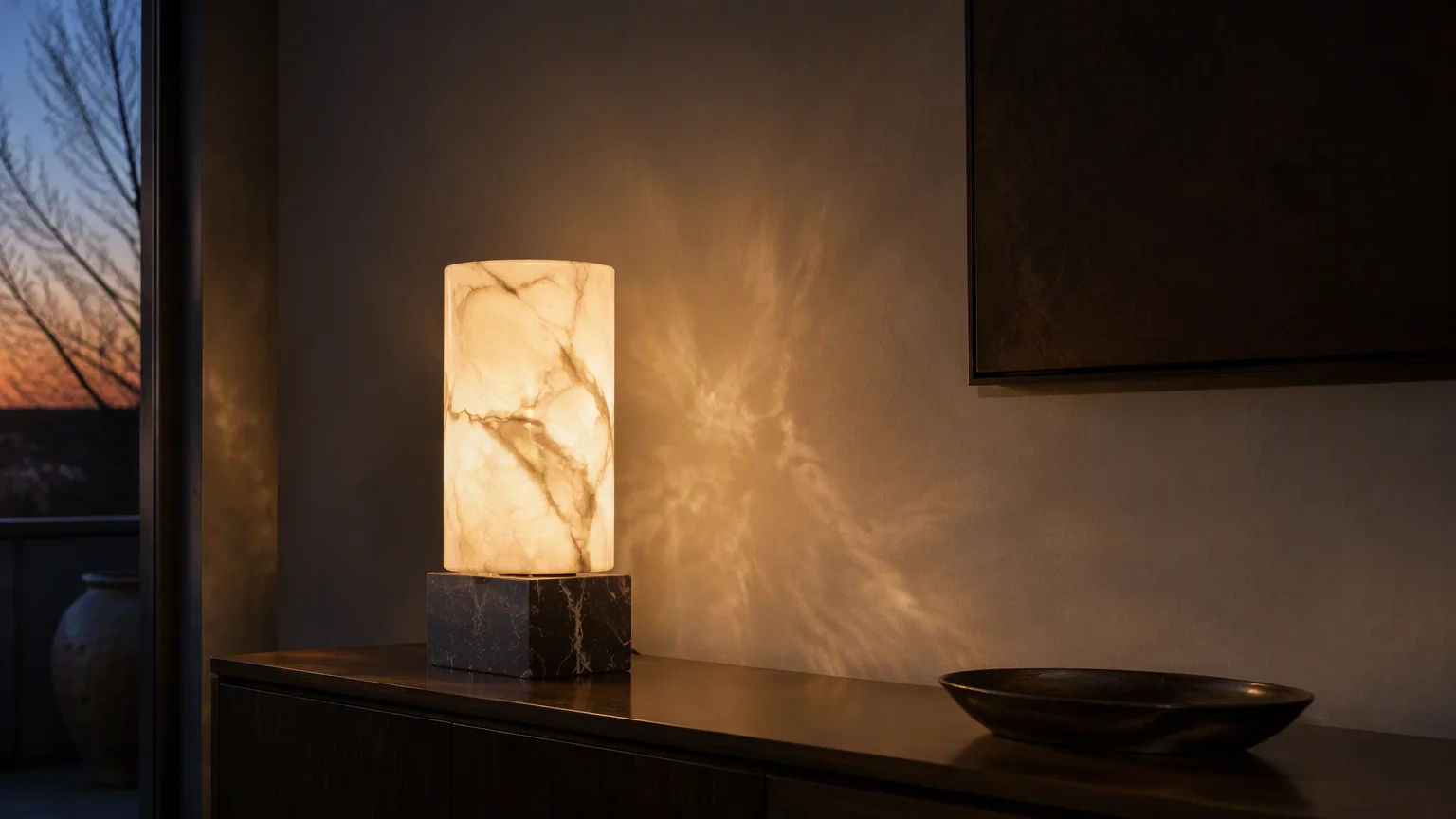
A stone lamp is usually described by its material and its shape, and that description leaves out the part that decides how the object actually behaves in a room. Within a single fixture there are two kinds of stone, doing two opposite jobs. One is thin enough to let light through, and its task is to transform a lamp into a glowing surface. The other is solid and polished, and its task is to catch the light that falls on it and return it, softened, into the space. When those two jobs are recognised separately, the specification becomes concrete: thickness, surface finish and the relationship between the parts can all be written down. When they are not, buyers approve a photograph and discover the difference on site.
This article is about that division of work. It is not about which stone is better, and it is not about polishing as a matter of taste. It is about the fact that the same block of material can be finished two ways and produce two entirely different optical components, and that the finish belongs in the specification rather than in the conversation after delivery.
- 01One Fixture, Two Optical Jobs
- 02Stone as a Shade: How Transmission Works
- 03Stone as a Reflector: What a Polished Base Does
- 04Surface Finish Is a Specification Item
- 05Thickness, Evenness and Where Hot Spots Come From
- 06What a Polished Face Does to a Room
- 07Reading a Stone in Two States: Off and On
- 08Matching the Two Roles in One Design
- 09A Four-Column Way to Specify It
- 10Where This Shows Up in a Real Project
One Fixture, Two Optical Jobs
Take a table lamp with a stone shade and a stone base. The shade surrounds the lamp. Light enters the inner face, scatters inside the material, and leaves through the outer face in every direction the surface faces. The base sits below. It does not enclose the lamp; it catches whatever light reaches it, from the shade above, from the ceiling, from a window, and it returns part of that light into the room while showing a bright shape where the reflection falls.
These are different physical processes and they fail in different ways. A transmission component fails by being too thick, too opaque, too uneven, or too close to a small bright source: the shade goes dim, or patchy, or shows the lamp as a hot spot. A reflection component fails by being too rough to reflect anything recognisable, or by reflecting something the designer did not want: a window, a bright ceiling, a bare lamp on the other side of the room.
Most of the confusion in the market comes from treating “stone” as a single specification. A buyer asks for a stone lamp, receives a stone lamp, and then finds that the shade glows like a paper lantern in one version and like a lump of chalk in another, or that the base reads as a warm mirror in one and as a dull grey mass in the other. The difference is not the mineral. It is the section thickness and the surface, applied differently to two components with different jobs.
The practical consequence is that a specification for a stone fixture needs at least four entries, not one: the material, the thickness of the transmitting part, the finish of the reflecting part, and the relationship between them. Everything else — the shape, the metalwork, the cable — sits on top of those four.
Stone as a Shade: How Transmission Works
Translucent stone works because it is not perfectly transparent. Light entering the material is scattered at grain boundaries and at the small structural features that give the stone its pattern, and it leaves the far side as a diffuse glow rather than an image. That scattering is the whole point: it removes the shape of the lamp from the visible surface and replaces it with an even field of light, which is why a good stone shade reads as a lit object rather than as a lamp behind a screen.
Two variables control the result. The first is thickness. Thin sections scatter less, transmit more, and show more of the structure behind them; thick sections scatter more, transmit less, and hide the source more completely. Neither is correct in the abstract. A shade that is intended to be a soft lantern wants enough thickness to erase the lamp; a panel that is intended to be a bright plane in a ceiling may want a thinner section so that the surface stays lively and the veining remains readable when lit.
The second is the size and character of the source behind it. A compact source close to a thin wall produces a bright core and a darker rim, because the light has less material to scatter through at the edges of its path. A longer or more diffuse source, or a greater distance between source and stone, spreads the entry points and produces a more uniform result. This is why the same shade can look excellent with one lamp and disappointing with another of nominally similar output, and why a maker who specifies the lamp as part of the design is easier to work with than one who leaves the choice to the buyer.
The pattern of the stone interacts with all of this. Veining is denser and often darker than the ground mass, so it transmits less. Under a bright source the veins read as soft grey lines across a warm field; under a weak source the whole face goes flat and the veins disappear. A stone chosen in daylight for its pattern may look plain once it is used as a diffuser, which is one reason sample approval should be done with the intended lamp and at the intended output.
Stone as a Reflector: What a Polished Base Does
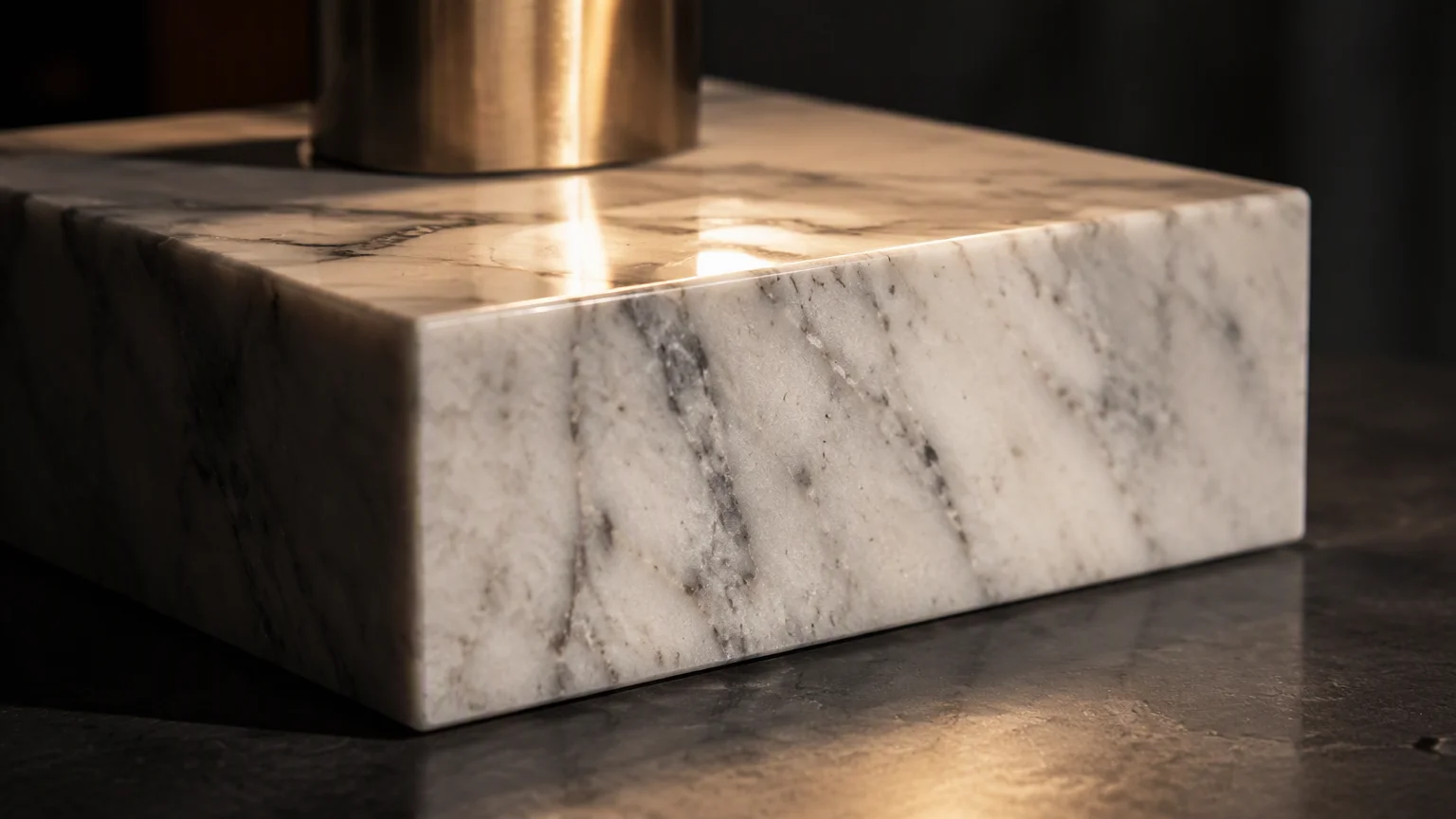
A base is not lit from inside. It is lit from outside, mostly from above, and its job is to decide what happens to that light. On a polished face, a proportion of the arriving light is reflected at the surface at an angle equal to the angle of arrival, which produces a highlight where the source is reflected and a general brightening of the face where the surroundings are. On a honed or matt face, the same light is scattered in many directions, which produces no distinct highlight and a much softer, lower-contrast surface.
Both behaviours are useful and they produce different rooms. A polished base acts as a small secondary source: it takes light from the shade above it, or from a ceiling, and throws a soft glow back onto the wall behind the lamp and onto the tabletop. In a dark room this is what makes the object feel generous rather than merely decorative, and it is the reason a polished stone base photographs so well in a dim interior. A honed base does something quieter. It absorbs the highlight, keeps the object visually compact, and lets the shade remain the single bright element.
The costs are symmetrical. A polished surface shows every mark: fingerprints, water rings, dust, and the fine scratches that accumulate when an object is dusted with a dry cloth. It also shows the reflection of whatever is opposite it, which on a console in a corridor may be a window or a bright doorway that the designer did not consider. A honed surface hides those marks and that reflection, and in exchange gives up the secondary glow.
For a hospitality project the decision usually follows the maintenance regime rather than the aesthetics. A room that is cleaned daily by a team with a defined routine can carry a polished base; a room where the lamp will be wiped occasionally with whatever cloth is at hand will look better with a honed one. That is a specification decision, and it can be written down before the order.
Surface Finish Is a Specification Item
Finish is the part of a stone specification most often left as an adjective. “Polished” and “honed” are not binary states; they sit on a scale that runs from a mirror finish through satin to a fine matt, and the position on that scale changes how much of the arriving light is reflected specularly and how much is scattered.
Three things follow for anyone writing a specification. First, the finish should be named with a reference rather than an adjective: a sample held by the project, a finish designation agreed with the maker, and a statement of which faces of which components receive it. Second, the finish should be assigned per component, because a fixture can legitimately combine a honed shade exterior with a polished base, and the two are doing different jobs. Third, the finish on hidden faces matters more than buyers expect, because the inner face of a shade is the first surface the light meets, and a rough inner face scatters differently from a smooth one.
There is also a maintenance clause that belongs in the same paragraph. Stone finishes change with cleaning. An acidic descaler or an abrasive cream will take a polished face towards satin within a season, and no amount of re-polishing on site will restore it evenly. The handover documentation should state the cleaner, the cloth, and the interval, and it should say plainly which products are excluded. This is not bureaucracy: a polished base that has been cleaned with the wrong product looks like a defect, and the complaint that follows is difficult to answer because the object was correct when it was delivered.
Finally, finish interacts with colour. Polishing darkens the apparent tone of a stone slightly and increases contrast, because the surface reflection adds a layer of the surrounding colour over the material’s own. Honing lightens it and reduces contrast by scattering. Two samples of the same block, finished differently, will not match on a wall, which is why finish has to be settled before the stone is selected rather than after.
Thickness, Evenness and Where Hot Spots Come From
The single most common defect in a translucent stone component is a hot spot: a bright area where the lamp behind the stone is closer, brighter, or less diffused than the rest of the face. It appears in three situations, and each has a design answer.
Proximity. When the source is close to a thin section, the light has little material to spread through before it leaves. The answer is distance, or a diffusing element between source and stone, or a thicker section at the point of closest approach.
Variation in section. Hand-worked stone is not machined to a constant thickness, and a face that varies will transmit unevenly. Some variation is part of the character of the material and reads as a gentle gradient; a step change reads as a fault. The control is to inspect the component unlit against a bright background before it is assembled, which reveals thickness variation in a way that a finished lamp does not reveal.
A source with a small emitting area. A compact lamp produces a concentrated entry point even at a distance. A longer source, or several smaller ones distributed behind the face, spreads the entry and produces the even field that the design intends. This is why the choice of lamp belongs to the fixture design rather than to the maintenance budget.
Evenness also depends on the shape of the shade. A cylinder wraps the source and produces a fairly even band of light with a brighter zone at the height of the lamp. A bowl concentrates light toward its lower opening, so the lower edge is brighter than the upper. A flat panel behaves differently again, with a soft centre and darker edges unless the source is deliberately arranged. A buyer who compares two fixtures of the same size but different geometry is comparing two different optical designs, not two versions of one.
What a Polished Face Does to a Room
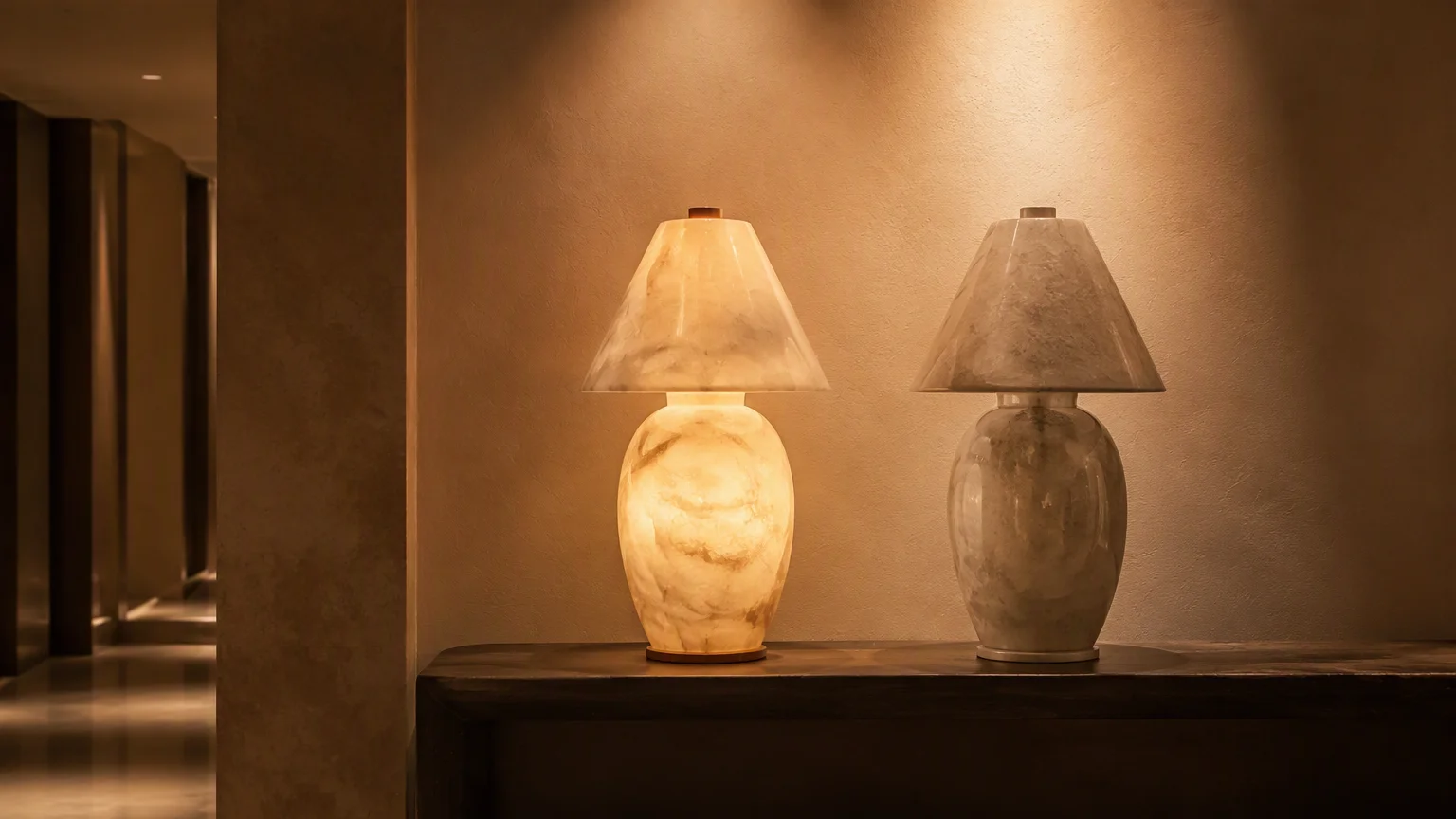
A reflective stone component is a small architectural element: it redistributes light inside a room without adding a source. That matters most where the lighting design is deliberately restrained, because it provides a second, softer layer of illumination at eye level without another visible fitting.
The effect is easiest to see on a console against a wall. A lamp with a polished base, lit from above, produces a bright patch on the wall behind it and a pool of light on the tabletop, both of which come from the base rather than from the shade. The result is a widening of the lit zone without an increase in output, and a warmer transition between the pool under the lamp and the darker room beyond. On a dark painted wall the effect is strong; on a pale wall it is subtle; on a wall with a strong pattern it becomes a second pattern, which may or may not be desirable.
There is a geometric limit worth knowing. A flat polished face reflects within a narrow range of angles, so the secondary glow is directional: it appears only for viewers positioned where the reflection geometry works, and it moves as they move. A curved or faceted base spreads the effect over a wider range and appears more consistent, at the cost of a less defined highlight. Neither is better; they suit different positions. A base seen mostly from one direction, at a fixed distance, can exploit the narrow reflection. A base that will be seen from all around a room needs the wider distribution.
In circulation areas the practical value is that the reflection continues to work after the lamp is switched off, because it is returning the ambient light of the space. A polished base in a corridor therefore keeps its presence during the day and at night when the room lighting is low, while a matt base becomes visually quiet. That is a decision about how visible the object should be when it is not doing its primary job.
Reading a Stone in Two States: Off and On
Stone fixtures have to be approved in both states, and the two states test different components. Switched on, the transmitting element is the subject: the face should be even, the pattern readable, the colour consistent with the scheme, and the source invisible. Switched off, the reflecting element becomes the subject: the base shows its finish, its colour, and its reaction to daylight, and the shade shows its unlit colour, which for many stones is noticeably cooler and greyer than the lit appearance.
Most approvals are done in one state. A sample photographed on a bench under an office light shows the unlit colour and the finish, and says nothing about how the shade will behave. A sample photographed lit shows the glow and hides the finish. Buyers who approve from a single image are effectively approving half an object, and the half they have not seen is the half that appears during the day.
There is a further state that matters in hotels: the room at night with the lamp off, lit only by a corridor or a bathroom door. In that condition the polished base is the one element that remains visible, because it reflects the light coming through the door. A fixture with a large polished base will therefore hold the composition at night in a way that a matt one will not, and a designer who has not seen that condition may be surprised by how much the object reads.
The practical recommendation is to ask for three images of the same fixture: unlit in daylight, lit in a dark room, and unlit in low ambient light. Those three cover the states a guest actually experiences, and they cost nothing compared with a site visit after installation.
Matching the Two Roles in One Design
When the transmitting and reflecting roles are understood, the design question becomes a balance rather than a preference. A fixture with a bright, thin shade over a highly polished base has two active surfaces competing for attention; the composition reads busy, and in a small room the base can become the brightest object after the shade. A fixture with a thick, quiet shade over a honed base has one active surface and a calm body, which is easier to place in a scheme that already has strong walls or artwork.
Three combinations recur in practice, and it is useful to be able to name them.
Active shade, quiet base. The shade carries the light and the base carries the mass. This is the most forgiving arrangement for a room with a lot of visual information, because only one surface is doing work. It suits corridors, guestrooms and any position seen in passing.
Quiet shade, active base. A denser shade that glows gently over a polished base that catches and returns the light. The object reads as a sculpture rather than a lantern, and it works where the lamp is seen against a dark wall and the design wants a pool of reflected light at table level.
Both active. A thin shade with strong veining over a mirror-polished base. This is the most dramatic and the hardest to place: it needs space around it, a dark or plain background, and a viewer who is not distracted by anything else. In a hotel it works in a lobby or a lounge with generous spacing, and it becomes restless in a bedroom.
In every combination the metalwork is the third element, and it should be decided with the other two rather than after them. A brass collar between a bright shade and a polished base can either separate the two surfaces usefully or introduce a third highlight that fights both.
A Four-Column Way to Specify It
The table below is the version we use when a project involves stone components, and it is written so that each row can be answered in a submittal rather than in a conversation.
| Component | Optical role | Surface and section requirement | What to confirm before order |
|---|---|---|---|
| Shade or panel (stone) | Transmits: converts the lamp into a glowing surface | Section thin enough to transmit, thick enough to hide the source; outer face finished to the agreed sheen; inner face smooth | Thickness range per face, lamp type and position, an unlit backlit inspection of the section |
| Base or plinth (stone) | Reflects: returns spill light, softens the pool, warms the wall | Finish named on a scale from mirror to matt; all visible faces treated consistently; edges agreed | Finish reference sample, behaviour under the intended cleaner, reflection check in the installed position |
| Metalwork and collar | Separates or bridges the two surfaces | Finish and gloss level matched to the stone decision, not chosen independently | Whether the metal introduces a third highlight, and how it ages against the stone |
| Assembly as a whole | Two states: on and off | Both surfaces visible in both states; no unreachable face left unfinished | Photographs of the three states, and the maintenance instruction for each surface |
The fourth row is the one that gets skipped. A fixture is not a sum of two components specified separately; it is an object that will be seen lit and unlit, in daylight and at night, and the parts have to be coherent in all of those. The cheapest way to check is to ask for the three photographs described earlier and to look at them side by side rather than in sequence, because the relationship between the bright shade and the reflective base is what the eye actually judges.
The second table turns the same logic into the questions that belong in a purchase order, since these are the items that, if left open, produce a change order later.
| Question | Why it is asked | Where the answer belongs |
|---|---|---|
| Which faces of which component are polished? | Finish is assigned per face, not per product | Drawing annotation plus approved sample |
| What is the section at the thinnest point? | Governs transmission and hot spot risk | Technical submittal |
| Which lamp, at what distance? | The shade is designed around a source | Fixture schedule and spare parts list |
| How is the base cleaned? | Finish changes with the wrong product | Handover file |
| How does the pair match? | Natural stone varies; pairs need selection | Pre-shipment approval |
Where This Shows Up in a Real Project
Three situations recur often enough to be worth naming, because each one is a case where the two-role reading changes a decision.
A guestroom bedside lamp. The shade is seen from the pillow, which is close and low, and the base is seen from the doorway, which is far and high. The shade has to be even at close range, which argues for a thicker section or a more diffuse source. The base is seen mostly in reflection at night, when the room is dark and the single light is from the bathroom door; a polished base will hold that view, and a matt one will disappear. Neither is wrong, but the choice should be made knowing which view matters.
A lobby console. Here the object is seen from several metres, often against a wall, and the base is doing the work of softening the junction between the lamp’s pool and the wall. A polished base at this distance reads as a glow on the plaster; a honed base reads as a shadow. The polished version is often the better answer in a large volume, and it is also the one that will show dust first, so the maintenance interval becomes part of the decision.
A corridor niche. With no other light nearby, the transmitting element is the sole source, and the base is lit only by what falls from the shade. A wide, flat polished base in a niche produces a strong secondary highlight on the side walls, which can be used deliberately to widen the apparent lit zone. A narrow base produces almost none. This is a case where the geometry of the base matters as much as its finish.
Across all three, the useful discipline is the same: name the component, name its optical job, then write the section and the finish that job requires. It takes a few minutes at specification stage and it removes an entire category of site argument.
Is polished stone preferable to honed stone? Neither. Polished faces return light in a defined direction, which creates a highlight and a secondary glow; honed faces scatter it, which keeps the object quiet and hides marks. The right choice follows the position and the maintenance regime.
Why does my stone shade look patchy when lit? Usually a thickness variation, a source that is too small or too close, or an uneven inner face. Inspecting the component against a bright background before assembly reveals the first of those before the lamp is built.
Can one fixture combine a translucent shade and a polished base? Yes, and many do. What matters is that the two surfaces are balanced, so that only one of them is the dominant bright element in the room.
Does the finish affect the colour? It does. Polishing deepens the apparent tone and raises contrast; honing lightens it and softens it. Two samples from the same block, finished differently, will not match on a wall.
We make stone fixtures with the transmitting and reflecting parts specified separately: section, finish and lamp agreed as one assembly, with a reference sample held for production. Send the fixture schedule and the intended position, and we will return a submittal that separates the two roles instead of describing the object as a single material.
See the alabaster collection · How thickness changes a stone shade · Talk to us about a project


