

Ask whether rattan can be used in a bathroom and you will get a confident answer from everyone and no two answers will agree. One supplier says it is fine with a protective finish. Another says it will fail within a season. Both are describing something real. The material is hygroscopic, the room is humid, and what happens next depends almost entirely on which zone of the room the fixture occupies and how the moisture arrives — not on whether the word “bathroom” appears in the brief.
This article treats that question as an engineering one. It sets out what moisture actually does to a plant fibre, where a woven fixture begins to fail first and why it is rarely the middle of a panel, how a metal frame and a woven skin respond to the same air in different ways, what a coating can and cannot do, and how to decide which rooms a woven fixture belongs in. It closes with the documents a project should obtain before accepting a woven fixture for a humid space, and how to read them.
One boundary needs to be stated at the outset. We do not publish ageing data, flame-retardant ratings or mould-resistance results for woven fixtures, because we do not hold verified test evidence for them. What follows therefore describes mechanisms and the paperwork a project must obtain from whoever is supplying the material. It does not assign a grade, a service life or a humidity limit to any product, and any supplier who offers one without documentation is offering a claim rather than a fact.
- 01The Question Behind the Question
- 02What Humidity Does to a Plant Fibre
- 03Where Failure Actually Starts
- 04Metal and Fibre Move Differently
- 05What a Coating Can and Cannot Do
- 06Air Movement Matters as Much as Moisture
- 07The Coastal Case
- 08Deciding Where a Woven Fixture Belongs
- 09What to Ask For, and How to Read It
- 10Commissioning and Aftercare
The Question Behind the Question
“Can I use rattan in a bathroom?” is not one question. It is at least three, and they have different answers. The first is about a room with a basin, a mirror and an extract fan, where the air is usually dry and occasionally steams up. The second is about a room where a shower runs twice a day and the air stays saturated for a quarter of an hour afterwards. The third is about a covered terrace or an open-air spa, where the air is humid most of the time and rain may reach the fixture sideways.
A woven fixture that would be perfectly reasonable in the first room may be a maintenance problem in the second and an outright error in the third. Yet all three are described to a supplier as “bathroom” or “spa”, and the supplier, hearing a word rather than a duty, quotes the same construction for all of them.
The useful reformulation is to ask about the moisture regime rather than the room name. How often does the air become saturated, for how long, and does the moisture arrive as vapour or as droplets? Is the fixture inside the spray cone of a shower or bath, or merely in the same room? Does the space have mechanical extract, operable windows, or neither? Is the fixture in the air path, or in a still corner where the boundary layer stays wet?
Those four questions produce a far better brief than a room label, and they can be answered by the operator rather than the designer. Once they are answered, the decision about whether to use a woven fixture, and with what protection and what inspection regime, becomes tractable. Without them, the conversation stays at the level of opinion, and opinion is what produces both the confident yes and the confident no.
What Humidity Does to a Plant Fibre
Rattan is a solid plant stem, and like most plant material it is hygroscopic: its cell walls take up water from the surrounding air and give it up again. The consequence is dimensional. Absorbed moisture pushes the cell walls apart, so the fibre swells as humidity rises and shrinks as it falls. The swelling is not uniform in all directions — it is greater across the diameter of the strand than along its length — which means a woven surface does not simply get slightly larger. It gets thicker, and the geometry of the weave tightens.
This has two visible effects. A shade that was woven with a certain openness in a dry workshop will read slightly denser in a damp room, because the strands have expanded into the gaps. And the fit between the strands and whatever holds them — a lashing, a rim, a frame — becomes tighter, then eventually looser, as the material cycles between swollen and dry states.
The cycling is the part that does lasting damage. A single wetting and drying does very little. Repeated cycles fatigue the material at the interfaces where movement is restrained: the lignin that stiffens the cell wall cracks, the surface lifts slightly, and small checks open along the length of the strand. Once a check is open, water enters more easily and dries more slowly, so the next cycle is worse. This is the mechanism behind the observation that a woven fixture in a humid room “looks fine for ages and then suddenly does not”. The deterioration is cumulative and mostly invisible until the surface begins to lift.
Rattan’s structure also creates an internal differential that matters in lighting. The peeled outer skin — the cane strip used for fine weaving — is dense and responds slowly. The inner material is more open and responds faster. In a strand that retains both, or in a construction that mixes peeled strip with whole stem, the two parts move at different rates, and the interface between them is where the first separation appears. The vocabulary for these parts, and why the words matter in a purchase order, is set out in our guide to material and weave.
None of this is a reason to avoid the material. It is the reason a woven fixture in a humid room is a maintenance item rather than a fit-and-forget item, and the reason the room’s moisture regime has to be known before the specification is written.
Where Failure Actually Starts
In a failing woven fixture, the middle of a panel is usually the last place to show it. The open face of a weave dries quickly: air moves across it, the strands are thin, and any moisture that lands there leaves almost as fast as it arrived. Failure concentrates at the places where geometry works against drying.
Cut ends. Every place a strand is cut exposes open cells at the end grain. Those cells wick moisture into the interior of the strand far faster than the sealed side surfaces allow, and they are the first place a coating fails because a coating applied to a surface does not necessarily seal a cut face. A shade whose cut ends were sealed after assembly will hold up longer than one where they were left bare, and the difference is invisible until the ends begin to fray.
Lashings and knots. Where strands are bound to a frame or to each other, the fibres are compressed and the crevices between them are narrow. Narrow crevices hold water by capillarity and dry slowly, and the compression itself relaxes as the fibre cycles, so the binding loosens. A loosened lashing allows movement, movement opens the weave locally, and the local opening becomes the place where the pattern on the wall changes first.
The frame interface. The joint where a woven body meets a metal rim or arm is a sheltered gap: two materials, a small void, and little air movement. This is where condensation sits longest, and it is where corrosion products from the frame can stain the fibre. It is also the hardest place to inspect, which is why it is usually discovered late.
The lower rim and the interior. The underside of a pendant inside a humid room collects moisture that condenses and runs, and it is not reached by dusting. A rim that looks sound from below can be soft on its inner face.
| What you see | Mechanism behind it | Where it appears first | What it means for the project |
|---|---|---|---|
| Strands standing slightly proud, weave looks tighter than the sample | Fibre has taken up moisture and swollen across its diameter | Any area exposed to room air | Reversible in dry conditions; not yet a defect, but confirms the room is wetter than assumed |
| Fine cracks along the length of a strand | Repeated swelling and drying has fatigued the cell wall | Near lashings and where strands bend sharply | Cumulative and not repairable by cleaning; plan replacement of the shade rather than the fixture |
| Frayed or pale tips at cut ends | Open end grain has wicked moisture; coating did not seal the cut face | Rim, lower edge, anywhere a strand terminates | Sealing the ends is a production decision; if it was skipped, treat the shade as unprotected |
| Loosened bindings and local gaps | Compressed fibre has relaxed after cycling; capillary water sits in crevices | Points where the weave meets the frame | Structural as well as cosmetic; check the frame before re-tensioning |
| Dark staining or a greenish bloom at a joint | Frame corrosion or biological growth in a persistently damp crevice | Metal-to-fibre interface, sheltered voids | Investigate the frame, not only the surface; cleaning alone will not stop it |
| A dull, chalky or patchy surface sheen | Coating has worn or eroded unevenly | Handling points and the lower body | The barrier is no longer continuous; ask what the maintenance basis for reapplication is |
Reading a woven fixture for these signatures takes a few minutes with a torch and a step ladder, and it is best done at handover rather than after the first season. The value of the list is that each signature points to a different cause, and therefore to a different remedy. Cleaning a shade that has loosened lashings does nothing; re-tensioning a shade whose cut ends are wicking does nothing either. Only the pairing of cause and remedy produces a result.
Metal and Fibre Move Differently
A woven fixture is a composite, and the two halves of the composite respond to the same air in opposite ways. The metal frame expands and contracts with temperature, and is essentially unaffected by humidity. The woven skin expands and contracts with humidity, and is affected by temperature mainly through drying. When the air warms and moistens at the same time — which is exactly what happens when a shower runs — the frame grows slightly while the weave grows differently, and the movement has to go somewhere.
Where the weave is lashed to a rigid frame at close intervals, that movement is converted into local stress at each binding. Where the weave is free to slide, it moves instead, and the pattern on the shade shifts slightly over time. Both outcomes are acceptable if they were anticipated; both become complaints if they were not, because the first loosens bindings and the second changes the appearance of the shade without anything having been damaged.
The frame material matters for a second reason. Ferrous metal in a damp crevice will corrode, and the corrosion products are both voluminous and coloured, so they stain the adjacent fibre as they form. A frame that would be perfectly adequate in a dry interior can become the visible failure point in a humid one, and the stain it leaves is not removable by cleaning the weave. Stainless steel is the usual answer where the frame will be exposed to moisture, but the grade and the environment it is specified for are matters for the project’s engineer, not for the lighting supplier.
There is a third, subtler issue: fixings. Screws, rivets and clips that are a different alloy from the frame create a small galvanic couple wherever moisture bridges them. The result is accelerated corrosion at the least visible point of the assembly, usually inside a rim. Asking what the fixings are made of is a more productive question than asking whether the frame is “rustproof”, because the second question invites an adjective and the first invites a material name.
For a project, the practical output of all this is a clause: the frame material and its coating system are specified, the fixings are specified as compatible with it, and the woven body is attached in a way that allows for movement rather than restraining it. Our wider notes on materials and finishes in hotel lighting cover how those clauses sit alongside the rest of a finish schedule.
What a Coating Can and Cannot Do
Almost every woven fixture offered for a humid space is described as treated, sealed or protected. The word covers at least two quite different technologies, and the difference decides how the fixture fails when it eventually does.
A film-forming coating sits on the surface as a continuous layer. It is an effective barrier while it is intact, and it is the reason a sealed cane surface feels smooth and sheds water. Its weakness is at the edges and at flex points: a film that covers the side of a strand does not necessarily cover the cut end, and a film that is rigid will craze where the strand bends or where the weave moves. Once the film is breached, water enters behind it and dries more slowly than it would from bare fibre, so a breached film can be worse than no film at all in a persistently damp location. This is why the edges of a woven surface deserve the same attention as its face.
A penetrating treatment soaks into the fibre rather than sitting on it. It leaves the surface able to breathe, which means moisture that enters can also leave, and it fails gradually rather than by cracking. Its weakness is durability of a different kind: it is consumed by exposure and needs renewal, and the interval depends on the exposure, which is exactly the information a project needs from the supplier and rarely asks for.
Neither technology changes what the material is. A coating slows the rate at which moisture enters and leaves the fibre; it does not make a hygroscopic material non-hygroscopic, and it does not turn a woven shade into a sealed luminaire. A fixture in the spray zone of a shower will still be wet, whatever the surface treatment, and the water will still reach the cut ends and the crevices unless the construction excludes them.
The question to put to a supplier is therefore not “is it treated” but “what is the treatment, what is its intended exposure, on what basis is it renewed, and what documentation covers the batch we are buying”. Those four parts are answerable in writing. An answer that consists of an adjective is not.
Air Movement Matters as Much as Moisture
Two rooms with the same measured humidity can treat a woven fixture very differently, because what damages the material is not the humidity at a moment in time but the length of time the fibre stays wet. That is governed by air movement.
In a sealed bathroom with no extract, the air above a basin saturates during use and stays saturated afterwards, and the boundary layer of still air against the shade stays wet long after the room has been wiped down. In the same room with effective extract, the moisture is removed within minutes and the fibre dries. The fixture, the material and the finish are identical; the outcome is not.
Placement within the room matters for the same reason. A pendant in the air path between a shower and an extract grille sees moving, moist air and then dry air, and cycles quickly. A pendant in a still corner behind a screen sits in damp air for hours. The second is the more damaging position and the more attractive one to a designer, because still corners are where a decorative fixture is most visible.
Lamp operation adds a thermal cycle on top of the humidity cycle. A fixture that is on for part of the day warms its own shade, drives moisture out of the fibre, and then cools when switched off, drawing moist air back in. This is not in itself harmful, but it means the fixture’s drying behaviour is tied to its operating pattern, and a fixture used continuously behaves differently from one used intermittently. It also means that a woven shade over a lamp with poor thermal design will cycle more aggressively than the same shade over a cooler lamp.
The practical conclusions are simple and rarely written down: specify extract as part of the wet-area design rather than as a building services afterthought, keep woven fixtures out of the direct plume and out of the spray cone, prefer positions with air movement, and accept that a fixture in a still corner needs more frequent inspection. For spa and thermal areas, where humidity is continuous rather than intermittent, the relevant design logic is closer to that of an exterior space than an interior one; our notes on spa lighting in humid, low-light conditions set out how that changes the fixture brief.
The Coastal Case
Coastal projects combine every factor above and add one of their own. The air is humid for most of the year rather than for part of the day, it carries salt, and it moves: wind drives moisture into sheltered spaces and deposits salt on surfaces that do not see rain. A covered terrace on a seafront property is not an interior room with a view. It is an exterior space with a roof, and the brief has to say so.
Salt changes the drying behaviour. Salt is itself hygroscopic, so a surface carrying salt deposits stays damp longer than a clean one at the same humidity. It also accelerates the corrosion of anything metal, which means the frame, the fixings and the suspension become at least as much of a risk as the woven body, and often fail first. In coastal installations the honest expectation is that the metal components set the maintenance interval, and the weave follows.
Wind-driven moisture is the second difference. Rain that arrives sideways reaches the underside of an overhang, the inside of a shade, and the top of a rim — places that a vertical rain event does not touch. A fixture that is protected from rain falling downwards may still be wetted regularly. The distance from the opening, the depth of the overhang and the prevailing wind all matter, and none of them is captured by the phrase “sheltered”.

The terrace above shows the configuration that works best: a deep overhang, the fixture set well back from the edge, and the woven body high enough that splash from the floor cannot reach it. Even so, this is a fixture that will be inspected, not a fixture that will be forgotten. Projects that treat a coastal terrace as an interior room with a sea view tend to replace woven shades on a cycle nobody planned for and everybody notices. Where a genuinely exposed position is unavoidable, the material choice is the issue: metal, glass or stone will outlast a plant fibre in that duty, and our guide to coastal resort lighting sets out how those choices are usually made across a property.
Deciding Where a Woven Fixture Belongs
With the mechanisms established, the decision can be made zone by zone rather than room by room. Four zones cover most hospitality bathrooms and spa areas, and the boundary between them is the presence of liquid water rather than the name of the space.
Dry rooms — bedrooms, lounges, dining rooms, corridors — present no unusual moisture duty. A woven fixture here is limited by dust and handling rather than by water, and the normal care regime applies.
Transitional wet rooms — powder rooms, dressing areas, bathrooms with effective extract where the fixture is away from the shower — are the realistic upper limit for an unlined woven shade. The moisture is intermittent and removable by ventilation. The fixture should still be inspected, and the shade should be positioned where it dries.
Splash-adjacent positions — beside a basin, outside a shower screen, above a bath but outside the spray — are where a project needs to be deliberate. A woven fixture can work here if the construction closes the cut ends, the treatment is documented for the exposure, the frame is specified for a damp environment, and the operator accepts a maintenance item with a stated inspection interval. That is a decision with conditions, not a default.
Wet zones — inside a shower enclosure, over a tub in daily use, in a steam room, in an open-air spa — are where the material is being asked to do something it is not suited to. A plant fibre in continuous liquid water will fail, and no surface treatment changes the category of the material. Glass, metal, stone or a sealed composite belongs here.
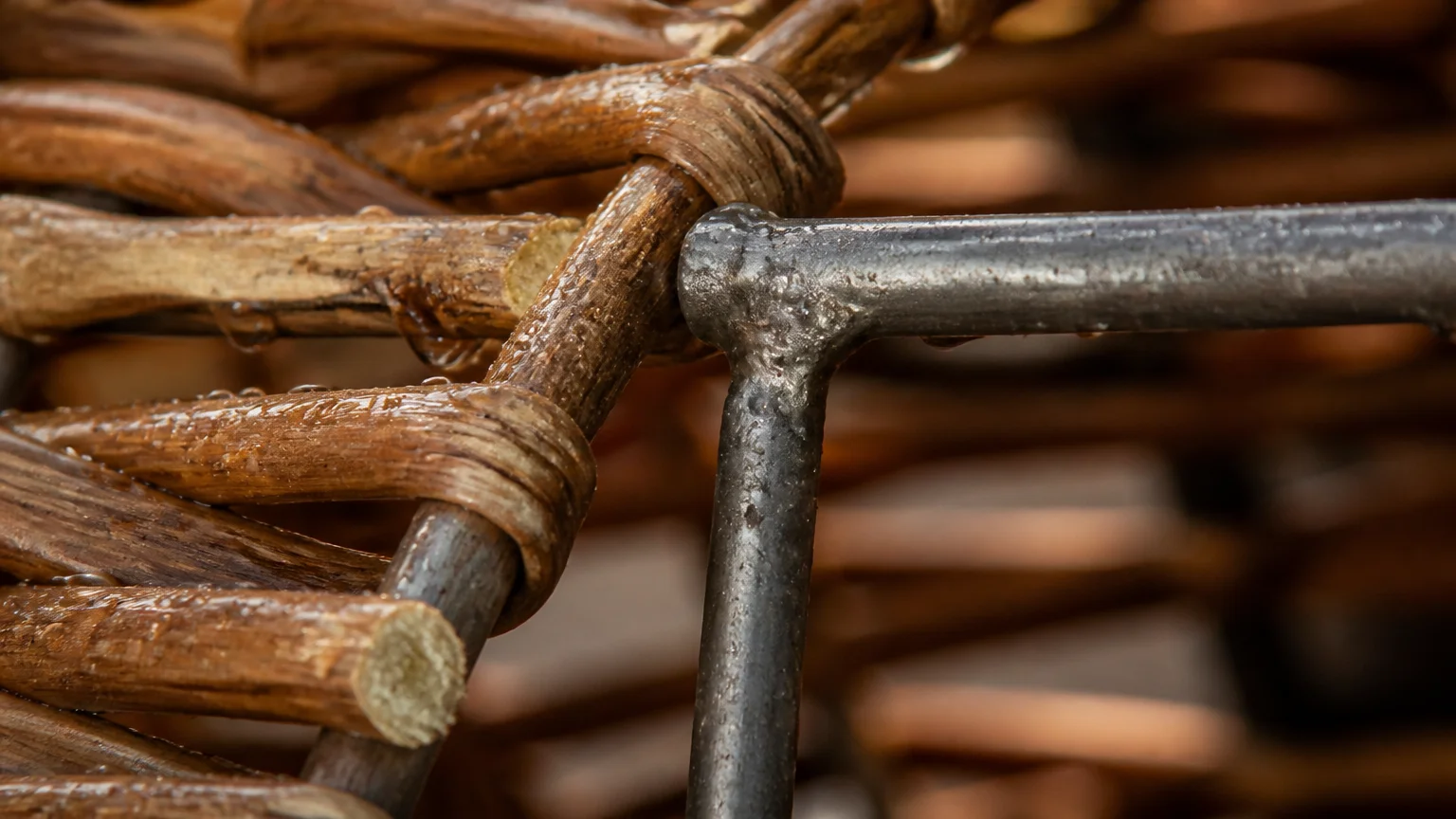
The detail above is the reason the zone decision is worth making carefully. The failure visible here is not in the woven face, which still looks sound; it is at the cut ends, where the protective layer stops, and at the metal joint, where moisture has been sitting. Neither would have been prevented by a denser weave or a heavier frame. Both would have been prevented by keeping the fixture out of the wet zone, or by specifying a construction whose ends are sealed and whose frame is detailed to drain.
For projects that need a protection grade rather than a zone decision — outdoor fixtures, pool surrounds, areas washed down with a hose — the conversation moves from materials to enclosure ratings, and it belongs with whoever is specifying the electrical installation. Our guide to bathroom lighting, protection grades and light quality explains how those ratings are read. A protection grade describes how well a luminaire enclosure resists the ingress of water and dust. It does not describe how well a natural fibre resists repeated wetting, and the two should not be offered as substitutes for each other.
What to Ask For, and How to Read It
Because the technical evidence for treated natural fibres sits with the material supplier rather than the fixture assembler, a project’s protection is its document set. Five documents cover the ground, and each has a specific thing to check.
A coating or treatment data sheet. It should name the product, state the substrate it is intended for, state the exposure conditions it is intended for, and state the basis on which it is renewed. Read it for scope: a sheet describing interior decorative use does not support a wet-area installation. Read it for the renewal basis: a treatment that is expected to be renewed has a maintenance implication that belongs in the operator’s manual.
A flame-retardant treatment record for the batch. Where a project’s fire strategy requires a treated textile or fibre, ask for the record that covers the material actually being supplied: the treatment applied, the test method used, the laboratory that issued the result, and the batch or lot it applies to. Read it for traceability. A report for a generic material, or for a batch that cannot be linked to the delivery, does not establish anything about the fixtures on site. The interpretation of such a report against a project’s fire strategy is a matter for the project’s fire engineer and for legal review, not for the lighting supplier.
Mould and fungal resistance evidence. Ask what testing, if any, has been carried out, on what specimen preparation, and against what pass criterion. Read it for specimen: a test on an untreated control, or on a laboratory-prepared sample rather than production material, answers a different question than the one being asked. Where no evidence exists, the correct conclusion is that the resistance is unverified — not that the material is resistant because the supplier has not seen a problem.
Frame and fixing specification. Material, coating system, and the compatibility of fixings with the frame. Read it for the joints rather than the surfaces, since that is where corrosion starts.
Care and inspection instructions. What to clean with, what to avoid, how often to inspect, and what the inspection should look for. A supplier who cannot provide this has not thought about the fixture’s life in the room, which is itself useful information.
| Document | What it should contain | What to check before accepting it | Red flag |
|---|---|---|---|
| Treatment data sheet | Product name, intended substrate, intended exposure, renewal basis | Whether the stated exposure matches the zone the fixture will occupy | An adjective instead of a product name; no renewal basis |
| Flame-retardant record | Treatment applied, test method, issuing laboratory, batch reference | Whether the batch reference can be linked to the delivery | A generic certificate with no link to the material supplied |
| Mould resistance evidence | Test method, specimen preparation, pass criterion | Whether the specimen was production material rather than a control | No stated criterion, or a claim with no test behind it |
| Frame and fixing specification | Frame alloy, coating system, fixing materials | Compatibility between fixings and frame; treatment of joints | “Rustproof” offered in place of a material name |
| Care and inspection instruction | Cleaning agents to use and avoid, inspection interval, what to look for | Whether the instruction addresses cut ends, lashings and joints | A general cleaning note that does not mention moisture at all |
The discipline that makes this set useful is to treat each document as answering one question and no more. A treatment sheet does not prove flame performance; a flame record does not prove mould resistance; neither proves that the frame will survive a coastal winter. Projects that ask for the five documents separately, and read each against the zone it applies to, end up with a defensible position. Projects that ask for “certification” receive a folder of paper that supports nothing in particular.
Where a document is missing, the honest response is to change the design rather than to accept a verbal assurance. Moving a fixture out of a wet zone, adding a liner, changing the material, or accepting a shorter replacement cycle are all real options. Accepting an unverified claim is not one of them, because the failure will be discovered by a guest rather than by the person who signed the approval. Our notes on how stone behaves in damp rooms cover the parallel case for a mineral material, where the mechanism differs but the documentation discipline is the same.
Commissioning and Aftercare
A woven fixture in a humid room should be inspected at handover, before the room enters service, and the inspection should be recorded. Handover is the moment when a baseline exists: the weave tension, the appearance of the cut ends, the condition of the frame joints. Without that baseline, every later observation is an opinion about whether something has changed.
The handover check has five parts. Look along the strands from a low angle with a torch, which reveals lifted coating and opened checks that are invisible from the front. Check the cut ends at the rim and at the lower edge for sealing. Flex a lashing gently to confirm it is still tight. Inspect the frame joints for dulling, staining or the first signs of corrosion. Confirm that the shade is dry, and record how long the room takes to dry after use, because that figure is the single best predictor of how the fixture will age.
Aftercare then follows from the mechanism rather than from a cleaning schedule. Dust dry, with a soft brush or a vacuum on low suction, working along the weave rather than across it. Avoid soaking: water that enters the fibre at a cut end or a crevice takes far longer to leave than water on the surface, and cleaning that wets the shade without drying it is worse than not cleaning it. Where a damp cloth is used, dry the surface afterwards and run the room’s extract until the fixture is dry to the touch.
Inspection intervals should follow exposure rather than a calendar habit. A dry-room fixture needs attention when it looks dusty; a splash-adjacent one in daily use needs a look at the cut ends and joints at a frequency the operator sets and records. The point of the interval is not the interval itself but the record: a maintenance log that shows the shade was inspected and found sound is what allows a project to distinguish normal wear from a defect. Our guide to hotel lighting maintenance sets out how those checks sit within a wider regime, and the tender specification checklist covers the documents that should be in place before a project reaches that stage.
Finally, plan for replacement rather than repair. A woven shade that has begun to check and fray at its cut ends is not restored by cleaning, and re-coating a failing surface on site is rarely successful because the preparation the coating needs cannot be achieved in place. The practical provision is a spare shade or a documented reorder path, agreed at purchase. For a property with a dozen woven fixtures in guest bathrooms, that provision is the difference between a maintenance line item and a recurring complaint.
Humidity does not make woven lighting impossible in hospitality. It makes the duty visible, and it moves the decision from the material to the zone, the construction and the paperwork. A project that answers the four moisture questions, keeps the fixture out of the wet zone, closes the cut ends, specifies the frame for a damp environment, and obtains the five documents has a fixture that will behave predictably. That is a more useful outcome than a confident yes or a confident no.
Can rattan lighting be used in a bathroom? In a bathroom that dries out between uses, and with the fixture away from the shower and the basin splash, it can be an acceptable choice provided the cut ends are sealed, the frame is specified for a damp environment, and the operator accepts an inspection routine. Inside a shower enclosure or over a tub in daily use, a plant fibre is the wrong material regardless of treatment.
Does a protective coating make a woven fixture waterproof? No. A coating slows the rate at which moisture enters and leaves the fibre. It does not seal the material, and it is weakest at cut ends and flex points, which are exactly where failure begins. A coating also creates a maintenance obligation, because a breached film can hold water against the fibre.
Why did my woven shade fail at the rim rather than in the middle? Because the open face of a weave dries quickly while cut ends, knots and frame joints hold water. End grain wicks moisture into the strand, compressed fibres in a lashing relax as they cycle, and the sheltered gap at a metal joint stays damp longest. Failure follows the geometry of drying, not the area that looks most exposed.
Is stainless steel enough for a coastal installation? It removes the most common corrosion failure, but the grade, the fixings and the detailing of the joints still have to suit the exposure, and salt deposits keep surfaces damp for longer whatever the frame is made from. Coastal duty should be specified as an exterior condition, with an inspection interval that reflects it.
What should I do if a supplier cannot provide treatment documentation? Change the design rather than accept an assurance. Move the fixture to a drier zone, add a liner, change the material, or accept and plan a shorter replacement cycle. An unverified claim transfers the risk to the guest who notices the failure first.
We build woven and natural-fibre lighting with the construction, the frame and the finish stated separately, and we will tell you plainly which zones we would and would not put a plant fibre in. Send the room, the moisture regime and the drawings, and we will return the options with the documentation that accompanies them — and the parts of the requirement that need to be resolved by your fire engineer or your M&E consultant rather than by us.
Pendants and chandeliers · Hotel lighting projects · Talk to us about a specification


