
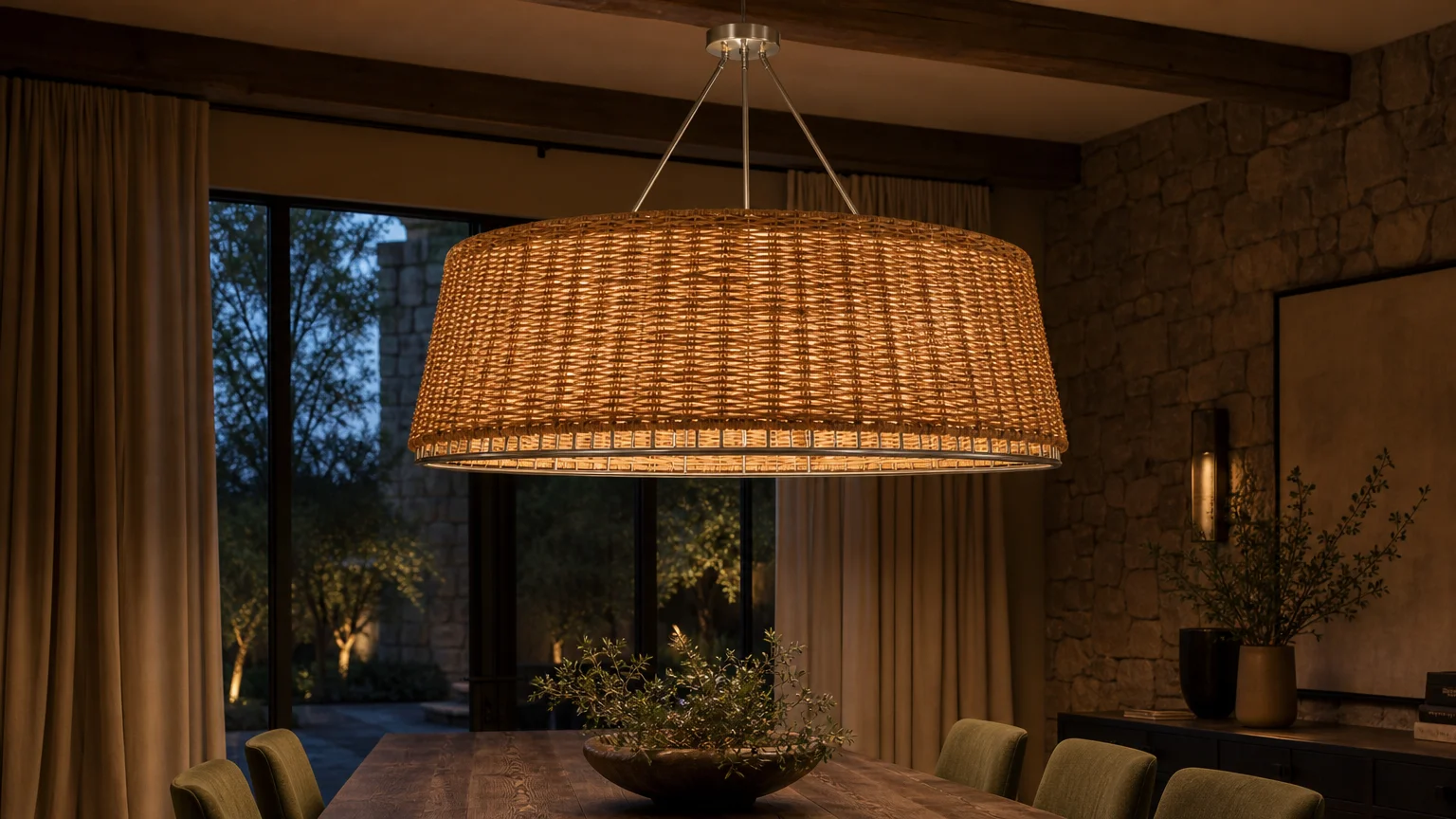
Ask a supplier what a woven pendant will hold and you will usually be told how much it weighs. That is the wrong figure, and the misunderstanding behind it explains most of the sagging woven fixtures in hospitality projects. A pendant does not hang from its weight; it hangs from a load path, and the question that matters is which part of the assembly that path runs through.
In a well-built woven fixture the answer is unambiguous. The woven body is an enclosure and an optical element. The frame carries the load, holds the geometry and keeps the weave in tension. The suspension hardware transfers that load to a canopy, an anchor and the building structure. Each of those three has one job, and every failure mode worth knowing about begins when one of them is asked to do another’s work.
This article sets out that division of labour, what a plant stem can and cannot do structurally, what a frame is actually for, the mechanisms behind sagging, how to read a frame specification, and what early movement looks like on site before it becomes visible to a guest. It avoids carrying capacities and clearances deliberately: those belong to a structural assessment of a specific fixture in a specific ceiling, not to an article. What follows is the reasoning you need in order to ask the right questions of whoever is supplying the fixture, and to recognise a vague answer when you get one.
- 01The Question Behind “How Much Does It Hold?”
- 02Two Jobs, Two Materials
- 03What a Plant Stem Can and Cannot Do
- 04What the Frame Is Actually For
- 05Why Woven Fixtures Sag
- 06Reading a Frame Specification
- 07The Interface Where Failures Show
- 08The Other Load Path: Ceiling, Canopy, Anchor
- 09What Early Movement Looks Like on Site
- 10Specifying It So It Stays Straight
The Question Behind “How Much Does It Hold?”
When a designer asks whether a woven pendant is strong enough, the underlying worry is usually concrete: will this thing still be round and level in five years, with the same silhouette that was approved in the mock-up? That is a question about stiffness and creep, not about strength. A fixture can be strong enough not to break and still be a disappointment, because what fails first in a decorative pendant is rarely a fracture. It is shape.
The distinction matters because it changes what you need from a supplier. If you ask about strength, you will be told about breaking loads and safety factors, and the answer may well be reassuring. If you ask about shape retention over time, under a warm lamp, in a lobby with a seasonal humidity swing and a cleaning regime that involves a ladder, you are asking about the stiffness of a frame, the creep behaviour of a natural fibre under sustained tension, the relaxation of the bindings that hold the weave, and the detailing at the points where the two materials meet.
There is a second reason the weight answer is unhelpful. The weight of a fixture is a property of the whole object, but the load does not travel through the whole object equally. It concentrates: from the weave into the rim, from the rim into the arms or the cage, from the arms into the suspension points, and from there into a canopy and an anchor. A fixture whose weave is beautifully made and whose frame is under-built will fail at the frame. A fixture with a generous frame and a careless rim will fail at the rim. Knowing the total weight tells you nothing about which of those is likely.
So the useful version of the question is: draw me the load path. Which component picks up the weight of the woven body, how does it get from there to the suspension points, and what holds the geometry when the fibre wants to move? A supplier who can answer that in a drawing is a supplier who has thought about the fixture’s fifth year. A supplier who answers with a kilogram figure has answered a different question.
Two Jobs, Two Materials
Natural-fibre lighting works because two materials with different properties are asked to do two different things. The fibre is good at being a surface: it is warm, textured, tactile, and it breaks up light in a way that no moulded polymer reproduces convincingly. The metal is good at being a structure: it is stiff, it is consistent, it can be welded and drilled and threaded, and its behaviour under load is predictable in a way that a plant stem’s is not.
The discipline that follows is simple to state and easy to get wrong in production. The woven body should be an enclosure that is supported, not a structure that supports. The frame should be a structure that is concealed or deliberately expressed, not a decoration that happens to hold something. When those roles are reversed — a self-supporting weave with a token metal ring, or a frame so slender that the weave is quietly carrying part of the span — the fixture will behave well in the showroom and badly in service.
The same principle appears elsewhere in lighting. A leather sleeve on a pendant stem is a visible and tactile element; it is not a load-bearing strap, and a design that lets it become one has introduced a component with no structural pedigree into the load path. A fabric wrap on a large shade is an optical and decorative skin; it is not a diaphragm that stiffens the frame. Woven fibre belongs in the same category. It can contribute stiffness — a tightly woven surface does brace a frame to some degree — but that contribution should be treated as a bonus rather than as part of the design calculation, because it degrades with humidity, with age and with any local damage.
| Element | The job it should do | Evidence that it is doing it | What goes wrong when it is asked to do the other job |
|---|---|---|---|
| Woven body | Enclosure, light diffusion, visual texture, shadow pattern | Weave tension even; the body keeps its profile when the frame is supported and the weave is not loaded | Local sagging between fixings, rim pulled out of round, weave opening unevenly as the fibre relaxes |
| Rim and lashings | Transfer load from weave to frame; define the silhouette edge | Lashings tight and evenly spaced; rim continuous; no relative movement between rim and frame | Rim distorts, lashings slacken, the shadow line at the edge becomes wavy |
| Frame and arms | Carry load to the suspension points; hold geometry; provide fixing and cable routes | Frame drawing exists separately from the weave; bracing visible; joints welded or mechanically fixed, not merely touching | Deflection under load, arms bow, the whole fixture hangs lower in the middle than at the edges |
| Suspension and canopy | Transfer load to the building structure; set the height and level | Hardware identified by type and rating; canopy fixed to a structure, not to a finish | Height drift, tilt, creaking, movement transmitted to the ceiling finish |
The table is worth reading from right to left as a diagnostic. When a woven fixture is described as sagging, the report usually names the weave, because that is the visible part. The mechanism is more often in one of the lower rows, and the weave is simply where the consequence shows.
What a Plant Stem Can and Cannot Do
Rattan is a solid stem, not a hollow cane like bamboo, and that single fact explains most of its useful behaviour. It is light for its stiffness, it bends a long way before it breaks, and it does not split along the grain the way a sawn timber batten does. In bending over a short distance, a rattan strand is a capable element, which is why the material has been used for structural baskets and chair frames for a very long time.
What it does not do is behave like a beam over a long span. Three limitations matter for lighting. The first is creep: a natural fibre held under sustained tension or bending will continue to deform slowly, even at loads well below anything that would break it. The deformation is small per unit length and cumulative over years, and it is accelerated by warmth and by moisture. A shade whose weave was pulled tight at assembly is, in effect, a system of strands held under sustained tension, and the tension will not stay where it was put.
The second is variability. Two strands from the same bundle differ in diameter, density and stiffness, and the difference is visible in how they respond to the same load. A frame that relies on the weave to distribute force evenly is relying on a material that does not distribute force evenly. Metal does, which is the whole reason to use it.
The third is the behaviour of the peeled strip. The outer skin used for fine weaving is thinner and denser than the whole stem, and it is the strip most often used where the weave needs to be delicate. It is also the part that responds fastest to moisture and reaches its limits soonest. A construction that mixes whole stem and peeled strip is asking two materials with different movement to share one surface, and the interface between them is where separation begins.
None of this argues against the material. It argues for using it in the role it is good at — a surface in tension over a short distance, supported at close intervals by something whose behaviour does not change with the weather. How a weave reads optically, and why density changes the light rather than the strength, is covered in our article on weave density and light. The point here is narrower: density is an optical decision, not a structural one, and a denser weave does not make a weak frame stronger.
What the Frame Is Actually For
A frame in a woven fixture does more than hold the shape. It performs five distinct jobs, and a specification that addresses only the first will produce a fixture that looks right and behaves badly.
It defines the geometry. Diameter, profile, the relationship between the top and bottom rims, and the position of any internal light source are set by the frame. This is the job everyone recognises. It is also the job that is easiest to get right, because a frame that is the wrong shape is obvious immediately.
It carries the load to the suspension points. This is the job that is invisible in a photograph and decisive in service. The path runs from the weave, through lashings and rim, into arms or a cage, and up to one or more suspension points. Every transfer in that path is a joint, and every joint is a place where stiffness is lost. A frame with a single central suspension and long unsupported arms is a lever; a frame with a ring and cross-bracing is a structure.
It keeps the weave in tension. A woven surface that is allowed to go slack loses its profile and its shadow pattern at the same time. The frame’s rim is what holds the last row of weave at the correct tension, which is why the rim detail matters more than its visual weight suggests. A rim that is a thin flat band will allow the weave to move; a rim with a formed edge or a return gives the lashing something to bear against.
It provides the interfaces. Suspension points, cable entries, driver or lamp holder mounting, earth continuity where the design requires it, and access for service all attach to the frame. A frame designed without those interfaces ends up with them added at assembly, usually by drilling a finished component in a place chosen for convenience.
It protects the edge in handling. A woven body is at its most vulnerable at the rim, during packing, transit and installation. A metal rim that stands slightly proud of the weave takes the knocks that would otherwise break strands. This is a small design decision with a large effect on how a batch looks after a journey.
Frames achieve these jobs in a handful of recognisable ways. A welded steel armature with a top and bottom ring is the most common for drum and basket forms; a bent-tube frame suits elongated and organic profiles; a laser-cut plate or a formed rib cage is used where the silhouette is complex; a wire cage is used where weight and openness matter more than rigidity. The details that make any of them work are unglamorous: cross-bracing, a double rim where the span is long, gussets at the arm-to-ring junction, welded rather than butted joints, and a coating system that covers the inside of joints as well as the outside.
Why Woven Fixtures Sag
Sagging is not one failure. It is a family of them, and they are distinguished by where the movement originates, when it appears and who owns the remedy. Separating them is what allows a project to fix a problem instead of tolerating it.
Creep in the fibre. The slowest and most predictable mechanism. A strand under sustained tension elongates, the weave settles, and the body takes on a slightly softer profile than it had at assembly. This is normal material behaviour rather than a defect, and it is the reason a newly installed woven shade may look marginally different after a season. Warmth accelerates it, which is why the effect is greater in fixtures that run for long hours.
Relaxation at the lashings. Bindings compress the fibre locally, and compressed fibre relaxes. A lashing that was tight at assembly becomes hand-tight, then loose, and the weave it was holding begins to move relative to the frame. The visible consequence is a local change in the shadow pattern near the rim, followed by a slight waviness of the edge.
Frame deflection. The classic mechanism in large pieces. If the arms are slender, or the ring has no bracing, the frame bends under the weight it carries and the whole fixture hangs lower at the centre than at its edge. It reads as a weave problem because the weave follows the frame down, but nothing about the weave has changed.
Moisture cycling. Natural fibre takes up and gives up moisture, swelling across the strand and shrinking again. The weave tightens and loosens with the seasons, the fit between strand and rim changes, and the interfaces that restrain movement are worked repeatedly. In a dry interior this is a slow background effect; in a humid or coastal room it becomes the dominant one, and the mechanisms are set out in our article on woven fixtures in wet areas.
Thermal movement at the lamp. The air inside a lit shade is warmer than the room, and the metal frame and the fibre expand by different amounts. The frame grows slightly; the fibre, drying as it warms, may contract slightly. The result is a small, repeated relative movement at every point where the two are bound together. It is not dramatic, and over years it is exactly the kind of cyclic loading that loosens a lashing.
Installation geometry. A fixture hung out of level loads its frame asymmetrically, and an asymmetric load produces asymmetric deflection. A canopy fixed to a plasterboard ceiling rather than to structure will move, and movement at the top is amplified at the bottom of a long pendant. The ceiling end of the load path is discussed separately below, because it is the part of the system most often left to somebody else.
| What you observe | Mechanism | Where it shows first | Who owns the remedy |
|---|---|---|---|
| Body slightly softer in profile than at handover, no local distortion | Creep of the fibre under sustained tension | Evenly across the woven face | Nobody — it is expected behaviour; record it as the new baseline |
| Edge becomes wavy; shadow pattern near the rim changes | Lashings have relaxed and the weave has moved locally | Rim, especially at the lower edge | Supplier — re-tensioning is a production or maintenance operation, not a cleaning task |
| Centre hangs lower than the edge; arms visibly bowed | Frame deflection from undersized arms or missing bracing | Suspension arms and the top ring | Supplier and designer — this is a design shortfall, not wear |
| Weave tight in one season, loose in another; fit at the rim changes | Moisture cycling of a hygroscopic fibre | Rim, cut ends, lashings | Project — zone decision and moisture control, as set out in the wet-area article |
| Whole fixture lower than set, or tilted, with no change in the weave | Suspension hardware or ceiling fixing has moved | Canopy and ceiling line | Installer and building structure owner |
Read as a sequence, the table is also a warranty conversation. The first row is not a defect and should not be claimed as one. The second and third are supplier issues that a frame drawing and a re-tensioning provision would have made visible before production. The fourth is a project decision about where the fixture was placed. The fifth is an installation issue, and it is the one that most often gets misdiagnosed as poor quality in the fixture.
Reading a Frame Specification
Most woven lighting is bought from a document that describes the weave and says very little about the frame. The weave is easy to describe — material, colour, openness, pattern — and the frame is easy to leave as an assumption. That asymmetry is where the risk sits, and correcting it is mostly a matter of asking for the missing half of the drawing.
Ask for the material by name, not by adjective. A frame described as rustproof, heavy-duty or marine-grade has not been described. What is needed is the alloy family and the finish system: which stainless grade, which carbon steel with which coating, which aluminium with which anodising or powder coat. The adjective is a claim; the material name is a specification that a second supplier can quote against and a third party can inspect.
Ask for the section, not only the profile. Two frames can look identical in elevation and behave completely differently because one uses tube and the other uses strip. Wall thickness, tube diameter, the depth of a formed rib — these are the numbers that determine deflection, and they belong in the drawing rather than in a conversation.
Ask how the joints are made. A welded joint, a mechanically fastened joint and a joint that relies on a decorative sleeve are three different structures. Welded joints need to be dressed and coated after welding, because a coating applied before welding burns away at exactly the point where corrosion will start. Bolted joints need locking and access for inspection. Sleeved joints need to be understood for what they are: a location feature, not a connection.
Ask what braces the frame. Bracing is the least visible and most consequential detail in a large woven fixture. Cross-bracing, a second ring, radial spokes, a central hub, gussets at the arm root — all of these increase stiffness without changing the silhouette. A frame drawing that shows a top ring, a bottom ring and nothing between them is telling you that the weave is expected to provide the shear stiffness. In a dry room, for a while, it may.
Ask what the coating has to survive. Coating systems are chosen for an environment, not for a look. An interior powder coat on a frame that will sit in a coastal lobby is a different proposition from the same coat in a dry corridor, and the difference is real even though neither fixture will ever be rained on. The relevant questions are what the coating is, how it is applied, how the joints and cut edges are treated, and how it is expected to be maintained.
Ask for the suspension hardware as a specified item. Cables, rods, chains, grippers, canopies and anchors should be listed with their type and their stated duty, and the ceiling anchor should be identified as a separate responsibility. A fixture whose suspension is described as “cable” has not been specified.
Ask whether the shade can be removed. Serviceability is a structural property in disguise. A shade that can be unhooked, unclipped or unscrewed can be cleaned, re-tensioned or replaced. A shade that is lashed permanently to its frame turns a small maintenance task into a fixture replacement. The detail to look for is a removable connection at the rim — clips, hooks, a split ring — rather than a continuous binding.
One further request is worth making, and it costs a supplier nothing: ask for a photograph of the frame before the weave goes on. It is the single most informative image in a submittal, because it shows the bracing, the joint quality and the coating coverage that the finished fixture conceals. Projects that keep that photograph alongside the approved sample have a reference point for every later conversation about whether something has moved.
The Interface Where Failures Show
If there is one place to look first in a woven fixture, it is the line where the weave meets the metal. It is a joint between two materials with different stiffness, different movement under moisture and heat, and different corrosion behaviour, and it is also the hardest place to inspect once the fixture is hanging above a dining table.
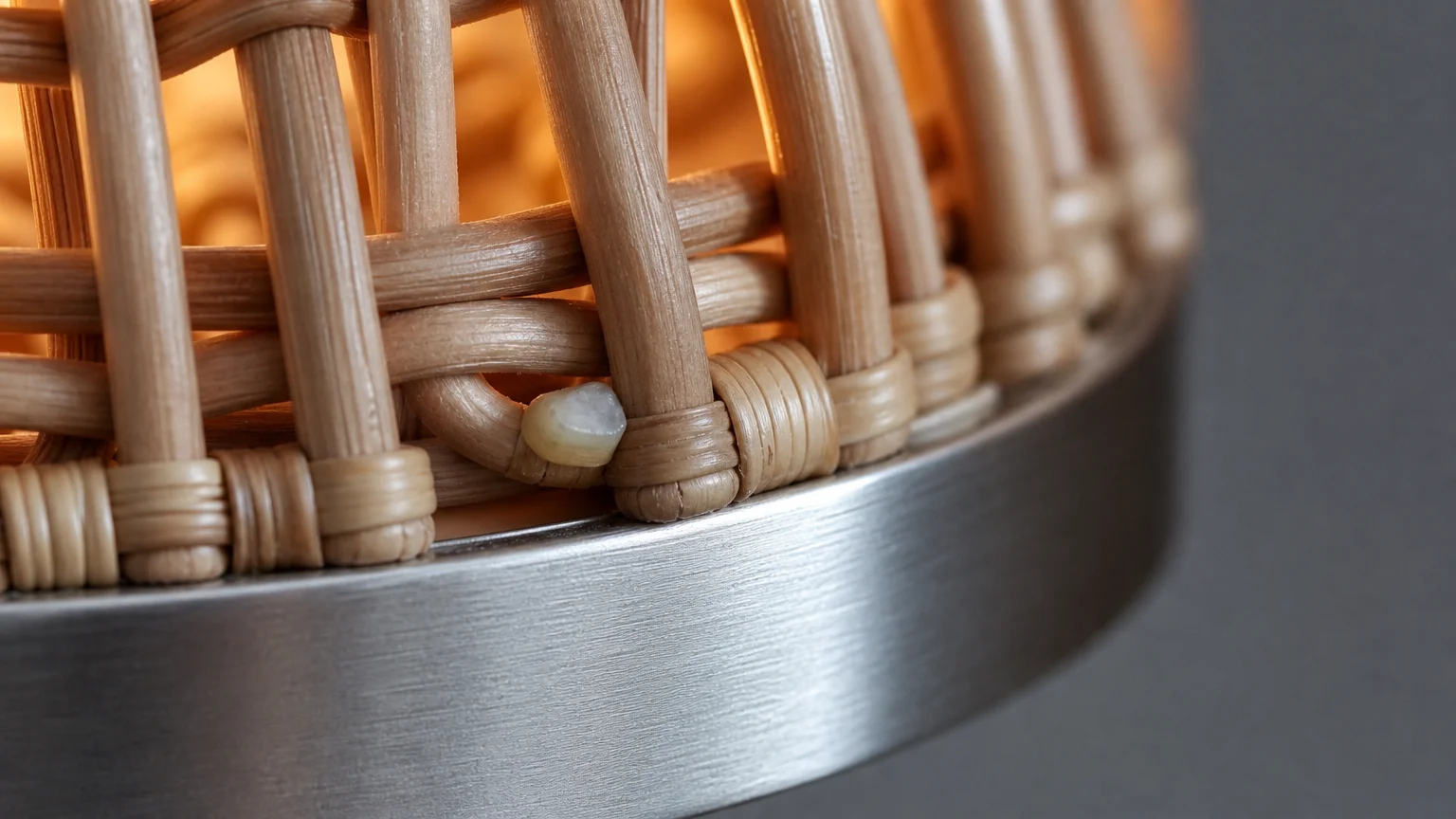
Three things happen at that interface. The first is mechanical: the lashing bears on the rim, and every relative movement between fibre and metal is absorbed by a small number of contact points. Those points abrade. A fibre that has been rubbed against a metal edge for years thins, and a thinned strand carries less. This is one reason a formed or rolled rim edge is worth specifying: a sharp edge concentrates the contact and accelerates the wear.
The second is chemical. Where two dissimilar materials sit in a sheltered gap, moisture collects and stays. The metal may corrode; the corrosion products may migrate into the fibre and stain it; and the fibre, holding moisture against the metal, keeps the corrosion going. The staining is usually the first visible sign, and by the time it appears the mechanism has been running for a while. Good detailing addresses it by draining the joint rather than sealing it, and by choosing a coating that tolerates a damp crevice.
The third is geometric. The rim is what holds the weave at its intended tension, so any movement at the rim changes the optical character of the whole surface. This is why a sagging fixture so often looks “tired” rather than broken: the weave has not failed, the rim has allowed it to relax, and the shadow pattern that made the piece interesting has softened.
The practical consequence is that the rim detail should be specified and inspected as a structural feature. Ask how the weave is terminated at the top and bottom edges, whether the strand ends are turned and bound or simply cut, whether the lashing is a single continuous binding or a series of discrete ties, and whether the whole thing can be re-tensioned on site. A fixture with discrete ties can be re-tensioned with a hand tool by a maintenance technician. A fixture with a continuous machine binding cannot, and its service life is set at the factory.
It is also worth being clear about what a re-tensioning operation does not fix. Tightening a lashing restores the local geometry; it does not restore a strand that has thinned through abrasion, and it does not correct a frame that has deflected. Where the interface is showing wear, the question to ask is not how to tighten it but what has been moving and why.
The Other Load Path: Ceiling, Canopy, Anchor
Everything above has described the fixture. But a pendant is only as stable as what it hangs from, and the ceiling end of the load path is where responsibilities are most often unclear. The lighting supplier supplies a fixture with a stated mass and a suspension assembly; the building supplies a structure; somebody in between decides how the two are connected.
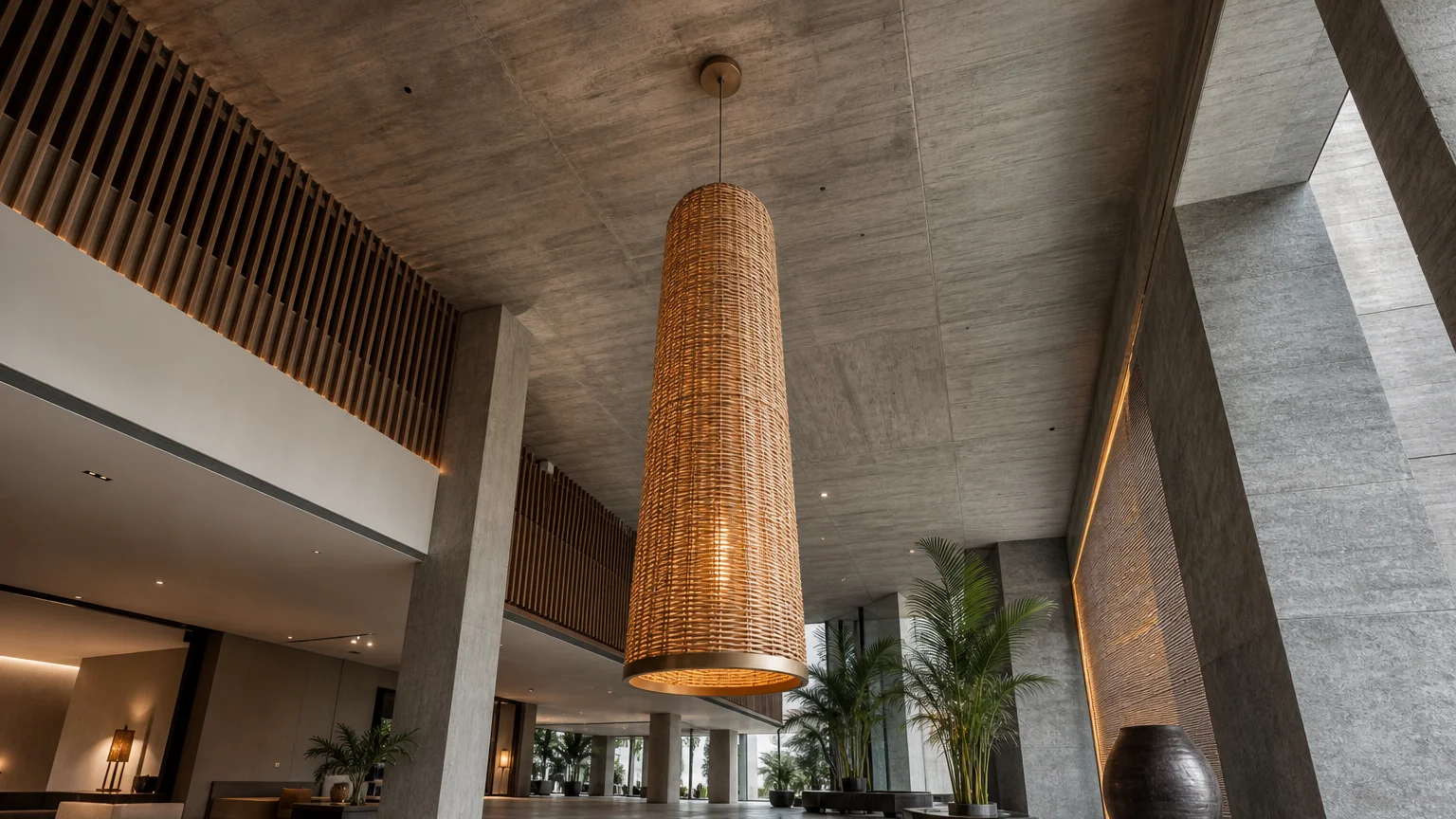
The first distinction to make is between the fixture’s mass and the packaging mass. They are not the same figure, and confusing them is a common source of under-specified anchors. A fixture that is light enough to lift with one hand may arrive in a crate that is not, and the crate tells you something about fragility rather than about hanging load. The figure that belongs in the structural conversation is the hanging mass of the finished assembly, including any removable components that will be fitted after installation.
The second distinction is between the structure and the finish. A canopy screwed into a plasterboard ceiling is fixed to a lining, not to a structure. A canopy fixed to a concrete soffit is fixed to something that can carry load, provided the anchor is appropriate to the concrete and to the direction of the load. A canopy fixed to a metal deck or to a suspension grid is a third case again, and it usually requires a secondary frame. None of these decisions belongs to the lighting supplier alone, and none of them can be inferred from the drawing of the fixture.
The third is the one that gets forgotten in handover: what happens to the load path when the fixture is serviced. Cleaning, lamp replacement and re-tensioning all involve somebody working near the suspension. If access requires a ladder and a reach over a table, the fixture will be pushed and pulled, and the anchor will see loads it was not designed for. Provision for maintenance access is therefore part of the structural story, not a separate facilities question, and our notes on maintenance access for statement fixtures set out how that is usually resolved.
The workable division of responsibility is straightforward to write down. The lighting supplier states the hanging mass, the suspension points and the hardware rating, and supplies the canopy. The project’s structural or M&E engineer confirms the ceiling can accept that load at that location and specifies the anchor. The installer executes to that specification and records what was used. The operator inspects on a stated interval. Where any of those four is missing, the gap is filled by whoever is on site, which is how a fixture ends up hanging from a lining by accident.
Our guide to pre-installation checks before a heavy fixture arrives covers the site-side sequence in more detail, and the general question of how a fixture’s materials are specified is set out in materials and finishes. What matters for this article is the principle: the frame is only the middle of a load path that begins in the slab and ends in the weave, and every joint along it deserves the same scrutiny.
What Early Movement Looks Like on Site
By the time sagging is obvious to a guest, it has usually been measurable for a long time. The purpose of a handover inspection is to create a baseline detailed enough that early movement can be recognised as movement rather than as a change of taste.
Look along the rim from a low angle. A rim that is out of round or out of plane is easiest to see against a straight reference — a ceiling line, a beam, the edge of a table. Photograph it that way, from a fixed position, and keep the photograph. The value of the image is not its beauty but its repeatability: the same view, later, answers the question directly.
Check the shadow line. Where light spills from inside a woven shade, the pattern at the rim is a sensitive indicator of local movement. An even scalloped edge at handover that becomes uneven later means the weave has moved relative to the frame, not that the lamp has changed.
Flex the lashings by hand. A lashing that is sound has no perceptible give. One that has relaxed will move under a gentle thumb. This is a two-minute check per fixture and it is the earliest indicator available, well before anything is visible from below.
Listen. A woven fixture that creaks when touched, or when the air moves, is telling you that something is moving against something else. Creaking at the canopy suggests the suspension is working; creaking at the rim suggests the interface is. Both are worth recording and both have different owners.
Compare with the approved sample. Colour, weave openness and profile should be judged against the sample that was approved, under the same light, not against memory. This is the same discipline that applies to any natural material, and our article on reading material and weave sets out the vocabulary for describing the differences precisely enough to be actionable.
The output of these checks is a short record per fixture: profile photograph, rim photograph, lashing condition, any sound noted, and the date. That record is what makes a later conversation about warranty factual. Without it, a project is arguing about whether a fixture has changed, and the supplier is entitled to say that it has not.
Specifying It So It Stays Straight
The productive way to prevent sagging is to write the requirement into the specification, because the mechanisms are known in advance and the remedies are all decisions that can be made before production. The clauses below are short, and each one closes a specific failure route.
State the load path. Require the submittal to show how the hanging load travels from the woven body to the suspension points, with the frame drawn separately from the weave. This single requirement removes most of the ambiguity, because a supplier who has not thought about it cannot draw it.
Require bracing and describe the span. Ask for the frame’s bracing to be shown, and for the number and position of suspension points to be stated. Where a fixture is large, expect a ring and radial structure rather than a single central point with long arms.
Require a removable shade. State that the woven body must be detachable for cleaning and re-tensioning without cutting bindings, and that a re-tensioning method must be documented.
Require the suspension hardware to be listed. Type, material, finish and rated duty, plus a separate statement of what the project must provide at the ceiling. This is where the boundary between supplier and structure is drawn, and it should be drawn in the submittal rather than on site.
Require a frame photograph before weaving. As described above, no other view of the structure will exist once the weave is on, and it costs nothing to keep.
Require care and inspection instructions that mention structure. A cleaning note that addresses dust but not lashings, joints and rims has not addressed the life of the fixture. The instructions should say what to look at, how often, and what to do when something is found.
Require a spare provision. Lashings, clips and a length of matching weave cost little at the point of order and are difficult to obtain years later, when the material has aged and the batch has closed. For a property with a repeating fixture type, a documented reorder path is more useful than a stock of finished shades.
None of these clauses is exotic, and together they describe a fixture that behaves predictably. That is the modest and achievable goal. A woven pendant is not a structural material expressing itself; it is a well-understood enclosure sitting on a frame that was designed to carry it, hung from a ceiling that was checked. The failures that fill maintenance logs come from the seams between those three responsibilities, and a specification that names each one is how a project keeps them closed.
Does the woven body carry any of the weight? A tight weave contributes some stiffness to a frame, and in a small fixture that contribution is real. It should not be counted on. Natural fibre creeps under sustained load, moves with humidity and loses local stiffness when damaged, so a design that depends on the weave for structural stability has built in a slow failure. Specify the frame to carry the load and treat the weave’s contribution as a bonus.
Why has my pendant sagged in the middle when the weave still looks unchanged? That pattern points at the frame rather than the weave. If the arms are slender, or the ring has no bracing, the frame deflects under load and the weave follows it down. The weave is intact because nothing has happened to it; the shape has changed because the structure beneath it has. Compare the profile against the frame photograph taken before weaving, if one exists.
Can a relaxed lashing be tightened on site? If the weave is tied with discrete lashings and the rim is accessible, yes — it is a maintenance operation with a hand tool. If the weave is bound with a continuous machine lashing, it cannot be re-tensioned in place, and the fixture’s geometry is fixed at production. This is worth establishing before the order, not after the first season.
Is stainless steel the answer for a coastal project? It removes the most common corrosion failure at the frame, but the grade, the fixings and the detailing of the joints still have to suit the exposure, and salt deposits keep surfaces damp whatever the metal is. Coastal duty is a specification of the whole assembly, including the coating on the weave and the inspection interval, not a single material choice.
Who decides what the fixture hangs from? The project, not the lighting supplier. The supplier states the hanging mass, the suspension points and the hardware duty; the structural or M&E engineer confirms the ceiling can accept that load where it is being placed and specifies the anchor; the installer executes and records. A canopy fixed to a ceiling lining rather than to structure is a decision that has been made by default, and it is the one most likely to be discovered by a guest.
We build woven and natural-fibre fixtures with the frame, the suspension and the enclosure specified as three separate items, and we will show you the load path, the bracing and the rim detail before the weave goes on. Send the ceiling condition, the fixture size and the room it is going into, and we will return the frame drawing, the suspension schedule and the parts of the requirement that belong with your structural engineer rather than with us.
Pendants and chandeliers · Hotel lighting projects · Talk to us about a specification


