
A specification line that reads “rattan pendant, natural finish” looks complete and is not. It names a plant, a look and nothing that can be quoted, inspected or rejected. The same is true of “wicker”, which is not a material at all, and of “cane”, which is either a peeled strip or a sheet of woven mesh depending on who is writing. Three words that buyers and sellers use interchangeably are doing three different jobs, and the gap between them is where most woven lighting orders go wrong.
This article is a reading guide for those three words and for the spec line they end up in. It is written for the buyer who has to send an enquiry, the designer who has to approve a sample, and the hotel owner who has to accept a delivery, and it assumes no prior vocabulary. Nothing here is about style. It is about the difference between a description and a specification, and about the small number of questions that turn one into the other.
The reason the distinction earns a whole article is that woven lighting is one of the few categories where the material and the method are both visible in the finished object, and where neither can be inferred from the other. A tight machine-wound drum and a loose hand-lashed basket can be made from the same plant, sold under the same word, and behave completely differently above a dining table. When the word on the drawing is ambiguous, the sample that arrives is not wrong, exactly. It is simply one of several things the word allowed.
- 01Three Words, Three Different Jobs
- 02What Rattan Actually Names
- 03What Cane Names, and Why It Shifts
- 04What Wicker Names: A Method, Not a Material
- 05Why the Confusion Is Structural
- 06Reading a Weave: What the Pattern Tells You
- 07What Each Word Commits You To
- 08Writing the Spec Line So It Can Be Quoted
- 09The Traps Inside a Woven Lighting Enquiry
- 10A Short Reading Order for Buyers
Three Words, Three Different Jobs
Start with the grammatical difference, because it explains almost everything that follows. Rattan is a noun that names a plant and the stems cut from it. Cane is a noun that names a part of that plant, and also a noun that names a manufactured sheet, and also a verb meaning to weave with it. Wicker is a noun that names a way of making things, which is why it can be applied to objects made from plants that have nothing to do with rattan at all.
Put the three in a sentence and the problem becomes obvious. “A wicker pendant in rattan with a cane shade” is a perfectly ordinary trade description, and it contains one method, one material and one part, in that order. Reverse the sentence and it stops making sense: a rattan pendant in wicker with a rattan shade describes nothing. The words are not synonyms at different price points. They sit at different levels of the same hierarchy, and a spec line that mixes the levels cannot be quoted precisely or inspected consistently.
There is a practical test for whether a description has reached the level of a specification. Ask what would have to change for the object to be a different object. If the answer is the plant, the line is at the material level. If the answer is the width of the strip or the direction of the weave, the line is at the construction level. If the answer is the frame, the line is at the structure level. A usable specification has something to say at all three, and most catalogue copy has something to say at none of them.
The vocabulary also carries commercial weight. Rattan has a specific origin and a recognised set of working properties; wicker has neither, because it is a technique that any flexible fibre can satisfy. When a seller writes “wicker” where “rattan” is meant, the buyer loses the ability to reason about the material, and the seller keeps the freedom to substitute. That is not necessarily dishonest, and it is worth noticing. The rest of this article treats each word on its own terms, then puts them back together in the form a buyer can actually send.
What Rattan Actually Names
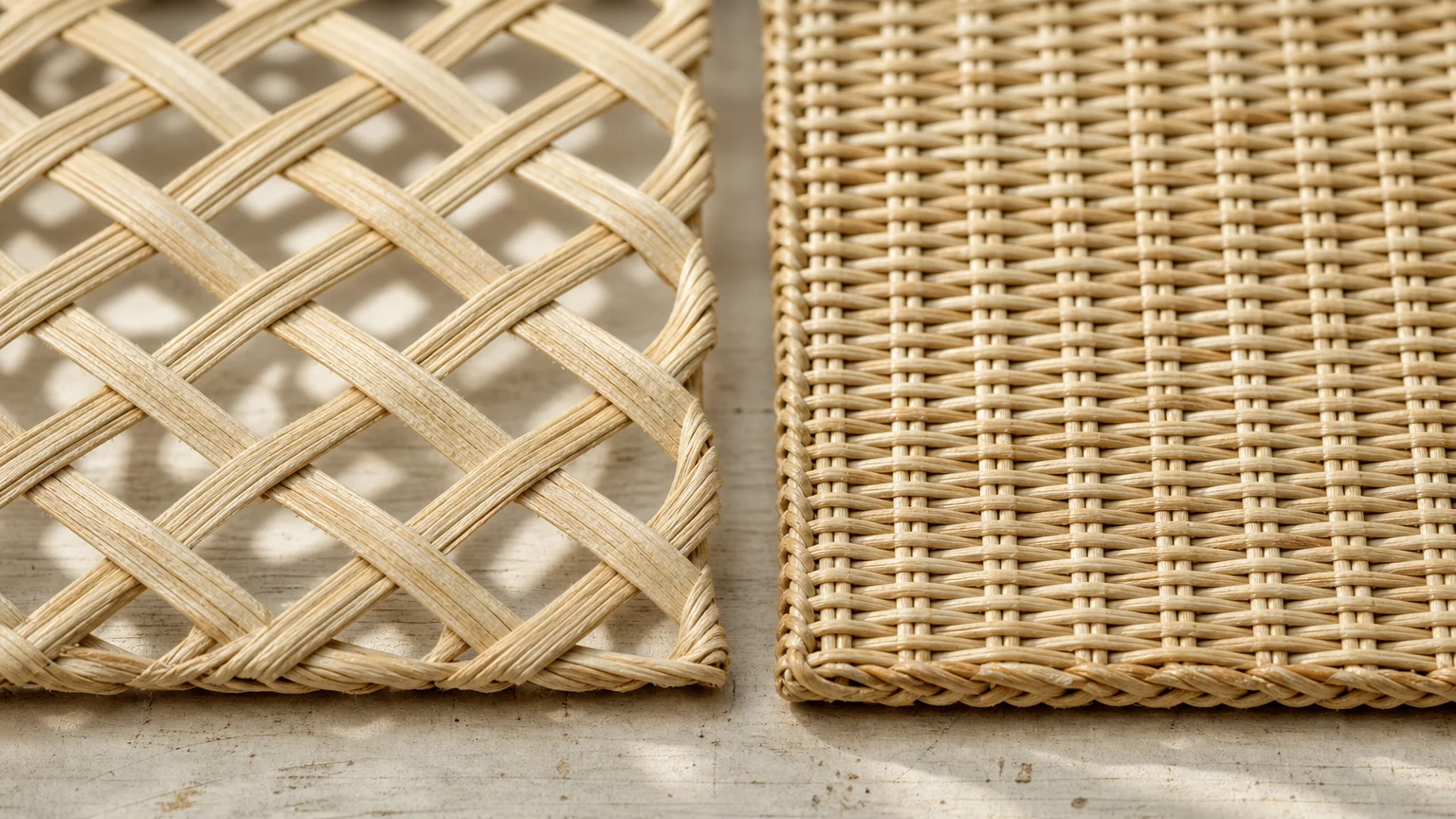
Rattan is a climbing palm. It grows as a long slender stem reaching through tropical forest rather than as a free-standing tree, and it is harvested by cutting lengths and stripping them, a method that has been sustainable in practice for as long as it has been used, because the plant regrows from the root and the harvested stem is a small part of the plant. The material that arrives at a workshop is a round stem with a hard outer skin and a softer core, and both parts are useful in lighting, which is where the vocabulary starts to split.
Two properties matter more than any other for lighting. The first is that the stem is solid. This is the single most useful fact a buyer can hold, because it distinguishes rattan from bamboo, which is hollow and jointed. A solid stem can be steam-bent, split, shaved and joined without collapsing, and it holds a curve once formed. A hollow culm cannot be treated the same way, and a woven form designed around one will not behave like a form designed around the other. When a supplier describes a piece as “bamboo or rattan”, the two words are not interchangeable in construction terms even when they are interchangeable in style terms.
The second property is that the stem is strong in proportion to its weight, and it does not split along the grain the way timber does. That combination is why the material became a weaving material rather than a joinery material. It bends further before failing, it tolerates being lashed and knotted, and a frame made from it can be light enough to hang without a structural ceiling. In a pendant, those are the properties that decide whether a large shade is possible at all.
Rattan also carries a specific set of associations that a spec line should not lean on. It has been used for baskets and light furniture in its growing regions for a very long time, it entered European interiors through trade in the colonial period, it was absorbed into modernism in the middle of the twentieth century, it was pronounced dated when moulded plastics arrived, and it returned when the argument about materials shifted toward renewable and low-energy production. None of that history tells you anything about the object in front of you, but it explains why the word carries a promise of naturalness that sellers are keen to invoke and buyers are slow to test.
What Cane Names, and Why It Shifts
Cane is the outer skin of the rattan stem, peeled off in long strips. It is smoother, denser and more uniform than the core, and it takes a finish better, which is why it is used where a clean surface and a fine line matter. In a woven shade, cane strips produce the narrow, even ribs that read as a drawn line rather than a bundle. In furniture it is the material of the familiar wrapped seat, and in lighting it is the material of the shade that looks engineered rather than gathered.
The word then shifts, and this is the first real trap. Cane is also used for a manufactured sheet: strips of cane woven into a fixed mesh and sold by the panel, which a maker cuts and fixes into a frame rather than weaving strand by strand. In that sense cane is a product, not a plant part, and a shade made from a cane panel is a different object from a shade hand-woven from cane strips, even though the same word appears on both invoices. The difference shows at the edges, where a panel terminates in a cut line and a hand-woven shade terminates in a bound or lashed edge, and it shows in the pattern, which repeats precisely across a panel and drifts slightly across a hand-woven surface.
There is a third use, less common in lighting but frequent in enquiry language: cane as a verb, meaning to weave a seat or a panel with cane. A supplier who says a shade is “cane work” may mean any of the three. The question that resolves it is not “is it cane?” but “is the cane a strip I weave, a panel I cut, or the skin of the stem you bought?” Each answer points to a different construction and a different cost base.
Because cane is the skin, its supply is tied to the stem it came from. A workshop that buys stems and peels them has control over strip width, colour and straightness. A workshop that buys cane by the bundle or the panel is choosing from what is available, and the shade it makes will be consistent with that supply rather than with the stem. For a single pendant this hardly matters. For a run of shades in one room, or for a replacement made a year later, it is the difference between a match and a near-miss.
What Wicker Names: A Method, Not a Material
Wicker is a technique. It describes objects made by weaving flexible plant material over and around a frame, and it says nothing about which plant. Willow, rattan, bamboo, seagrass, rush, paper rope and extruded synthetic filament can all be wickered. This is why the word appears on garden furniture made of coated aluminium strand and on a museum basket made of split oak, and why it cannot be used to reason about weight, flexibility, moisture behaviour or repairability.
In lighting the word is usually doing one of two jobs. Sometimes it is a style signal: “wicker pendant” tells a buyer to expect an open, textured, basket-like body rather than a smooth drum. Sometimes it is a way of avoiding a material commitment, and a spec line that stops at wicker has effectively left the material open. Both uses are legitimate in conversation and neither is sufficient in a purchase order.
The method does have consequences worth knowing, because a technique imposes its own logic on the object. A woven body needs a frame to weave onto, and the frame is usually metal, which means every woven fixture is a composite of at least two materials with different expansion, different fastening and different failure modes. A woven body is also, by construction, full of gaps. Those gaps are the optical feature of the category and the maintenance feature of the category at the same time: they let light out in a pattern, and they let dust in. Neither property is visible in the word wicker, and both are decided by the weave rather than the fibre.
There is one more consequence, and it is the one that matters most in a hotel project. Because wicker names a method, there is no such thing as a wicker specification. There is only a specification for a woven object: which fibre, which strip, which weave, which frame, which finish. A buyer who accepts “wicker” as the material description has accepted the method and left the substance to the supplier’s judgement, which is exactly the outcome a written specification exists to prevent.
Why the Confusion Is Structural
The three words blur for reasons that are not careless. Four of them are worth naming, because each one has a countermeasure.
Catalogue language is written to be searched, not quoted. A product page has to contain the words a buyer might type, which means it accumulates “rattan”, “wicker”, “cane” and “natural fibre” whether or not all four are accurate. The page is not lying; it is optimising for discovery. The buyer’s mistake is treating a page written for search as a document written for procurement.
The categories overlap in the real world. A pendant can genuinely be rattan in the frame, cane in the shade and wicker in the method, and a correct description of it uses all three words in one sentence. When the same object legitimately attracts every term, the terms stop discriminating between objects, and the reader has no way to tell whether the writer is being precise or approximate.
Translation flattens the hierarchy. Many source catalogues are written in a producing country and translated for export, and translation tends to collapse specialist terms into the nearest common word. “Rattan”, “cane”, “vine” and “wicker” arrive in English as a single acceptable phrase, and the distinction that existed in the original is lost before the buyer ever sees it. This is not a reason to distrust a supplier; it is a reason to ask a question that the translation cannot absorb.
The look is easy to imitate. Printed patterns, embossed resin, extruded polymer strand and paper rope wound to a cane-like gauge can all produce a photograph that reads as woven rattan at a distance. Because the visual result is achievable without the material, the word alone cannot carry the guarantee. Only a material statement, a sample and a document can.
None of this is fixed by better vocabulary on its own. It is fixed by writing a line that separates the levels, and by asking for the two things that cannot be faked: a physical sample and a written material statement. A supplier who can supply both has a specification. A supplier who can supply neither has a description, and a description is what a buyer gets when a woven fixture arrives and does not match the room.
Reading a Weave: What the Pattern Tells You

Once the material is settled, the weave decides what the fixture does. Three variables carry most of the effect, and all three can be read from a sample in a few minutes without any instrument.
Openness. How much of the surface is gap rather than strand. An open weave passes light in stripes and throws a visible pattern onto the ceiling and the wall behind; a closed weave passes light as an even field and reads almost like a fabric shade. Neither is better. The open weave is more dramatic and more revealing of the lamp inside; the closed weave is calmer and hides the bulb. The mistake is to order one and expect the other, which happens whenever the specification says “woven” and stops there.
Direction. Whether the strands run vertically, horizontally or diagonally, and whether the pattern is a plain over-and-under, a twill that steps sideways, or a bound construction where the strands are lashed rather than crossed. Direction sets the grain of the object: a vertical weave makes a shade look taller, a diagonal weave makes it look busier, and a bound construction reads as a handmade basket rather than a manufactured drum. Direction also decides how the shade behaves optically, because a strand crossing the light path at an angle throws its shadow at a different angle.
Regularity. Machine-wound and panel-based constructions produce an even surface with a repeating pattern. Hand-woven constructions produce a surface that varies slightly across its face, with small changes in strand spacing and tension. The variation is not a defect and it is not a guarantee of quality either; it is a signature, and it tells you which of the two families you are looking at. In a set of pendants over a long counter, that signature has to be consistent from one piece to the next, which is a question about the workshop rather than the design.
Two further features are worth learning to see because they are frequently confused. The first is the difference between a woven panel and a woven surface: a panel is a sheet cut to shape and fixed into a frame, so its pattern terminates at a cut edge and its repeat is exact; a woven surface is built onto the frame strand by strand, so its pattern turns at the corners and its repeat drifts. The second is the difference between a shade that is structure and a shade that is skin: in some fixtures the woven body carries the form and the frame is a minimal armature, while in others the metal frame carries everything and the weave is a decorative sleeve. Which one you are buying decides what happens when the weave is damaged, and whether a repair is possible at all.
What Each Word Commits You To
The table below is the practical core of this article. For each word, it sets out what the word actually promises, what it leaves open, and the question that closes the gap. Read it as a translation layer between catalogue language and a purchase order.
| Word on the page | What it commits the seller to | What it leaves open | The question that closes it |
|---|---|---|---|
| Rattan | A climbing palm stem, solid, worked as a structural or woven element | Whether the stem, the peeled skin or both are used; which part of the plant is visible | Is the visible element the stem, the peel, or a mix, and which is structural? |
| Cane | Rattan outer skin, or a woven sheet made from it | Strip work versus panel work; hand-woven versus pre-woven sheet | Is this a panel cut to shape, or strands woven onto the frame? |
| Wicker | A weaving method over a frame | The fibre, the strip, the weave, the finish — all of it | Which fibre, and what is the frame it is woven onto? |
| Natural fibre | A plant-based material, unspecified | Which plant; whether the fibre is a stem, a leaf, a bark or a seed casing | Name the plant and the part of it used in the visible surface. |
| Woven shade | Some form of interlaced construction | Everything about openness, direction and frame | Send a sample, and state open or closed and vertical, horizontal or diagonal. |
| Rattan effect | An appearance, not a material | Whether any plant fibre is present at all | What is the material, precisely, and is it printed, moulded or wound? |
Two readings of the table are worth spelling out. The first is that the top three rows are cumulative rather than alternative: a good line uses rattan for the material, cane for the visible skin or panel, and wicker only as a description of method, in that order. The second is that the bottom two rows are not commitments at all. “Natural fibre” is a category, and “rattan effect” is a look. Both are acceptable in marketing copy and neither can be inspected, which is the mark of a phrase that has no place in a purchase order.
There is a third reading, less comfortable. A supplier who is asked to be precise and answers vaguely is telling you something about the supply chain, not about their English. Precision requires knowing which workshop made the piece and what it bought, and a trader who cannot answer may be sourcing from whoever has stock. That is a legitimate business model. It is simply a different risk profile from a workshop that peels its own stems, and the specification is where the difference becomes visible.
Writing the Spec Line So It Can Be Quoted
A specification is not a longer description. It is a set of statements that can be checked, each of which could be false. The test for every clause is simple: if nobody could disagree about whether it has been met, it is decoration. “High quality natural material” cannot be met or unmet. “Visible surface: peeled cane strips, hand-woven onto a steel frame, open plain weave, natural undyed finish” can be checked against a sample in under a minute.
The table below sets out the clauses a woven lighting line needs, in the order they should be written. It is deliberately short. Most failed orders fail on a clause that went unwritten rather than on a clause that was written badly.
| Clause | What to write | Why this clause exists |
|---|---|---|
| Material and plant part | Name the plant and the part: stem, peeled skin, leaf, or a named non-plant fibre | Separates rattan from bamboo, palm leaf, seagrass and paper rope before any price discussion |
| Construction of the visible surface | Hand-woven onto the frame, or a woven panel cut and fixed | Decides the edge detail, the pattern repeat and whether a repair is possible |
| Weave | Open or closed; strand direction; plain, twill or bound | The optical behaviour of the fixture and its dust behaviour both follow from this |
| Frame and load path | Frame material, and an explicit statement of which element carries the pendant | Woven bodies are composites; the frame is what keeps a large shade in shape |
| Finish and treatment | What is applied, to which element, and what documentation accompanies it | Finish claims are the least verifiable part of any woven fixture; ask for the file, not the adjective |
| Sample and approval | A physical sample of the actual weave and finish, approved before production | The artefact that resolves vocabulary disputes without argument |
| Consistency across a set | How variation between pieces will be managed, and what counts as acceptable | Natural material varies; the question is whether the set still reads as one set |
Two of these clauses deserve a note. On finish and treatment, the correct request is documentary rather than verbal: ask which treatments have been applied, to which component, and request the supplier’s own test or treatment record for the batch. Do not ask a supplier to name a performance grade, and do not accept one volunteered in conversation; a grade is a claim about a tested assembly, and the defensible position for a buyer is to hold the document that supports it. On consistency across a set, the productive conversation is about the batch rather than the individual piece: a run of pendants made from one delivery of stems will match; a run assembled from stock will match approximately, and the buyer should decide in advance whether approximately is acceptable in the room.
Written this way, the line stops being a description and becomes a small contract. It also changes the nature of the quotation. A supplier quoting against a written line is quoting a construction, and a supplier quoting against “wicker pendant” is quoting an impression. The two numbers are not comparable, which is why buyers who compare quotes without a common specification usually conclude that the cheapest quote is the fair price and discover otherwise on delivery.
The Traps Inside a Woven Lighting Enquiry
Six situations account for most of the confusion in this category. Each one is a place where a reasonable buyer, using reasonable words, ends up with an object they did not intend.
The palm-leaf substitution. Dried and pressed palm leaf produces a woven shade with a looser, more organic surface than cane, and it is often sold under the same broad description. It is a legitimate material with its own character, and it is not rattan. If the design depends on the crisp rib of cane, palm leaf will not deliver it, and the difference will be obvious only when the sample arrives.
The paper-rope substitution. Paper rope winds into a smooth, regular shade with a soft matte surface and it photographs beautifully. It is also lighter and less rigid than a cane construction, and it belongs to a different family of object. A buyer who specifies “natural woven shade” can receive paper rope and have no ground for complaint, because nothing in the phrase excluded it.
The printed or moulded imitation. A pattern printed on a rigid shell, or a resin body moulded to a weave texture, can look convincing in a catalogue and reads as flat in a room, especially when lit. The give-away is the absence of shadow: a real weave throws a pattern, an imitation throws an even glow. Ask for a lit photograph of the actual production piece, not a render.
The “real rattan” assurance. An assurance is not a document. When a supplier says a piece is real rattan, the useful follow-up is a request for the material statement and a sample of the actual strip used, including its cut end. A solid cut end with visible fibre is a different object from a rolled or extruded section, and it is visible without any laboratory.
The treatment question, asked the wrong way. Buyers who need a woven fixture in a project with fire or moisture requirements often ask the supplier to confirm a performance level. This is the wrong direction of question, because it invites a verbal claim that cannot be verified and cannot be relied on. The right question is what documentation the supplier holds for the treatment applied to this batch, in what form, and whether the batch can be traced to it. If the documentation does not exist, the honest answer is that the requirement cannot be evidenced for this product, and the design should change rather than the paperwork.
The moisture assumption. Woven plant fibre in a wet or splash-exposed position is a material decision, not a finish decision, and a coating does not change what the substrate is. A supplier who offers a protective finish is offering a measure that helps in a humid interior; that is not the same as suitability for a wet zone. The distinction has to be made in the specification before the order, because after the order it becomes a warranty argument. Our note on natural materials and the light around them sets out how these fibres behave generally, and the broader family is surveyed in the guide to natural fibre lighting in rattan, bamboo, hemp rope and paper rope.
A Short Reading Order for Buyers
Everything above reduces to a sequence. Read the product description and identify which of the three words is being used, and at which level. If the page says wicker, you have a method and no material. If it says cane, you have a part of a plant and possibly a panel. If it says rattan, you have a material and still need to know which part of it is visible. Then ask for the sample, and read the sample against the three variables: openness, direction, regularity.
Only after that is it worth discussing price, because until then the quotes are not for the same object. This is the part buyers find hardest to accept, since it inverts the usual order of a procurement conversation. It is also the part that saves the most money, because the expensive failures in woven lighting are not overpriced fixtures. They are correct-looking fixtures that had to be replaced.
For a project, the line to hold in mind is that a woven fixture is a composite: fibre, weave, frame and finish, each of which can be specified and each of which can fail on its own. The vocabulary of rattan, cane and wicker describes that composite from three different angles, and a specification is simply the act of describing all three in the same document. Once that is done, the words stop being ambiguous, because they are no longer carrying the whole description on their own.
Our own woven and natural-material pendants are specified this way for project work, with the plant part, the weave and the frame stated separately and a sample approved before production. If you are writing a line for a hospitality interior and want a second reading of it, the place to start is the pendant and chandelier collection for form, and the custom lighting service for a specification review against your room.
Is wicker the same as rattan? No. Rattan is a plant, and wicker is a method of weaving flexible material over a frame. A rattan object is usually wicker, but a wicker object is only sometimes rattan: willow, bamboo, seagrass and synthetic strand all produce wicker. If you need to know what the object is made of, the word wicker will not tell you.
What is the difference between rattan and cane? Cane is the outer skin of the rattan stem, peeled off in strips. Rattan is the whole stem, solid through its section and strong enough to act as a frame. In lighting, cane usually appears as the fine visible weave and rattan as the structure or the heavier ribs, and many fixtures use both deliberately to add texture.
Is rattan hollow like bamboo? No. Rattan is solid, which is the property that lets it be steam-bent, split and shaved without collapsing. Bamboo is hollow and jointed, and a woven form designed around one material will not behave the same way if built from the other, even when the two look similar in a photograph.
How can I tell a real woven shade from a moulded imitation? Light it. A real weave throws a pattern of shadow on the surface behind it and shows gaps of varying size; a moulded or printed imitation throws an even glow and its texture is uniform. The cut edge is the second check: a woven shade ends in strands, a moulded one ends in a clean moulded line.
Should I specify a performance grade for a woven fixture? Ask instead what documentation the supplier holds for the treatment applied to the batch you are buying, and whether the batch can be traced to that document. A grade named in conversation is not evidence. If the documentation does not exist, treat the requirement as unmet and change the design or the material.
Can a woven pendant be repaired if a strand breaks? Usually yes, if the weave is built onto the frame strand by strand, because a repair can be worked into the surface. A cut panel is harder to repair invisibly, since the pattern terminates at a cut edge. This is one of the practical reasons to know whether you are buying a woven surface or a woven panel.
We build woven and natural-fibre lighting for hospitality projects with the plant part, the weave, the frame and the finish stated separately, and with a physical sample approved before production rather than after delivery. Send the room, the drawing and the look you are after, and we will return the construction options and the documentation that goes with them.
Pendants and chandeliers · Hotel lighting projects · Talk to us about a specification


