

A recycled-content question arrives at a lighting supplier as a single cell in a spreadsheet, and it is usually answered with a single number. That number is the least reliable thing in the whole submittal. What a supplier can actually evidence is narrower, better defined, and far more useful to a buyer who knows how to read it.
Guestroom lighting has become one of the items where an operator’s design guide and a purchaser’s compliance list meet. The fixture is visible, it is replaced on a known cycle, and it sits inside a room whose whole specification is now written with material provenance in mind. So the schedule grows a column, the column asks for a figure, and the figure has to come from somewhere.
This article is about that somewhere. It sets out how a recycled-content claim travels through a lighting supply chain, which link in the chain can produce a document, what each document genuinely certifies and what it leaves untouched, and how to write the requirement so that the answer you receive is one you can defend to an auditor two years later. It stays deliberately at the level of evidence and document types; the figures themselves belong to a specific alloy, a specific batch and a specific bill of materials, and no general article can supply them.
- 01Why the Question Lands on the Lighting Supplier
- 02Four Links in the Chain
- 03What the Word Actually Names
- 04Metal: The Strongest Link in the Schedule
- 05Glass and Crystal: Where the Chain Weakens
- 06Finishes, Diffusers and the Parts Nobody Counts
- 07The Documents and What Each One Does Not Say
- 08Self-Declared Claims and the Rules Around Them
- 09Reading an Answer in a Tender
- 10What Belongs in the Schedule and the Order
Why the Question Lands on the Lighting Supplier
A hotel guestroom contains a great deal of material that nobody photographs. Behind the plaster there is blockwork, conduit, insulation and a fire strategy. In front of it there is a bed, a desk, a chair, a carpet, a curtain and a light. Of that visible layer, the light is the item that most often gets asked about, for three reasons that have nothing to do with its mass.
The first is that the fixture is an assembly of metals and glass, and metals and glass are the two material families the public associates with recycling. A question about recycled content feels answerable here in a way that it does not feel answerable about a carpet underlay. The second is that the fixture is a repeat item: the same pendant appears in a few hundred rooms, so any figure attached to it multiplies. The third is that the fixture is a replaceable item with a documented model number, which makes it easy to put in a submittal and easy to audit later.
So the question is reasonable. The problem is what happens next. A buyer asks for recycled content; the supplier answers with a percentage; the percentage goes into the submittal; the submittal is approved; the project is audited; and the supplier is asked, sometimes years later, to produce the basis for a number that was originally written by a salesperson from memory. That sequence is common, and it is the reason so many recycled-content statements in this industry are simultaneously true in spirit and indefensible in fact.
The way out is not to refuse the question. It is to answer it at the level where evidence exists, and to say plainly where evidence does not exist. A supplier that can hand over four documents and name three gaps is more useful to a project than one that hands over a single number and a logo. The rest of this article is about which four documents, and which three gaps.
Four Links in the Chain
A recycled-content claim is not a property of a fixture. It is a property of a material, aggregated into a component, aggregated again into an assembly, and then apportioned to a project. Each of those four steps has its own paperwork and its own arithmetic, and a claim that skips a step is not wrong so much as unmoored: it has lost the information that would let anyone check it.
The material link. A metal ingot, a glass batch, a sheet of acrylic. At this level the claim is about what went into the melt. It is documented by the party that made the material, and it is specific to an alloy designation or a batch number.
The component link. A spun canopy, a cast base, a bent arm, a blown shade. Here the material is transformed, and some of it is lost as swarf, offcut or reject. A component can carry a higher or a lower recycled share than the material it came from, depending on whether process scrap is fed back. The document at this level is usually a supplier declaration tied to a drawing revision.
The assembly link. The finished fixture: canopy, body, diffuser, driver, cable, gaskets, fasteners, packaging. This is where the arithmetic becomes a weighted average, and where most claims quietly become unverifiable, because the weighting depends on a bill of materials that is rarely published and a mass breakdown that is rarely measured.
The project link. The FF&E package. Here the fixture is one line among hundreds, and the figure that matters to the operator is a package-level one. The lighting supplier cannot produce that figure alone, because it does not know the rest of the package.
Two consequences follow, and both are practical. First, a fixture-level recycled-content figure is only meaningful if the weighting basis travels with it: which parts were counted, which were estimated, and what share of the total mass those parts represent. Second, a project-level figure quoted by a lighting supplier should be treated as a contribution, not a result. It is one input to a calculation that someone else has to finish.
There is a further complication that deserves to be named early, because it is the single most common source of confusion in submittals. Mass and value do not track each other. In a decorative fixture, the parts that carry the strongest material evidence, the brass body and the steel frame, are often the parts with the largest mass share, so the arithmetic usually works in the buyer’s favour. But in a fixture where a large moulded diffuser or a fabric shade dominates the envelope, the visually dominant part can be the one with the weakest chain and a substantial mass share, and the fixture-level figure then depends almost entirely on how that part was assessed. The bill of materials, not the photograph, decides which case you are in.
What the Word Actually Names
Before any document is requested, the term needs to be pinned down, because four different things are routinely called recycled content and they are not interchangeable.
Post-consumer material is material recovered from a product that has completed its useful life in the hands of an end user. A brass tap removed from a building and re-melted is post-consumer. This is the stream that most sustainability programmes are actually asking about, because it is the one that diverts material from disposal.
Pre-consumer material is manufacturing scrap that left the production process before reaching an end user: swarf from machining, offcuts from sheet, rejects from a casting run. It is genuinely recycled in the everyday sense, and it is the stream that most factories can document most easily, because it does not leave their control. But it is a weaker claim in programme terms, since it would in many cases have been re-melted anyway as ordinary good housekeeping.
Closed-loop and open-loop describe where the material goes, not how much of it there is. Closed-loop means scrap returns to the same product or process; open-loop means it goes into a different application, often a lower-grade one. A closed-loop figure and an open-loop figure can be numerically identical and mean different things to an auditor, so the route belongs in the statement.
Mass balance is an accounting method rather than a physical property. Under a mass-balance approach, a volume of certified material entering a production system is attributed to a run of output, without any individual unit necessarily containing it. This is a legitimate and widely used method in some material chains, and it is also the method most likely to be presented without its name. If a supplier’s claim is accounted on a mass-balance basis, the buyer needs to know that, because the physical unit in the room may not contain the material the claim refers to.
Alongside those four, two near-misses cause most of the remaining confusion. Recyclability is a statement about what could happen to the fixture at end of life; it says nothing about what went into it. And a recycled feedstock claim about the energy used in production is a different claim again. A submittal that uses one of these words where the other was asked for will pass a casual reading and fail a real one.
Metal: The Strongest Link in the Schedule
Metal is where a lighting supplier can answer properly, and it is worth understanding why, because the same reasoning explains why other materials cannot be answered in the same way.

Copper alloys, carbon steel and aluminium have had established secondary markets for well over a century. The consequence is an infrastructure: scrap is graded, sorted, sold, re-melted and re-certified, and the resulting ingot or sheet is sold with a material certificate that identifies the alloy and the heat. A factory buying brass sheet therefore receives, with the delivery, a document that a buyer can read. It is not a recycled-content declaration; it is a material certificate. But it is the anchor that makes a recycled-content declaration checkable, because it establishes what the material is and where it came from.
What to ask for, in order of strength. First, the material certificate for the alloy actually used in the fixture, with the heat or batch reference. Second, the mill’s or the stockholder’s declaration of the input stream: primary, secondary, or a stated mix, and whether the secondary portion is pre-consumer, post-consumer or both. Third, the internal scrap-return procedure at the fabricator, which tells you how much process scrap re-enters the melt and therefore how much of the component’s mass should be counted twice if the arithmetic is done carelessly.
There is a trap in this chain that catches experienced buyers. The substrate and the finish are separate claims. A canopy can be made from secondary brass and then plated, lacquered or coated, and the finish layer is not recycled material in any sense. The same is true of a powder-coated aluminium extrusion: the aluminium may carry a strong secondary content, while the coating does not. If the submittal says “recycled brass canopy” without distinguishing substrate from finish, the claim is not false, but it is imprecise in a way that will surface at audit.
A second trap is alloy substitution. Secondary metal is only as good as its sorting, and some foundries will meet a specification by adjusting alloy additions rather than by controlling scrap input. This is normal metallurgy, not misconduct, but it means that the alloy designation on the certificate and the alloy actually in the part can drift unless the factory is checking. A buyer who wants the claim to hold should ask for the incoming material certificate and, where the part is structural, the composition result from the finished component.
The practical upshot for a guestroom fixture is encouraging. In a typical decorative pendant or wall light, the metal parts usually carry the largest single share of mass and they sit at the strongest point in the evidence chain. That is why metal-led statements survive audit far more often than fixture-level averages, and why a supplier that leads with the metal chain is usually the one with something real to show.
Glass and Crystal: Where the Chain Weakens
Glass is the material that buyers assume is the easiest case and is in practice the harder one. Cullet, the crushed scrap glass used as furnace feedstock, is genuinely and routinely reused, and most lighting glassworks run a substantial proportion of it. The difficulty is documentation rather than practice.
Three things weaken the chain. The first is that cullet use is usually managed as an internal process parameter rather than as a declared product property. A glassworks knows what it put in the furnace; it does not necessarily issue a per-batch statement of recycled input, and it may reasonably regard the ratio as commercially sensitive because it affects yield and colour consistency. The second is that colour and clarity constrain the ratio. A clear crystal batch tolerates far less foreign cullet than an amber or opal batch, so a factory making both cannot apply one figure across its range. The third is that the material is often made in small batches by hand, and hand production generates its own scrap that is re-melted on site; that scrap is real, but it is pre-consumer and internal.
Lead-bearing crystal adds a further distinction that matters for end-of-life rather than for content. Crystal with a lead content is a separate waste stream from ordinary container glass in most markets, and its recovery route is different and less developed. A fixture made from lead crystal can therefore have a defensible recycled-content story and a weak recyclability story at the same time. Both statements can be true; a submittal that conflates them will mislead whichever reader it reaches first.
The honest answer from a glass supplier is usually one of three, and a buyer should be able to recognise which one they have been given. The first is a batch-level declaration of cullet input, issued by the glassworks, which is the strongest form and is not available everywhere. The second is a process statement describing how scrap is recovered and re-used on site, which supports a pre-consumer claim and does not support a post-consumer one. The third is a statement that no figure is currently available. The third answer is not a failure of the supplier; it is a description of the state of the chain, and it is far more useful than a number with no basis.
For the buyer, the consequence is a scheduling one. Glass evidence tends to arrive later than metal evidence, because it depends on a third party who is not part of the fixture order. A submittal plan that assumes all documents will be available at the same moment will slip. Asking for the metal chain first and the glass chain second, with an explicit deadline for each, keeps the package moving.
Finishes, Diffusers and the Parts Nobody Counts
The parts of a fixture that a guest actually looks at are frequently the parts with the weakest recycled-content chain. This is uncomfortable and it is worth stating plainly, because it determines whether a fixture-level figure is likely to be robust or decorative.
Finishes. Electroplating, physical vapour deposition and powder coating all apply a thin layer to a substrate. The layer is measured in microns, contributes almost nothing to mass, and is not recovered in any recycling route. The substrate underneath may be excellent. A claim about the “recycled content of a finished component” therefore depends almost entirely on how the finish mass was treated in the calculation: included at zero, excluded, or apportioned. Each treatment is defensible if stated, and none is defensible if unstated.
Diffusers and shades. Opal glass, acrylic, fabric and woven natural fibre are the components most likely to dominate the visual envelope and least likely to carry third-party content documentation. Acrylic in particular is often bought as sheet from a distributor with limited traceability. Woven shades raise a separate set of questions about the fibre itself, which are covered elsewhere in our material work rather than here. The point for this article is arithmetic: in a fixture where the shade is a large share of the mass, the fixture-level figure is mostly a statement about the shade, and the shade is where the evidence is thinnest.
Drivers and electronics. A driver is a small mass share with a disproportionate effect on durability, and it belongs to a different waste stream from the metal and glass. Its recyclability depends on take-back rather than on content. A supplier that mentions the driver in a recycled-content statement is usually confusing end-of-life with content.
Gaskets, cable, fasteners and packaging. Individually minor, collectively not. Silicone gaskets, PVC or fabric cable, zinc-plated fasteners and moulded pulp or foam packaging all carry their own material stories, and packaging in particular is the item most often excluded from a fixture claim while being the item the site actually has to dispose of.
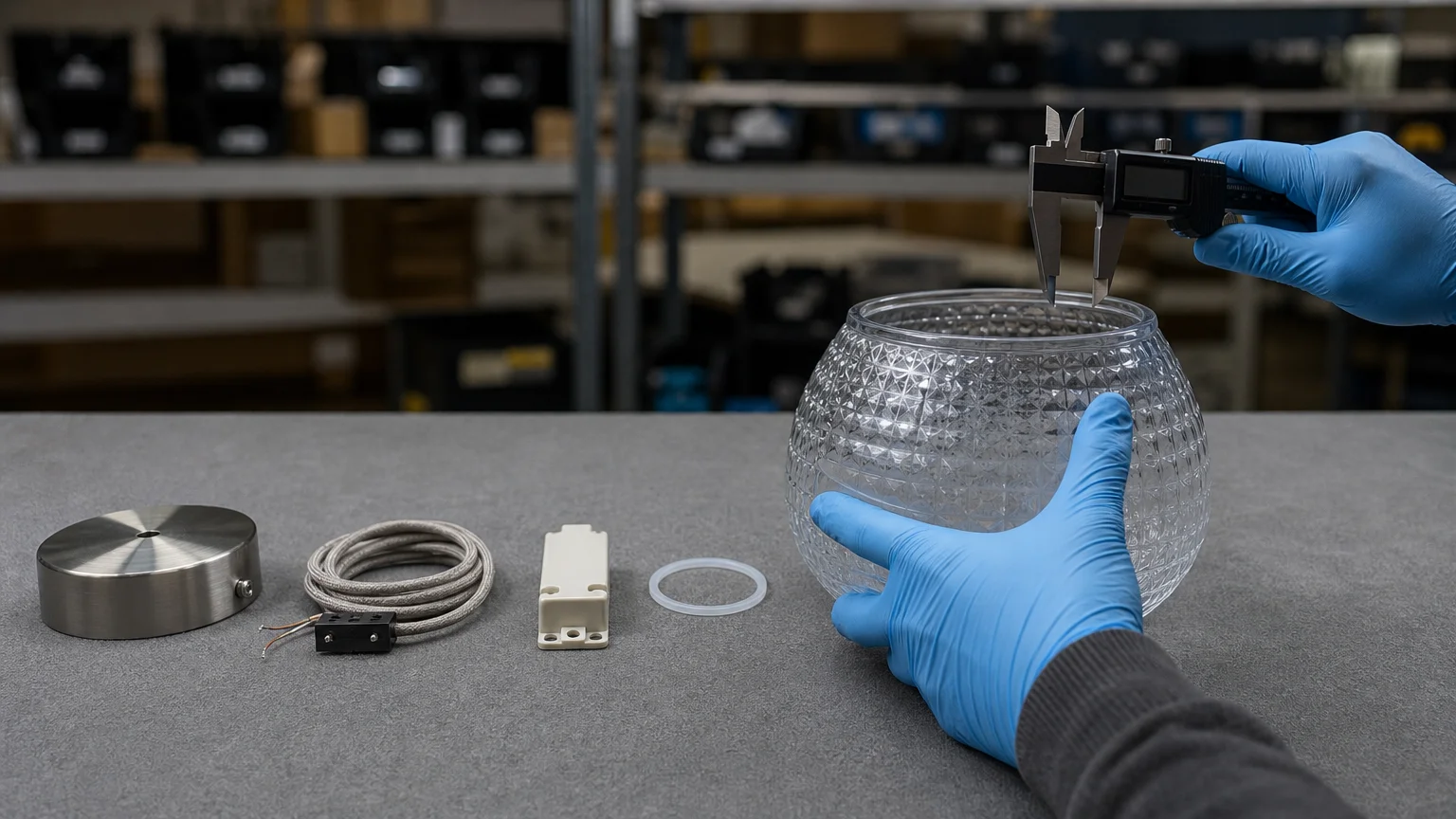
The practical response is a bill-of-materials review rather than a document chase. Before asking for declarations, ask for the mass breakdown by material family. A factory that can produce one is a factory that can support a claim; a factory that cannot is unlikely to be able to defend any figure it gives you, however plausible. The review also tells you where to spend effort: if the shade is the largest mass item, the conversation belongs with the shade supplier, not with the metal finisher.
The Documents and What Each One Does Not Say
The single most useful discipline in this area is to read every document for what it certifies and to note, in the same breath, what it leaves untouched. The table below maps the common documents in a lighting submittal to their actual scope. It is deliberately written in terms of document types rather than named schemes, because the schemes vary by market and change over time, while the scope of a document type does not.
| Level | Typical document | What it evidences | What it does not evidence |
|---|---|---|---|
| Material | Mill or material certificate with alloy and heat reference | What the material is, and which production batch it came from | How much of the input was secondary; whether the secondary portion was pre- or post-consumer |
| Material | Supplier declaration of input stream | The declared proportion of primary and secondary input for a named grade | Verification by a third party; performance of the finished part |
| Component | Component declaration tied to a drawing revision | Content of one manufactured part, at the revision stated | Content of the assembled fixture; effect of any later design change |
| Assembly | Fixture-level declaration on a bill of materials | A weighted figure for the fixture, if the weighting basis is stated | Anything about parts excluded from the bill of materials, such as packaging |
| Claim | Third-party verified environmental declaration | A claim verified against a published method, for a defined product | Content of a variant, a different size, or a revised design |
| Compliance | Declaration of conformity, test report | That the product meets a specified requirement, or how it performed under test | Nothing about material content; these are performance and conformity documents |
Two rows in that table cause most of the arguments. The first is the assembly row. A fixture-level figure is legitimate, and it is also the figure most likely to be quoted without its basis. When a supplier gives one, ask for the bill of materials behind it and the treatment of the finish layer, the diffuser, the driver and the packaging. The answer will tell you whether the figure is a calculation or an impression.
The second is the compliance row. A declaration of conformity and a test report are the two documents that purchasers ask for most often and they are the two that say least about content. A product can conform fully and contain no recycled material at all. A product can contain a great deal of recycled material and fail a conformity requirement. The two questions are independent, and a submittal that answers one has not answered the other. This distinction is worth making explicitly in the schedule, because it is the point at which a buyer’s certification list and a brand’s sustainability checklist most often get crossed — a subject we treat separately in our guide to reading a brand checklist against a certification list.
There is one more document worth naming, because it is frequently offered and frequently misunderstood: a chain-of-custody certificate. It evidences that a defined volume of material moved through a defined route under a defined control. It does not evidence that the fixture in front of you contains that material, unless the certificate names the product and the quantity. Offered at material level, it is a good document. Offered as a substitute for a product-level declaration, it is a category error.
Self-Declared Claims and the Rules Around Them
Most recycled-content statements in this industry are self-declared. That is normal, it is permitted in most markets, and it comes with rules that are more specific than suppliers often realise.
The governing principle in international practice is that a self-declared environmental claim must be specific, must have a basis that the claimant holds, and must not be vague or unqualified. Terms that imply a benefit without defining it are treated as unacceptable, and a claim about a specific aspect must not be presented in a way that suggests a general environmental advantage. Verification by an independent party is encouraged and is sometimes required by a particular buyer or programme, but the obligation to hold the basis exists whether or not anyone verifies it.
Three consequences follow for a lighting supplier. First, a bare figure with no stated level is not a compliant self-declaration, because it does not say what it is a figure for. Second, a claim must be qualified where qualification is needed: if the recycled content relates to the metal body and not to the diffuser, saying so is part of the claim, not a weakening of it. Third, comparative language is a separate and much stricter category. A statement that one fixture has a higher recycled content than another is a comparative claim, and it needs the comparison to be defined and supportable.
Life-cycle assessment belongs in a different box and is often dragged into this one. A life-cycle study addresses impacts across a defined system boundary using a published method. A recycled-content figure is an input inventory item, not a life-cycle result, and a high recycled content does not by itself establish a lower overall impact. Transport distance, process energy and end-of-life route can all move the answer. A supplier that presents recycled content as though it were a life-cycle conclusion is overreaching, and a buyer who accepts that framing is buying an argument they cannot defend.
The working rule that survives all of these distinctions is short enough to put in a schedule note. Every claim should carry four things: the level it applies to, the basis on which it was calculated, the party that issued it, and the date or revision it refers to. A statement missing any one of the four is not evidence; it is a sentence.
Reading an Answer in a Tender
When answers come back, they arrive in a small number of recognisable shapes. Knowing the shapes makes the review fast, and it also makes the follow-up question obvious.
| Pattern in the answer | Why it fails | What to ask instead |
|---|---|---|
| A figure with no stated level | It is impossible to tell whether it describes the alloy, the part, the fixture or the package | Ask which level, and for the bill of materials if the answer is fixture level |
| A figure with no stated basis | Pre-consumer and post-consumer input, and mass balance, produce different numbers from the same plant | Ask which input stream, and whether the accounting is physical or mass balance |
| A material claim presented as a product claim | The material certificate is real but the fixture contains other parts that were not assessed | Ask for the component and assembly documents, or for the claim to be reworded to material level |
| A conformity certificate offered as content evidence | Conformity and content are independent properties | Ask for the content declaration separately, and accept a nil answer if that is the truth |
| A document described as pending | A pending document is often recorded as held once it enters a submittal pack | Ask for the issue date and the issuing party, and record the item as open until both exist |
Beyond the shapes, it helps to score answers in three columns rather than two. The first column is evidence in hand: a document exists, it is dated, and it names the product. The second is evidence reachable: the supplier has identified the issuer and can obtain the document by a stated date. The third is no evidence: the chain does not currently produce a document. Most real submittals are mostly in the second column, and treating the second column as though it were the first is how a project ends up with an unverifiable claim.
Two habits make this review more reliable. Ask for documents as files rather than as statements in an email, because a file can be filed and an email gets summarised. And keep a single register, with one row per claim, that records the four fields from the previous section. A register with gaps in it is a useful management tool. A submittal with no register and a paragraph of assurance is not.
The same discipline applies to the wider procurement file. Our guide to cross-border procurement risk covers the commercial side of document control; the recycled-content question is the material side of the same problem, and it fails in the same way when documents are accepted without their scope being read.
What Belongs in the Schedule and the Order
The requirement is only as good as its wording. Four changes to a standard schedule note move a project from asking a question to obtaining an answer.
Name the level. Ask for recycled content at material level for the principal metal parts, and at assembly level only if a bill of materials will be supplied with it. A schedule that asks for one figure for the whole fixture invites the weakest possible answer.
Name the input stream. State whether pre-consumer material counts, whether mass balance is acceptable, and whether the route (closed or open loop) has to be declared. These three choices change the number substantially and are the buyer’s to make, not the supplier’s.
Name the documents and the issuer. A material certificate from the mill, a component declaration from the fabricator, a glass statement from the glassworks. Naming the issuer is what separates a document from a description.
Name the remedy. If a declared document is not produced by the stated date, the schedule should say what happens: the line is recorded as unverified, or the item is substituted, or payment is withheld against that line. A requirement without a consequence is a preference.
Two further clauses are worth adding for decorative fixtures specifically. The first is a bill-of-materials and mass-breakdown requirement at sample approval, which costs the factory an hour and saves the project a year. The second is a packaging declaration, stated separately from the fixture, because packaging is the item the site disposes of first and the item most often left out of a fixture-level figure.
None of this requires the supplier to know more than it knows. It requires the supplier to say which link in the chain it is speaking about, and to put a date on the document. For a buyer, that is the difference between a submittal that can be defended and one that merely reads well. Our pre-shipment inspection process is where the material documents are checked against the parts on the bench, which is the point at which a paper claim either meets the hardware or does not, and our note on specification sheets that disagree with themselves covers the related problem of a document that is internally inconsistent.
The closing argument is straightforward. Recycled content is a real requirement, it is going to stay in the schedule, and it is better served by a narrow, documented, honestly incomplete answer than by a broad figure that cannot be traced. A supplier who says “secondary brass in the body, declared at material level, certificate attached; the diffuser is not assessed and we do not have a figure for it” has given a buyer something usable. A supplier who says “our fixtures are made from recycled materials” has given them a sentence to defend in a meeting they will not attend.
Frequently Asked Questions
Can a lighting supplier give a recycled-content figure for a whole fixture?
It can, and the figure is a weighted average over a bill of materials. It is only meaningful if the weighting basis travels with it: which parts were counted, which were estimated, how the finish layer was treated, and what share of total mass those parts represent. Without that, the number cannot be checked by anyone, including the supplier.
Is pre-consumer scrap the same as post-consumer material?
No. Pre-consumer material is manufacturing scrap that did not reach an end user, and most factories can document it easily because it stays inside their control. Post-consumer material is recovered from a product that has completed its useful life, and it is the stream most sustainability programmes are actually asking about. The two produce different numbers from the same plant.
What is mass balance, and should a buyer accept it?
Mass balance is an accounting method in which a volume of certified material entering a production system is attributed to a run of output, without any individual unit necessarily containing it. It is a legitimate method in several material chains. A buyer can accept it, provided the statement says so, because otherwise the reader will assume the physical unit in the room contains the material.
Does a conformity certificate tell me anything about recycled content?
No. Conformity and content are independent properties. A product can conform fully and contain no recycled material; a product can contain a great deal and fail a conformity requirement. The two questions need two different documents, and a submittal that answers one has not answered the other.
Why is glass harder to document than metal?
Because metal has an established secondary market with graded scrap and re-certified ingot, while cullet use is usually managed as an internal process parameter. Colour and clarity also constrain how much foreign cullet a clear batch can take, so a factory making both clear and coloured glass cannot apply a single figure across its range.
Does higher recycled content mean a lower environmental impact?
Not on its own. Recycled content is an input inventory item, while impact depends on process energy, transport distance and end-of-life route as well. A life-cycle study addresses the whole system under a defined boundary; a recycled-content figure addresses one input. Presenting the second as though it were the first overstates what has been shown.
What should be excluded from a fixture-level claim?
Nothing should be excluded silently. Packaging, gaskets, cable, fasteners and the driver are often left out because their evidence is weak, and that is precisely why their treatment has to be stated. A claim that names its exclusions is stronger than one that quietly omits them.
How should a pending document be recorded?
As open, with the issuer and the promised date named. The failure mode is that a pending item enters a submittal pack and is then read, by everyone downstream, as held. Recording it as open until a dated document exists is the way to keep the register honest.
Working Through a Recycled-Content Requirement?
Send us the schedule line as it was written, the material families involved and the level at which evidence is required, and we will tell you which documents we can produce, which depend on a third party, and which we cannot support at all. We would rather name a gap at tender stage than defend a number later.
Our chandelier, wall sconce and table lamp families set out the material route for each component, and the hotel lighting section collects the specification notes that most often meet a sustainability checklist.


