
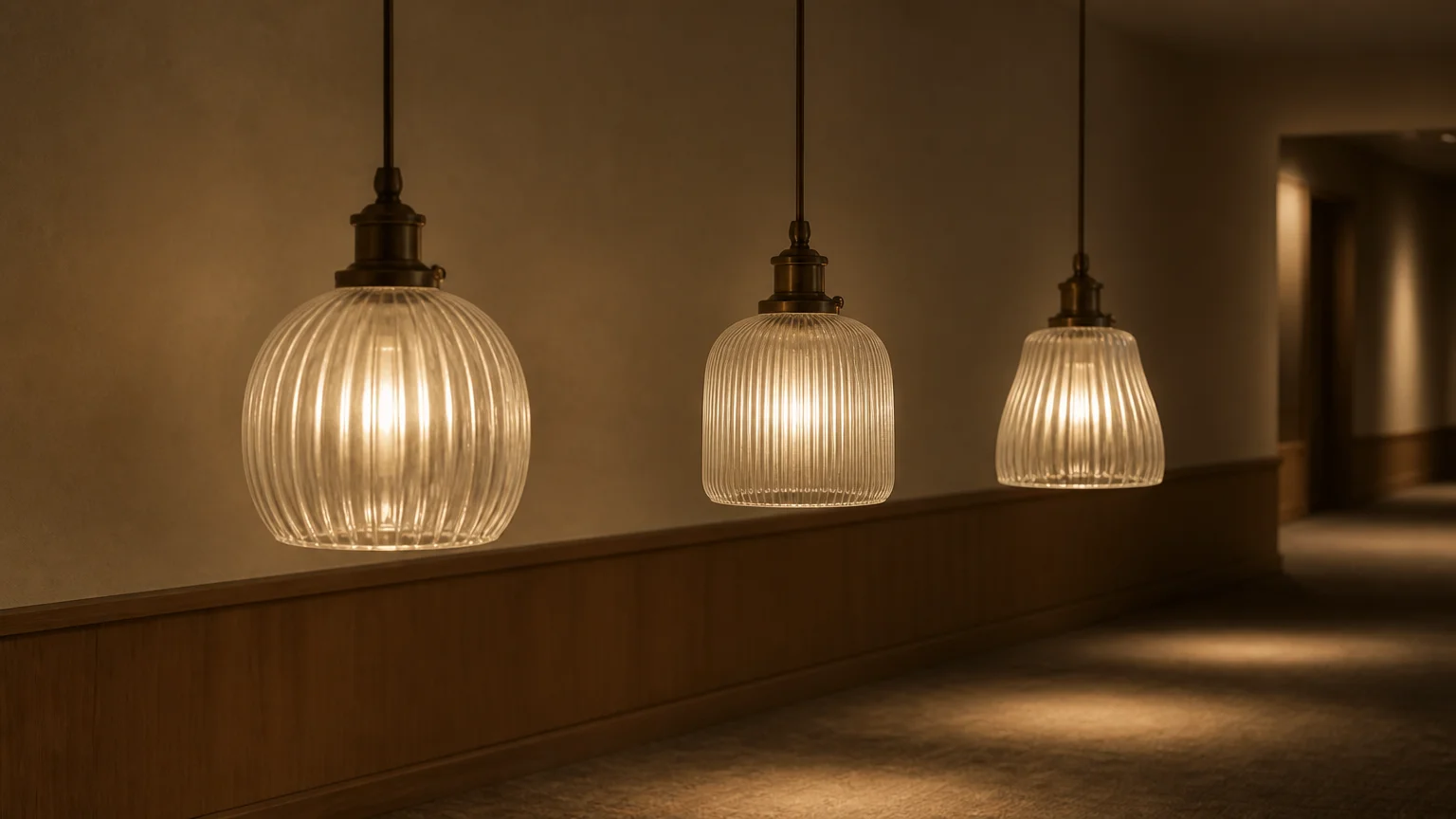
Ribbed, reeded and fluted are used interchangeably across the trade, and the difference between them is not decoration. Each one describes a different groove profile, and the groove profile is what decides whether a filament disappears behind the glass or sits there in full view. Three words, three kinds of light, one question worth asking before the order goes out.
- 01Three Words, One Family
- 02What Each Groove Profile Does to the Light
- 03Depth, Pitch and Which Face Is Cut
- 04Why Textured Glass Earned Its Place
- 05Where the Language Betrays a Specification
- 06Pressed or Hand-Formed: Where the Cost Actually Sits
- 07Textured Glass in Hotel and Hospitality Work
- 08What to Ask Before the Order Is Placed
01Three Words, One Family
Ask a factory for ribbed glass and you will get a quotation. Ask three factories and you may get three different surfaces, all of them described as ribbed, all of them defensible. The vocabulary in decorative glass has never been standardised, and the reason is historical: most of these words arrived from architecture and from glassware rather than from lighting, and they were adopted by lighting catalogues at different times by different people. A word that means one thing in one workshop means something adjacent in the next.
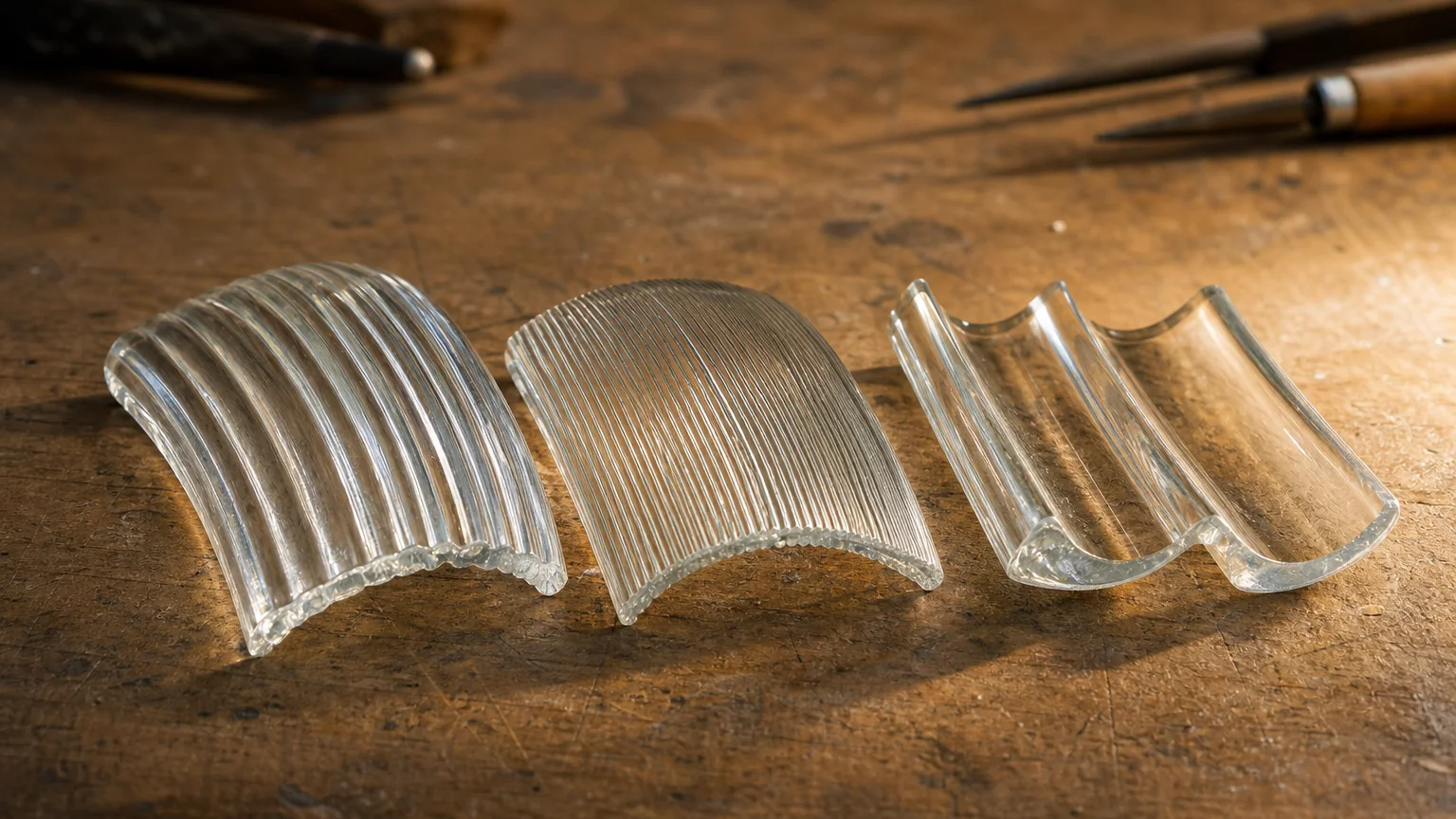
The three terms do, however, share a family resemblance. All three describe a shade or lens whose surface is cut into a series of parallel vertical grooves, and all three are made to interrupt the view of the light source behind them. What separates them is the shape of the cut. That single geometric fact — is the groove cut into the glass, or is it built up out of it? — is the whole of the difference, and it is the difference that a buyer can see from across a room.
The clearest way to keep the three apart is to set them side by side on profile rather than on appearance:
| Term | Groove profile | Spacing | What you see when lit |
|---|---|---|---|
| Ribbed | Convex — rounded ridges that stand proud of the surface | Wider ridges, fewer of them | Bold vertical bands of light; the lamp reads as broad stripes |
| Reeded | Convex — narrow rounded ridges, packed like reeds | Fine and closely set | Even, dense striation; the most effective of the three at dissolving the source |
| Fluted | Concave — channels cut into the glass, borrowed from column fluting | Variable, usually wider than reeding | Softer lines with shadow in the channels; more sculptural, less optical |
Two of the three are additive and one is subtractive, and that is the distinction worth carrying into a specification meeting. Ribbing and reeding are formed by material standing out from the surface. Fluting is formed by material removed from it. The first two work on the light; the third mostly works on the object. A fluted shade is a shape you notice with the light off; a reeded shade is a light you notice with the light on.
There is a fourth word in circulation, crackled, which describes a different phenomenon again — thermally shocked glass with an internal fracture pattern rather than an ordered groove. It belongs to the same family of surface treatments but it behaves optically like a diffuser rather than like a lens, and it is worth holding aside from the three-groove discussion so that a specification does not accidentally treat it as a variant of the same thing.
02What Each Groove Profile Does to the Light
The optical mechanism is the same in every case and it is genuinely simple once stated. Every vertical groove on a glass shade behaves as a cylindrical lens. A cylindrical lens takes the image of the filament and stretches it along one axis. Because the grooves run vertically, the filament is stretched vertically with them, and a point source becomes a vertical line. Repeat that with forty or eighty grooves around a shade and the point source stops existing. What reaches the room is not a bulb behind glass but a curtain of soft vertical striation.
The important corollary is that the light has been redirected, not absorbed. This is where textured glass parts company with opal glass, and it is the point most often misunderstood. Opal glass solves glare by scattering and losing light; it flattens everything into an even wash and takes a predictable cut of the output with it. Textured clear glass solves glare by bending light sideways while keeping the material transparent, so the sparkle survives. A well-reeded shade that looks bright and crisp when lit is not an illusion of efficiency — it is a shade that has moved the light rather than swallowed it.
The three profiles spend that mechanism differently. Fine, closely set reeding produces the densest array of lenses per unit of shade, so it fragments the source most thoroughly and is the profile to reach for when the brief says the lamp must not be visible. Broad ribbing produces fewer, stronger lenses, so the striation is coarser and the source is harder to hide; this is the profile that reads as Art Deco or as an industrial fixture depending on how wide the ridges are. Fluting redirects least of all, because the concave channels direct far more of their surface normal back toward the viewer, and the result is a shade whose main contribution is modelling and shadow rather than concealment.
An honest limit belongs here. A clear filament lamp behind shallow, wide ribbing is still visible, and no amount of vocabulary changes that. Where the requirement is genuinely “the source must not be seen”, the profile has to be tight reeding, or the inner face has to be etched, or the lamp itself has to be frosted. Specifying the word ribbed while asking for invisibility sets up a dispute that nobody can win, because the two requirements are in tension and only the second one is measurable.
03Depth, Pitch and Which Face Is Cut
Three variables carry more weight than the name does, and all three are measurable from a drawing. This is why the practical answer to “which of the three do I want” is usually “none of the above — send me a section”.
Depth. A deep groove bends light strongly; a shallow decorative ridge barely bends it at all. This is the single largest determinant of whether the lamp hides, and it is the variable most often omitted from a specification because depth is not visible in a photograph. Two shades can both be described as finely reeded and behave completely differently if one has grooves twice as deep as the other.
Pitch. The distance between groove centres sets the fineness of the striation. Tight pitch means narrow stripes, more lenses per shade and better concealment. Wide pitch means broader light bands and a source that remains legible. Pitch is also the variable that separates what one catalogue calls reeded from what another catalogue calls fine ribbed — frequently the same physical product under two names.
Which face is cut. This is the variable with the highest practical value for hospitality work and the lowest profile in most specifications. Grooves cut into the outer face of a shade collect dust in the channels, and the channels are awkward to clean. Grooves cut into the inner face leave a smooth outer surface that wipes like plain glass while producing the same optical effect. The trade-off is that the cut face is no longer visible as a texture in daylight, so a design that wanted the ribs as a decorative object needs them outside. Where the brief is optical and the room is heavily used, internal texturing gives the effect without the maintenance chore, and it is worth saying so explicitly rather than leaving the choice to the workshop.
Because the words are unreliable, the two documents that do settle a glass specification are a section drawing and a physical sample. A section drawing shows depth and pitch as dimensions instead of adjectives. A sample shows what the section drawing means when the light is on, which no drawing can. Reconciling the two before production is normal practice and should be built into the programme rather than treated as an exception.
04Why Textured Glass Earned Its Place
Textured glass is not a stylistic preference that arrived with a trend. It solves five recurring problems at once, which is why it appears in every period of decorative lighting from the early twentieth century to contemporary work.
- It conceals hardware. Lamps, holders and internal cable dissolve behind the striation. In a pendants cluster where six shades hang at eye level, this is the difference between a composition and a display of light fittings.
- It cuts glare without killing clarity. Opal glass removes glare by removing transparency. Textured glass removes glare while keeping the material alive, which matters where the glass is part of the composition rather than merely a cover.
- It tolerates real life. Fingerprints, water marks and light dust are immediately visible on polished clear glass and effectively invisible in a groove. In a busy restaurant or a hotel corridor, this is a maintenance argument, not an aesthetic one.
- It reads as an object when switched off. A textured shade has presence in daylight. A plain clear shade is, in daylight, a cover over a lamp.
- It carries period signals. Fine dense reeding reads as Art Deco and as contemporary work; broad ribbing reads as industrial and as early twentieth century institutional; classical fluting reads as traditional and architectural. The same physics produces three different rooms.
The maintenance point deserves one qualification. Texturing protects the glass, not the fixture. A shade with internal grooves still needs the same access for lamp replacement as any other, and the surrounding metalwork still needs the cleaning regime that its finish demands. A shade that is easy to wipe is a small win inside a larger maintenance plan, and our notes on designing statement fixtures for maintenance treat glass selection as one line item among several rather than as a solution.
05Where the Language Betrays a Specification
Because no standards body governs these three words, mismatches between what a document says and what arrives are common, and they are rarely anyone’s fault. The pattern to watch for is a specification built on adjectives where it should be built on dimensions. Four failures recur.
The first is using the term as a substitute for the profile. “Reeded shades throughout” tells a workshop almost nothing, because one factory’s reeded is another’s fine ribbed and the depth is unspecified in both cases. The remedy is a section drawing or an accepted sample, referenced by revision number in the order.
The second is assuming that fine and broad profiles differ only in taste. They differ substantially in how well they hide a light source, and a project that chose fine reeding in the design phase and received broad ribbing will notice. Where concealment is a stated requirement, the profile belongs in the acceptance criteria rather than in the design narrative.
The third is believing that textured glass necessarily reduces output. It redirects rather than absorbs, so the assumption is wrong and it leads people to over-specify lamp wattage to compensate for light that was never lost. The correct approach is to commission the fixture on its own terms — the combined effect of lamp, driver and glass — rather than reasoning from the glass alone, which is the same discipline covered in our guide to specifying dimmable LED fittings.
The fourth is treating hand-formed as an automatic premium and machine-pressed as an automatic compromise. For a commercial shape produced at volume, a pressed shade is not the lesser choice; it is the correct one. That question turns on three cost lines and on what happens to colour between melting batches, and it is worth settling before the glass is ordered rather than after the shades arrive.
06Pressed or Hand-Formed: Where the Cost Actually Sits
Two production routes sit behind these profiles, and the choice between them is a commercial decision more than an optical one.
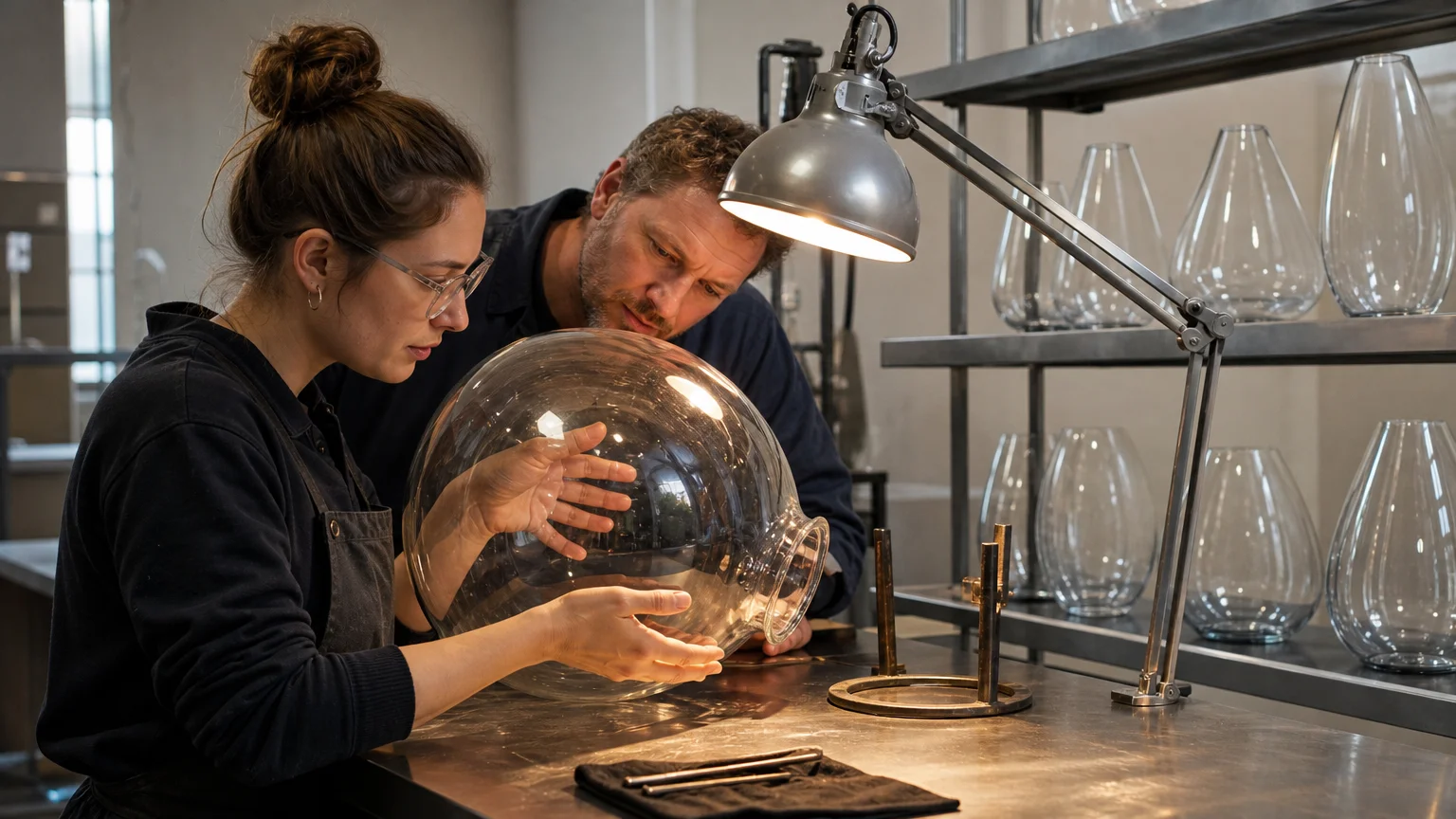
The pressed route cuts the grooves into a steel mould once and repeats that mould for the life of the design. Every piece is identical, the cost sits in the tooling, and the unit price falls as volume rises. The hand-forming route involves a glassworker shaping each shade, either free-blown or blown into a shaping form, with no large tooling cost and a meaningful labour content in every piece. Pieces vary slightly, and the variation is either a defect or the entire point depending on the brief.
The commercial consequence is straightforward. A press mould only pays for itself in volume, so a genuinely new custom texture normally carries a real minimum order, while ordering against an existing production mould does not. This is worth understanding before assuming that a minimum quantity is a negotiating position rather than a manufacturing arithmetic: it usually reflects tooling that has to be amortised, and it is the same arithmetic behind the minimums discussed in our notes on briefing a custom lighting manufacturer.
For texture specifically, there is a second-order effect that buyers rarely anticipate. Groove depth and pitch are fixed by the mould in the pressed route and vary piece to piece in the hand route. A project that specified “fine reeding” without tolerances and then received hand-formed shades should expect the concealment performance to vary between units, which is acceptable in a single feature pendant and less so across forty corridor sconces where the eye can compare them. Where consistency of optical effect matters, the pressed route delivers it as a function of the tooling rather than as a function of care.
07Textured Glass in Hotel and Hospitality Work
In hospitality interiors textured glass performs two jobs simultaneously, which is why it appears so often in specifications that are otherwise quite restrained. It manages the light source in spaces where the fixture is at eye level, and it gives the designer a material of visual weight that does not require opaque material to be interesting.
The eye-level problem is the practical one. Lobby pendants, corridor sconces, bedside lights and restaurant fixtures are all seen from close to their own height, and a bare source at that distance is uncomfortable regardless of how elegant the fixture is. Reeding solves it while keeping the glass legible, which is why a tight, fine pattern is so often the pragmatic answer in guestroom corridors: the source disappears, the shade stays crisp, and the maintenance team can wipe the outside of the shade without attacking channels.
Materials density is the second job, and it connects directly to how a fixture reads in a large volume. A single pendant with dense textured glass can hold a tall space with less visual mass than an open frame of the same diameter, because the glass gives the eye something to land on. Our survey of how this plays out at scale — the difference between physical diameter and visual weight, and why a compact shade may be the right choice under a high ceiling — is set out in the guide to sculptural glass statement lighting and in our guide to sizing fixtures for high ceilings.
One practical warning applies to every textured shade in a commercial building: the lamp type has to be agreed before the glass is ordered. A clear filament lamp, a frosted lamp and an integrated LED module each need a different amount of texture to achieve the same result, and a shade selected against the wrong assumption will either show the source or flatten the effect. This is the same integration discipline that governs colour and dimming in a layered scheme, covered in our notes on colour temperature.
08What to Ask Before the Order Is Placed
Six questions settle a textured glass specification, and all six can be answered before the first piece is made.
- What is the actual profile depth and pitch, in millimetres? Ask for a section drawing or a dimensioned sample record. The name of the pattern is not an answer.
- Which face carries the texture? External for a visible texture that collects dust, internal for the same optics with an easy-clean outer surface.
- What lamp will be used? Clear, frosted or integrated changes how much texture is needed to conceal the source.
- Is the pattern an existing production mould or a new one? This determines whether a minimum quantity applies and how consistent the optical result will be across the batch.
- What is the acceptance standard for the glass itself? Seams, inclusions, wall-thickness variation and batch colour should be defined before the batch is formed, not after it arrives.
- How will replacements match later? Where a project may need matching shades in future years, the batch question belongs in the order, not in a conversation after damage.
Textured glass is a mature, well-understood material, and almost every problem it causes in project work traces back to a specification that named a style instead of a surface. Naming the profile, the depth, the pitch, the face and the lamp costs a paragraph and removes an entire category of dispute.
Frequently Asked Questions
Are ribbed, reeded and fluted actually different products?
Yes, but the words are not standardised, so the same physical shade may appear under two of them in two catalogues. Ribbed and reeded are convex ridges standing out from the surface, with reeding the finer and denser of the two; fluted is concave, cut into the glass. What separates them in practice is groove depth and pitch, not the label.
Which one hides the light bulb best?
Fine, closely set reeding, because it places the most cylindrical lenses between the viewer and the source. Broad ribbing and wide fluting leave more of the source legible. If the requirement is that the lamp must not be visible at all, a tight profile with an etched inner face or a frosted lamp is the reliable route.
Does textured glass make a room darker?
Not in the way opal glass does. Grooves redirect light sideways instead of absorbing it, so a clear textured shade keeps most of the output while removing the harsh view of the source. Assuming otherwise leads to over-specified lamps compensating for light that was never lost.
Should the grooves be on the inside or the outside?
Grooves on the outside give a texture that is visible in daylight and collect dust in the channels. Grooves on the inside produce the same optical effect with a smooth outer surface that wipes easily. Optical briefs on busy projects usually favour internal texturing; designs where the ribs are part of the object favour external.
Can the pattern be matched if I reorder in two years?
Only if the same production tooling is still in use. Glass made from a new mould, or hand-formed to the same nominal profile, will not necessarily match the original. Where future matching matters, the order should state the pattern reference and the original batch, and it is worth holding spare shades from the first run.
Is textured glass suitable for bathrooms and covered outdoor areas?
The texture itself is not the deciding factor; the fitting’s environmental rating is, and that is a property of the complete assembly rather than of the glass. Where a shade is required in an exposed position, ask what the assembled fixture is rated for rather than what the glass is made of.
Specifying Glass Shades for a Hotel or Restaurant Project?
Send us the profile you have in mind, the lamp you intend to use and the rooms the shades will hang in. We will confirm the groove depth and pitch that will achieve the effect on the drawing, tell you whether the pattern is available from existing tooling, and set out what an acceptance standard for the glass should contain before the first piece is made.
For projects where the fixture is bespoke from the outset, our guide to reviewing shop drawings explains how the glass profile, the lamp holder and the metalwork are reconciled before production is released, and our project team can take a profile enquiry from first sketch to sample.


