
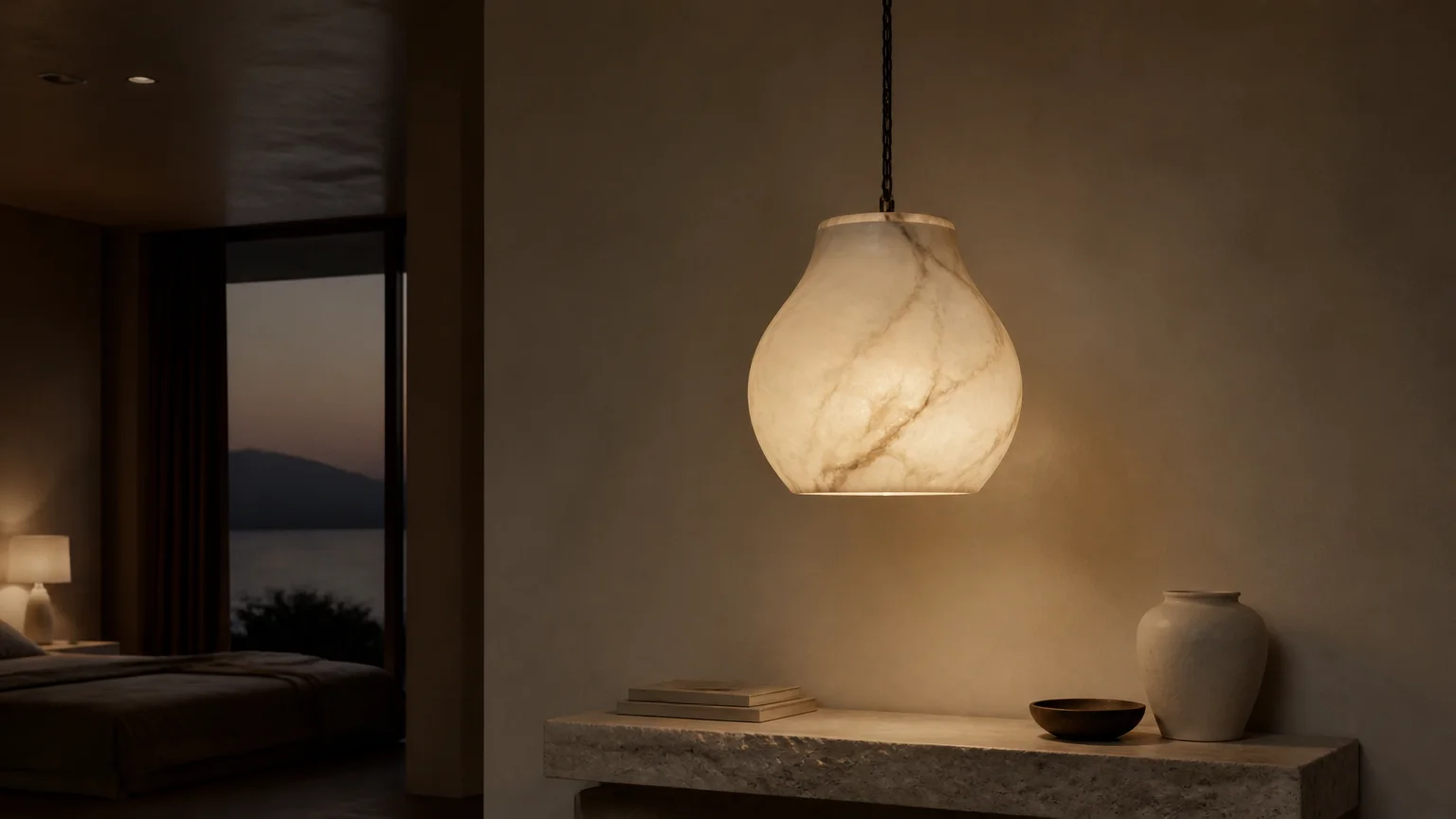
Ask two people why a stone lamp looks the way it does and you will get two different answers. One will say it is the stone: the veining, the colour, the fact that no two pieces match. The other will say it is the light: the warmth, the way it seems to come from inside. Both are describing the same physical event, which is that light is passing through a mineral, and the character of the result is set less by the stone’s reputation than by one unglamorous variable — how far the light has to travel before it gets out. Thickness is the quiet decision in every translucent stone fixture, and it is usually the one nobody writes down.
This article is about that decision. It covers the two optical roles a stone can play in a fixture, why thickness moves a piece from one role to the other, what the stone itself does to the beam on the way through, and how to read a sample under power so that a specification describes the effect you actually want rather than a picture you once saw. It is written for the people who have to commit: a designer fixing a schedule, a procurement team pricing a custom order, an architect checking whether the drawing and the sample agree, and the owner who has to live with the result for a decade.
It deliberately contains no dimensions. Translucency is not a catalogue number, and the honest way to specify it is behaviourally — what the piece must look like when it is switched on, from where, and with what tolerance for variation. The manufacturing side of stone fixtures is covered separately in our guide to how an alabaster lamp is made, from block to finished piece, and the vocabulary of the material itself is set out in what alabaster is and how to recognise real stone. This piece sits between those two: it is about what happens optically once the stone and the light source meet.
- 01Two Ways Stone Meets Light
- 02Why Thickness Decides Which Way You Get
- 03The Thin Path: Stone That Becomes the Source
- 04The Thick Path: Light That Leaves at the Edges
- 05What the Stone Itself Does to the Beam
- 06The Source Behind the Stone
- 07Surface Finish Changes the Result Twice
- 08Reading a Sample Under Power
- 09Specifying It Without Quoting Numbers
- 10Whole-Body Glow or Edge Wash
Two Ways Stone Meets Light
A stone fixture can do one of two optical jobs, and most of the confusion in this category comes from people expecting one while specifying the other.
The first job is transmission. Light enters the stone, scatters inside it, and leaves through the outer surface. The stone is not lit; it is the lamp. What you see is not a surface with light on it but a volume with light in it, and the surface brightness is fairly even across the whole piece. This is the effect people are reaching for when they describe a stone shade as “glowing”, and it is the reason a carved alabaster body can read as a soft object rather than a bright one.
The second job is reflection. Light lands on the stone and comes back off it. Nothing passes through. A polished stone base, a honed plinth, a stone backplate behind a lamp head — these are reflectors, and their contribution is the pool of warm light they throw back into the room, plus the soft bounce they add to whatever else is lit nearby. It is a quieter effect than transmission, but in a hotel room it is often the difference between a scheme that feels furnished and one that feels installed.
Most real fixtures use both, in different parts. In a table lamp, the shade usually transmits and the base reflects. In a wall sconce, the stone body may transmit while the mounting plate reflects. In a ceiling piece, the diffuser transmits downward while a stone collar above it reflects a little light back onto the ceiling. Once you start looking at fixtures this way, the design intent becomes legible: which part is supposed to be a light source, and which part is supposed to be a surface that returns light.
The reason this distinction matters commercially is that the two jobs have completely different failure modes. A transmission part that fails looks patchy — bright in one area, dull in another, or with a visible bright spot where the source sits too close. A reflection part that fails looks harsh — a hot patch on a wall, a glare source at eye level, a base that reads as a mirror rather than as stone. The remedies are different, the samplings are different, and the person who signs off on one is not necessarily qualified to sign off the other.
Why Thickness Decides Which Way You Get
Light travelling through a translucent mineral does not go straight. It is scattered at grain boundaries, at micro-cracks, at the boundaries between one crystalline region and the next, and at inclusions of a different composition. Every one of those events sends the ray off at a new angle. The ray eventually leaves the stone, but it leaves as diffuse light rather than as a beam, and the further it has to travel, the more scattering events it accumulates.
That single mechanism explains almost everything in this category. A short path means few scattering events: the light gets out with much of its direction and intensity intact, the surface reads bright, and the internal structure of the stone is visible as a pattern of light and shade because some paths are easier than others. A long path means many scattering events: the light is redistributed, weakened and thoroughly diffused, and most of it escapes wherever the geometry gives it a short way out — which in a closed body means the openings.
So the practical rule is that thin gives you a body that glows, and thick gives you a body that holds its light. A thin wall turns the whole surface into an emitter. A thick wall turns the stone into a mass with a small inner bloom, and concentrates the useful output at the apertures — the top and bottom of a sconce, the slot in a carved column, the gap between a shade and its cap.
Two qualifications matter, and both of them are where specifications go wrong.
First, thin and thick are relative to the stone, not absolute. A highly translucent material at a given thickness may pass light the way a denser material at half that thickness does not. Alabaster, onyx, certain marbles and some fine-grained gypsum-bearing stones behave differently from each other, and even within one material family the translucency varies from block to block. This is why a sample approved from one block cannot be used as a guarantee for the next, and why the sensible specification fixes the effect and the source of stone together rather than either on its own.
Second, thickness is not uniform in a hand-worked piece. A carved body has thin shoulders and thick ribs. A turned base has a thin rim and a solid core. Those differences are visible when the piece is lit, and they are a large part of why a stone fixture looks handmade. The design decision is not “make it thin” but “decide which parts are allowed to glow and which are meant to stay solid”.
The Thin Path: Stone That Becomes the Source
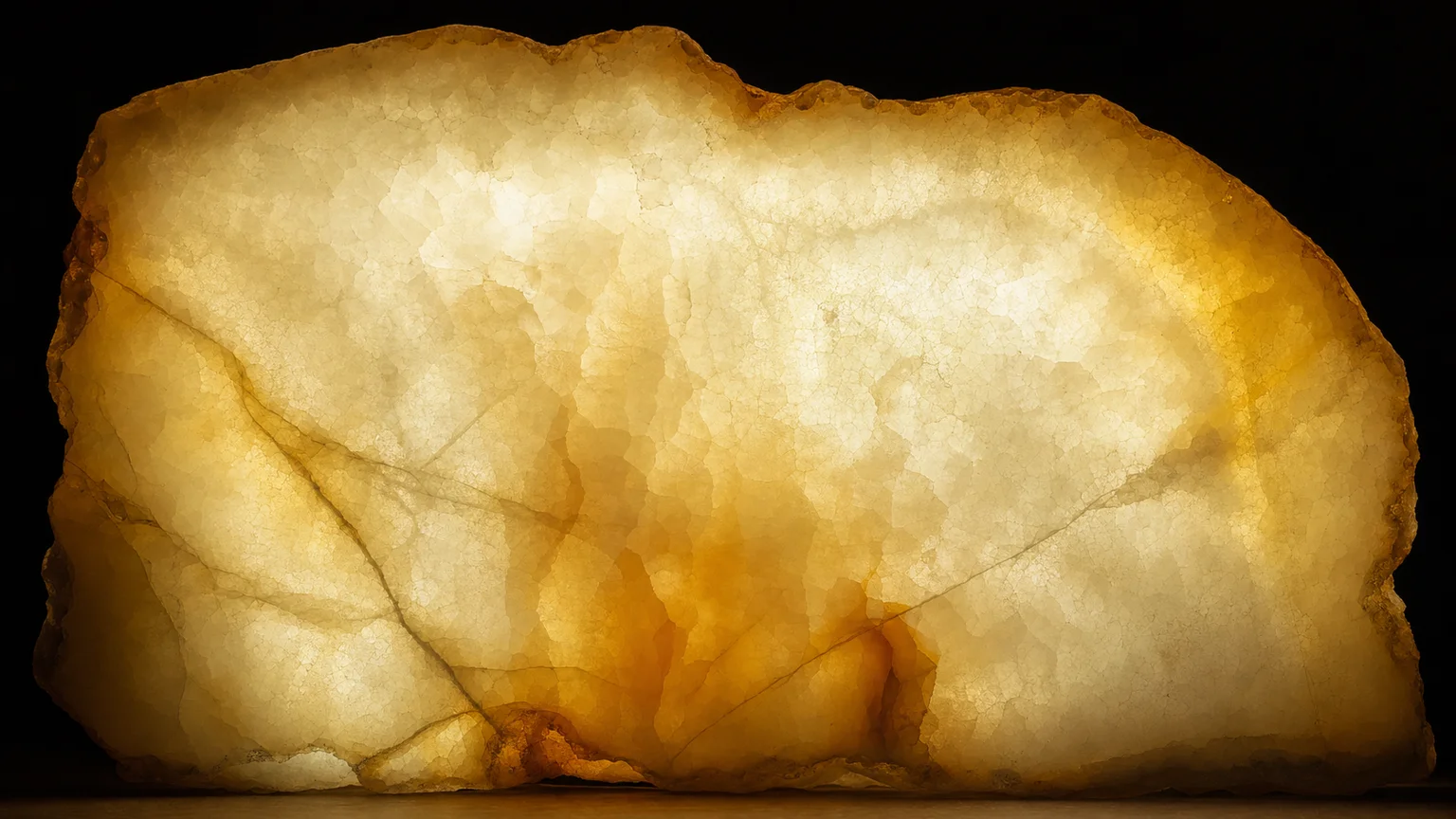
When the wall of stone is thin enough for the light to escape across the whole surface, the fixture stops behaving like a shaded lamp and starts behaving like an area source. Several things follow, and they are worth knowing before you fall in love with a photograph.
The surface becomes the light. There is no separate bright element to look at, which is why these pieces are so effective at close range and in low-ceilinged rooms: there is nothing to catch the eye as a point of glare. What you see instead is a large, low-brightness field with a gentle gradient — brighter where the source is nearer, softer at the extremities.
The internal structure becomes the pattern. In a thin section, the places where the stone is more crystalline or more fissured read as brighter veins, and the denser bands read as darker ones. The veining you saw in the unlit sample is still there, but it is no longer a surface pattern; it has become a pattern in the light. This is the visual signature people recognise as translucent stone, and it is impossible to reproduce convincingly in a homogeneous material.
The source has to be spread out. A thin panel with a single small lamp behind it is the classic failure of this approach: a bright coin of light with a falloff around it, and every flaw in the stone lit from one direction so that the panel looks stained rather than luminous. The fix is optical, not cosmetic — more sources, a longer source, a diffusing layer between the lamp and the stone, or a greater separation — and each of those has a cost in depth, efficiency or heat.
Support becomes a design problem. A thin stone wall is not strong. It needs an internal frame, a generous return at the edges, and fixings that do not load the thin field. In a pendant, that frame is usually visible from below and has to be designed as part of the object rather than hidden as an afterthought. In a wall piece, the mounting has to keep the panel flat without clamping it hard enough to crack it.
Repair is a different proposition. Thin stone is more likely to chip at an edge than to break in the middle, and a chipped edge on a glowing panel is very visible because the short path at the edge is the brightest part of the piece. That is a strong argument for a protected edge detail — a metal cap, a thicker return, or a rebate — rather than a bare arris.
The commercial consequence is that a thin-walled piece is usually a custom or semi-custom object rather than a stocked one. It cannot be made to a tolerance the way a glass diffuser can, and the sample you approve is a sample of an effect rather than of a specification. That is also why we treat the lit sample as the controlling document in these projects, rather than the drawing.
The Thick Path: Light That Leaves at the Edges
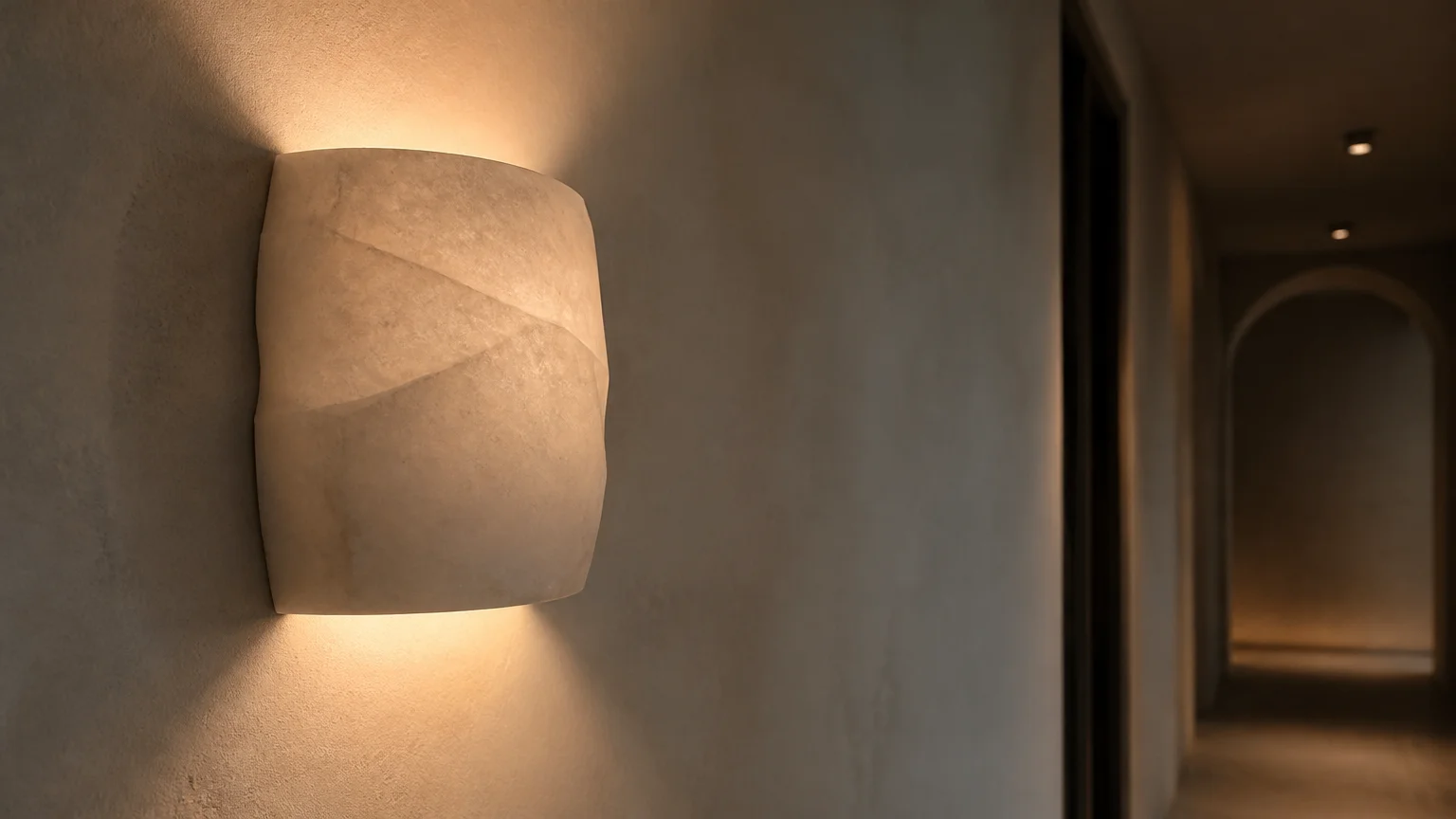
Take the same stone and make the wall substantial, and the behaviour inverts. The light cannot cross the body efficiently, so it exits where the geometry offers a short route out. In most designs those routes are deliberate: an open top, an open bottom, a slot, a carved recess, a gap between the body and its cap.
The stone becomes a mass with a lit interior. The face of the piece keeps a faint inner bloom rather than a glow — enough to show that it is a lamp and not a sculpture, not enough to read as a light source. This is the effect that makes heavy stone sconces feel calm in a corridor: the wall gets the light, and the object stays quiet.
The wall does the lighting work. With a top and bottom aperture, the sconce becomes an uplight and a downlight at the same time, and the two washes meet the ceiling and the floor in soft pools. The apparent size of the fixture in the room is much larger than the fixture itself, because the lit surface is the wall. In a hotel corridor, that is the whole point: you are lighting a long vertical surface, not decorating it.
Aperture geometry decides the quality. A wide, clean opening throws a broad soft wash. A narrow slot throws a tighter, more defined band that can read as a line of light. An uneven or partially obstructed opening produces a scalloped edge or a shadow band, and because the light is concentrated, those defects are much more obvious than they would be on a diffused panel. If the design calls for a defined wash, the aperture has to be built to a tolerance; if it calls for softness, the aperture has to be generous enough to avoid forming an image of itself.
Seeing the source is the risk. The more open the aperture, the more likely it is that someone standing below or beside the fixture will see the lamp itself. A recessed lamp, a shielded position, or a diffusing element inside the aperture removes that risk at some cost in output. In circulation areas the shielding is worth more than the output, because a visible source in a corridor is a glare complaint waiting to happen.
The body can carry weight and detail. This is the practical advantage that keeps thick stone in the catalogue. A substantial body can be carved, can hold its own shape without an internal frame, can be mounted on a bracket rather than suspended in a cage, and can survive the handling that a project installation involves. It also ages differently: a heavy piece reads as architecture, and a chip on a thick return is a chip, not a crisis.
What the Stone Itself Does to the Beam
Thickness sets the regime. The stone sets the texture within it, and four characteristics matter more than the rest.
Veining. A vein is a region of different composition, and it usually attenuates light more strongly than the surrounding field. In a thin panel this reads as a darker line across a glowing surface — sometimes the strongest thing about the piece, sometimes a distraction, depending on whether the veins run with the form or across it. Because the pattern is fixed by the block, the orientation of the cut relative to the veins is a design decision that has to be made before carving, not after.
Internal figure. Many translucent stones have a cloudy, mottled or granular internal structure. It is what gives the glow its depth: the eye reads variation in the scattered light as depth, and a completely uniform material reads as shallow and, at worst, synthetic. Some clients want maximum figure, some want a clean field. Both are legitimate, and both need to be stated, because a supplier who does not know which is wanted will optimise for yield instead.
Colour and its interaction with the source. Translucent stone acts as a warm filter. A neutral or cool source passing through it comes out warmer and slightly muted, which is usually desirable and occasionally not: if a project has specified a particular appearance for the light on the wall, the stone is part of that specification and has to be sampled with the actual source, not with a generic lamp.
Fissures and inclusions. A stable fissure that has no structural consequence can still read as a bright line when lit, because light finds an easier path along it. In an unlit sample it may be almost invisible. This is the single most common surprise in stone lighting, and it is the reason our sampling protocol requires the sample to be seen in both states before approval.
There is a further point about variation that belongs in the contract rather than the design conversation. Natural stone varies between pieces, and it varies between the sample and the production run. A specification that says “as sample” and stops there will produce disputes, because “as sample” is interpreted as identical by a buyer and as “same family” by a fabricator. The workable version describes the acceptable range: which characteristics must be present, which must be absent, and how much difference is tolerable in the glow.
The Source Behind the Stone
The light source is where most of the engineering difficulty lives, because the stone is an obstacle as well as a filter. Five variables control the result.
Separation. The distance between the lamp and the stone sets the evenness. Close in, the output is efficient and the surface is bright, but the source images through the stone as a hot area. Further away, the field flattens out and the piece looks like a volume rather than a lit panel, but the output drops and the body has to be deeper. Every stone fixture is negotiating this trade, and the visible depth of the body is the evidence of which way it was settled.
Number and shape of sources. A single lamp gives a single centre. A ring, a line or a cluster gives a field. For long or tall pieces, a linear arrangement along the axis is usually the practical way to avoid a gradient from one end to the other. This is a manufacturing decision that affects the internal frame, the wiring and the service access, so it should be settled at the sample stage, not at the quotation stage.
Interposed diffusion. A diffusing layer between lamp and stone will even out the field, at the cost of some output and some of the stone’s own texture, because the diffuser adds its own scattering to the stone’s. Used well, it rescues a piece that would otherwise show a hotspot. Used badly, it flattens the glow into something that looks like plastic behind glass.
Heat and access. A closed stone body traps heat. The driver may need to be remote, the lamp may need to be a low-heat type, and there has to be a way to get to the lamp and the connections without dismantling the stone. This is the least photogenic part of the design and the one that determines whether the fixture is maintainable in year five. The same discipline that governs planning maintenance across a hotel lighting scheme applies here in miniature: if the source cannot be reached, the fixture has a service life set by its first failure.
Dimming behaviour. A dimmed stone fixture does not simply get dimmer. The glow contracts: the brightest region narrows, the extremities fall away first, and at low output the piece can look like a dull object with a faint stain. If the design intent is a night-time low level, that behaviour has to be sampled at the low level, not assumed from the full-output appearance.
Surface Finish Changes the Result Twice
Finish is usually discussed in terms of how the stone looks when it is off. In a translucent piece it matters at least as much when the light is on, and it acts on both faces.
The outer face decides how the piece meets the room. Polished, it returns specular highlights and reflections of whatever is opposite — which can be beautiful in a dining room and awkward in a corridor where the opposite surface is a fire door. Honed or matte, the reflections break up and the surface reads as a soft, chalky field with the glow behind it. Neither is inherently preferable; they answer different questions about how much the fixture should participate in its surroundings.
The inner face decides how the light is delivered to the stone. An unpolished inner surface scatters more before the light even enters the body, which softens the field and slightly reduces the apparent depth of the internal structure. A polished inner face keeps more direction, which can produce a brighter core and stronger internal pattern, and can also produce internal reflections that read as a second, ghost image of the source.
The edge is the brightest zone in most thick pieces, because the path out is shortest there. A raw edge glows hard; a chamfer turns that into a defined line of light; a metal cap removes it and gives the piece a drawn outline instead. On a thin panel the same logic applies at a smaller scale, which is why edge treatment is one of the first things to look at when judging a sample.
There is a second-order effect worth naming: finish and thickness interact. A polished thin panel can be almost too bright at the surface, losing the sense of depth that makes the material interesting. A honed thin panel keeps the depth and loses some output. A polished thick body gains a crisp reflected highlight that helps it read as an object rather than a lamp. The combination has to be chosen together, which is why the finish should be sampled on the actual thickness rather than on a flat swatch. Our overview of materials and finishes across a hotel lighting package covers the wider question of how finishes sit next to each other in a room; the point here is narrower and optical.
Reading a Sample Under Power
Almost every disappointment in this category comes from approving a sample that was only ever seen unlit, or only seen in a photograph. The following routine takes a few minutes and settles most of the risk.
See it in both states. Look at the piece switched off first, and note the veining, the figure and the finish. Then switch it on and note what happened to each. If the pattern you liked disappeared, or a feature you did not notice became dominant, that is information you need before production, not after delivery.
Walk around it. A stone body is rarely viewed from one position. Move to the sides, look from below, look from the height of a seated person, and look from the distance at which it will actually be seen. Hotspots, visible lamps and edge glare appear at specific angles, and those angles are usually the ones nobody checked.
Look for the four optical faults. A bright coin where the source sits; banding where the internal structure is denser in one direction; dull patches where the stone is thicker than the fabricator intended; and a colour shift at the thin areas, which reads as a pale or greenish stain. Each of these is fixable at sample stage and expensive later.
Check the low end. Dim the sample to the level it will run at night and look again. This is the state in which most hotel guests will actually see the fixture.
Compare against a second piece. Where the order is for several identical fixtures, ask to see two together. The variation between them is the variation you are buying, and seeing it early is what makes a decision about acceptability possible. This is also the moment to discuss spares: a matched pair held back from the same block is worth more than a promise of future availability.
Fix the record. Photograph the approved sample under power with a fixed exposure and a neutral reference in frame, and keep the photograph with the signed sample. Disputes about glow are usually disputes about memory, and a fixed-exposure record ends them.
Specifying It Without Quoting Numbers
The reason this article avoids dimensions is not coyness. It is that a number for wall thickness means nothing without the stone it refers to, and a number for output means nothing without the source, the separation and the diffuser. A specification that is built from numbers alone cannot describe the thing the client actually cares about, which is how the piece looks when it is on.
The workable alternative is a three-part specification, written in behaviour.
Optical intent. One or two sentences describing what the stone should do. For a transmitting piece: the body should read as a continuous luminous volume, with no visible source and no localised bright area from any normal viewing position, and with the internal structure of the stone legible as variation rather than as staining. For an edge-lit piece: the stone face should remain substantially opaque with a faint inner bloom, and the useful output should leave through the top and bottom apertures as an even wash with no scalloping. Those sentences are checkable, and they survive translation into another language and another factory.
Mechanical and service constraints. What the piece has to survive: the fixing condition, the weight the structure can take, the access needed to change a lamp or a driver, and whether the stone can be removed without disturbing the electrical connection. A stone fixture that cannot be serviced is a fixture with a predetermined end date.
The controlling sample. The approved lit sample, photographed and signed, is the document that governs acceptance. Everything else is commentary. This is also the point at which the stone source should be fixed: which block, which orientation, and whether the supplier will hold matching material for spares.
Alongside that, there are six questions worth asking any supplier before an order, and the answers tell you more than a data sheet:
- Which stone is this, and from which block, and what does the supplier say about its translucency relative to the last batch?
- What wall thickness was chosen, and what was it chosen for — evenness, strength, or output?
- What source is inside, how is it arranged, and how far is it from the stone?
- Is there a diffusing layer, and what does it cost in output and in texture?
- How is the lamp reached for replacement, and where does the driver live?
- What matching material will be held for spares, and for how long?
None of those questions requires a number in the answer. All of them expose whether the piece was designed or merely assembled. A supplier who can answer them has thought about the optical behaviour of the material; one who cannot is selling a shape.
Whole-Body Glow or Edge Wash
Everything above reduces to one question that a client can answer in a sentence: do you want the stone to be the light, or to hold the light?
If the stone is to be the light, the design is a thin-walled body with a spread source and a controlled interior. It suits rooms where the fixture is seen close and often: bedside, console, dining table, a reception desk at seated height. It gives a large soft field, it is kind at eye level, and it makes the material the subject. It asks for care in handling, a protected edge, and a sample-driven approval process.
If the stone is to hold the light, the design is a substantial body with deliberate apertures and a shielded source. It suits circulation and volume: corridors, lobbies, stairwells, dining rooms with high walls to wash. It gives a defined wash, it survives handling, and it reads as architecture. It asks for precision in the aperture and discipline about seeing the lamp.
Many of the strongest pieces are hybrids, and the hybrid is usually the honest answer to a real brief: a thin panel set into a thick frame, so that the centre glows and the border stays solid; a thick body with one thin carved section that lights up as a motif; a shallow transmitting shade over a heavy reflecting base. In each case the design is legible because the two optical roles are assigned to different parts of the object rather than mixed within one.
Whichever route a project takes, the same three things decide whether the result holds up: the stone was sampled lit and unlit, the source arrangement was designed for the thickness rather than added afterwards, and the specification describes the effect instead of a dimension. Those are unglamorous commitments, and they are the difference between a fixture that looks like a photograph and one that looks like a mistake.
If you are working through this decision on a live project, our overview of alabaster in hotel and luxury interiors sets out where these pieces usually sit in a scheme, the guide to alabaster pendants covers the suspended case, and the comparison pieces on alabaster against marble and alabaster against travertine explain why two stones that look similar in a showroom behave differently once lit. For the buying side of the same material, see what a marble stone lamp offers and where it falls short, and for older pieces in the same family, how age and condition are read on a vintage alabaster lamp.
Frequently Asked Questions
Why does my stone lamp look bright in one place and dull in another?
That is the signature of a source that is too close, or too few sources for the area. Light leaving the stone is strongest where the path from the lamp is shortest, so a single lamp behind a wide panel produces a bright centre and a dull rim. The remedies are a more spread-out source, more separation between lamp and stone, or a diffusing layer — in that order of effectiveness.
Can a thin stone shade be made to look even without a diffuser?
Yes, if the source is arranged to match the shape of the panel. A ring of small sources behind a round shade, or a line of sources behind a long one, will produce an even field without an extra diffusing layer, provided the separation is adequate. The diffuser is a shortcut that costs some of the stone’s own texture, so it is worth trying the arrangement first.
Is a heavier stone fixture better made?
Not necessarily, but weight usually tells you which optical regime the piece was designed for. A substantial body is behaving as a mass that releases light at its apertures; a light body is behaving as a diffusing panel. Both can be well or badly made. What weight does predict is how the piece tolerates handling, and how much internal structure it needs.
Why did the pattern in the stone change when the light was switched on?
Because the visible pattern in a translucent material is a pattern in transmitted light, not a surface print. Veins and dense bands attenuate more strongly, so they appear as darker lines once the piece is lit, and fissures appear as brighter ones. The pattern was there all along; the lighting changed which parts of it you can see.
How do I compare two batches of the same fixture?
Put both under power at the same level, in the same position, and photograph them with identical exposure and a neutral reference in frame. Then compare the bright core, the edge behaviour and the colour. Photographs taken at different times, in different rooms, at automatic exposure, are not comparable and should not be used to accept or reject a batch.
What should be in the order documents for a custom stone fixture?
Three things: a behavioural description of the optical effect, the mechanical and service constraints, and a signed lit sample with a fixed-exposure photograph. Add the stone source and the spares arrangement. A drawing alone is not enough, because a drawing cannot show whether the piece will glow or merely hold its light.
Working Out Whether a Stone Piece Should Glow or Hold Its Light?
Send us the intended position, the viewing distance, the surface the fixture will be seen against, and one sentence on the effect you want when it is switched on. We will come back with the optical approach that fits — transmitting body or aperture wash — the source arrangement that suits it, the edge and finish treatment that protects the effect, and the sampling sequence that closes the decision before anything is carved.
Our alabaster lighting collection shows the transmitting and edge-lit forms side by side, and the alabaster wall sconce range is where the aperture-wash approach is developed for corridors and bathrooms. For the design logic behind the material choice, why designers pair Spanish alabaster with lighting fixtures is the companion piece.


