
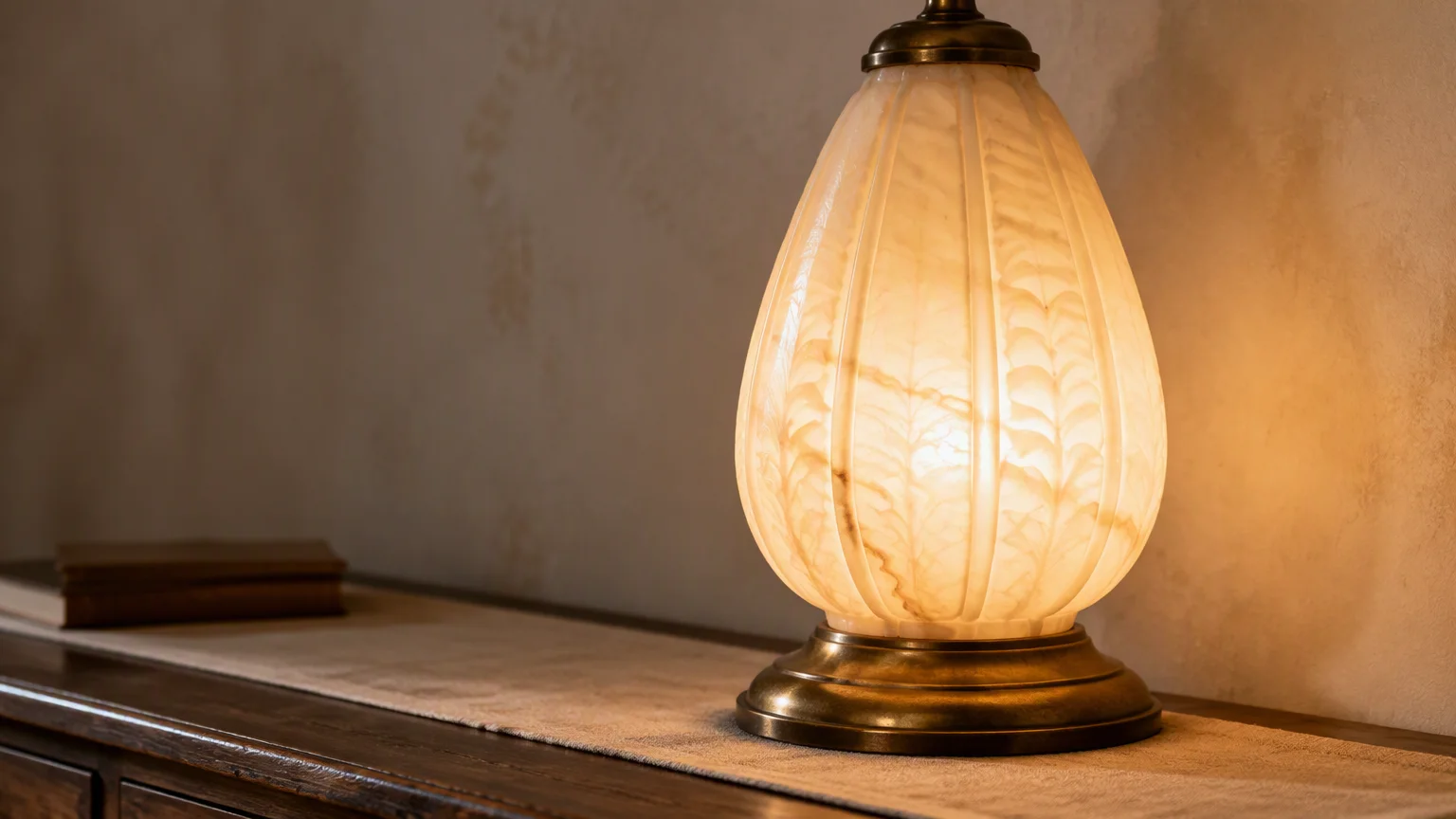
A new stone lamp is a controlled range of material supplied against an approved reference. An old one is a single finished object that will never be made again. Almost every difficult question about an antique stone lamp — is it old, is it original, what has been done to it, what is it worth to me — comes from that difference, and none of them can be answered by looking at the stone alone.
Stone lighting occupies an unusual position among antiques. It is heavy, it is fragile in ways that are not obvious, and the part of it that carries the most information about its own history is the part most often replaced. Buyers who approach it the way they approach a metal or glass antique are usually looking at the wrong evidence. Buyers who approach it as a lighting product are usually looking at the wrong risk.
This article is written for people deciding what to do with a stone lamp they already own, or with one they are considering. It sets out where the age evidence actually lives, how to tell real ageing from applied ageing, what genuinely drives value in this category, why the spares problem is harder here than anywhere else in decorative lighting, and what must happen before an old fixture is switched on. It deliberately gives no valuations, no date-lookup table and no figures, because none of those can be established reliably from the outside.
What it gives instead is a sequence of things to look at and a list of things to write down.
Two companion pieces cover the material itself. Our explainer on what alabaster actually is sets out the terminology and the distinction between the translucent stone families sold under this trade name, and our account of how a translucent stone lamp is made explains which decisions in production can never be reversed. Both matter here, because the condition of an old lamp is largely a record of those decisions and of what has happened to them since.
- 01Why an Old Stone Lamp Is a Different Object From a New One
- 02Where the Age Evidence Actually Lives
- 03Sockets, Switches and Cable: Reading the Sequence
- 04Metal Parts: Patina, Plating and the Line Between Age and Intent
- 05The Stone Itself: Weathering, Colour Movement and Applied Ageing
- 06What Actually Drives the Value of an Antique Stone Lamp
- 07Original Parts, Matching Spares and the Continuity Problem
- 08Handling, Moving and Installing an Old Stone Fixture
- 09What Must Be Checked Before an Old Lamp Is Used
- 10A Disposition Checklist, and Finding the Same Form New
01Why an Old Stone Lamp Is a Different Object From a New One
When you buy a new translucent stone lamp, you are buying a piece of material with a schedule attached. The material is quarried rather than manufactured, so no two units are identical, and the whole purpose of the specification is to define an acceptable range of variation, agree a reference piece in both the lit and unlit state, and hold enough material from one selection to cover the quantity plus spares. The object you receive is the outcome of a controlled process that someone can still repeat.
An old lamp is the opposite arrangement. The process is finished, the material selection is closed, and there is no reserve. What you are assessing is not whether the piece conforms to a specification but what it is now: how much of it is original, what condition the original parts are in, what has been replaced, and whether the replacements were done well. Those are conservation questions rather than procurement questions, and they require different habits of looking.
The practical consequences start immediately. On a new order, a drawing carries most of the technical information and the approved sample carries the appearance. On an old object, the drawing does not exist, the sample is the object itself, and the appearance has been modified by time. That means the two questions that matter most are not about the material at all.
The first is how much of the original object survives. The second is what has been done to the parts that do not.
There is a third difference, and it is the one buyers most often underestimate. Stone behaves differently in service from metal and glass, and this makes an old stone lamp a different maintenance proposition from an old metal one. A brass body can be re-polished, re-lacquered or re-plated almost indefinitely. A stone body can be cleaned, but it cannot be restored to new condition without removing material, and removing material changes how it transmits light.
The finish of a stone piece is not a surface treatment sitting on top of the object. It is part of the optical body.
The consequence for anyone assessing an old lamp is a change of emphasis. Instead of asking what the piece looks like, ask what has been changed and why. Instead of asking whether the stone is of the highest grade, ask whether it is intact, whether the transmission is even, and whether any dullness is the material’s own character or the result of something done to it later. Sections that follow take those questions one at a time, beginning with the part of the lamp that carries the clearest record: the electrical hardware.
02Where the Age Evidence Actually Lives
The stone is the least informative part of an old lamp. It is durable, it does not corrode, and it can be re-polished, re-cut or replaced by a competent workshop in a way that leaves very little trace. Ageing in stone is real, but it is subtle and it can be imitated. Anyone who tries to date a stone lamp from the appearance of the stone alone is working with weak evidence and a strong incentive to be wrong.
The fitted hardware behaves in the opposite way. It is made from materials with finite lives, it is replaced when it fails, and it is replaced again when fashions and regulations change. A lamp that has been in use for decades will usually have been through at least one re-wire, and the fittings will reflect when that happened. This is why the electrical parts are the closest thing a stone lamp has to a service record.
They do not tell you when the stone was cut. They tell you how long the lamp has been in continuous use and how recently someone worked on it.
This also means the evidence has to be read as a sequence rather than as a lookup. A single observation — a particular kind of holder shell, a particular kind of cord, a particular kind of switch — does not give a date. It gives an ordering. The honest output of an inspection is not “this lamp is from a particular year” but “this lamp is older than a given development and newer than another, and the wiring was renewed after the stone was worked.”
That is a much weaker statement, and it is the strongest one the physical evidence supports.
There is a caveat that cuts the other way, and it matters as much as the point itself. Because fittings are the part most often replaced, an old fitting is much stronger evidence than a new one. Finding a modern holder inside a stone body tells you nothing about the age of the body, because that is what a re-wire looks like. Finding fittings that have clearly never been disturbed tells you that the lamp has not been rebuilt, which is a genuinely useful fact.
The absence of a re-wire is not evidence of neglect; it is evidence that the object has been left alone.
The last point to carry into an inspection is that all of this is circumstantial. Old fittings can be harvested from one lamp and fitted to another. A stone body can be turned into a lamp decades after it was made. The sequence of evidence is worth building, but the conclusion should always be held as a probability rather than a fact, and anything that will be relied on commercially should be recorded with a photograph and a description rather than a date.
03Sockets, Switches and Cable: Reading the Sequence
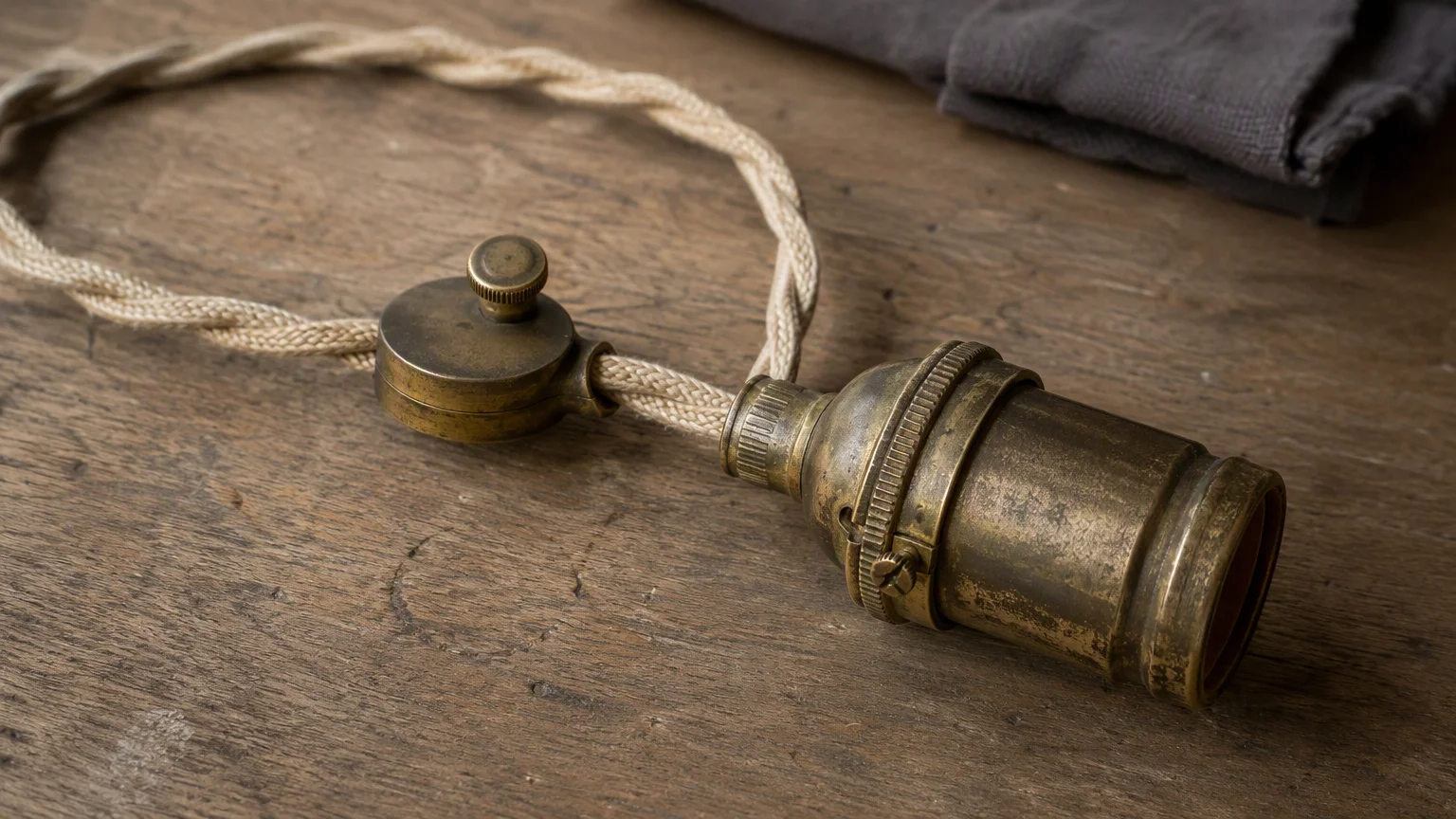
The most productive way to inspect an old lamp is to start at the point where it meets the wall and work inward, because the parts nearest the supply were usually replaced first and the parts nearest the bulb were usually replaced last. Each item on that path is worth describing in words rather than classifying into a period.
The cord is the most revealing single item. Older cord was built up from textile-covered conductors, and over time it hardens, cracks at the point where it enters the holder, and darkens unevenly along its length. Later cord was rubber-insulated and then plastic-insulated, and each generation behaves differently as it ages: the older textile covers fray, the mid-generation rubber insulation becomes brittle and can crumble at a flex point, and the later plastic insulation tends to stay flexible but hardens near the heat of the socket.
Reading the cord tells you which generation of repair you are looking at, and the condition of the cord tells you how much of the lamp’s life was spent plugged in.
The holder, sometimes called the socket, carries the next layer of information. Early holders are often built as a metal shell with an exposed collar and a separate insulating sleeve inside it, and the shell itself is frequently a plated or lacquered fitting over a base metal. Later holders moved the whole assembly into a moulded insulating body. Two things are worth noting here.
First, the construction method is a better clue than the finish, because finishes are the easiest thing to have been redone. Second, the holder is the part that has seen the most heat, so it is the part most likely to have been replaced, and a holder that matches the rest of the fitting in age and wear is a stronger signal than a clean one.
The switch is the most informative of the three, because switches reflect habit rather than fashion. A switch placed in the cord itself, close to the lamp, suggests the lamp was used on a table where the user could reach it. A switch built into the holder suggests a small lamp intended to be operated by touch in the dark. A lamp with no switch at all was controlled from the wall.
None of these tells you a year, but together they tell you how the lamp was actually used, and that in turn is often consistent with the form of the base and the size of the shade.
The bulb fitting at the end of the sequence matters for a different reason. Bulb standards changed slowly and with regional variation, and the fitting that a lamp was built around determines what can be put in it now. An old lamp with a small bulb fitting and a metal holder was dimensioned for the heat and dimensions of the sources available when it was made. That is a design constraint on the object, not merely a compatibility detail, and it is the reason any change of light source in an old lamp has to be planned rather than improvised.
Our article on putting modern sources inside antique and crystal fixtures covers what a respectable retrofit involves.
Three disciplines keep this exercise honest. Describe rather than diagnose: record what you see and where, and do not convert an observation into a claimed cause. Do not use a single item as proof; use the whole sequence. And photograph everything before touching anything, because the arrangement itself is part of the evidence, and once a fitting has been disassembled the arrangement is gone.
04Metal Parts: Patina, Plating and the Line Between Age and Intent
The metal parts of a stone lamp — the base, the collar, the cap, the arm, sometimes a bracket — raise the most common confusion in this category, which is the difference between an object that has aged and an object that was made to look aged from the start. Both are legitimate, and both are collectable. The problem is that they call for different treatment and different expectations, and a buyer who cannot tell them apart will eventually either destroy a genuine patina by cleaning it or preserve a factory finish that was never meant to be preserved.
Metal that has aged naturally wears according to touch. The areas that are handled — the collar, the base rim, the switch body, the places a hand naturally lands — become brighter, because oil and friction keep them polished. The recesses darken, because they collect oxidation and dirt and are not reached by a cloth. The transition between the two is gradual rather than abrupt, and the colour change runs continuously across an edge instead of stopping at it.
A naturally patinated piece therefore reads as a map of where it has been touched, and that map is difficult to fake convincingly because it depends on human ergonomics rather than on a decorative pattern.
Applied ageing behaves differently. It tends to be even where natural wear would be uneven, it tends to follow the shape of the part rather than the map of the hand, and it often stops at a mechanical edge because it is produced by a process that treats surfaces rather than a process that reflects use.
A dulled surface produced by a coating or a film can behave unusually in one more respect: it may look uniform from a distance and then show an abrupt boundary or a slight sheen at close range, and it may respond to a finger differently from the surrounding metal.
This is why a finish on a metal component of a lighting fixture should always be approved by describing the behaviour that is expected of it, not just the colour. In practice a finish specification should state one of three things: that the appearance is intended to remain stable, that it is expected to warm gradually with use, or that it has been deliberately aged and will continue to develop. That single sentence, written down at the point of purchase, prevents most disputes years later, because it converts a subjective question — is this patina original — into a recorded expectation.
Our note on aged and unlacquered brass finishes sets out how those three behaviours differ in service.
There is a second distinction that matters even more when a piece is being assessed or priced, and it is one of construction rather than appearance. A metal part can be solid, in which case the metal you see is the metal that is there, or it can be a base metal carrying a coloured finish, in which case the colour and the material are two separate facts. Brass-coloured plating over a different substrate behaves quite differently from solid brass in the presence of moisture, cleaning agents and time, and the difference is invisible on the day of purchase.
The only reliable way to establish which one you are looking at is documentation and inspection of an unfaced area, never colour.
Two practical points follow. First, cleaning is part of the finish specification, not an afterthought: an abrasive polish applied to a deliberately aged surface removes the very thing that was specified, and a cloth used on a laquered surface can leave streaks that read as damage. Second, replacements are matched against the finish statement rather than against a photograph. When a metal part has to be replaced years later, the useful record is the finish code, the reference sample and the expected behaviour — not a picture taken under different light.
Our guide to materials and finishes in lighting treats this as part of the specification rather than as a maintenance note.
05The Stone Itself: Weathering, Colour Movement and Applied Ageing
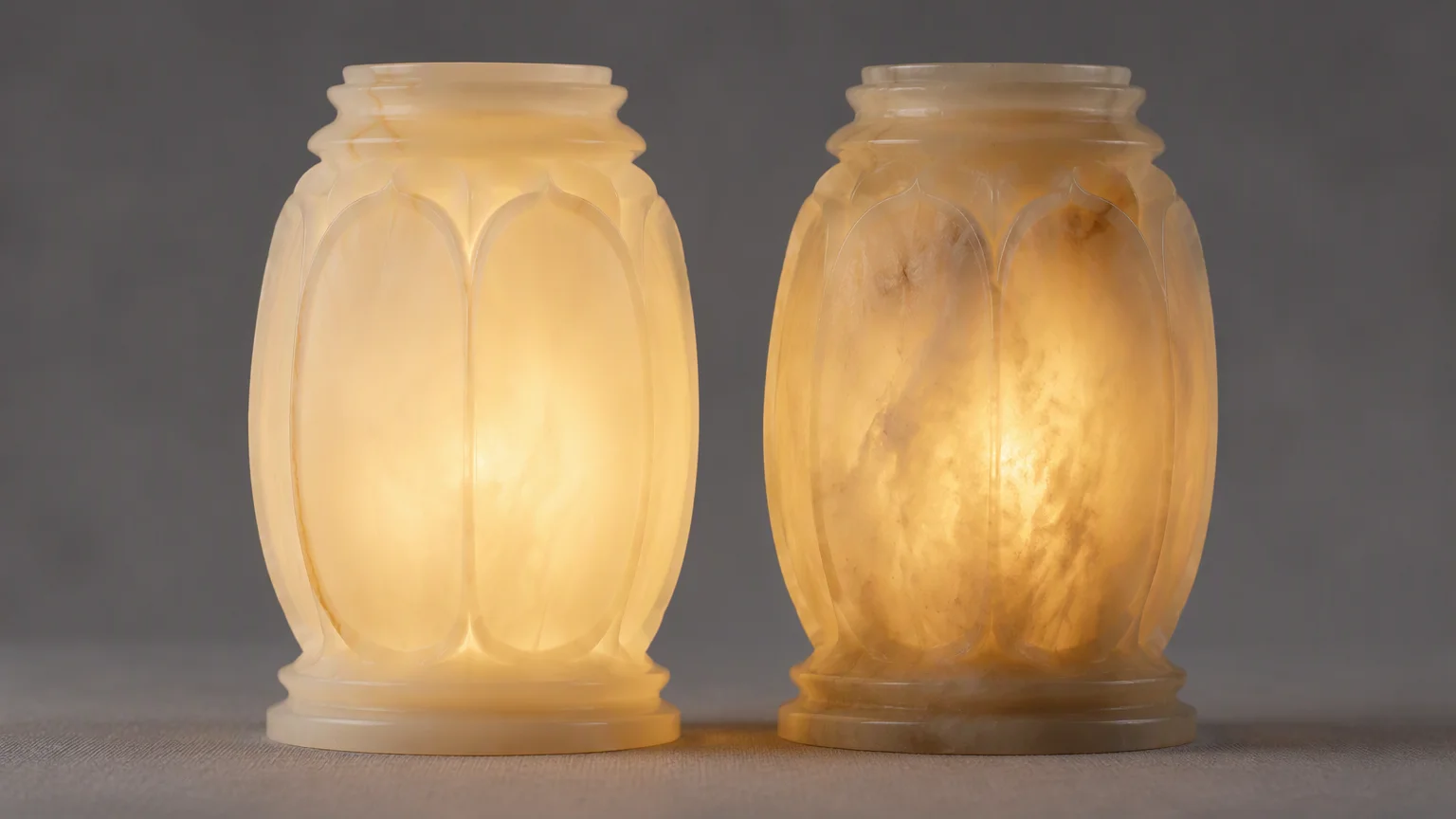
Stone ages in a way that has nothing in common with corrosion. It does not rust, pit or delaminate. What happens over decades is a slow change in the surface and in the way light passes through it, and the result is usually described as a patina. For translucent stone this is not a defect and should not be treated as one.
It is the natural, gradual change of a natural material, comparable to the way leather and timber change, and it is one of the reasons these fixtures remain desirable long after the period in which they were made.
The change has several parts, and separating them is what makes an assessment possible. The surface dulls slightly where it is handled and cleaned, because the finest surface layer is gradually abraded. The edges soften, because the sharpest material is the most exposed. The colour tends to deepen and warm rather than lighten, because the material takes up a small amount of atmospheric material into its open structure and because the polished layer that reflected a little more light has been worn back.
And the pattern inside the stone reads differently, because the depth the light has to travel has changed slightly wherever the surface has been worked.
Applied ageing follows a different logic, and it can be told apart from real ageing by the same principle that applies to metal: real ageing follows use, while applied ageing follows the object. Real wear concentrates on the parts a person touches — the base, the lower body, the edges of a shade a cloth is drawn across. Applied ageing tends to be uniform across the surface, including areas that would rarely be handled, and it frequently shows an even film or a boundary where a treatment was stopped.
The observation that is genuinely useful here, and the one we would keep from the specialist literature on this material, is that softening of the edges together with a change in surface lustre is the most reliable single indicator of age in a stone part. Neither sign can be produced by tinting.
Colour movement deserves its own warning. In a material with banding and clouds, the same stone can read cool in one place and warm in another, and a piece that was specified as the palest grade can look considerably deeper after decades. Buyers who compare an old lamp against a photograph of the same model when new will usually conclude, wrongly, that the material is stained. The correct comparison is against the piece’s own unchanged areas — an inner face, the underside of a base, a surface that has never been exposed.
If those areas match the exposed surface, the colour is the material’s own. If they do not, something has been applied or absorbed.
The most consequential intervention to watch for is re-polishing. Because stone can be refinished, a dull old surface can be brought back, and the result is often presented as restoration. What actually happens is that a thin layer of material is removed. That changes the thickness of the section, and thickness is the variable that decides whether a stone body glows throughout or reads as a solid form with the light concentrated at its edges.
A re-polished shade that was close to the boundary may therefore transmit differently from an untouched one of the same pattern. It is not necessarily a worse object, but it is a different one, and it should be evaluated switched on rather than on a bench. The underlying geometry is explained in our account of how translucent stone lamps are made, and the distinction between soft translucent stone and denser stone that only transmits when cut very thin is covered in our comparison of translucent stone and marble in lighting fixtures.
06What Actually Drives the Value of an Antique Stone Lamp
This section deliberately contains no figures and no valuations. Age alone is not a value driver, condition alone is not a value driver, and the market for one-off decorative objects does not reduce to a formula that can be read off an object in a room. What can be set out is the set of factors that reliably change how desirable, usable and defensible a piece is, which is what a buyer actually needs in order to decide what to do with it.
The first factor is completeness. A lamp in which the stone body, the base, the metalwork and the fittings all belong together is a coherent object. A lamp assembled from parts of several different pieces may look well and serve perfectly, but it is a different thing, and the difference is worth knowing before money changes hands. The second factor is the condition of the stone: whether the body is intact, whether any damage is superficial or structural, and whether the carving is crisp or rounded off by repeated refinishing.
Intact and crisp is better than intact and over-worked, and both are better than intact but cracked.
The third factor is whether the stone body is a single piece or an assembly, and this is more significant than it first appears. A one-piece body has fewer joints to fail and transmits more evenly, because light does not have to cross a seam. An assembled body gains in scale and in the freedom to use several pieces of matching material, but introduces joints that must be sound and seams that must be clean. The fourth factor is the proportion of original to replaced parts.
Replacement is normally a good thing for anything electrical, and a poor thing for anything visible, so the honest assessment separates the two: a re-wired old lamp with original stone and original metal is in a different category from one whose stone has been replaced with newer material.
The fifth factor is safety, treated as a value factor rather than as a footnote. A fixture whose fixing, frame and electrical parts are sound can be used, moved and maintained. One that is not imposes a project on its owner before it can be used at all. The sixth factor is the quality and the documentation of any restoration.
Restoration done well and recorded adds to the piece; restoration done well and unrecorded leaves its owner unable to explain or repeat it; restoration done badly is a cost. And the seventh factor is the rarity of the form itself — the shape, the carving and the proportions — which is the factor most often claimed and least often demonstrable.
Two familiar claims deserve to be set aside here. The first is that a stone lamp “holds its value” or will appreciate. That is a market prediction about a single object, and it cannot be supported from the object itself; anyone who needs one should seek it from a specialist valuer rather than from a supplier. The second is that the material can be identified by the name it is being sold under.
Over the decades the same families of translucent stone have been sold under several names, and the names have been used interchangeably and inconsistently in catalogues. A name on a label is a commercial claim, and the useful statement for a buyer is the one the material itself supports. Our comparison of stone types marketed under overlapping names explains why the naming is unreliable and which questions actually settle it.
07Original Parts, Matching Spares and the Continuity Problem
The hardest fact about owning an old translucent stone fixture is that it is not a repairable object in the ordinary sense. It is a replaceable object with a supply problem. Every part of it — stone, fittings, metalwork — either cannot be obtained at all or cannot be obtained in a matching form, and this is true regardless of how much is spent on the work.
Start with the fittings, because they are the part most often assumed to be easy. Lamp holders and switches are indeed still made, but the small details that matter to an old fixture have changed: the thread and collar dimensions, the depth of the shade ring, the position of the cable entry, the thickness of the shell. A modern holder can usually be made to fit, and when it is fitted the difference is visible to anyone who looks closely at the point where the holder meets the stone or the metal cap.
That is not a reason not to re-wire. It is a reason to record what was there before, so that the change is at least documented.
Stone spares are a different order of problem. New translucent stone parts are selected from a block at the time of production and finished to match the pieces being made with it. A part produced years later will come from different material, with different banding, a different degree of transmission and a different colour temperature under light. On a single lamp this is usually unacceptable; on a set of repeated fixtures it is unavoidable, which is why any project involving these materials treats spares as part of the original order rather than as a later purchase.
The same discipline applies retrospectively to an old fixture: if matching material is available, it should be secured while it is, because it will not be later.
Metal parts occupy a middle position. They can be remade, and a competent workshop can reproduce a base or a bracket closely. What cannot be reproduced is the surface: a hand-finished or naturally patinated component cannot be matched by a new one, and the mismatch between a replaced part and an aged original is usually more conspicuous than a small difference in form. Practical owners therefore do three things.
They hold a spare if one exists. They photograph every component before any work begins, including the insides and the fixings, because the record becomes the specification for any future replacement. And they write down which parts are original and which have been replaced, at the time the work is done, when the information is still available.
The shipping consequence deserves a mention, because old fixtures fail in transit more often than in use. Stone is heavy and brittle at the same time, which is the worst combination for transport: heavy enough to damage itself, brittle enough to crack under a point load. Parts should travel separately, supported across their whole form rather than at a few points, and never assembled into one heavy unit for convenience.
The general discipline for moving large decorative fixtures is set out in our guide to shipping and installing custom fixtures for international projects, and it applies with more force to an object that cannot be replaced.
08Handling, Moving and Installing an Old Stone Fixture
Handling rules for old stone fixtures follow from one property: the material is heavy, it is brittle, and it does not deform before it fails. A metal body bends and tells you it is being strained. A stone body resists silently and then breaks. Every handling discipline in this section exists because of that single difference.
The first rule is to carry the fixture by its structure rather than by its stone. On a table lamp this means supporting the base and, where the design allows, the frame, not the shade. On a wall fixture it means handling the backplate rather than pulling on the stone face. Where a stone body has to be moved on its own, it should be supported over as much of its surface as possible, with the load spread across both hands and no pressure concentrated on an edge or a thin section.
The second rule is about contact. Stone takes up oils and marks from hands, and an old surface that already carries a patina is more sensitive to this than a new one, because the surface is slightly more open. Clean, dry hands are the minimum; clean cotton gloves are better and are the normal practice when stone parts are being handled during installation. Metal parts do not require the same treatment, but the same discipline protects a patinated finish from being polished by accident.
The third rule concerns the point of attachment, and it is the one that most frequently goes wrong. The fixture’s own fixing is only part of the load path; the other part belongs to the building. In older buildings, the structure behind a ceiling rose or a wall bracket may be timber lath, a shallow plasterboard skim, or masonry of unknown condition, and none of that can be assessed from the room side. A fixture that has hung in one place for decades has proved that the original fixing was adequate for that place, and nothing more.
Any re-installation in a new location is a new engineering question, and the answer belongs to a qualified person who has seen the actual construction — not to the fixture’s supplier, who has no visibility of the wall. Our note on specifying translucent stone lighting for hotels and luxury interiors treats the same question from the project side.
The fourth rule is environmental, and it is specific to stone. Stone expands and contracts with temperature and moisture, and it does so slowly. Two things follow. A fixture that has settled into one environment for years should be moved into another gradually rather than being taken from a cold store into a hot, humid room and installed immediately.
And a fixture should not be placed where a ducted air outlet blows directly onto it, because the resulting local cycling of temperature and humidity is exactly the kind of repeated stress that a brittle material tolerates least well. Neither point requires any technical apparatus to apply; both are matters of placement, and both are easier to observe before the fixture is fixed in position than afterwards.
09What Must Be Checked Before an Old Lamp Is Used
An old lamp is not automatically unsafe, and it is not automatically safe either. The only position worth holding is that the electrical condition of any fixture of unknown history has to be established before it is connected, and that establishing it is a job for a qualified electrician rather than for the owner, the seller or the supplier. This is not a formality. Old insulation, old terminals and old metalwork fail in ways that are invisible from outside, and the household rule that a lamp worked yesterday says nothing about whether it will work safely today.
What such an inspection looks at is straightforward to describe, which helps in deciding how much of a project the lamp represents. Insulation on the cord is assessed over its whole length, with particular attention to the points where it enters the holder and leaves the base, since those are where the bending stress concentrates. The condition of the terminals inside the holder is checked for looseness and for heat marking.
The continuity of any earth connection between the metal parts of the fixture and the supply is verified, because a metal-bodied lamp whose earthing has been lost is a different object from one whose earthing is intact. The insulating parts of the holder are checked for cracking and for the effects of long exposure to heat. And the mechanical integrity of the holder, the shade ring and the cable entry is confirmed, because a holder that grips nothing will fail under the weight of a shade long before it fails electrically.
Two further disciplines apply specifically to old fixtures and are frequently ignored. The first concerns the light source. Old holders were designed around sources whose heat output and physical size were different from those of modern replacements, and the holder has a rated capacity that should be respected. Fitting a higher-output source than the holder is rated for, in order to make the lamp appear brighter, is a common and avoidable cause of damage: the failure mode is not electrical but thermal, and it affects the holder and the material around it before anything else.
Where more light is genuinely needed, the correct answer is a larger fixture or more of them rather than a hotter source.
The second discipline concerns stone and heat together. Stone conducts heat poorly, so a source placed close to a thin stone section raises the temperature of that section without any visible sign until damage has occurred. In a fixture of unknown history it is worth checking whether an earlier re-wire moved the source closer to the stone than the original design intended, and whether the stone around the holder shows any discolouration.
Where stone damage is found — a crack, a chipped corner, a deep surface loss — it should be assessed structurally rather than treated cosmetically, and repaired by a specialist rather than filled at home. A crack in a load-bearing part of the body is not a surface blemish.
The final point is about who does the work. Cleaning and inspection are owner-level tasks. Anything involving the electrical circuit, the fixing of the fixture, or the repair of damaged stone is not, and the appropriate course is to have it done by someone qualified to do it and to keep the record of what was done. That record is what makes the next assessment, and any future sale or insurance of the piece, straightforward.
10A Disposition Checklist, and Finding the Same Form New
By this point the decision has usually resolved into one of two paths, and both are legitimate. The first is to keep and restore the piece. The second is to keep the way it looks and replace it with something new that can be specified, warranted and supplied with spares. The checklist below is what makes either path defensible, because it produces the record that each path needs.
Record the object before doing anything to it: the whole fixture from several angles, the underside of the base, the holder and its collar, the cable at both ends, the switch, and any making marks or stamps. Record what is original and what is not, as far as the evidence allows, and be explicit about the difference between what is known and what is inferred. Record the condition of the stone accurately — intact, cracked, previously refinished, colour changed — and note where each observation was made.
Record the fixing and what it attaches to, because the next installation will depend on it. And record the finish behaviour that is expected of the metal, as a single sentence, so that cleaning and any future replacement have something to refer to.
For the restoration path, the checklist becomes a scope. The electrical work is a re-wire by a qualified person, with the original fittings photographed and retained if they are to be kept, and replaced only where they are not safe. The stone work, if any, is limited to cleaning with the appropriate method and to structural repair by a specialist; refinishing should be approached with care, because it removes material and changes transmission. The metal work is stabilisation rather than restoration in most cases, and a patinated finish should be protected rather than removed.
This is the same logic that governs buying and maintaining translucent stone generally: understand what the material is, then do as little to it as the goal requires.
For the replacement path, the advantages are concrete. A new fixture is made from material selected for the purpose, finished to a stated reference, supplied with matching spares from the same selection and delivered with a documented specification. The trade-off is equally concrete: a new piece is not the old piece, and the character of a body that has spent decades softening at the edges cannot be reproduced, only approximated. Where a set of fixtures is needed rather than one, the new option is usually the practical one, because the old option cannot be repeated.
Where a single object is the point, the old option is usually the better one, provided the record above exists.
If the aim is the same form in new material, the useful approach is to treat the old lamp as a brief rather than as a pattern. Note its proportion, its shade shape, its finish and its light behaviour; then look for new pieces that answer the same requirements in a material whose condition and supply are known. Our current range of translucent stone table lamps, wall lights and floor lamps covers the same families in new production, and the stone lighting collection gathers the suspended and close-to-ceiling forms as well.
Each new piece carries the advantage the old one cannot: matching material can be reserved at the time of order, and a replacement part can be made from the same selection.
Source note: the statements in this article about the identification of age, the behaviour of aged finishes, the ageing of natural stone, the availability of matching parts and the electrical inspection of old fixtures describe general practice in decorative lighting and conservation, and are given as experience-based guidance rather than as the requirements of any standard. No dimensions, weights, values or date tables are quoted, because such figures depend on the individual object and must be established by inspection of that object. Nothing here is a valuation or a statement about investment performance. Statements about mineral families, trade names and origins are commercial claims to be confirmed in writing by the supplier for each piece. Work involving electrical connections, the fixing of heavy fixtures, the repair of cracked stone and any work at height must be carried out by suitably qualified personnel, with structural adequacy confirmed against the applicable local requirements by the project’s own engineer. This article endorses no brand, maker, auction house or project.
Frequently Asked Questions
Can the age of a stone lamp be judged from the stone alone?
Not reliably. Stone is durable, it does not corrode, and it can be refinished or replaced with very little trace. What the stone does show is wear: softened edges and a changed surface lustre are the most dependable indicators that a part is old rather than treated. But those signs say “old”, not “made in a particular period”, and they can only be read alongside the fittings, which are the part most likely to have been renewed.
Does re-wiring an antique lamp destroy its age evidence?
It removes the clearest evidence of the lamp’s own history, because the electrical parts are the closest thing to a service record. That is an argument for documenting them thoroughly before any work begins rather than for leaving unsafe wiring in place. Photograph the holder, the collar, the cable, the switch and the cable entries at both ends, and note anything unusual about how they were assembled. The record then survives the replacement.
Should a dull old stone shade be re-polished?
Only with a clear understanding of what re-polishing does. The process removes a thin layer of material, and thickness is what decides whether a stone body glows throughout or reads as a solid form with light concentrated at its edges. A re-polished shade is therefore a different optical object from an untouched one, not simply a cleaner version of the same thing. Clean first, evaluate it switched on, and refinish only if the change in light behaviour is acceptable.
Are two old lamps of the same model ever identical?
No, and the difference increases with age. Hand-worked stone parts vary from piece to piece from the start, because the maker follows the material rather than a mould. Decades of differing use then add a second layer of difference through uneven wear, cleaning and repair. Sets of old fixtures are therefore assembled by selecting and pairing rather than by expecting uniformity.
Is an old stone lamp safe to use?
It can be, once its electrical condition has been established by a qualified electrician. The variables that matter — insulation, terminal condition, earthing continuity, the state of the holder’s insulating parts and the mechanical grip on the shade — cannot be assessed by looking at the outside of the lamp. Until that inspection has been done, the safe assumption is that the wiring is unknown rather than that it is sound.
Keeping an Old Stone Lamp, or Looking for the Same Form New?
If you already own a translucent stone fixture, tell us the form, the material and the condition you can see, and send photographs of the base, the holder and the stone in both the lit and unlit state. We can explain which parts are likely to be original, what a sensible restoration scope looks like, and whether matching material can still be reserved from the same family.
If you are looking for the same proportions in a piece that can be specified and supplied with spares, send the dimensions of the space, the light behaviour you want and the finish direction, and we will return suitable forms in new production with the material, source arrangement and spares position set out.
Our guide on what translucent stone actually is is the place to start on terminology, and the article on how these fixtures are made explains which production decisions cannot be revisited later.


