
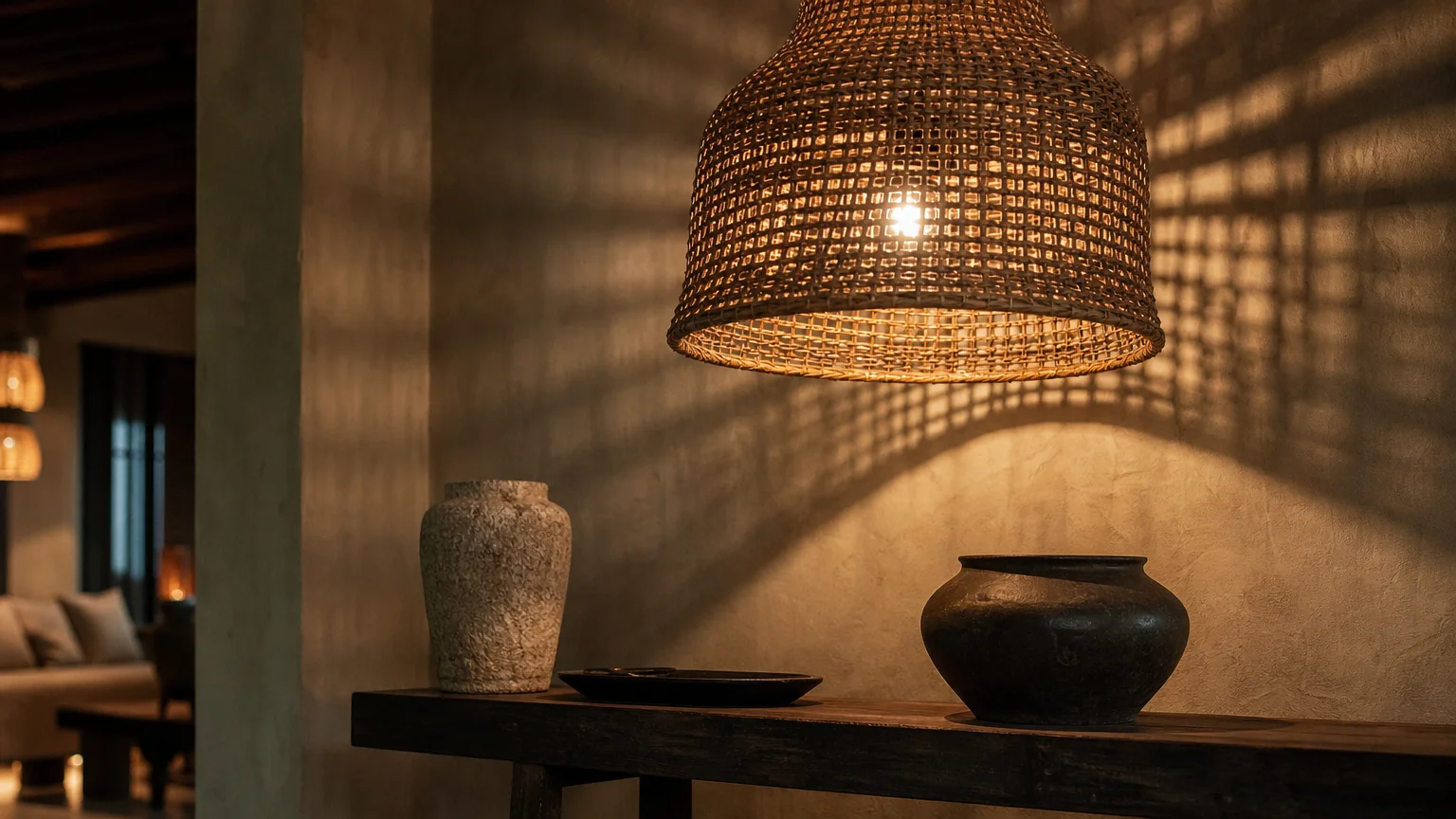
Put two woven pendants of the same size in the same room, one above the other, and light them with the same bulb. The first lays a soft, even glow across the ceiling. The second prints a lattice of bright lines and dark diamonds on the wall behind it, sharp enough to read as a graphic. Both are sold under the same description, both are hand-woven from the same plant, and neither supplier has done anything wrong. The property that separates them is density, and density is the one thing a woven lighting specification rarely states.
This article is about that property, treated as an optical question rather than a stylistic one. It sets out what density is actually measuring, why the gaps in a weave behave like a row of small apertures, why the bulb sometimes becomes visible through a shade that looked opaque in the showroom, and how the distance from the shade to the nearest surface decides whether the pattern reads as texture or as decoration. It is written for the buyer who has to approve a sample, the designer who has to draw the ceiling, and the hotel operator who has to live with the result.
None of it is about which look is better. A pattern on a wall can be the reason a resort lounge feels worth the rate, and the same pattern in a corridor can look like a maintenance defect. What follows is a way to predict which one you are buying before the fixture is on site.
- 01Two Shades, One Bulb, Two Rooms
- 02What Density Is Actually Measuring
- 03Why the Gap Is the Image
- 04When the Bulb Becomes Visible
- 05Strand Width and Open Area
- 06Layering: The Second Skin
- 07Distance, Angle and Sharpness
- 08Colour, Finish and the Warm Shift
- 09Reading a Sample Before Commitment
- 10Writing Density Into a Specification
Two Shades, One Bulb, Two Rooms
In a hotel lounge in the evening, the pendant is usually the brightest object in the upper third of the room that is brighter than the wall. Everything the eye reads about that upper third — the texture of the plaster, the line where wall meets ceiling, the depth of the room beyond the seating group — is mediated by what the shade does with the light on its way out. Change the weave and the room does not merely get brighter or dimmer. It changes character, because the shade is not a filter so much as an array of apertures, and apertures create structure.
This is why two woven shades can measure identically in every dimension a spec sheet carries — diameter, height, drop, frame material, lamp type — and still behave like different products. The measurement that is missing is the one that describes the holes.
There is a second reason the question matters commercially. Woven lighting is sold largely on appearance in daylight, and the buyer sees the sample unlit, or lit in a showroom with a white ceiling directly above it. Under those conditions a moderately open weave looks like a warm, textured surface. Installed over a dining table with a pale wall a short distance behind it, the same weave becomes a projector. The gap between the showroom impression and the installed result is almost invariably a geometry gap, not a quality gap.
The useful way to close it is to stop treating the weave as a texture and start treating it as a set of decisions: how much solid material sits between the lamp and the room, in how many layers, at what width, and at what distance from the surfaces that will receive the light. Those four decisions can be discussed, sampled and written down. “Natural woven pendant” cannot.
What Density Is Actually Measuring
The word density arrives in lighting from textiles, where it usually means the count of strands in a given length — a measure of how many threads cross a unit of cloth. That number is useful for durability and for hand-feel. It is a poor predictor of what a shade does with light, because two cloths with the same strand count can differ in transparency by a wide margin once the strands differ in width. A dense cloth of thin strands and a sparse cloth of thick strands can present the same proportion of solid surface, and that proportion, not the count, is what the light responds to.
The quantity worth asking about is the fraction of the shade’s surface that is open. It is rarely published, and it does not need to be published as a number to be discussed usefully: a sample held against a bright window answers the question in a second, because the eye is good at estimating how much of a surface is transmitting and how much is blocking. What the eye is less good at is judging the second and third variables, which is why they are worth naming separately.
The second variable is the number of layers. A single woven skin behaves differently from two offset skins, and both behave differently from a woven skin with a liner behind it. Layering does not change the open fraction of either skin, but it changes the probability that a straight line from the eye reaches the lamp, and that probability is what decides whether the bulb is visible.
The third variable is the surface of the strand itself. A peeled cane strip with a satin finish reflects part of the light that strikes it and carries a bright edge along its length; a matte, unfinished strand absorbs more and reads darker against the gaps. Two shades with identical geometry but different strand finishes produce patterns of different contrast — the same lattice, drawn in graphite or in pencil.
| Variable | What it controls | What the room shows | Question that establishes it |
|---|---|---|---|
| Open fraction | How much light passes directly, and how large each aperture is | Whether the shade reads as a glowing surface or as a pattern of separate openings | Held against a bright background, can the lamp be seen as a distinct shape? |
| Number of layers | The chance of a straight sightline from eye to lamp | Whether the bulb is hidden at seated eye height, at standing height, or both | Is this a single skin, two offset skins, or a skin with a liner? |
| Strand width | The width of each dark band between apertures, and the softness of its edge | Fine texture or bold graphic; high contrast or low | What is the visible width of the strand compared with the visible width of the gap? |
| Strand finish | How much light is reflected off the strand rather than absorbed | Pattern drawn in light grey or in near-black | Is the strand sealed and satin, or left matte and open-pored? |
| Weave regularity | Whether the pattern is even across the whole shade | An even field, or a visible seam where the pattern changes | Does the weave tighten or open between the shoulder and the belly of the shade? |
Notice that none of these variables is a style choice in itself. A loose weave is not more rustic and a tight weave is not more formal; those associations come from the finishes and the shapes the market usually pairs with each. Optically, the variables above are neutral. They predict behaviour, and behaviour is what a specification can be held to.
Why the Gap Is the Image
Each opening in a woven shade is a small aperture with a bright source behind it. An aperture does what any small hole does: it constrains the light passing through it into a narrow cone. If the receiving surface is close, the cone has not spread far and lands as a small bright patch with a defined edge. If the receiving surface is far, the cone has widened and the patch is soft. When the patches from neighbouring apertures overlap, the surface reads as evenly lit. When they stay separate, the surface reads as a pattern.
This single mechanism explains most of the surprises in woven lighting. The same pendant that looks like a warm drum in a double-height lobby, where the nearest wall is far away and the ceiling is high, will print a crisp grid on the wall of a low corridor. The shade did not change. The receiving geometry did.
It also explains why the pattern on a wall is usually sharper than the pattern on a ceiling directly above the shade. A wall behind a pendant is often at roughly the pendant’s own height, a short distance away, so the cones arrive small. A ceiling above the pendant is lit at a grazing angle, and grazing incidence stretches the pattern along the surface, smearing each patch into an elongated shape. The result is a softer, more smeared grid — often the more attractive of the two effects, and rarely the one the buyer was imagining.
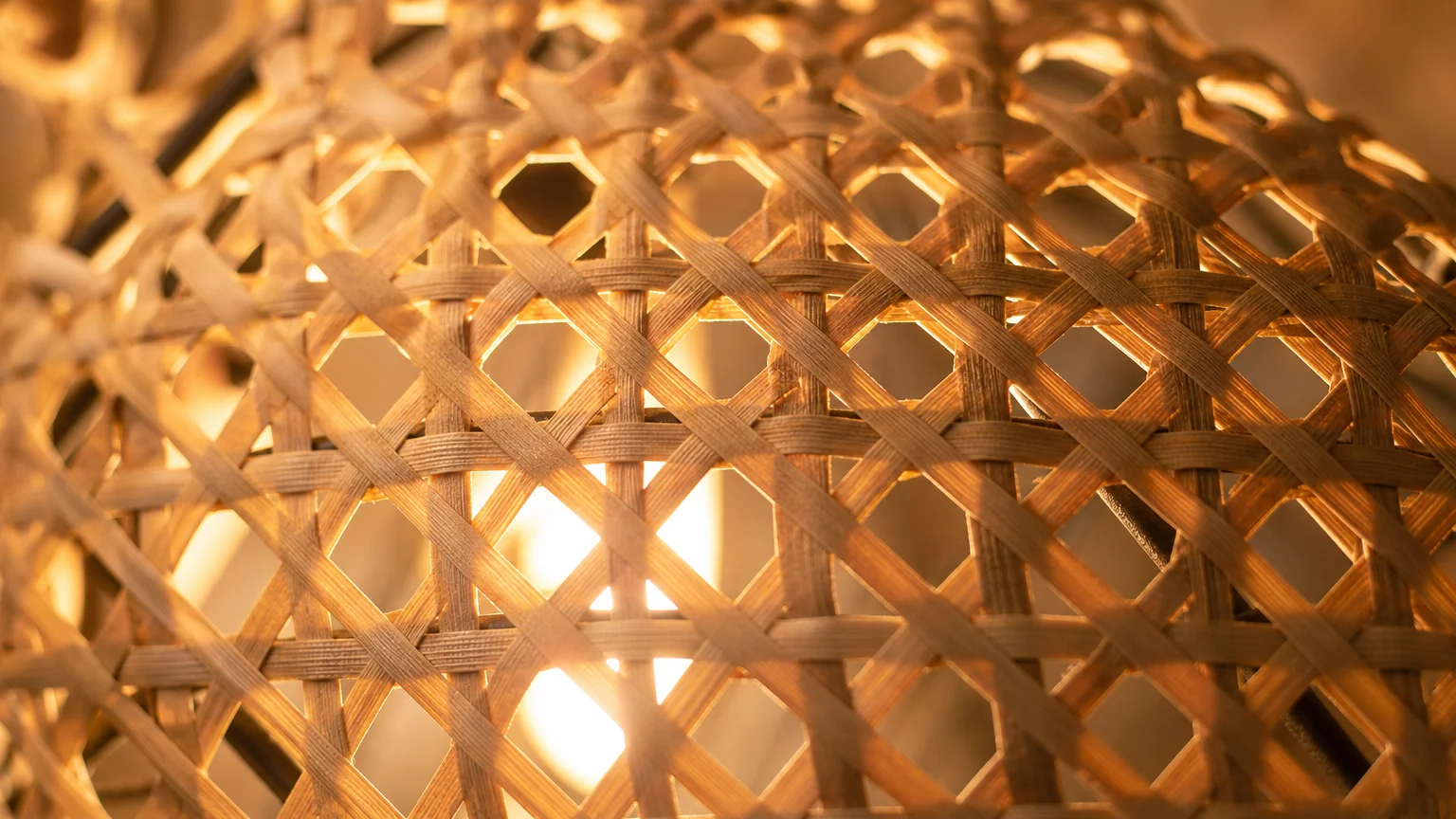
There is a practical consequence for anyone drawing a ceiling. The pattern is a projection, so it obeys projection rules: it scales with distance and it distorts with angle. A sample tested hanging at the wrong drop tells you very little. The reliable test is a mock-up at the intended drop, in the intended room, at night. Where that is impossible, the next best thing is a mock-up against a wall at the distance the real wall will be, with the real shade and the real lamp.
One more thing follows from the aperture model, and it is the part most often missed in specification reviews: the pattern is an image of the source, not of the shade. If the lamp is a small bright point, each aperture projects a small bright point and the pattern is crisp. If the lamp is a large opal globe, each aperture projects a soft disc and the pattern becomes a soft mottle. The same shade with a different lamp is a different fixture. This is why a woven pendant approved with one lamp type and installed with another can fail an inspection without anything having been manufactured incorrectly.
When the Bulb Becomes Visible
The complaint that reaches a supplier most often about woven pendants is not about pattern at all. It is that the lamp can be seen. Someone sitting at the table, or standing at a reception desk, has a straight line through the weave to the light source, and from that angle the shade stops reading as a shade and starts reading as a cage with a bright object inside it.
The condition is purely geometric. A sightline exists when the eye, an aperture and the lamp line up. Because a pendant hangs above eye height, the most exposed viewpoint is usually from a distance: the further back the viewer stands, the shallower the angle through the weave, and the more likely the sightline passes cleanly through. A woven shade that conceals the lamp when viewed from directly underneath can be completely transparent from across the room. Buyers who check only the first condition approve shades that fail the second.
There are four honest ways to close the sightline, and they have different costs.
Recess the lamp. Moving the lamp further up inside the shade puts more woven surface between the eye and the source at shallow angles. It is free, it changes the distribution of light on the ceiling, and it usually reduces the amount of light leaving the shade sideways.
Offset a second layer. Two woven skins rotated relative to each other multiply the number of apertures that must align, so a sightline that passes one layer is blocked by the other. The pattern survives, softened, and the bulb becomes much harder to see. This is the usual solution for guestroom pendants where the fixture is seen from a bed at a shallow angle.
Add a liner. A translucent liner converts the shade from an aperture array into a diffuser with a decorative outer shell. It removes the pattern almost entirely, reduces output, and changes the thermal behaviour of the fixture because less air moves through the weave. It is the most effective remedy and the one that most changes what you are buying.
Tighten the weave near the sightline. Where a shade is seen mostly from below, a tighter weave or a solid band at the lower edge can close the low angles while leaving the upper body open. This is a design decision rather than a component choice, and it needs to be made with the room’s viewpoint in hand.
What does not work is adding more strands everywhere. A uniformly tightened weave solves the sightline and removes the pattern, which is usually the reason the fixture was chosen. The question to settle before production is therefore not “is the weave dense enough” but “from which viewpoints must the lamp be concealed, and what is the cheapest change that conceals it from those and no others”.
Strand Width and Open Area
Two shades can transmit the same proportion of light and draw completely different patterns, because the pattern is made by the solid part, not the open part. The open fraction sets the total; the strand width sets the graphic. Wide strands produce broad dark bands with a soft edge, and the resulting pattern reads at a distance as blocks of shadow. Narrow strands produce fine lines and a pattern that dissolves into texture a few steps away from the wall.
Width also changes how the shade reads when it is seen unlit, which matters more in hospitality than in residential work because a pendant is on for part of the day and off for the rest. A shade of wide strands looks heavy and sculptural in daylight and graphic at night; a shade of narrow strands looks delicate in daylight and nearly plain at night. Neither is a defect. They are different objects that share a description.
The finish on the strand then decides contrast. A sealed, satin cane reflects light along its length, so each strand carries a bright highlight and the band between apertures is not uniformly dark. That highlight softens the pattern and adds a sheen that reads as quality in a lit interior. A matte, open-pored strand absorbs, the band goes dark, and the pattern gains contrast. In a room with pale walls and a single pendant, the matte version often produces the crisper image; the sealed version produces the warmer surface. This is also the variable that most affects how the fixture will age in a humid climate, which is treated separately in our guide to rattan and humidity.
Regularity deserves its own sentence because it is invisible in a photograph and obvious on a wall. Hand-woven shades are rarely perfectly uniform: the weave tightens where the strand turns at the rim and opens slightly over the belly. Those variations are what make the object worth buying, and they are also what produce a pattern that changes across the shade. If the design intent is an even field of light, that variation must be controlled at the sample stage; if the intent is a hand-made surface, it should be accepted deliberately rather than discovered on site.
Layering: The Second Skin
Most of the disagreement about woven lighting comes from buyers and suppliers using the same words for two different constructions. In one, the woven body is the shade: it carries the form, it is the surface the light passes through, and the frame is a minimal armature. In the other, the woven body is a decorative sleeve over an inner diffuser that does the actual work of softening the light. The first is an aperture array. The second is a diffuser wearing a woven coat. Their behaviour has almost nothing in common, and both are sold as a woven pendant.
The distinction matters for four reasons. It decides whether the bulb is visible, because a diffuser closes every sightline. It decides how much light reaches the room, because a liner absorbs and reflects a proportion of what would otherwise pass. It decides heat, because an open weave ventilates the lamp and a lined shade traps warm air, which changes what lamp is permissible. And it decides maintenance, because a woven surface collects dust in its crevices and a liner behind it cannot be reached without dismantling.
Where both pattern and concealment are required, the compromise is two woven layers offset from each other. It keeps the aperture character, multiplies the alignment needed for a sightline, and softens the pattern just enough that it reads as texture at close range and as a field of light at a distance. It costs more to weave and it is harder to clean, which is why it tends to appear in guestrooms and private dining rooms rather than in large volumes.
For specification purposes, the useful discipline is to state which construction is being bought, in the first line of the description, before any mention of style. “Hand-woven rattan body over a translucent liner” and “hand-woven rattan body, unlined, single skin” are two different products. If the line does not say, the sample will decide for you.
Distance, Angle and Sharpness
The distance from the shade to the nearest receiving surface is the variable most often left to site conditions, and it is the one that most changes the result. A pendant hung close to a wall behaves like a projector with a short throw: the pattern is small, sharp and legible. The same pendant moved away from the wall spreads its pattern, softens the edges and loses legibility, until at sufficient distance the wall simply looks brighter in that area.
Angle changes the shape as well as the sharpness. Light arriving at a wall perpendicular to it produces a pattern close to the weave’s own geometry. Light arriving at a grazing angle stretches the pattern along the surface, which is why ceilings above pendants show elongated grids and why a sloped soffit produces a pattern that seems to slide. Neither effect is a fault, but both must be drawn rather than discovered, particularly where a pendant sits close to a cove or a beam.
In hotel work, the practical control is the drop. The same fixture at two different drops produces two different rooms, and the drop is usually set late, by whoever installs the suspension, without reference to the optical intent. Writing the drop into the specification, and marking it on the ceiling drawing, is a cheaper intervention than any change to the weave. Where the fixture lights a wall rather than a table, our guide to indirect lighting in guestrooms sets out how the distance to the surface changes the quality of the wash.
There is one more geometric factor that rarely appears in specifications: the height of the observer. A pattern judged from a standing position in an empty room is judged from a different angle than the same pattern seen by a seated guest. For dining and lounge spaces, the seated view is the one that matters, and it is the one a mock-up should be judged from.
Colour, Finish and the Warm Shift
Geometry decides where the light goes; colour decides what the pattern looks like when it arrives. A pale cane shade transmits a warm, low-contrast image, because the light passing through the gaps and the light reflecting off the strands are close in tone. A dark-stained body absorbs more of the reflected component, so the bands between apertures go darker and the pattern gains contrast without any change to the weave.
Lampholder colour temperature interacts with this in a way that is easy to underestimate. A warm source behind a honey-toned fibre produces a monochrome result in which the pattern reads as texture; the eye sees variation in brightness but very little variation in colour. A cooler source separates the transmitted light from the reflected light, and the pattern starts to read as a graphic with visible edges. Neither is more correct. The point is that the choice is a system choice — weave, strand finish, fibre tone and lamp together — and approving them separately tends to produce a result that nobody specified.
There is a related effect that matters for hospitality photography and for how a room is remembered: a woven shade seen from the side, with a wall behind it, is one of the few lighting conditions in which the fixture and its effect are visible at the same time. That is a large part of why the category photographs so well. It is also why a pattern that looks charming in a photograph can feel busy in a room where the same wall is in the guest’s field of view for an hour.
The neutral description for a specification is therefore not a colour name but a relationship: the shade should read as a single warm field from the primary viewpoint, or the weave should remain legible as a pattern from that viewpoint. Those two sentences lead to different samples, and they can be checked at approval time. Our notes on natural materials and the light around them cover the same interaction from the material side.
Reading a Sample Before Commitment
A woven sample can be read in a few minutes without any instrument, provided it is read in the right conditions. The mistake is to read it in a lit office or against a white table, where the eye is adapted to a bright surface and the weave looks denser than it will look at night above a dining table.
Hold it against a bright window. This is the single most informative test. What you see is approximately what the shade will project: a uniform glow means the apertures overlap at working distances; a visible filament or a distinct bright shape means the shade will print that shape on any nearby surface. Nothing else in the assessment matters as much as this first look.
Rotate it. As the sample turns against the light, the pattern should breathe — tightening and opening as the apertures align and misalign. If it does not change at all, the weave is either extremely dense or, more likely, what you are holding is a moulded or printed imitation rather than a woven surface. The cut edge confirms it: a woven shade ends in strands, an imitation ends in a moulded line.
Sight the lamp from both seated and standing height. Ask the supplier to hang the sample at the intended drop if at all possible, then view it from the height of the people who will live with it. This is the reliable way to answer the visibility question, and it takes less time than resolving a complaint after installation.
Compare shoulder and belly. In a hand-woven shade the weave usually varies between the top and the middle. Look for the point where it changes and decide whether that variation is acceptable as a pattern. It will be visible on the wall as a change in the density of the grid.
Check the edges and the lashings. The rim is where the strand terminates, where the finish is thinnest, and where a fixture in a humid room will begin to fail. A rim that has been sealed after cutting will hold longer than one where the cut ends were left open. This is a two-second check in the sample room and an expensive discovery on site.
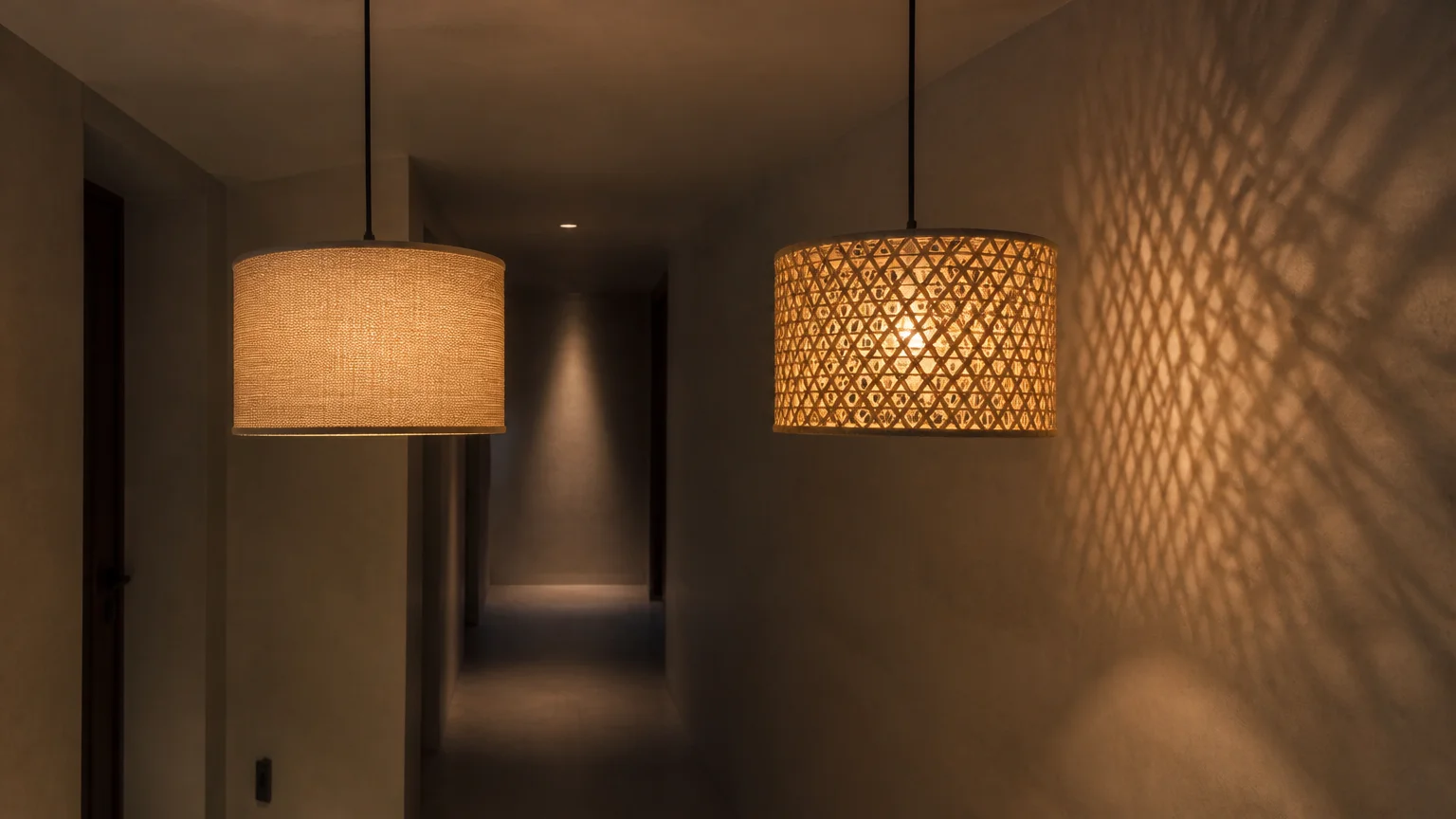
The pair of pendants above shows the same frame size and the same lamp under two weaves. The difference in what the room receives is not a difference in quality, cost or care. It is a difference in one number that neither catalogue states. Approving a woven shade without seeing this comparison is, in effect, delegating the decision to whoever packs the sample.
Writing Density Into a Specification
The aim of the specification is not to pin the weave to a measured figure. It is to make the intended optical result checkable, so that a sample can be accepted or rejected on evidence rather than opinion. That takes four clauses and one approval step.
Name the material and the construction. State the plant and the part of it that is visible — stem, peeled skin, leaf or another fibre — and whether the woven body is a single skin, two offset skins, or a skin over a liner. The vocabulary for the material part is set out in our guide to reading material and weave; the construction part is the sentence most often missing.
State the visual target in observable terms. “Shade shall read as an even warm field from a seated position in the adjoining room” and “weave shall remain legible as a pattern on a wall at the specified distance” are both checkable. “Natural look” is not. Choose one, and accept the consequence: the first implies a closed sightline and probably a liner; the second implies an open aperture and a visible pattern.
State the drop and the receiving surfaces. The pattern is a projection, so the specification should name the distance to the wall behind and to the ceiling above, and the drop at which the fixture will hang. These are drawing items, and they belong in the lighting specification rather than in the site instructions.
State the lamp. Because each aperture projects an image of the source, the lamp shape and diffusion are part of the optical design. A change of lamp after approval is a change of product, and it should require a re-check rather than a substitution.
| What the description says | Why it is not yet a specification | Clause that makes it usable | Evidence to request |
|---|---|---|---|
| Natural woven pendant | Names a look; says nothing about apertures or construction | Plant and part named; single skin, offset double skin or skin over liner stated | Construction drawing or section through the shade |
| Hand-woven, tight weave | “Tight” is relative and unmeasured | Either the visual target is stated, or the sample is the reference and is retained as the approved standard | Signed sample retained by both parties, with the approval date |
| Warm glow | Describes an impression, not a distribution | Distribution and the primary viewpoint named; lamp type fixed | Mock-up photograph from the primary viewpoint, at the intended drop |
| Dimmable | Says nothing about pattern at low output | Behaviour at the lowest intended level stated, since low output raises pattern contrast | Demonstration at the lowest level used in service |
| Suitable for hospitality | Not an attribute of the object | Cleaning method, access for relamping, and hinge or opening stated | Maintenance instruction covering the woven surface and the liner |
The approval step is the part that makes the rest real. A sample approved in daylight has not been approved for the condition that matters; a sample approved at the intended drop, at night, from the intended viewpoint, with the intended lamp, has. Keep that sample. When a later batch arrives with a weave that looks slightly different, the retained sample is the argument that settles the question without a site visit.
For buyers assembling a full schedule of woven fixtures across a project, the same logic scales: group the fixtures by the optical job they are doing — even field, legible pattern, concealed source — and specify each group once. A property that buys three different weaves for three different jobs, and documents none of them, ends up with three rooms that look inconsistent for reasons nobody can name. The wider question of how a fixture schedule holds together across a property is covered in our guide to hotel lighting and, for public and tender work, in the specification checklist for tenders.
Woven lighting is one of the few categories where the buyer can predict the result almost completely, because the mechanism is simple and visible: apertures, layers, strand width, distance. The information is all present in the sample. What is usually missing is the vocabulary to ask for it, and that is a gap a single page of clauses closes.
Does a tighter weave mean less pattern? Less pattern and less output, generally, because more solid material sits between the lamp and the room. But the pattern can survive a tight weave if the strands are thin and the contrast is raised by a dark finish. Read the sample against a bright background rather than judging by how tight it feels.
Why does the same pendant look different in two rooms? Because the pattern is a projection and depends on the distance and angle to the surfaces that receive it. A short distance to a wall gives a small, sharp image; a long distance spreads and softens it; a ceiling above the fixture is lit at a grazing angle and stretches the pattern. The shade is unchanged in all three cases.
Can I use a woven pendant over a dining table in a hotel? Yes, if the lamp is concealed from the seated viewpoint and the pattern is wanted at that distance. That usually means an offset second layer or a recessed lamp rather than a denser single weave. Approve it at the intended drop, from a seated height.
Is an unlined woven shade brighter than a lined one? It transmits more light in total, because nothing absorbs a proportion of it, but it also concentrates light into a pattern rather than distributing it. The lined version tends to look brighter as a surface and dimmer as a room.
How do I compare two suppliers’ samples fairly? Hang both at the same drop, with the same lamp, against the same wall, and view them from the same position at night. If that is impossible, photograph both under identical conditions from the primary viewpoint. Any comparison made in different rooms is a comparison of rooms.
We build woven and natural-fibre lighting for hospitality projects with the construction, the layering and the finish stated separately, and with a sample approved at the intended drop rather than in a showroom. Send the room, the drawing and the effect you want on the wall, and we will return the construction options that produce it — and the ones that will not.
Pendants and chandeliers · Hotel lighting projects · Talk to us about a specification


