
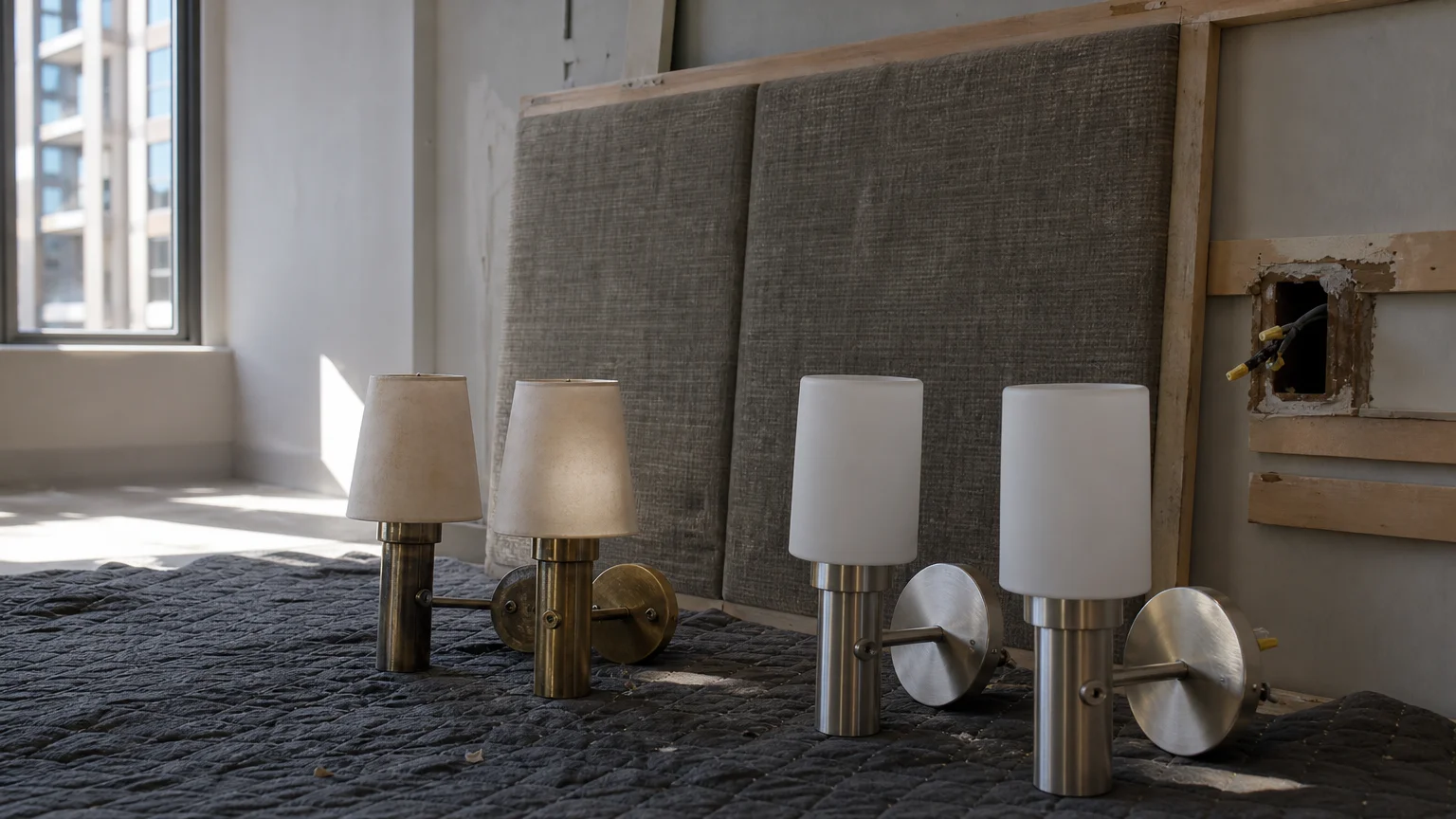
A conversion lighting package is rarely decided by how tired a fitting looks. Four forces decide it: the brand standard, the efficiency benchmark, the life-safety obligation, and the items a guest actually perceives. For each item it answers three questions: why it is in the package, when the existing installation can stay, and what a buyer should verify before ordering.
Refurbishment planning often assumes the scope follows the condition survey: whatever looks worn is swapped, whatever still works stays. On a conversion that produces a package too small in some rooms and too large in others. The driver decides, not the wear.
- 01A condition survey tells you what is worn, not what to replace
- 02Driver one: the brand standard defines the guest-facing layer
- 03Driver two: the efficiency case is a whole-building calculation
- 04Driver three: the life-safety layer is not negotiable
- 05Driver four: the items a guest actually perceives
- 06The master scope table
- 07What published project reporting shows about real conversion scope
- 08Turning drivers into a purchasable scope
01A Condition Survey Tells You What Is Worn, Not What to Replace
A condition survey records what can be observed: light output that has fallen away, yellowed diffusers, finishes painted over, buzzing drivers, components no longer obtainable. It is useful, but it describes past performance against the brief the installation was bought to meet, and a conversion changes the brief.
Hence two recurring errors. A serviceable installation is condemned because it no longer matches the incoming standard on colour quality or control behaviour, neither of which a survey can see. Or a tired installation is judged against a standard that no longer applies, so full replacement is proposed where a new source or diffuser would do. Both use condition as a proxy for compliance.
- Brand standard. A contractual definition of the guest-facing layer: what must be illuminated, to what quality, with what control behaviour.
- Efficiency benchmark. A property-level target measured across the estate, so one room type affects every other.
- Life safety. Emergency illumination and signage obligations that follow the new plan, with their own testing duties.
- Guest-perceived experience. The items in the guest’s line of sight: the reading light, the mirror light, the corridor run, the arrival space.
Every position should also carry one of three dispositions: replace, retain, or refurbish in place with a new source, diffuser, driver or finish. The third is the least used and often the only option a protected envelope allows, as our guide to heritage hotel lighting renovation sets out.
02Driver One: The Brand Standard Defines the Guest-Facing Layer
A brand standard controls the result rather than the product: a level at the bed head for reading, a quality of light at the mirror, colour temperature and rendering for ambient light, a predictable scene on entry, and a visual language for anything on a wall. Where a conversion repositions the asset, the incoming standard applies and the existing installation was specified against the previous one.
| Guest-facing layer | What the standard typically governs | What the buyer verifies |
|---|---|---|
| Guestroom ambient | Colour temperature, rendering, level, glare from a lying position | Colour quality, beam distribution, appearance beside retained fittings |
| Bed head reading | Adjustability, control location, light on the page with minimal spill | Articulation, switch position, behaviour at the bottom of the dimming range |
| Bathroom and mirror | Quality of light on the face, uniformity, wet-area appearance | Rendering, vertical illuminance, ingress protection for the zone |
| Corridor and circulation | Rhythm, mounting height, uniformity, no hot spots on the wall | Spacing and optics against the actual wall build-up |
| Public and arrival spaces | Scene setting, layering of decorative and functional light | Control zones and scenes, lumen package, handling tolerance |
Why replace. The standard is contractual and, in a repositioning, it has changed; a fitting that satisfied the old requirement can fail the new one on appearance, colour or control behaviour alone. When it can stay. Where the retained fitting meets the performance elements and only appearance or control behaviour is dated, a new source of the correct colour quality, a re-finished housing or a control change is enough — and keeping one family protects the spares position. What to verify. The complete luminaire as delivered, not the light source alone, plus batch colour consistency wherever two fittings share a wall. Our guide to specifying hotel wall sconces lists the parameters worth writing into the schedule.
03Driver Two: The Efficiency Case Is a Whole-Building Calculation
Efficiency targets are set at property level, not per room, which makes the lighting decision an allocation problem as much as a specification one. A conversion that upgrades guestrooms while leaving back-of-house and circulation lighting untouched improves only the load that was convenient to reach.
Why replace. The target is measured on the whole property, and a renovation allowance is often calibrated to what a modern installation achieves, so an unchanged legacy layer consumes margin the new areas were meant to create. When it can stay. Where the existing luminaire uses a comparable solid-state source and its driver accepts a control signal, the marginal gain from a swap may not justify opening a ceiling in a trading building. Controls before luminaires is then the better order of work: occupancy sensing in back-of-house corridors, daylight dimming at perimeter zones and scheduled setback. That layer, covered in our guestroom lighting controls guide, is the one most often omitted because it is invisible in a rendering. What to verify. Complete-luminaire efficacy at the drive current used, driver standby consumption, the protocol supported, and behaviour at the bottom of the dimming range.
04Driver Three: The Life-Safety Layer Is Not Negotiable
Emergency illumination and escape signage are the only parts of the package whose requirement is independent of decoration and brand. A conversion changes the escape strategy as a matter of course: rooms are combined, travel distances change, back-of-house routes are re-planned, and a space may move from storage to public use. Any of those can invalidate a scheme assessed against the previous layout, and none is visible in a survey of the fittings.
| Life-safety item | Typical treatment in a conversion | Procurement parameters to verify |
|---|---|---|
| Escape route illumination | Re-planned against the new layout, then extended, relocated or retained | Rated duration, mode of operation, mounting height, spacing and uniformity |
| Exit signage | Reviewed against the new circulation, with direction and mounting re-confirmed | Viewing distance, legend, mounting height and angle, illumination method |
| Test and monitoring provision | Extended to new units and re-commissioned where the layout changed | Whether the unit self-tests, how results are retrieved and exported |
| Energy storage | Usually the item that decides whether a retained housing is worth keeping | Cell type, service life, field replaceability, later availability of the pack |
| Retained units | Kept only where route geometry and documentation are unchanged | Whether the family can still be tested, monitored and spares-supported |
Why replace. The emergency layer has to match the building as converted, and a changed door position or corridor width alters what the scheme must cover. When it can stay. Units can be retained where the escape geometry is unchanged, provided they sit inside a live testing regime, are compatible with the monitoring chosen for new units, and have documentation that survives the project. Retaining one family while introducing another creates a spares obligation for two, which belongs in the decision rather than a later discovery. What to verify. Confirm the required duration and mode against the applicable code for the property, not a previous specification, and confirm how the finished installation will be tested. Our product guide to emergency lighting covers the fitting-level questions that follow.
05Driver Four: The Items a Guest Actually Perceives
Guests do not evaluate a lighting scheme; they experience a short list of moments, and those moments are what a conversion can most reliably improve. The list is worth writing down because it is where a retained installation is most often acceptable.
- The reading light at the bed. Replace where the standard for adjustability or control has moved. Retain where the geometry and switching work and only light quality is dated. Verify articulation, switch location and the lit appearance from a lying position.
- The mirror light in the bathroom. Replace or refurbish where the standard for face lighting or wet-zone compliance has moved. Verify rendering, vertical illuminance and the ingress protection rating for the zone.
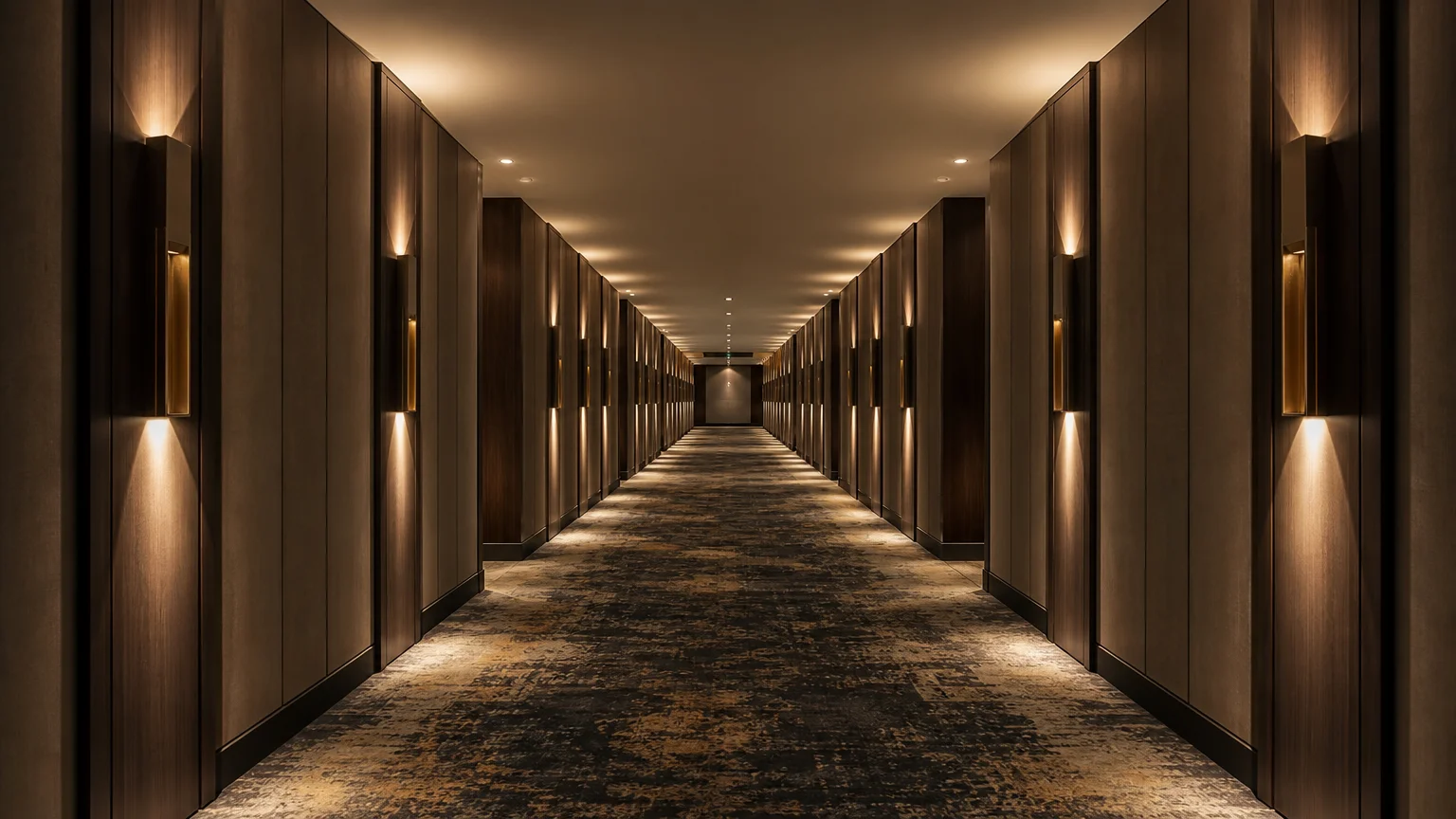
- The corridor sequence. Judged as rhythm, because the guest sees a repeated run. Retain where spacing and mounting height still suit the wall. Verify optics and spacing against the wall construction, since new panelling changes the wash.
- The arrival and lobby layer. Judged as atmosphere and driven by controlled contrast. Retain where the decorative elements hold up and only control behaviour is wrong. Verify zoning and what happens to the scene after a power interruption.
- The dressing and wardrobe light. Judged by whether the guest can judge colour while choosing clothing. Retain where position and switching are sound. Verify rendering and the absence of shadow across the shelf.
06The Master Scope Table
The four drivers combine into one working document. The middle column is a condition rather than an instruction, because the right answer depends on the layout, the brand position and the state of what is installed.
| Replacement item | Whether it is normally replaced | Basis for the decision | Procurement parameters to verify |
|---|---|---|---|
| Guestroom ambient downlights | Usually replaced | Colour standard; efficiency; ceiling already open | Colour consistency, beam and spacing, cut-out against the new ceiling |
| Bed head reading and wall lights | Usually replaced | Adjustment and control standard; headboard re-work | Articulation, switch position, finish approvals, wall panel interface |
| Bathroom mirror and vanity lighting | Usually replaced or refurbished | Guest-perceived; wet-zone compliance; finish changes | Ingress protection, rendering, vertical illuminance, control location |
| Corridor and circulation luminaires | Conditional, often retained | Rhythm and level standard; efficiency; finish changes | Spacing and optics against the wall, uniformity, dimming behaviour |
| Public space and decorative lighting | Conditional, often re-controlled | Atmosphere; material palette; scene requirements | Zoning and scene capacity, colour quality, handling tolerance |
| Lighting control layer | Usually replaced | Scene behaviour; efficiency credit; legacy end of support | Protocol, dimming range, sensor coverage, behaviour after power loss |
| Emergency luminaires | Re-planned, then extended or relocated | Life-safety obligation against the converted layout | Rated duration, mode of operation, self-test, replaceable storage |
| Exit signage | Reviewed and generally adjusted | Life-safety obligation against the new circulation | Legend, viewing distance, mounting height and aim |
| Exterior and entrance lighting | Conditional | Arrival standard; safety lighting; site changes | Ingress protection and corrosion class, spill control, service access |
| Repair parts and spares | Always in scope | Retained families create a parts obligation | Driver types, sources, diffusers, trims, long-term availability |
Six of the ten rows are conditional, and the two that are never optional — emergency provision and spares — are the two a decorative review reaches last. A scope built backwards from the visual result orders more than required; one built forwards from the obligations is defensible line by line.
07What Published Project Reporting Shows About Real Conversion Scope
Reported conversions show what owners actually put into a package when a project is described to the market. The projects below were covered in industry reporting during August and September 2026, with project, operator and designer names omitted.
| Reported project | Headline scope | How lighting appears | What a buyer can read from it |
|---|---|---|---|
| A 16-key courtyard suite refurbishment at a country property | Full interior renovation of all 16 courtyard suites | Fireplace walls upgraded to architectural panelling with integrated decorative lighting; tactile finishes and carpets woven from recycled yarn | Decorative lighting sits inside an architectural element, not in loose FF&E, which moves it in the package and the trades sequence |
| A 523-key city-centre hotel | First phase covers all guestrooms and suites plus the top-floor executive lounge; a second phase for lobby, restaurants and meeting space is expected in the first quarter of 2027 | Guestroom lighting identified as LED, with appliances carrying a recognised efficiency label; custom mural headboards; furniture with integrated power | Lighting is bundled with the electrical and technology package, and phasing means two procurement windows |
| A 484-key city-centre hotel | Complete renovation of all guestrooms and suites plus 21,000 square feet of meeting and pre-function space | Summarised as refreshed finishes and enhanced lighting, with guestrooms in a light greige palette and layered greens | Where lighting is described as an enhancement to finishes, the scope is usually a change of quality within a retained layout |
| A 49-key Upper East Side conversion | Small luxury conversion of guestrooms and public areas | Guestrooms in midnight blue with white millwork, high ceilings, warm timber and brushed brass; public spaces using soft lighting with residential joinery and natural stone | An atmosphere-driven brief is judged on effect rather than fitting count, and the schedule follows the joinery |
| A 214-key historic property converted from a 1941 bank building by adaptive reuse in 2006 and 2007 | Guestroom upgrade within a protected envelope | A 34-foot arched banking hall, marble staircase and carved emblems retained; the original vault reused for private dining and events | The envelope governs what may be fixed to it, so refurbishment is more likely than wholesale replacement |
Three patterns run through that reporting. The vocabulary is about effect — decorative, enhanced, soft — which is how a package should be briefed and not how it should be bought. Phasing splits delivery across two windows, forcing retained public-area lighting to last through an interim period. And lighting is integrated into panelling, technology upgrades and joinery, which moves the specification earlier in the construction sequence.
08Turning Drivers into a Purchasable Scope
Once the drivers have been applied the remaining work is procedural, and it is where packages are usually weakened. Four habits carry most of the benefit.
- Build one mock-up room before the schedule is frozen. One completed room reveals batch colour consistency, the fitting against the new wall finish, the entry scene, and the reading light from a lying position.
- Write the disposition into the schedule. Every position carries replace, retain or refurbish, and every retained position carries its evidence. A scope that records only what is being bought cannot be defended later.
- Keep the number of retained families small. Each one is a driver type, a source, a spare part and a service procedure. Retaining one family is a saving; retaining four is an operational liability.
- Reconcile lighting with the furniture and technology packages. Integrated power, headboard geometry, joinery and control interfaces all constrain the fitting; a package agreed after those are fixed absorbs their tolerances instead of setting them.

One boundary should be restated. Which lighting a property must have, how escape routes are lit and for how long, and what may be altered inside a protected envelope are set by the applicable codes, the brand agreement and the inspecting authority. No supplier can substitute a different standard; what a supplier can do is make the scope purchasable and the obligations achievable.
Source type: the driver categories, dispositions and procurement parameters above reflect published hospitality brand-standard practice, building energy-efficiency compliance regimes, life-safety codes and their testing obligations, and general procurement practice in hotel conversions. Project evidence is drawn from industry reporting published during August and September 2026, with project, operator and designer identities removed and no figures added. Requirements differ between markets and are set by the applicable code and the authority having jurisdiction; confirm them for the property.
Frequently Asked Questions
Does a conversion mean every light fitting has to be replaced?
No. Two of the three dispositions — retain as it is, or refurbish with a new source, diffuser, driver or finish — are legitimate outcomes. The items almost always in the package are the control layer, the emergency provision, the bed and bathroom positions, and the spares.
How do we choose between replacing a fitting and refurbishing it?
Test it against the requirement the new fitting must meet, not against its own history. If it already delivers the performance the brand standard and the efficiency target call for, and only appearance or control behaviour is dated, refurbishment is sufficient. If the requirement has moved, the question is whether the existing housing and optics can produce the new result at all.
Is the lighting scope part of the FF&E package?
Often described that way, but the two behave differently. Loose FF&E can be ordered late and delivered to a room; lighting depends on the ceiling build-up, wall construction, joinery and electrical infrastructure, so it is frozen earlier.
What should we check about the existing lighting before writing the scope?
Four things beyond condition: whether the brand standard has changed and how; whether the position still exists in the new layout; whether the control layer the fitting depends on is still supported; and whether spare parts, drivers and sources for that family are obtainable. A family with no parts supply is not a retention candidate.
What documentation should the conversion hand over for the lighting?
The installation as it actually exists, not as the new package alone: a schedule recording which positions were replaced, retained or refurbished, the performance at each position, the control zones and scenes as commissioned, the emergency scheme as re-planned, and a spares list covering every family still in service.
Writing a Conversion Lighting Scope?
Send us the room types, the ceiling and wall build-ups, the brand standard you are working to and the layout as converted. We will tell you which positions are genuinely in the replacement package, which can be refurbished in place, and what each disposition does to your spares position. Start from the schedule used for building a light fixture schedule with the seven fields that matter and the review becomes a line-by-line conversation rather than a discussion about appearance.


