
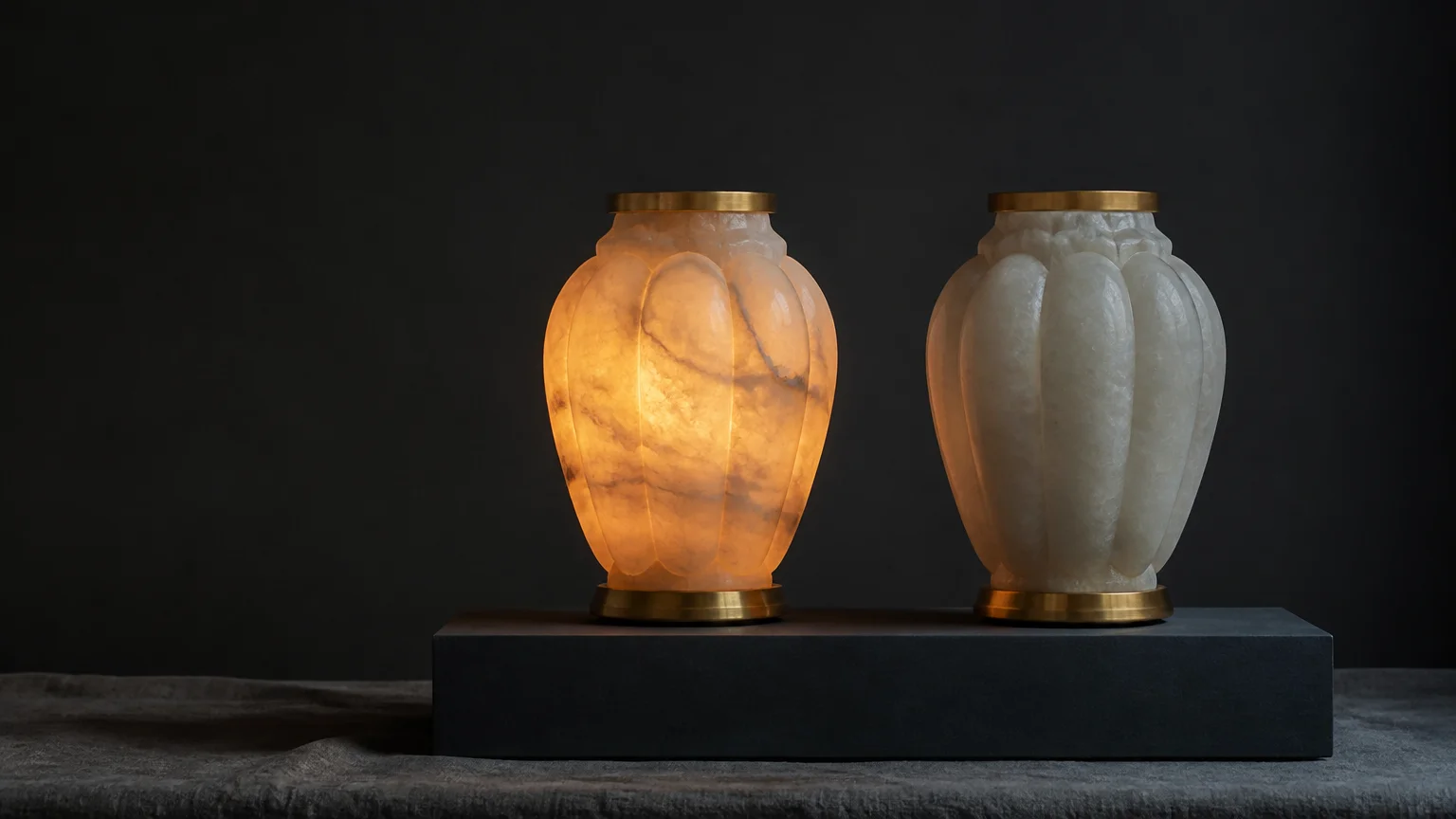
Ask ten people what alabaster is and you will get ten answers: a soft white stone, a type of marble, a lamp material, a synonym for luxury, or simply a colour. All of them are close to something real, and none of them is precise enough to buy with. This guide sets out what the word actually covers, what a buyer can check without a laboratory, and where the limits of a visual judgement lie.
The reason the term is so slippery is that it describes a material by its appearance and working behaviour rather than by a single mineral identity. Stone that is pale, fine-grained and capable of transmitting light has been called alabaster for a very long time, in different places, for stones that are not the same material at all. Trade usage has preserved that ambiguity, and it survives in product listings today.
For a buyer, this creates a specific practical problem. The word on a quotation looks like a material specification, but on its own it is not one. It describes a family of appearances without fixing hardness, water resistance, working method or light transmission — the four things that actually determine whether a lamp made from it will suit a particular room. This article is concerned with closing that gap.
It is written for people specifying lighting rather than studying geology: designers choosing a material for a scheme, procurement teams writing a purchase order that will be honoured, and buyers who want to know what they are looking at before they commit. Where a point can only be settled by documentation, we say so, because the honest answer in several of these areas is that the supplier’s own material file is the authority and a general guide is not.
Two companion pieces go further into adjacent territory: our study of translucent alabaster compared with marble in fixtures and of alabaster compared with travertine handle material identification in depth, and our description of how an alabaster lamp is made from the block to the glow follows the manufacturing chain. This article is the entry point: what the material is, and how to recognise it.
- 01What the Word Actually Covers
- 02Two Mineral Families Behind One Trade Name
- 03What You Can Judge With Your Own Eyes
- 04Why Lookalike Stone Is a Different Product
- 05Why No Two Pieces Are Identical
- 06Reading Translucency, Colour and Grain
- 07The Line Between Character and Damage
- 08How Translucent Stone Behaves in a Room
- 09Questions to Ask Before You Buy
- 10Where to Go From Here
01What the Word Actually Covers
In everyday use, alabaster means a pale, soft, fine-grained stone that lets some light through. That description is accurate as far as it goes and is the one most buyers are working with. The trouble begins when it is treated as a specification, because it names an appearance and a working character rather than a material identity.
The word has two lives. As a geological term it refers to specific mineral forms, and it is used for more than one of them. As a trade term it has been applied for centuries to any stone that could be carved into a pale translucent object, which historically included materials that a geologist would not group together. Both usages are legitimate in their own context; the difficulty is that a product page or a quotation does not tell you which one it is using.
What follows from that is a simple rule. Treat the word as a starting description rather than as a specification. It tells you the material is likely to be pale, fine-grained and at least partly translucent. It does not tell you the mineral family, the hardness, how it behaves in a damp room, how it takes a finish, or what happens to it over a decade of use. Those are separate questions, and each one has to be answered in writing if it matters to the project.
There is an important consolation. The ambiguity in the word does not mean the material itself is uncertain once you have a sample in your hands. Stone is one of the few materials where a buyer can form an accurate impression directly, without instrumentation, because appearance and physical response are inseparable in a hand-held piece. The next sections set out what can be judged that way and what cannot.
A brief historical note is worth including because it explains why the term broadened in the first place. Pale translucent carving stone has been worked for decorative and functional objects for a very long time, across more than one civilisation, and the objects made from it were valued specifically for their light-transmitting quality rather than for hardness or durability. Because that quality, not the mineral composition, was the property people were selecting for, the name drifted to follow the appearance. Trade language has been consistent on that point ever since: it names what the stone does.
02Two Mineral Families Behind One Trade Name
Behind the single trade word there are at least two mineral families, and they behave differently enough that the difference matters commercially.
One family is a fine-grained form of gypsum: a soft mineral that is the classic carving material of the name, valued for being workable and for transmitting light when cut thin. The other is a fine-grained form of calcite, which also transmits light but is a harder material with different working characteristics and different behaviour in the presence of water. Both have been called alabaster. Both still are.
The practical differences are in three places. Working: the softer family carves readily and tolerates a wider range of thicknesses, while the harder family resists tooling more and rewards different methods. Moisture: the two are not equally happy in a damp environment, and a design that is sensible in one material may be unwise in the other. Finish: the two take and retain a surface treatment differently, which affects both appearance and how it ages.
What is important for a lighting buyer is not the mineralogy itself but its consequence. If a fixture is specified for a bathroom, a spa, an outdoor-adjacent space or any location with sustained humidity, the family is no longer a piece of general knowledge — it is a selection decision with a service consequence, and it should be answered from the supplier’s material documentation. Our discussion of alabaster in hotel bathrooms covers the damp-location reasoning in more detail; the point here is that the question must be asked, because the trade word will not answer it.
It is worth being explicit about what this section is not saying. It is not saying that one family is superior to the other. Each has applications where it is the sensible choice, and the ranges of appearance available in both overlap considerably. Nor is it saying that a buyer can determine the family from across a room. It is saying that where the answer affects the design — damp locations above all — the answer has to come from documentation rather than from the label.
The corollary is a piece of advice about quotations. A quotation that names the material only by its trade word has not specified the material. A quotation that names the family, or that references a material data file, has. The difference costs nothing to ask for and often removes a later dispute entirely.
One more layer of terminology deserves a sentence, because it appears in buyer questions. Composite or reconstituted stone products are sometimes marketed with similar wording. These are manufactured materials, and they have real advantages in consistency and in cost. They are simply not quarried stone, and the trade name should not be allowed to obscure that distinction. The correct handling is not to treat one as a substitute for the other, but to make sure the buyer knows which one is on the quotation.
03What You Can Judge With Your Own Eyes
With a piece of the material in hand, a buyer can form a reliable impression of several things without any instrument. This is genuinely useful, and it is why stone is one of the few materials where approving a physical sample beats approving a specification sheet.
Light transmission. Hold the material against a light source and observe what happens. A translucent piece carries the light through and emerges as a glow with a soft internal structure. A piece that merely reflects the light will look pale and opaque, with no internal illumination. This is the single most informative test, and it distinguishes the material’s defining property from a general pale appearance.
Weight and feel in the hand. The material has a characteristic density in the hand and a coolness that persists on contact. This is not a formal measurement, and it should never be used alone — a heavier piece is not automatically more genuine, since section thickness and form affect the impression considerably. Used alongside the other checks, though, it is informative.
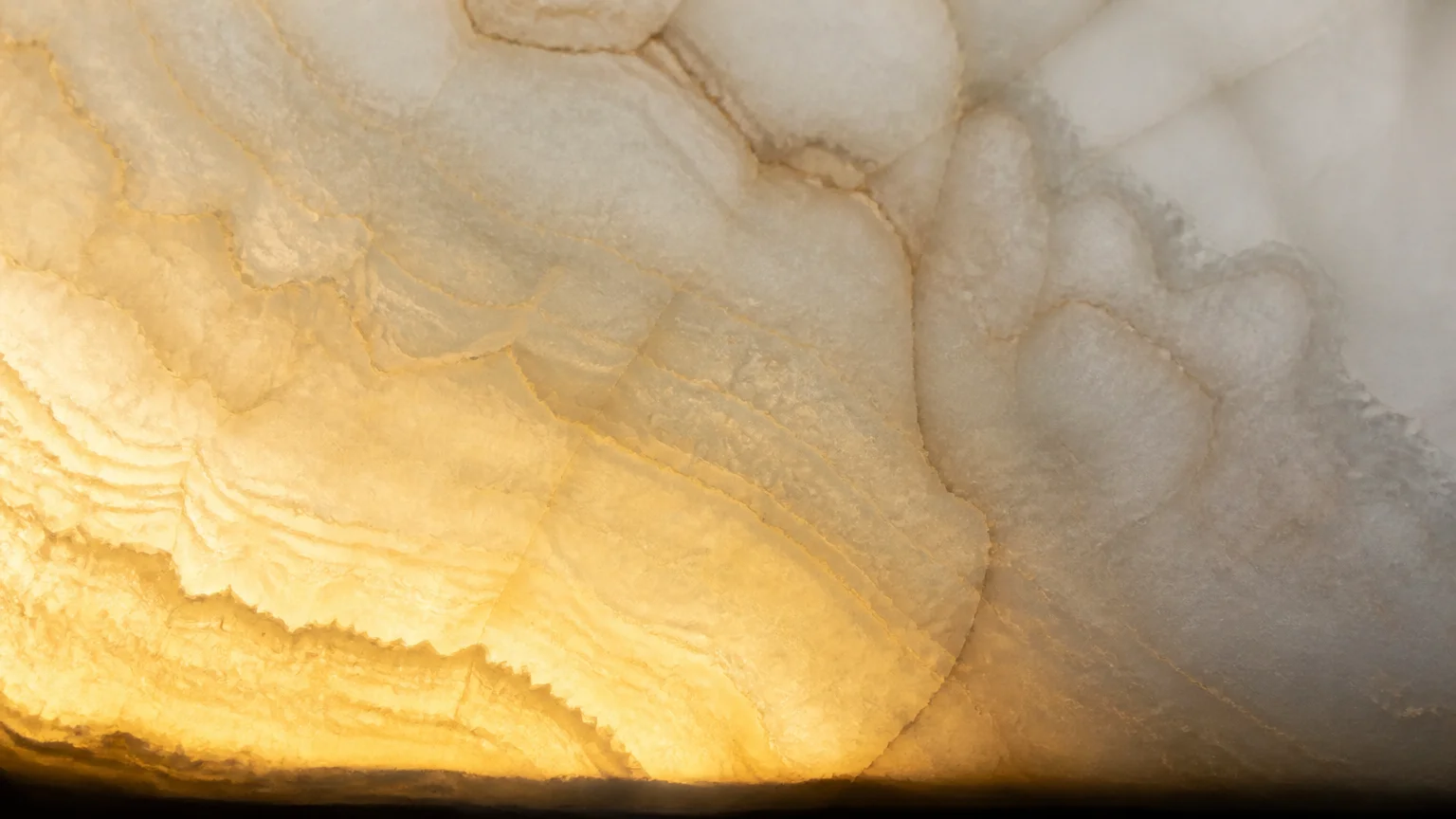
Surface structure. Look closely at the surface and at the cut edge. Quarried translucent stone shows fine structural detail: mineral banding, subtle directional grain, and small variations in translucency that follow the internal structure rather than sitting on the surface. What you are looking for is evidence that the appearance comes from inside the material.
Behaviour under the lamp, not under the ceiling light. The final and most important check is the one most buyers skip. Because the material is designed to transmit light rather than reflect it, a sample should be judged the way the finished lamp will be used: held against a warm light source, at roughly the distance and angle at which the fixture will be seen. A block judged on a bench under a workshop light tells you about the workshop.
It is worth stating plainly what this set of checks cannot establish. It cannot tell you the mineral family, the hardness, the water resistance, or how the material will age under a particular cleaning regime. It cannot tell you whether two pieces will match, because matching is a comparison between pieces rather than a property of one. And it cannot tell you whether the material is suitable for a damp project. All of those require documentation. But the checks above will tell you whether what you are holding is the kind of material you thought you were buying, and in practice that resolves most of the uncertainty a buyer has.
04Why Lookalike Stone Is a Different Product
There are materials that look like quarried translucent stone and are not. Some are manufactured composites; some are other minerals with a similar pale appearance; some are glass or resin forms produced to imitate the effect. None of these is inherently bad, and several are entirely appropriate choices for their own reasons. The problem is not that they exist; it is that the trade word is loose enough to cover them all.
The practical question for a buyer is therefore not which is better, but which is being supplied. There are two situations where the difference has real consequences.
The first is repetition. A manufactured material can be extremely consistent, which is an advantage in a project with a large number of repeated fixtures where visual uniformity matters more than individuality. Quarried stone delivers variation by nature, which is an advantage where the design intends the material to be specific to each piece but a liability if the project expected uniformity. The two are answering different briefs, and the brief should determine which is bought.
The second is long-term appearance. Quarried stone changes slowly in service: the surface takes on a patina, developing a gentle warmth that most specifiers regard as part of the material’s character. Manufactured substitutes change on their own terms, and while some age well, they do so differently. Where a project is planning a decade of operation, the two trajectories should be understood before the material is fixed rather than after.
Between materials that are both genuinely quarried stone, the same logic applies at a finer scale. Pale translucent stone has relatives that look superficially similar — denser calcareous stone among them — and the reasons they are not interchangeable in a lamp have less to do with appearance than with how light behaves in each. Our comparison of alabaster and marble in lighting fixtures sets out that difference, and the parallel comparison with travertine covers the second common pairing. The essential point is that a material can look pale and still be the wrong optical choice.
There is a practical test worth building into a procurement process, and it costs almost nothing. Ask for the material family and the source in writing, and ask whether the supplied item is quarried or manufactured. A supplier who can answer plainly is a supplier whose material claim can be relied on. Where the answer is vague, the ambiguity will surface at delivery.
05Why No Two Pieces Are Identical
The most frequently asked question about translucent stone lighting is also the simplest: why do two lamps of the same design not match exactly? The answer is that the material is not produced, it is extracted, and its internal structure was formed long before anyone drew the lamp.
Quarried stone carries the record of how it formed: layered mineral deposition, variations in density, veins of different composition running through the body. When a block is cut, the plane of the cut determines which of those features appears on the visible face, and the same block cut differently produces a visibly different panel. Two lamps made from neighbouring pieces of the same material will therefore differ in the distribution of their veining and in the local intensity of their glow.
This variation is the material’s identity, not a production tolerance that has been missed. It is the reason translucent stone is chosen in the first place: a manufactured diffuser can be perfectly even, and being perfectly even is precisely what makes it uninteresting. The buyer’s task is not to eliminate variation but to define an acceptable range and to control how it is distributed across a project.
Control in practice is a matter of grouping rather than of matching. Finished pieces are laid out together and arranged into the sets that will be installed together, so that each group reads as a family and no single unit stands out against its neighbours. In a hotel this means a corridor receives its fixtures as a group and a guestroom its pair. That arrangement is decided in the workshop, not on site, and it is one of the clearest signs of a supplier who works with the material rather than against it.
There is a documentation consequence too. Because variation is intrinsic, the specification of a stone fixture has to be sample-based: an approved reference piece, retained by both parties, defines the range. This is the standard approach in project work, and it is why the sample matters more in this category than in almost any other. A drawing controls geometry; a sample controls appearance. Both are needed, and neither substitutes for the other.
06Reading Translucency, Colour and Grain
Three qualities do most of the work in judging translucent stone, and each is best examined in a particular way.
Translucency is the material’s willingness to carry light through its body. Judged properly, it is not a single number but a distribution: a piece can be highly transmissive in one area and largely opaque in another, and the boundary between the two is what gives the lit lamp its internal pattern. When a buyer examines a sample, the useful observation is not whether it glows but how evenly, and where the transitions fall. A piece with an even glow and gentle transitions will produce a calm lamp; a piece with abrupt changes will produce a lamp with pronounced internal structure. Both can be right for a project, but they are different effects and should be chosen deliberately.
Colour in translucent stone is warm by nature. The characteristic range runs from a clean cream through soft ivory to a honeyed tone, with fine mineral detail running through it, and the overall cast sits close to candlelight rather than daylight. This is one of the reasons the material suits evening interiors so well, and it is also the reason a sample can look wrong in a cool-lit showroom and right once installed. The colour should be assessed under warm light, and the light the finished fixture will actually use should be part of the assessment.
Grain is the fine structural texture of the material. It is worth understanding the two levels on which it operates. There is the pattern — the visible arrangement of veins and bands, which is random and unrepeatable, and which is the main reason each piece is individual. And there is the texture — the fineness and evenness of the material itself, which is what makes a worked surface feel smooth and dense rather than coarse. The two are not in conflict: a piece can have a bold, unrepeatable pattern and a perfectly fine, even texture. When a buyer describes a piece as inconsistent, it is worth establishing which of the two they mean, because the pattern is character and the texture is quality.
The interaction between these three qualities and the light source is the part that cannot be judged from a photograph. A warm source behind a strongly veined panel produces a different reading from the same source behind a plain one, and the choice of lamp or LED output shifts the result further. This is one of the reasons a working prototype, reviewed switched on, is the only reliable approval method for a stone fixture, and the reason our manufacturing piece spends as much time on the relationship between stone and source as on the stone itself.
07The Line Between Character and Damage
The single most useful distinction a buyer can learn about translucent stone is where natural character ends and a defect begins. Projects that get this wrong lose money in both directions: they reject good material, or they accept genuinely damaged pieces and discover the problem a year later.
Natural features that are not defects include the pattern of veining, small variations in colour between one area and another, and minor surface detail arising from the structure of the stone. These are the evidence that the material is quarried, and a specification that cannot accommodate them is a specification for a manufactured product. It is entirely reasonable to define how much variation is acceptable, and to require that variation be distributed sensibly across a project, but the variation itself is not a fault.
Features that do indicate a problem are those affecting the integrity of the piece. A structural crack that runs through the body, a chip that has removed material from a formed edge, or a deep pit in a surface that should be smooth are all conditions that will affect either the strength of the part or the evenness of its glow, and they are the legitimate grounds for rejection. The test is not whether the feature is visible but whether it compromises the material.
Because the distinction is visual but consequential, it is worth writing into the inspection procedure rather than leaving it to individual judgement. The most workable approach is to define, at approval, what variation is expected and to record it on the reference sample, so that a later inspection compares a delivery against a known standard rather than against an impression. This converts a subjective argument into a documented comparison, which is the whole purpose of having a reference piece.
Physical handling belongs in the same conversation. Translucent stone is a soft material by the standards of building components, and the methods used on glass, metal or composite parts are not automatically appropriate. Cleaning with abrasive materials or vigorous pressure dulls the surface and can alter how evenly light passes through it, and the change is cumulative rather than sudden. The correct regime for a stone fixture therefore belongs in the handover documentation, not in the maintenance team’s general practice. Our materials and finishes guide for hospitality lighting materials and finishes covers this alongside the treatment of other natural surfaces in the same installation.
08How Translucent Stone Behaves in a Room
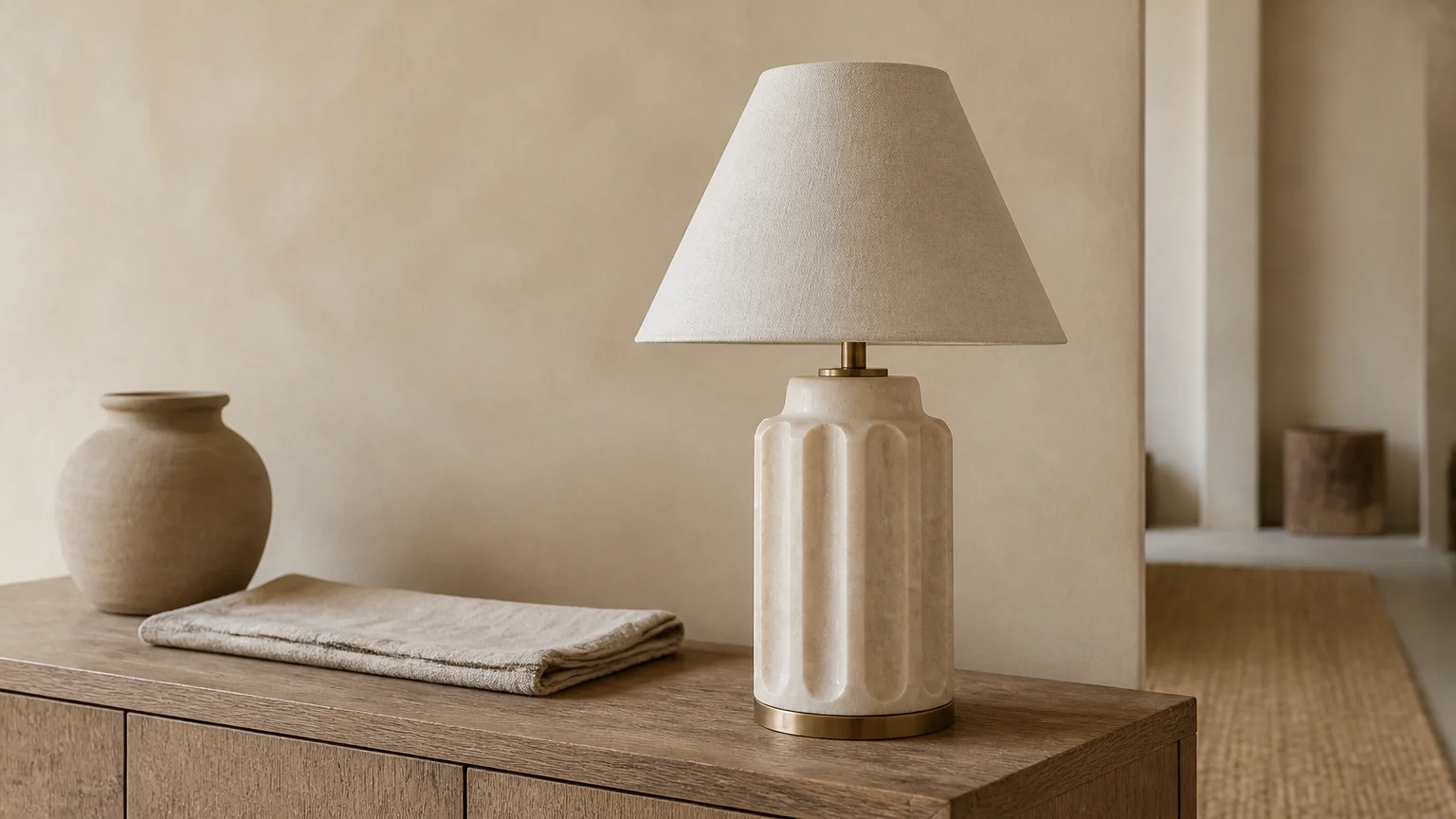
The optical behaviour of the material is the reason it is specified, and that behaviour has consequences for how a room feels.
Because light passes through the body rather than reflecting off the surface, a stone fixture does not present a bright point to the eye. It presents a surface that is itself luminous, at a moderate level, across an area. The consequence is a very low glare reading. Where a conventional fixture produces a small source that the eye must contend with, a stone fixture distributes the same light over a much larger area, and the visual result is quiet rather than bright, even when the measured output is comparable.
The second consequence concerns the boundary between the fixture and the room. A polished reflective surface in a warm interior draws attention to itself; a luminous stone surface reads as part of the room’s light rather than as an object standing in it. This is why the material is often chosen where the intention is an even, ambient quality rather than an emphasised focal point, and it is why stone fixtures tend to be specified in groups — pairs at a bed, a run along a corridor, a row above a counter — rather than as a single dominating piece.
Third, the material’s appearance changes between the lit and unlit states, and both matter. Switched off, a stone fixture is a pale sculpted object with visible structure. Switched on, it becomes a light source with an internal pattern that shifts as the viewer moves. A design that works in one state and not the other has not been fully resolved, and this is the reason approval samples should be reviewed in both conditions.
Fourth is the relationship between the stone and the metal it is mounted on. Most stone fixtures pair the material with a metal frame or fitting, and the finish of that metal changes how the stone reads: a warm metal supports the warmth of the stone, while a cooler finish sets up a contrast that brings out the stone’s own colour. This relationship is decided at approval, and it is one of the reasons our note on pairing natural stone with lighting fixtures treats the combination rather than the stone alone.
Finally, placement matters more than quantity. Because the light is diffused and moderate, a single small stone fixture contributes atmosphere rather than illumination. Where a room needs task light — over a desk, beside a mirror used for close work — the stone fixture is the wrong instrument and should not be asked to be the only layer. The correct use is as part of a layered scheme, with the stone providing the soft ambient contribution and other layers providing the directed light. This is true whether the fixture is a table lamp, a wall sconce, a floor lamp or a pendant, and it is a useful corrective to the assumption that a beautiful material solves a lighting problem by itself.
09Questions to Ask Before You Buy
The purpose of this section is to turn everything above into a short, practical list. A buyer who asks these questions will know what they are purchasing; a buyer who does not will find out at delivery.
What mineral family is the material, and can that be confirmed in writing? This is the question that determines suitability for damp locations and explains most working differences. The trade word alone is not an answer.
Is the material quarried or manufactured? Both are legitimate, and both are sold. The question is which one is on the quotation, and whether the brief called for uniformity or for individuality.
How much variation should we expect between units, and how will it be controlled? A supplier who works with the material will have an answer ready, involving grouping or pairing, rather than promising identical output.
Can we approve a reference sample, and will it be finished as production will be? The sample is the specification for appearance. A sample in a different finish from the delivery is not a sample.
Can we see it switched on? The lit state is the product. An approval conducted with the fixture switched off has not tested the thing that was bought.
What material will be held for future replacement? Because a matching part cannot be sourced later from an unrelated selection, this is a purchase-order decision rather than a service question.
How should the surface be cleaned, and with what? The answer belongs in the handover documentation, because the correct regime for stone is not the general regime for glass or metal.
Which of these fixtures will be installed together, and how will they be grouped? This is the difference between a set that reads as a family and a set that reads as a collection of individual pieces.
A buyer who has answers to those eight questions has, in practice, a workable specification. There is nothing obscure about the list; the difficulty is only that the trade word conceals which questions are necessary, and the purpose of this article has been to make them visible.
10Where to Go From Here
Translucent stone is a material with a narrow set of genuine advantages and a wide set of misconceptions around it. It transmits rather than reflects, which produces light with a low glare reading and an even, ambient character. Its internal structure makes every piece individual, which is either the reason to choose it or the reason not to, depending on the brief. And its working properties vary by mineral family in ways that matter in damp locations and in long-term maintenance, which is why documentation matters as much as appearance.
None of that is complicated once it is stated. What makes the material awkward in practice is the looseness of the trade word: a single term covers more than one stone, more than one source, and more than one production method, and it is used in product listings as though those distinctions did not exist. A buyer who separates them early will spend less time negotiating at delivery and more time deciding what the room should look like.
For the practical next steps, our guide to alabaster lighting across fixture types shows how the material is applied across the range, our piece on specifying stone lighting for hotels and luxury interiors covers approval and variation control in project conditions, and our note on choosing alabaster lighting in the American market looks at how the material is specified in that context. Read together with the manufacturing chain described in how an alabaster lamp is made, they cover the questions a project will actually face.
Source note: the descriptions in this article of the material’s appearance, optical behaviour and working characteristics are given as general industry knowledge and as experience-based guidance, not as a specification. Mineral family, origin, hardness, water resistance and suitability for a particular location differ between materials and are commercial and technical claims that must be confirmed in writing against the supplier’s own material documentation for the specific product being purchased. No density, hardness, transmission or durability values are quoted here, because such figures vary between sources and cannot responsibly be generalised. Statements about historical use of the material describe established practice in broad terms and are not offered as a manufacturing claim. Physical handling, cleaning and any work involving electrical connections must follow the supplier’s instructions and, where relevant, be carried out by suitably qualified personnel. This article contains no product, brand or project endorsement.
Frequently Asked Questions
Is alabaster a type of marble?
No, although the two are often confused because both are pale stones used in interiors. They are different materials with different structure and different optical behaviour, and the practical difference in lighting is that one transmits light through its body while the other generally reflects it. Our comparison of the two in fixture applications sets out where that distinction changes a specification.
How can I tell if a stone lamp is genuinely translucent stone?
Hold it against a light source. Genuine translucent stone carries the light into the material, so the glow appears to come from inside it, with fine internal structure visible in the pattern. A material that only reflects light will look pale but will not appear to be illuminated from within. Supplementary checks include the feel and temperature of the material in the hand and the presence of natural structural detail at the cut edge.
Why do the pieces I received not match each other exactly?
Because the material is quarried rather than manufactured. Each block has its own structure, and the pattern of veining and the local intensity of the glow differ from piece to piece. This is controlled by grouping and pairing finished units for the positions in which they will be installed, and by agreeing an acceptable range against a reference sample. It is not controlled by demanding identical output, which no quarried material can deliver.
Can I use a stone fixture in a bathroom or another damp area?
That depends on the material family and the specific location, and the answer has to come from the supplier’s material documentation rather than from the general trade name. Some translucent stones are happier in humid conditions than others, and the exposure differs between a mirror surround and an area exposed to direct spray. Damp-location suitability should be confirmed in writing, together with the recommended maintenance regime.
Does the light source change how the stone looks?
Considerably. The material transmits light rather than reflecting it, so the colour and output of the source pass through the stone and shape the result. A warm source produces the familiar soft glow; a cooler source reads differently against the same material. The source and the stone should therefore be chosen together, and the sample should be reviewed switched on under the light the finished fixture will actually use.
Is translucent stone a suitable light for reading or working?
It is better understood as an ambient layer than as a task layer. Because the light leaves the fixture evenly across a surface rather than in a directed beam, it produces a comfortable, low-glare contribution to a room, and it is at its best combined with directed light where close work is done. Judging a stone fixture by its ability to illuminate a desk is a good way to be disappointed by a material that was never intended for that job.
Specifying Translucent Stone Lighting?
Send us the fixture types and positions, the intended quantity, the room conditions including any damp or high-traffic exposure, the effect you are trying to achieve in both the lit and unlit states, and the finish direction. We will return a material proposal with the family identified in writing, an approval approach based on a reference sample reviewed in both states, a grouping and pairing plan for the units that will be installed together, the maintenance guidance for handover, and a recommendation on holding matching material for future replacement.
Our material comparisons cover translucent stone against marble and against travertine, and our manufacturing piece follows the material from the block to the finished light.


