

The direction switch on a ceiling fan is one small control with an outsized reputation. Half the people who own a fan do not know it exists; the other half have been told to flip it twice a year without being told why. The why is simple, and it changes how the fan should be used for the rest of the year.
This article answers the question directly, then explains the physics behind the answer, then corrects the misunderstanding that makes people expect more from a fan than a fan can deliver. It covers summer and winter settings, the comfort effect that does the actual work, the situations where a fan is the wrong tool, and the control and installation questions that decide whether the direction switch is reachable at all.
There are no performance figures here, deliberately. Air movement, room volume, ceiling height and blade geometry interact in ways that make a single published number misleading, and the numbers that circulate in retail copy are usually measured under conditions that no living room reproduces. What travels is the relationship: which way the air goes, what that does to the person in the room, and when to stop.
The framing to hold onto is that a ceiling fan is a comfort device, not a cooling appliance. It does not remove heat from the air. It changes how the air feels against skin and how heat is distributed through the room. Once that is clear, the seasonal switch stops being folklore and becomes a sensible response to two different problems.
- 01The Question Behind the Question
- 02What the Direction Switch Actually Changes
- 03Summer: Air Moving Downward
- 04Winter: Air Moving Upward, Slowly
- 05The Misunderstanding That Will Not Go Away
- 06Why It Still Feels Cooler
- 07When a Fan Is the Wrong Tool
- 08Switches, Remotes and Reachability
- 09Designing the Room So the Fan Works
- 10A Seasonal Routine Worth Keeping
The Question Behind the Question
“Which way should it turn?” is usually asked in the middle of a hot week, by somebody standing under a fan that is moving air in a direction they cannot identify by feel. The question is practical, but the answer only makes sense once two other questions are settled: what the fan is doing to the air, and what the person in the room actually needs.
Those two questions are different in summer and winter, which is the whole reason a direction switch exists. In summer the problem is a body that is too warm and air that is too still. In winter the problem is warm air that has risen to the ceiling and stayed there while the floor stays cool. Same fan, same blades, opposite jobs.
There is also a third question hiding underneath, and it is the one that determines whether the fan will be used well: is the switch reachable? On many fans the direction control is a small slide switch on the motor housing, which means changing it involves a step ladder twice a year. On others it is on the remote, which means it is used when needed. That design detail matters more than most buyers expect, and it is discussed later in this article.
What the Direction Switch Actually Changes
Reversing a ceiling fan changes the direction of the airflow through the blades. It does not change the motor’s job, the amount of air the fan moves at a given speed, or the electricity it draws. It changes where that air goes.
Viewed from below, with the fan running, one direction pushes air down towards the floor and the other pulls air up towards the ceiling. The blades are pitched, so reversing the rotation reverses the vertical component of the flow. That is the entire mechanism. Everything else — the seasonal advice, the comfort claims, the folklore — follows from it.
Because the change is directional rather than quantitative, the fan’s speed setting becomes part of the same decision. A fan running in the upward direction at a high speed will still move a great deal of air, and the effect at head height will be noticeable. A fan running upward at its slowest setting moves air gently and is almost imperceptible as a draught, which is exactly what winter use requires.
One practical note before the seasonal rules. Some fans have a reverse function on the remote and some have it on the housing; a few have both, and the two can disagree if the remote is replaced or re-paired. If a fan appears to ignore the switch, check whether a remote is overriding it before assuming a fault. Our notes on lighting and fan controls in rooms describe the same class of problem in the hospitality context, where a wall switch and a remote can both claim authority over one device.
Summer: Air Moving Downward
In summer, the useful setting is the one that pushes air down into the occupied zone. Viewed from below, that is the counterclockwise direction on the great majority of fans; if you are unsure, stand under it and feel for the column of air, or hold a tissue above your head and watch which way it is pushed.
Downward flow does two things. It increases the speed of air across skin, which increases evaporative and convective heat loss from the body. It also disrupts the still layer of warm, humid air that accumulates around a seated person. Both effects are immediate, both are felt rather than measured, and both stop the moment the fan stops.
Speed selection matters more than direction in this season. A fan running fast enough to lift papers is running faster than comfort requires, and the noise becomes the dominant impression of the room. A moderate speed that produces a gentle, continuous movement of air is usually more comfortable than an intermittent blast, and it is quieter. Where the ceiling is low, the same airflow feels stronger because the air has less distance to spread, which is one reason a fan that feels pleasant in a tall room can feel aggressive in a small one.
There is a common mistake worth naming: pointing the fan at the place where people sit, and then running it hard because the effect is not strong enough. Air movement is not a spotlight. The useful effect comes from the whole room’s air being set in motion, not from a narrow jet aimed at a chair. Aiming is not adjustable on a standard ceiling fan anyway, which is why position and speed do the work that a directional fixture would do in other contexts.
Winter: Air Moving Upward, Slowly
In winter, the useful setting is the reverse: viewed from below, clockwise on most fans, at the slowest speed the fan offers. The purpose is not to cool anybody. It is to stop the warmest air in the room from sitting against the ceiling.
Warm air rises. In a room with a heat source at floor level — a radiator, a stove, underfloor heating — the air near the ceiling ends up warmer than the air at ankle height. That stratification is a comfort problem as well as an energy one: the occupied zone is cooler than the thermostat believes, so the heating runs longer than it needs to. A fan turning slowly in the upward direction pulls air up the centre and pushes it out along the ceiling and down the walls, which mixes the layers without creating a draught at head height.
The “slowly” is not a suggestion. At higher speeds the downward return along the walls becomes strong enough to be felt as a cool draught, which defeats the purpose and makes people switch the fan off entirely. The correct winter setting is the one where you cannot feel the fan unless you look up at it.
Some fans offer a dedicated low speed for this purpose, and some remotes make it easy to select. Where the fan is controlled only by a pull chain, the slowest position is the one to use, and the direction switch has to be reached on the housing. That is worth checking at the point of purchase rather than in the first cold week, because a fan that cannot be set to a genuinely slow speed will not be used in winter at all, and the seasonal benefit is lost.
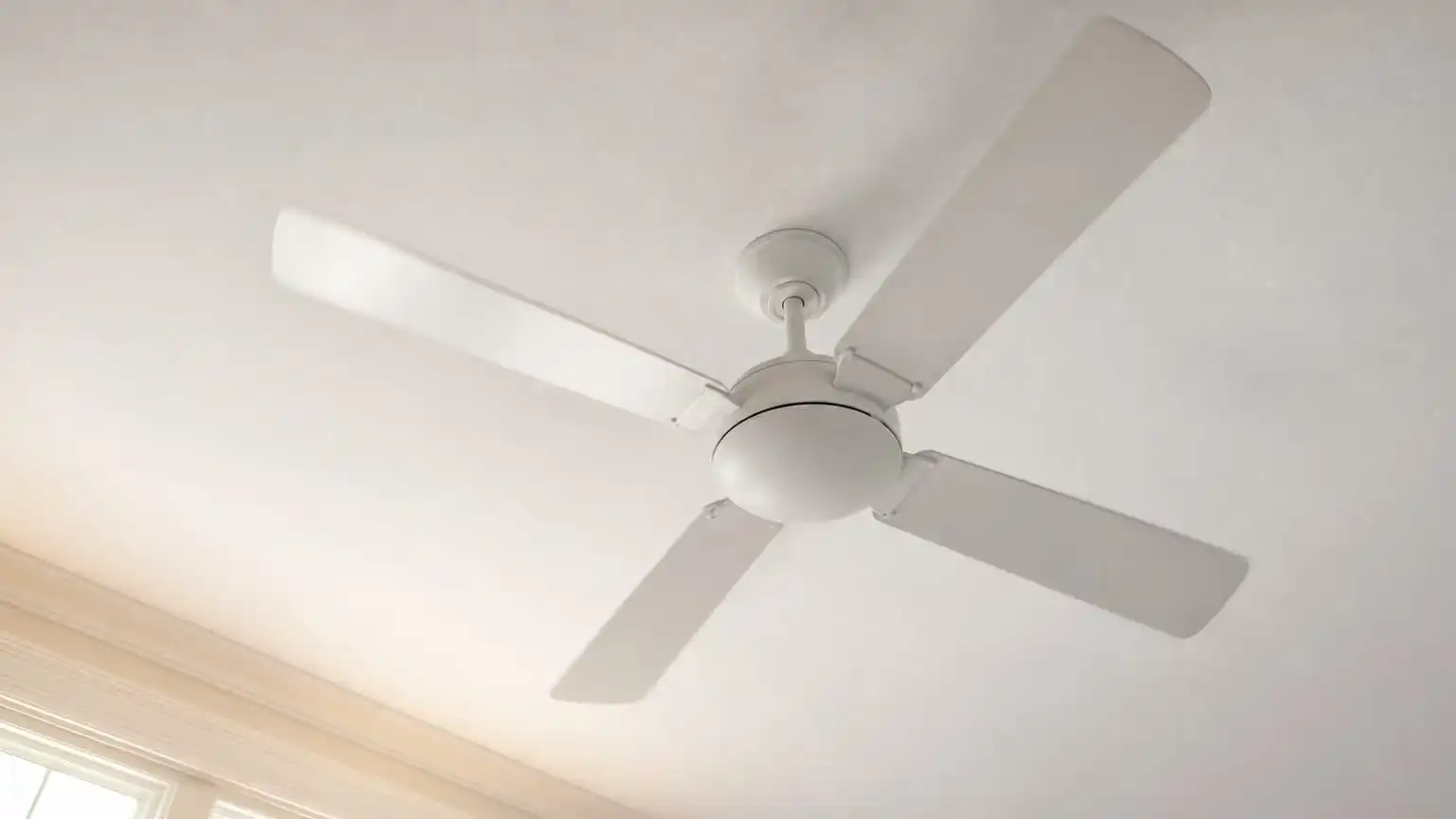
The Misunderstanding That Will Not Go Away
Here is the correction that matters more than the seasonal rule: a ceiling fan does not lower the temperature of a room. It cannot. A fan moves air; it does not remove heat from it. If a thermometer is placed in the room with the fan running, it will read the same as it did before, once the fan’s own motor heat is accounted for.
This is not a technicality. It changes how the fan should be used. Because the fan does not cool the air, leaving it running in an empty room achieves nothing except consuming electricity and adding a small amount of motor heat. The comfort benefit exists only while a person is present to feel the air moving across their skin. A fan running in an unoccupied room is a device doing no work.
The same correction applies to the winter setting. A fan running slowly upward does not “warm” a room; it redistributes air that has already been warmed, which can make the occupied zone more comfortable and can reduce the amount of heating needed to keep it there. The heat itself comes from the heating system, not from the fan.
Where this misunderstanding becomes expensive is in specification. A buyer who believes a fan cools air may specify fewer or smaller air-conditioning units, expecting the fans to make up the difference. They will not. Fans and cooling equipment do different jobs: the cooling equipment removes heat, the fan makes the resulting air feel better against skin and distributes it through the room. Both are useful, and neither substitutes for the other.
Why It Still Feels Cooler
The effect that does the work is usually described as a wind-chill effect, which is a slightly misleading name for something simple. Moving air increases the rate at which heat leaves the body’s surface. The skin is surrounded by a thin layer of air that has been warmed and moistened by the body; moving air replaces that layer continuously, so the body loses heat more quickly and the perceived temperature drops.
Two conditions determine how strong the effect is. The first is air speed at the body. The second is the humidity of the air, because evaporation carries a larger share of the heat loss when the air is dry enough to accept moisture. This is why the same fan setting feels more effective in a dry climate than in a humid one, and why a fan in a humid room can feel like it is moving warm air around without much relief.
The effect is also personal. Two people in the same room will disagree about whether the fan is pleasant, because body size, clothing, activity level and acclimatisation all change the balance. This is the practical argument for a fan with a wide range of speeds and, where the budget allows, a control that allows fine adjustment rather than three discrete steps. In a household or a shared space, the ability to find a setting that suits more than one person is worth more than a higher top speed.
None of this makes the fan a clinical device, and it should not be sold as one. It is a comfort device whose effect is felt, temporary and dependent on the person. Claims about what air movement does to health belong outside a product page, and the same caution applies to claims about what a fan does for sleep, which are better described in terms of comfort than in terms of outcome.
When a Fan Is the Wrong Tool
A fan is the wrong tool in more situations than retail copy admits. Four of them are worth naming, because each has a different correct response.
Low ceilings. Where the ceiling is low enough that the blades sit close to head height, the airflow becomes a draught rather than a comfort effect, and the fan also becomes a visual intrusion. A low-profile fan helps with the visual problem but not with the physical one. In that situation, the better answer is usually air movement from a different source, or a fan in an adjacent space.
Rooms that are unoccupied for long periods. A guest room, a meeting room or a seasonal cottage does not benefit from a fan running while nobody is there. The correct control is one that stops the fan when the room is empty, whether that is a person switching it off or a control system doing it. This is one of the areas where a simple occupancy-based control earns its cost.
Rooms that need actual cooling. If the requirement is to reduce the temperature of the air, a fan will not do it. The honest answer is that the room needs cooling equipment, and the fan’s role is to distribute the cooled air and to extend the range of temperatures at which the room feels acceptable.
Rooms with strong existing draughts. A room with a through-draught, an open stairwell or a large single-glazed window may already have more air movement than comfort requires. Adding a fan to that situation can make the room feel worse, particularly in winter, where the interaction between a slow fan and an existing draught is unpredictable.
In each case the useful question is not “which fan” but “what is the actual problem”. A fan solves problems of still air and stratified air. It does not solve problems of heat, humidity, glare or noise, and buying a larger fan to address those problems usually produces a larger disappointment.
Switches, Remotes and Reachability
The direction switch is a mechanical or electronic control on the fan, and its location decides whether the seasonal routine actually happens. Three arrangements are common: a slide switch on the motor housing, a function on a remote handset, and a setting inside a control system.
The housing switch is the simplest and the least convenient. Changing it requires reaching the fan, which means a stable platform and, in most households, a step ladder. If the fan is above a bed, a stairwell or a piece of furniture, the operation becomes awkward enough that it is deferred, and a deferred seasonal switch is a switch that is not made.
The remote is the practical answer for most rooms, provided the remote is not lost and the receiver is not dependent on a wall switch being left on. This last point causes a surprising number of service calls: a fan that appears dead because the wall switch was turned off, which also cut power to the remote receiver. Our controls guide covers the same failure pattern in rooms where guests, housekeeping and maintenance all interact with one circuit.
A control system arrangement is the right answer for a property with many fans, because it makes the seasonal change a schedule rather than a ladder task. It also allows the fan to be stopped when a room is unoccupied and restarted when it is not, which is where the real energy and comfort benefit sits.
Whichever arrangement is chosen, the electrical work belongs to a qualified trade. Work of this kind has to be carried out by qualified personnel and governed by the local code and the equipment manufacturer’s instructions, and that applies to replacing a switch, fitting a receiver or changing a fan, not just to a new installation. A fan is a motor on a ceiling above people; the installation standard is not a detail to be improvised.
Designing the Room So the Fan Works
A fan’s usefulness is decided as much by the room as by the fan. Four design decisions carry most of the weight, and all of them are easier to make before the ceiling is closed than after.
Position relative to the occupied zone. A fan works by moving the air in the space people use. A fan centred over a bed, a sofa or a dining table will feel effective; a fan centred over an empty part of a large room will move air that nobody is sitting in. In an open plan, this usually means more than one smaller fan rather than one large fan, because the occupied zones are separate.
Height and blade clearance. The relationship between ceiling height and blade height decides whether the airflow reaches people as a gentle movement or as a draught. Where the ceiling is high, a downrod brings the fan closer to the occupied zone; where it is low, a flush mount is the sensible option and the fan is likely to be a marginal benefit.
Interaction with the lighting scheme. A fan and a lighting scheme compete for the same ceiling real estate, and the compromise is usually visible: a fan in the centre of the room forces the general lighting to the perimeter, which changes the whole character of the room. Where the fan also carries a light kit, the light source ends up in the middle of the ceiling, which is rarely where a designed scheme would put it, and if that light sits on a dimmer the dimming compatibility question arrives with it. Our guide to layered lighting explains why a single central source struggles to do the work of several, and the same reasoning applies at home.
Colour and finish in the room. A fan is a large moving object on the ceiling, and its colour decides whether it reads as part of the architecture or as an appliance. In most interiors a fan that matches the ceiling recedes, and a fan that contrasts becomes a feature. Neither is wrong; the decision should be made deliberately rather than inherited from whatever finish was in stock. The same logic that governs choosing colour temperature for residential lighting applies here: consistency across the ceiling plane matters more than the individual choice.
A Seasonal Routine Worth Keeping
Two changes a year, done together with the other seasonal tasks, are enough to keep a fan useful. In the warm season, set the direction so that air moves downward, choose a moderate speed, and switch the fan off in rooms that are not occupied. In the cool season, reverse the direction so that air moves upward, select the slowest speed, and leave it there while the heating is running.
The routine is worth writing down somewhere visible, because it is the kind of task that is obvious to the person who knows and invisible to everyone else. A small label inside a cupboard door, a line in a maintenance schedule or a note in a guest-facing instructions card all work. What does not work is assuming that the next occupant of the building knows why the switch exists.
It is also worth reviewing the routine when the room changes use. A fan that was specified for a bedroom — following advice from a room-by-room design guide — may end up in a room used as a study, where the occupied hours are different and the tolerance for air movement is lower. A fan that was specified before a heating system was upgraded may now be doing a job that the heating system does better. These are not failures of the fan; they are normal consequences of a building changing while its equipment does not.
The summary is short enough to carry away. Direction decides where the air goes: downward when the body is too warm, upward when the warm air is in the wrong place. Speed decides how much is felt. The fan itself decides nothing about temperature, which is why it should be run when somebody is there to feel it and stopped when nobody is. Get those three right and the seasonal switch stops being a piece of folklore and becomes what it is: a small control that changes the direction of a comfort effect.
Frequently Asked Questions
Which direction should a ceiling fan turn in summer?
The direction that pushes air down into the room, which on most fans is counterclockwise as seen from below. Confirm it by feel rather than by memory: stand under the fan and check that air is reaching you, or hold a light tissue above your head and watch which way it moves.
And in winter?
The reverse, at the slowest speed the fan offers. The purpose is to move the warm air that has collected at the ceiling back into the occupied part of the room without creating a draught. If you can feel the fan on your skin in winter, it is running too fast.
Does a ceiling fan actually cool the room?
No. It moves air, and moving air increases heat loss from the body, which is why it feels cooler. The air temperature itself does not change. That is also why a fan in an empty room achieves nothing except consuming electricity.
Can I leave the fan on all day?
You can, but there is little point unless somebody is there to feel the effect. In a room that is occupied intermittently, a control that stops the fan when the room is empty is more useful than a fan left running.
Why does my fan feel weaker than it did in the shop?
Usually because the room is different: a larger volume, a higher ceiling, or an occupied zone that is not directly under the fan. Air movement spreads and slows with distance, so a fan that felt strong in a small showroom can feel mild in a large room.
Does reversing the fan use more electricity?
No. Reversing changes the direction of the airflow, not the work the motor does at a given speed. Consumption is governed by the speed setting, which is why the winter advice is to use the slowest speed rather than to treat reverse as a separate mode.
Where is the direction switch?
On many fans it is a small slide switch on the motor housing; on others it is a function on the remote; on system-controlled fans it is a setting in the control interface. If a fan seems to ignore the switch, check whether a remote is overriding it before assuming a fault.
Can a fan be fitted to any ceiling?
No. The ceiling structure, the mounting method and the electrical supply all have to be suitable, and the work has to be carried out by qualified personnel in accordance with the local code and the manufacturer’s instructions. A fan is a motor above people, and the mounting decision is an engineering decision rather than a decorative one.
Planning Ceiling Comfort and Ceiling Light Together?
Tell us the room, the ceiling height and how the space is used, and we will set out what the ceiling has to carry: the fan position, the lighting layers around it and the control arrangement that keeps both usable. Where the answer depends on the structure or the supply, we will say so rather than assume.
Our ceiling lamp, floor lamp and table lamp ranges are specified with the control requirement stated alongside the fixture, so a room’s lighting and its air movement can be planned as one decision rather than two.


