
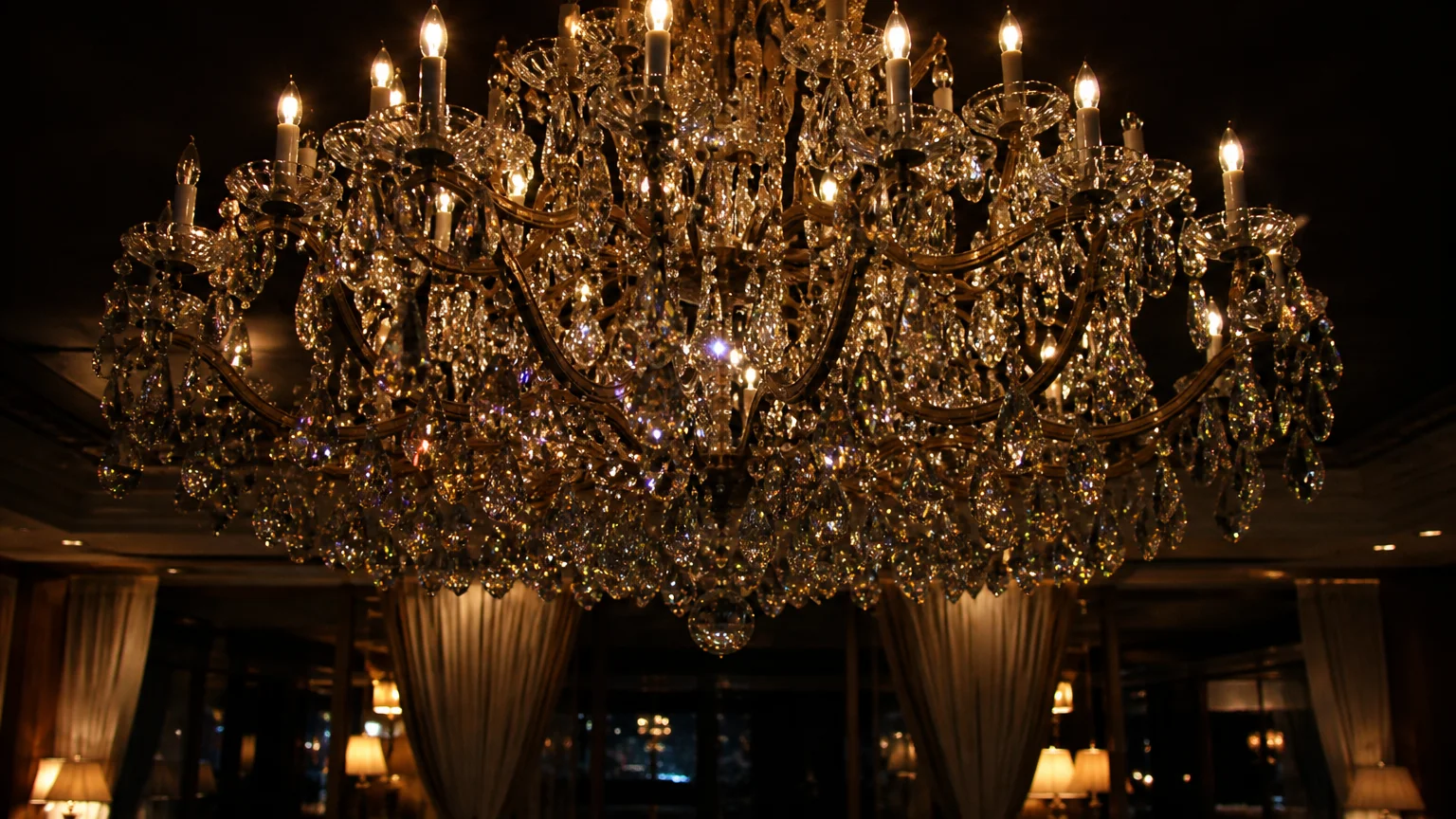
A crystal chandelier does not lose its sparkle because the crystal has changed. Crystal is stable; it does not fade, cloud over with age, or forget how to bend light. What changes is the last micron of its surface. A film of dust, cooking grease, humidity residue or dried cleaning product settles on the facets, and once that film is there the light stops behaving the way the cutter intended. The fixture is still full of crystal. It has simply stopped being an optical instrument and become a decorative object that happens to be lit.
This article is about that failure, in mechanical terms. It explains what sparkle physically is, why a film destroys it so efficiently, where the film comes from, and how to tell the three different causes of a dull chandelier apart before spending money on the wrong remedy. It is the mechanism behind the procedure: our step-by-step guide to cleaning a crystal chandelier in six steps covers what to do and what to avoid, and this piece covers why any of it matters.
It is written for the people who maintain these fixtures in service — housekeeping supervisors, facilities teams, maintenance contractors — and for the designers and buyers who specify them and then discover, two years later, that the effect they signed off has quietly gone flat. It contains no product recommendations, no brand names and no proportions, because the useful knowledge here is diagnostic rather than formulary.
- 01What Sparkle Actually Is
- 02A Film Is an Optical Component Nobody Designed
- 03The Four Things That Land on a Crystal
- 04Why Residue Is Worse Than Dirt
- 05Three Causes of Dull, and the Order to Check Them
- 06Why the Frame and the Crystal Need Different Logic
- 07What a Cleaner Has to Do
- 08The Rooms That Fail First
- 09A Diagnostic Walk-Through
- 10A Regime That Keeps Dispersion Alive
What Sparkle Actually Is
The word covers three separate optical events, and separating them makes the whole subject easier to reason about.
Reflection is the simplest. Light strikes a facet and bounces off it. On a flat polished surface you get a highlight — a small bright image of the light source. On a faceted surface you get many highlights at many angles, which is why a chandelier appears to have more lights in it than it does. Reflection is what makes a crystal read as bright from across a room. It depends almost entirely on the surface being smooth and clean at the scale of the wavelength of light, and that is exactly what a film destroys first.
Refraction is the bending that happens when light crosses from air into a denser medium and back out again. A prism does this: light enters, changes direction, exits, changes direction again, and the two bends separate colours slightly because different wavelengths bend by different amounts. That separation is dispersion, and it is where the small rainbows on a chandelier come from. Dispersion needs clean entry and exit faces, precise angles, and a material with high refractive index. A film on the surface does not stop the light entering; it changes the angle at which it enters, and adds a scatter event before the bending begins.
Total internal reflection is the third and least obvious. Inside a faceted crystal, light that strikes an internal face at a shallow enough angle is reflected back into the material rather than passing out. A well-cut stone uses this deliberately: light is bounced from facet to facet inside the piece before it finally exits, which multiplies the number of bright points and gives the characteristic internal fire rather than a simple surface shine. This is the effect most sensitive to surface condition, because the light may cross the surface several times on its way out, and each crossing is an opportunity for a film to scatter it.
Put together, the three explain a fact that surprises people: a dusty crystal does not look dim, it looks flat. The overall light level barely drops. What disappears is the contrast — the sharp highlights, the small coloured fringes, the sense of depth inside the piece. The fixture is still emitting roughly the same amount of light, but it is emitting it diffusely, like a frosted surface, instead of directionally, like a cut stone. The room is still lit; the object has stopped performing. The material basis for all of this is covered in our guide to what the lead crystal, lead-free and K9 labels actually mean, and the practical question of identifying the material in the first place is set out in six checks that separate real crystal from faux.
A Film Is an Optical Component Nobody Designed
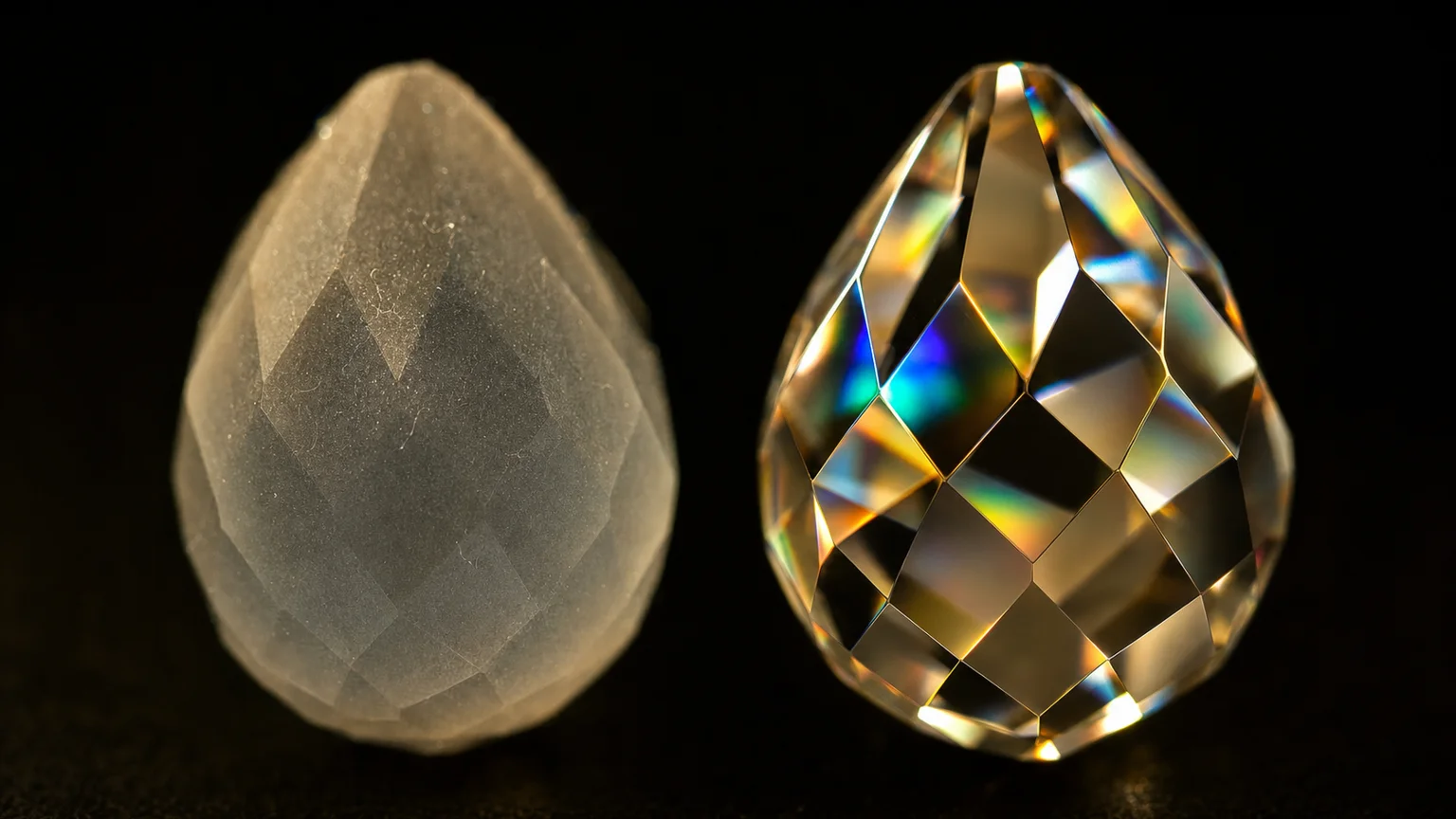
A film is thin. That is precisely why it is so damaging, and why it is so often missed.
At the scale of the light’s wavelength, a coating only a fraction of a micron thick is already a substantial optical layer. It has its own refractive index, different from the crystal. It is rough at the microscopic scale even when it looks smooth. When light crosses from crystal into that layer, it is refracted by an interface the designer did not specify, and then scattered by the roughness of the layer’s outer surface. Two things follow: the exit angle is no longer the one the cutter ground, and the light leaves in many directions instead of one.
The visible result is a loss of specularity — the sharp bright point becomes a broad, weak glow. On a chandelier with hundreds of elements, the aggregate effect is a piece that appears uniformly lit rather than sparkling. Photographs taken before and after a proper cleaning frequently show almost no change in average brightness and a dramatic change in contrast, which is why brightness meters make poor maintenance tools and why the eye is a better judge here than an instrument.
There is a second mechanism that matters more in some rooms than the first. A film that is not uniform — thicker in the recesses of a facet, thinner on the ridges, patchy where a cloth has passed — turns the surface into a set of slightly different optical zones. Instead of one clean exit face you have a mosaic of small areas each bending light a little differently. The result is a surface that looks smeared or greasy even after cleaning, because it is. The eye reads it as dirt, and the remedy is not more effort but a different method.
The important practical point is that a film is not the same as dirt. Dirt sits on the surface as particles; a film is a layer that has bonded or dried onto it. Dusting removes particles. Removing a film requires dissolving it and then removing the dissolved material completely, which is why the final step of any proper cleaning is a dry pass with a clean cloth rather than a wet one.
The Four Things That Land on a Crystal
Nearly all surface contamination on an installed chandelier comes from four sources, and each behaves differently.
Dust. Airborne particles settle on upward-facing surfaces. On a chandelier every facet has an upward-facing area, so the whole piece collects dust steadily. Dust is comparatively easy to remove dry, and comparatively harmless if removed before it combines with moisture. Left long enough in a humid room, dust cakes and becomes the matrix for something worse.
Cooking grease and kitchen volatiles. Any chandelier within range of a kitchen — a dining room adjacent to an open pass, a hotel suite with a kitchenette, a restaurant with an open grill — collects an oily film that is invisible at first and then attracts dust. Grease films are the most common cause of a chandelier that looks dull in a room that is otherwise well maintained, and they are the hardest to remove without a solvent that is safe for the metal frame.
Moisture and its residue. In humid climates and in rooms with spas, pools or heavy bathroom use, water vapour condenses on the colder surfaces of the fixture and then evaporates, leaving behind whatever was dissolved in it. Over many cycles this builds a mineral haze that is very even, very thin, and very effective at killing dispersion. This is the failure mode that surprises operators in coastal and tropical properties, because the room looks clean and the fixture has not been touched.
Handling oils and product residue. Fingerprints from installation, and the dried residue of cleaning products applied earlier, are the two most avoidable sources. Both leave a film that is patchy rather than uniform, and both are frequently the reason a second cleaning appears to make no difference: the first attempt added a layer instead of removing one.
The relative importance of the four varies by building. A city-centre hotel with sealed windows and a busy kitchen fights grease. A resort on a coast fights humidity. A heritage property with open fires fights particulates. A retail floor with daily glass cleaning fights residue from its own maintenance regime. Naming the dominant source in a given property is the first useful step, because it determines both the frequency and the method.
Why Residue Is Worse Than Dirt
This is the counter-intuitive part of the subject, and it is where most cleaning programmes go wrong.
A cleaning product works by lowering the surface tension of water so that it can wet the surface and lift material off it. That is a good thing during the wash. The problem is what happens afterwards. As the liquid evaporates, the surfactant that made it work is left behind, and it does not evaporate. It dries into a thin, uneven film — the same film that makes a window look streaky when it is cleaned in sunlight, except that on a window the film is almost invisible, and on a faceted crystal it is an opaque barrier in front of the one surface that was supposed to be optically perfect.
On a flat pane, a residue film causes visible streaks because the film thickness varies. On a cut crystal, the same film has a worse effect: it destroys the sharpness of the facet edges, which are the parts doing the dispersing. A crystal with slightly rounded optical edges from a dried film behaves like a much softer material, and the small rainbows disappear first. That is the single most common reason a chandelier looks “clean but flat” after a maintenance visit.
The implication for method is direct. Whatever is used to dissolve the film has to be removed completely, and the reliable way to remove a dissolved film is to take it up into a cloth and then to pass a second, dry cloth over the surface. A single wipe with a damp cloth spreads the material around and lets it dry where it lies. This is why the procedure in our six-step cleaning guide ends with a separate dry pass and an instruction to confirm the piece is fully dry before the power goes back on, and it is why the guide is emphatic about pressure: pressing harder does not remove a film, it burnishes it into the surface.
There is a related mistake that deserves naming because it is so common. Adding more product to a surface that is already filmed makes the problem worse, not better, because each application adds surfactant. When a first clean appears to have no effect, the correct response is to change the method — less product, more mechanical lift, a clean dry pass — rather than to increase the dose.
Three Causes of Dull, and the Order to Check Them
“The chandelier has gone dull” is a symptom with three quite different causes. Checking them in the wrong order wastes money, usually by commissioning a deep clean that cannot fix the actual problem.
Cause one: a surface film. The most common. The crystal itself looks hazy when examined closely, the haze is patchy or follows the direction of an earlier wipe, and the drop nearest a heat source or an open kitchen is worse than the ones furthest away. Remedy: a correct clean, with a proper dry pass. Test on one arm before committing to the whole fixture.
Cause two: a residue film from previous cleaning. Looks similar at a distance, different up close. The surface may look slightly slick or uniformly grey, facet edges appear softened, and the problem is often worse on the elements that were easiest to get at — which is the tell, because dirt accumulates where it is hardest to get at. Remedy: strip the residue rather than add to it. This is a method problem, not an effort problem.
Cause three: the light source has aged. The crystal is fine and the fixture is clean, but the light coming out of it has changed. Sources lose output and shift colour over their service life; the shift is gradual, so nobody notices it happening, and the fixture simply stops throwing the sharp highlights it used to. The tell is that the brightness of the room has dropped while the appearance of the crystal, examined closely, is unchanged. Remedy: relamping or replacement, not cleaning.
The order matters because the three produce similar complaints and different bills. A practical sequence is: look at the room’s brightness first (cheap, and it rules cause three in or out), then examine three or four elements closely under a torch at different parts of the fixture (distinguishes one from two by the distribution of the haze), and only then decide what to commission. Doing it the other way round — booking a deep clean because the fixture looks dull — is how properties end up paying twice.
There is a fourth, rarer possibility worth keeping in mind: the material may not be what it appeared to be. Not every faceted drop on the market is crystal in the sense the buyer assumed, and some materials lose their appearance faster than others. Our comparison of what the K9 designation means in practice and the wider discussion in chandelier materials: crystal, glass and metal explain the difference between the families; the diagnostic point here is that if a fixture has gone flat within a year of installation and cleaning changes nothing, the material question should be asked early.
Why the Frame and the Crystal Need Different Logic
A chandelier is two different objects sharing a shape: an optical assembly made of crystal, and a structural assembly made of metal, usually with a coated or plated finish. The two have opposite requirements, and a single method applied to both will damage one of them.
The crystal wants: no abrasion, no ammonia, no aggressive solvent, and above all no residue. It tolerates water, mild soap and mechanical lift with a soft cloth or brush. It does not tolerate being scrubbed, because the facet edges that produce dispersion are precisely the features that abrasion rounds off.
The metal wants: removal of oily film without attacking the coating, and drying without leaving water marks, which are far more visible on a dark bronze or an aged brass than on stone or glass. Some finishes are deliberately unlacquered and are meant to develop a patina; aggressive cleaning strips that patina unevenly and leaves a mottled surface that cannot be corrected locally. The care of these finishes is a subject in its own right, set out in our guide to materials and finishes across a lighting package.
The practical consequence is that the work has to be sequenced and the materials kept apart: crystal elements treated with the gentler method, metal treated with a method chosen for its finish, and the two kept from sharing a cloth. A cloth that has been used on a metal frame carries both the removed film and, potentially, traces of whatever was used on the coating. Using it on a crystal afterwards deposits exactly the residue the crystal cleaning was meant to remove.
This is also the argument for planning the work at fixture level rather than at element level. A chandelier on a hoist can be lowered, worked on at a bench, and raised again; a chandelier fixed at height has to be worked on in place, which constrains both the method and the person doing it. Our guide to chandelier hoists and cleaning access covers the access question in engineering terms, and it is worth reading before commissioning a deep clean on any fixture above head height, because the method that is safe to use depends on how the fixture can be reached.
What a Cleaner Has to Do
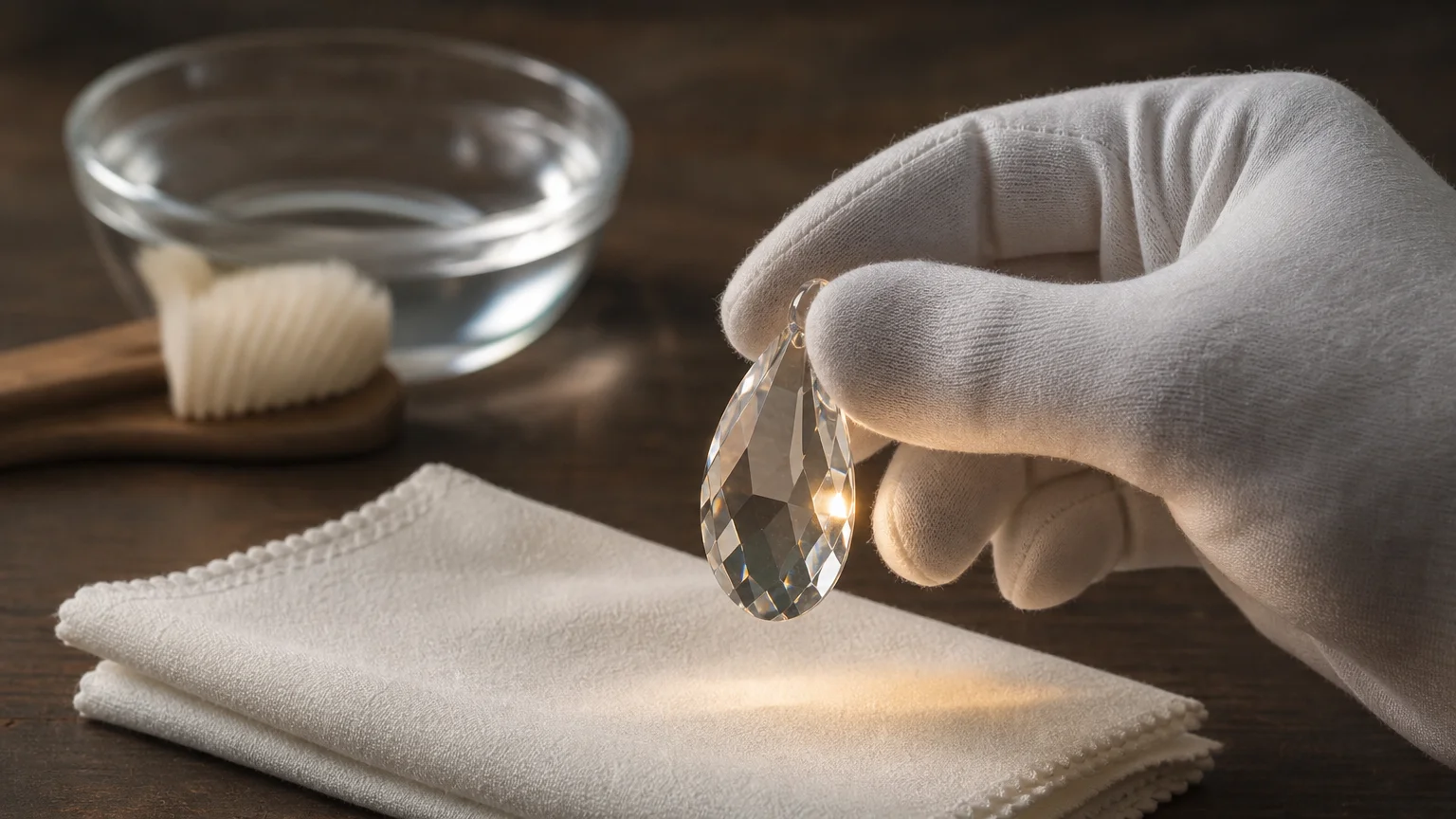
Rather than recommending products, it is more useful to describe the four properties a cleaning liquid needs for this specific job. Any product that satisfies all four will work; any product that fails one of them will create work later.
It must be free of ammonia. Ammonia is effective on glass and is a traditional ingredient in window cleaners, which is exactly why it ends up on chandeliers. It attacks some metal finishes and some platings, and on a fixture where the crystal and the frame are in intimate contact, a liquid that is safe for one and not the other is the wrong liquid. This is a materials-compatibility constraint, not a performance claim.
It must wet and spread rather than bead. A liquid that beads on a crystal leaves droplets that dry as rings. A liquid that spreads into an even film can be taken up evenly by a cloth, which is what makes a complete removal possible.
It must evaporate quickly and completely. Slow evaporation is what allows dissolved material to concentrate and dry in place. Fast evaporation reduces the window in which residue can form, and it also reduces the time the liquid sits against metal parts. The practical benefit is a shorter dry time before the fixture can be re-energised.
It must leave nothing behind. This is the property that distinguishes a cleaner designed for optical surfaces from a general-purpose one. Some products include ingredients that leave a protective or shine-enhancing layer; on a facet, that layer is a new film. If the surface is meant to be optically clean, the correct end state is nothing at all.
Water quality belongs in the same list. Tap water carries dissolved minerals, and on a surface that is left to dry in air those minerals remain as a fine haze — the same reason a shower screen clouds over. Where water is hard, using distilled or demineralised water for the wet stage removes a whole category of residue before it starts, and it is cheaper than cleaning the fixture twice.
Two mechanical points complete the method. Lint-free cloths matter more than they sound: a cloth that sheds fibres leaves them on the facets, and each fibre is a scatter point. And the direction of work matters: dusting from the top of the fixture downwards keeps dislodged material from landing on parts already cleaned, which is why every competent procedure starts at the top and works down.
The Rooms That Fail First
Some environments produce a flat chandelier in a year; others keep one bright for a decade. The difference is almost entirely environmental, and it is predictable enough to be designed for.
Rooms with cooking nearby. The worst case, and the most common in hospitality. An open kitchen pass, a breakfast room, a suite with a kitchenette: airborne grease travels further than people expect and settles on every horizontal facet. A chandelier in this position needs a shorter interval between cleans and a method that addresses oil rather than dust.
Humid and coastal interiors. Condensation cycling leaves mineral haze and, in properties with pools or spas, can be continuous. The haze is even and thin, and it is easy to mistake for a change in the material. Rooms with a spa or a plunge pool attached are the classic example, and they are also the rooms where a fixture is most likely to be specified with a decorative finish that cannot take aggressive cleaning — a combination that has to be resolved at design stage.
High spaces with stratification. Warm air rises and carries particles with it. A fixture hung high in an atrium or over a stairwell sits in the zone where dust concentrates, and it is also the hardest place to clean. Our guide to maintenance planning across a hotel lighting scheme treats these as scheduled items with their own access cost, which is the right way to budget them.
Rooms with open fires or heavy footfall. Particulates from combustion and from the floor settle on upward surfaces. The material is abrasive, and repeated dry dusting of an abrasive powder across a polished facet is a slow way of degrading it. Gentle lift with a soft brush, before the deposit consolidates, is the appropriate response.
Recently renovated spaces. Construction dust is finer and more pervasive than domestic dust, and it reaches fixtures that were bagged but not sealed. A first clean shortly after handover is worth scheduling as part of the project, because the deposit from a build is much easier to remove in the first weeks than after it has bonded.
A Diagnostic Walk-Through
Before any cleaning is commissioned, twenty minutes with a torch will tell you what you are dealing with. The sequence below is deliberately simple, and it is ordered so that the cheapest explanation is eliminated first.
Step one: establish whether the room is dimmer. Compare the fixture with a neighbouring one on the same circuit, or with a photograph from handover taken at the same time of day. If the whole room is dimmer and the crystal looks unchanged up close, the problem is the light source, and cleaning will not solve it.
Step two: look at one element closely. Take a single drop, hold a torch at a low angle across it, and look at the facet edges. A clean edge throws a sharp line; a filmed edge throws a soft one. If the edges are soft, there is a film.
Step three: see whether the film is even or patchy. Even haze across the whole fixture points to environmental deposition — humidity, grease, dust. Patchy haze that correlates with how reachable the element is points to a previous cleaning. The two need different remedies, and this is the step that decides which.
Step four: look at the metal. Water marks on the frame, dulled highlights on the arms, or a mottled patch on a patinated finish indicate that the current method is already doing damage. Correct the method before repeating it.
Step five: check the parts nobody sees. The top surfaces of the arms, the inside of the canopy, the area above the ceiling plate. If those are far worse than the visible surfaces, the fixture has been cleaned cosmetically rather than properly, and a full procedure is required rather than a touch-up.
Step six: decide, and write it down. Record which of the three causes applies, what method is indicated, and what the acceptance criterion is — the appearance of a nominated element under a torch, compared with a photograph. That record is what makes the next maintenance visit cheaper, because it starts from a diagnosis rather than from a complaint.
For fixtures that are also being upgraded — retrofit lamps in older crystal bodies, for instance — the same diagnosis should be repeated after the change, because a new source with a different beam distribution will reveal films that the old source concealed. Our note on retrofitting lamps in crystal and antique fixtures covers the compatibility questions; the optical point is that the fixture’s appearance is a joint property of the crystal and the source, and changing one changes the diagnosis of the other.
A Regime That Keeps Dispersion Alive
The regime that works is unremarkable: light dusting at short intervals, a full clean at long intervals, and a method that removes rather than redistributes.
Dusting is the high-frequency, low-skill part, and it is where most of the benefit is. Removing loose particles before they bond with moisture or grease prevents the film from forming in the first place. A soft brush or a dry lint-free cloth, worked from the top down, is sufficient. Frequency depends on the room: a kitchen-adjacent fixture needs it far more often than one in a sealed suite, and a coastal property needs it more often than an inland one. Our companion piece on maintaining hotel crystal lamps sets out how this fits into a property’s wider schedule.
A full clean is the low-frequency, higher-skill part: the whole fixture, element by element, with the correct liquid, a clean cloth, and a dry pass. It is also the point at which the frame should be assessed, the fixings checked, and any elements that have chipped or gone missing replaced. Doing this on a planned interval rather than on complaint is what keeps a fixture consistent across a building, where otherwise the ones in heavy-use rooms age faster than the ones in back-of-house.
Recording is the part that is rarely done and usually pays. A photograph of a nominated element under a torch, taken at each full clean, is a cheap way to detect slow changes — a gradual yellowing of a coating, a gradual softening of the crystal’s highlights, a change in the source’s colour. Without that record, every decision is made from memory, and memory is unreliable over multi-year intervals.
The wider point is that a crystal chandelier is a maintained optical instrument, not a permanent decorative object. It is bought for an effect, the effect depends on the condition of a surface measured in fractions of a micron, and that condition is entirely a function of what the building does to it and what the maintenance programme does about it. A fixture that is dusted before the film forms, cleaned with a method that removes rather than spreads, and inspected against a record will still be throwing sharp highlights when the room around it has been refurbished twice.
If you are specifying new crystal work, the material questions are worth settling at the start: what the labels mean in the three crystal grades and how they are described, how glass and crystal differ in cast and hand-blown glass processes and in handmade against machine-pressed glass, and how surface texture behaves under light in ribbed, reeded and fluted glass. Those choices determine how much sparkle there is to protect. Protecting it is then a matter of method, and method is a decision that a building makes once and lives with.
Frequently Asked Questions
Why does my chandelier look dull even after cleaning?
Usually because the cleaning added a layer instead of removing one. Products that spread easily also dry into a film, and a single damp wipe redistributes that film rather than taking it away. The remedy is a lighter dose, mechanical lift with a soft cloth or brush, and a separate dry pass with a clean cloth, plus demineralised water where the local supply is hard.
Can crystal itself go cloudy with age?
The material does not cloud with age in normal interior service. What clouds is the surface, through deposited film. That is good news, because a film can be removed and the material beneath it is unchanged. If a fixture has gone flat and a correct clean produces no improvement, the next question is whether the light source has aged, not whether the crystal has.
Is it safe to use a glass cleaner on a chandelier?
Many glass cleaners contain ammonia, which is the specific ingredient to avoid on a fixture where crystal sits in contact with metal finishes. Beyond that, a cleaner designed for windows is formulated to leave a thin film that helps a flat pane look clear; on a faceted surface that film is a barrier. The four properties to look for are set out above and are a more reliable guide than the word on the bottle.
How often should a hotel chandelier be cleaned?
There is no universal interval, and a figure quoted without reference to the room is not useful. The interval is set by the dominant contaminant: grease in a kitchen-adjacent room, moisture in a spa or coastal property, particulates near an open fire or a busy entrance. Diagnose the dominant source first, then set the interval, and review it after the first two cycles.
Does dusting actually help, or is it just cosmetic?
It is the most effective single measure, because it removes material before it bonds. A particle that is brushed off is gone; the same particle left through a humid cycle becomes part of a film that requires a full clean to remove. High-frequency light dusting is what keeps the interval between full cleans long.
What is the single biggest mistake in chandelier maintenance?
Cleaning without a diagnosis, and cleaning harder when the first attempt appears to fail. More product, more pressure and more water all tend to make a film worse. Establish which of the three causes applies, choose the method that follows from it, and accept that the correct method is gentler than the instinct suggests.
Specifying Crystal That Will Still Sparkle in Ten Years?
Tell us where the fixture will hang, what happens in the room around it — cooking, moisture, open fires, heavy footfall — and how it will be reached for maintenance. We will advise on the material and finish combination that survives that environment, the access arrangement that makes proper cleaning possible, and the spare elements worth holding so that replacements match the original batch.
For the practical procedure, start with cleaning a crystal chandelier in six steps; for the material questions behind it, see crystal, glass and metal in chandelier construction and how to tell real crystal from faux.


