

A woven fixture can pass every factory inspection and still be wrong on site. The factory checks a batch against a specification; the site checks one fixture against the room it is going into, and against the sample that was approved months earlier. Those are different tests, performed by different people, at the point where changing anything has become expensive.
This article sets out a site acceptance routine for woven and natural-fibre lighting that a project manager, a clerk of works or a lighting designer can run in a morning, with no instruments beyond a torch, a notebook and the approved sample. It is built around five visual checks — cut ends, weave tension, colour across the batch, frame and suspension points, and coating smell and coverage — chosen because each one is legible without dismantling the fixture and each one corresponds to a failure that will otherwise appear in service.
One boundary belongs at the start. We do not publish flame-retardant ratings, mould-resistance results or ageing data for woven fixtures, because we do not hold verified test evidence for them. The section on documents therefore describes what to request from whoever supplies the material, and how to read it. It does not assign a grade, a service life or a threshold to any product, and the interpretation of a fire or hygiene document against a project’s strategy is a matter for the project’s fire engineer and its legal reviewer rather than for a lighting supplier.
- 01Why Site Acceptance Is a Different Job
- 02What Arrives Is Not What Was Approved
- 03Check One: Cut Ends and Burrs
- 04Check Two: Weave Tension and Regularity
- 05Check Three: Colour Across the Batch
- 06Check Four: Frame and Suspension Points
- 07Check Five: Coating Smell and Coverage
- 08The Documents to Request, and How to Read Them
- 09Recording the Result: Pass, Hold, Review
- 10Handover Into Service
Why Site Acceptance Is a Different Job
Factory inspection answers a question about process: was this batch made to the drawing, with the specified materials, tested and packed as agreed? It is a question about conformity, and it is answered inside the supplier’s system, usually in the days before shipment. Our notes on pre-shipment inspection describe that end of the work.
Site acceptance answers a different question: does this particular fixture, in this particular room, still meet the intent that was approved? The distinction is not pedantic. A batch can conform exactly to a drawing and still look wrong under a different light, next to a different wall, at a different height. A fixture can pass a factory check and arrive with a crushed rim, because the crate was opened with a blade. A colour can be within the tolerance that was written down and still sit badly against a finish that was chosen afterwards.
There is also a responsibility difference. Factory inspection is done by or on behalf of the buyer, and its output is a report that allows shipment. Site acceptance is done by the party who will hand the room over, and its output is a decision: accept, hold, or reject. That decision has contractual weight, and it needs a record. The routine below is designed to produce that record in a form that is short enough to be completed for every fixture and specific enough to be useful months later.
The reason to formalise it is that woven fixtures invite informality. They look handmade, they are often supplied by smaller workshops, and there is a natural tendency to accept small irregularities as character. Some of them are character. The checks below are the ones that are not: they distinguish natural variation, which is part of the material, from defects and mismatches, which are not.
What Arrives Is Not What Was Approved
Between the approved sample and the delivered batch, several things change. The material comes from a different part of the harvest. The weaving is done by a different pair of hands. The frame is produced on a jig that may have been adjusted. The coating is applied in a batch that may have been mixed on a different day. And time has passed, during which the sample has been handled, displayed and possibly faded.
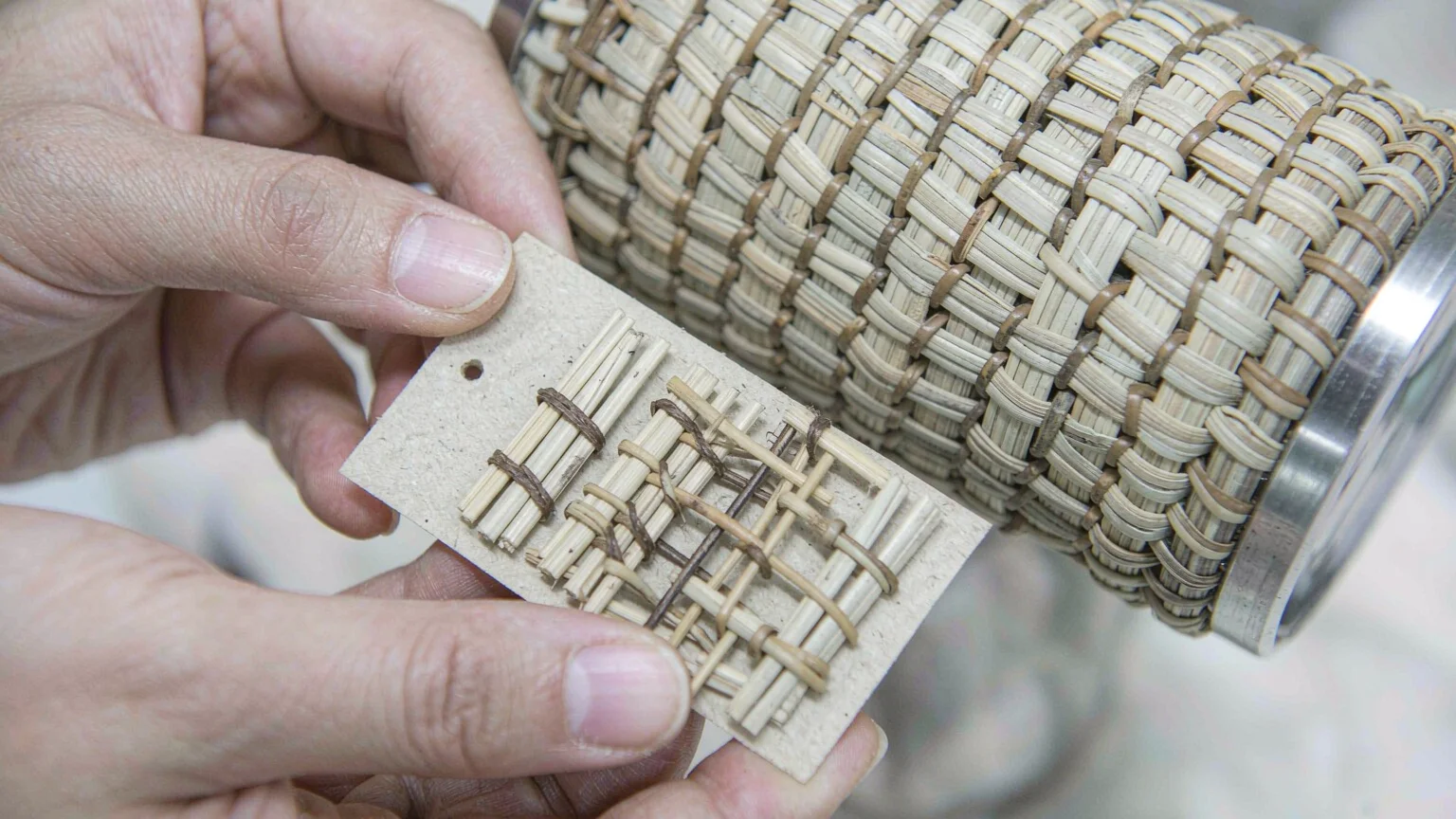
This is why the approved sample has to travel to site, and why it has to be kept in conditions that resemble the room rather than a site cabin. A sample that has been in a hot container for a month is not a reference for colour; it is a reference for what the material does when it is hot. Projects that photograph the sample on the day of approval, under the room’s own light, and keep that image with the specification, have a far better chance of resolving a colour conversation without argument.
Natural variation is real and should be expected. Strand diameter varies, the density of the fibre varies along a stem, and the colour of a natural material shifts between bundles and between seasons. A batch in which every panel is identical is more likely to have been stained than to be consistent. The judgement to make is not whether there is variation but whether the variation is within what the sample established, and whether it is distributed evenly across the batch rather than concentrated in one or two pieces.
The other thing that changes is the room. A fixture approved against a white wall in a studio can look darker against a stone wall in a lobby, warmer under a dimmed circuit than under a work light, and lighter when the sun is on it. Judging the delivered fixture inside the room, under the lighting that will actually be used, is part of acceptance rather than a refinement of it. Where a project has a mock-up, the mock-up is the reference, and our guide to judging a fixture before you buy covers how that reference is established.
The practical preparation for the checks that follow is therefore short. Have the approved sample on site. Have the room’s lighting operational, or a work light of similar colour. Have the drawings, including the frame drawing if one was supplied. Have a torch, a notebook and a camera with a fixed position for the profile photograph. And have the authority to say hold, which is the part that projects most often forget to arrange.
Check One: Cut Ends and Burrs
Every strand in a woven body terminates somewhere, and the termination is the most revealing detail in the whole fixture. A cut end exposes open cells at the end grain, which is where moisture enters fastest and where a coating is least likely to have sealed the material. It is also where handling damage concentrates, and where fraying begins.
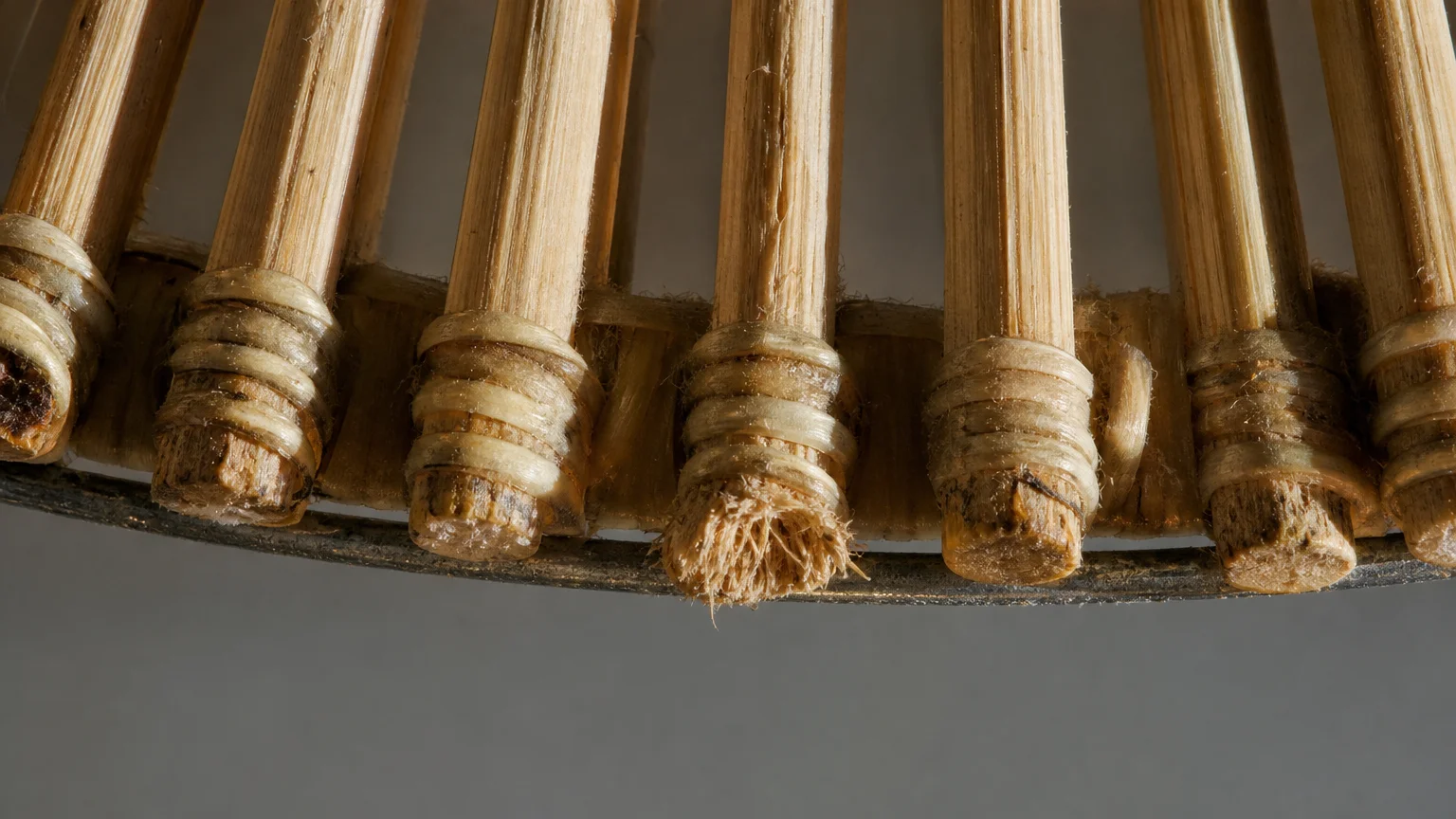
Run a torch along the rim at a low angle, in both directions. The raking light shows up lifted fibre, a bloom of loose strands and the small step where a coating stops. Then look at three specific places: the rim where the weave meets the frame, the lower edge where gravity and handling do their work, and any internal edge around the lamp holder or the cable entry, which is usually the least finished part of the fixture.
What you are looking for is a termination that has been closed rather than simply cut. A turned and bound end, a tucked end, or an end that has been sealed and then bound is a deliberate detail. An end that has been cut flush and left bare is not a defect in itself, but it tells you that the strand is unprotected at precisely the point where moisture will enter first, and it sets the fixture’s maintenance character: the ends will need attention earlier than the face.
Burrs matter for a different reason. A metal burr at the rim, or a sharp edge where a strand passes through a hole, will abrade the fibre from the inside. This is a slow failure that shows as a thinning of one or two strands near a fixing, long before anything looks wrong overall. Running a fingertip — carefully — along the inside of the rim finds them faster than looking.
Record what you find in terms of position and extent rather than in terms of adjectives. “Three strand ends at the lower rim on the north side are open and one is frayed for a short distance” is a record that a supplier can act on. “Rim looks rough” is a conversation.
Check Two: Weave Tension and Regularity
Weave tension is the property that decides whether a woven fixture keeps its silhouette. It is also the property that is hardest to describe and easiest to see, once you know what to look for. A sound weave is even: the gaps between strands are consistent, the strands run in straight or deliberately curved lines rather than wavy ones, and the surface responds to a gentle press with a small, even give rather than a soft pocket in one place.
Look at the fixture from the side, with a light behind it, and let the weave read as a pattern of openings. Consistent openings across the face mean consistent tension. Openings that are wide in one area and tight in another mean the weave has been pulled unevenly, and that unevenness will grow rather than settle, because the tighter area carries more load and creeps further.
Then look at the edges. The line where the weave meets the rim should be a clean curve or a straight line, not a scallop that changes rhythm. A local dip at the edge is a lashing that was left loose, and it will be the first place to show movement. On a large piece, check the same feature at the top and bottom: if the bottom edge is wavier than the top, the weave was hung before it was tensioned rather than tensioned before it was hung, and the whole body is carrying its own weight unevenly.
Finally, check regularity against the approved sample rather than against an ideal. Hand weaving is not machine weaving, and small differences in the rhythm are the evidence of the hand. What is not acceptable is a change of rhythm within one panel, because that is a change of tension rather than a change of hand. Our article on how weave density changes the light explains why these differences are so visible once the fixture is lit: an uneven weave produces an uneven pattern on the wall, and the wall is where guests see it.
Check Three: Colour Across the Batch
A single woven fixture is judged on its own. A batch is judged against itself, and colour is where a batch most often fails. Natural fibre varies, so the question is not whether there is variation but whether the variation reads as intentional or as a mistake.
The method is simple and needs discipline. Lay the pieces side by side, in the room, under the light they will be seen in, and stand back to the distance a guest will view them from. Then walk along the row and look for the piece that stands out. Repeat the exercise from the other direction, because the eye adapts to a sequence and picks up a mismatch more reliably when the order is reversed. Where fixtures will hang at different distances, compare them at those distances rather than in a tidy line.
Judge colour in three lights if the room has three: daylight, the warm circuit that will run in the evening, and any accent or feature lighting that will fall on the fixtures. A batch that matches under a work light and separates under warm light has a metamerism problem — the pieces have different spectral behaviour, not just different shade — and no amount of touch-up resolves it. The honest remedy is to regroup the batch: put the closest pieces in the most visible positions, and use the outliers where they will be seen alone.
Regrouping is a legitimate acceptance outcome and it should be recorded as such. It is not a concession on quality; it is the recognition that a natural material produces a distribution, and that a project with a fixed number of fixtures has to decide how that distribution is arranged. What is not legitimate is accepting a batch where one piece is visibly different from all the others in the same sightline, and hoping nobody notices. Somebody will, and they will notice it in the photograph that ends up in a review.
Look also at the direction of the weave within each piece. Strands catch light differently along their length, so a panel woven with the grain running one way will read slightly darker than its neighbour woven the other way. This is a manufacturing consistency issue rather than a material one, and it is worth raising before the fixtures are hung, because re-orienting a woven body after installation is rarely possible.
Check Four: Frame and Suspension Points
The frame is the part of a woven fixture that cannot be inspected after installation, which is exactly why it should be inspected before. At delivery, the frame is accessible through the open rim and, often, from underneath. Ten minutes with a torch answers the questions that would otherwise become a structural conversation later.
Begin with the geometry. Put the fixture on a flat surface, or hang it at working height, and look along the rim from a low angle. A rim that is out of plane will rock or show a gap; a rim that is out of round will show a changing gap against a straight reference. Both are frame and assembly issues rather than weave issues, and both are far easier to correct before the fixture is above a table.
Then inspect the frame itself through the weave. Look for the bracing: cross members, a second ring, radial spokes, a hub. On a large piece, an absence of bracing is a warning about how the fixture will behave under sustained load, for the reasons set out in our article on which part of a woven fixture carries the load. Look at the joints: a welded joint should be dressed and coated, a mechanical joint should be tight and locked, and a joint that consists of two components touching under a decorative sleeve is not a connection.
Then go to the suspension. Identify the actual hardware — cable, rod, chain, or a combination — and confirm it matches what was specified rather than what was available. Check the termination at the fixture: a cable that disappears into a hole without a visible terminal, or a rod that ends in a thread with no locking provision, is an assembly that relies on friction and hope. Check the canopy for deformation and for evidence that it has been used as a handle during transit.
Finally, confirm the separation of responsibilities. The fixture should arrive with a stated hanging mass and a stated suspension arrangement; the project should have a decision about what it is being fixed to. If the anchor has not been specified, the acceptance decision is not yet available, because a fixture that is correct in itself may still be un-hangable in that ceiling. The site sequence for that part of the work is covered in our notes on pre-installation checks, and it belongs before the crate is opened rather than after.
Check Five: Coating Smell and Coverage
The last check is the one people are most reluctant to perform, because it feels impolite: smell the fixture. A coating that has been applied recently and cured inadequately announces itself, and the smell is not a cosmetic issue. It indicates residual solvent or an incomplete cure, and both affect how the film behaves in service — how it adheres, how it flexes with the fibre, and how it responds to cleaning.
Smell the inside of the shade rather than the outside, and smell it again after the fixture has been running warm for a while. A faint, fading odour in a new fixture is normal. A strong odour that persists, or one that becomes more pronounced when the lamp is on, is a reason to hold the batch and ask the supplier what was applied and when. This is a question about production records, and a supplier who cannot answer it has a gap in their paperwork.
Coverage is the visual counterpart. A protective film is only useful where it is continuous, and it is thinnest or absent at exactly the places that matter: cut ends, the inside of the weave, the underside of the rim, and any point where a strand was bent sharply. Run a torch across the surface at a low angle and look for the dull patches that indicate an uncoated or thinly coated area, then confirm the pattern: an evenly matt finish is a coating; a patchy one is a coating that was sprayed from one direction.
Check the frame coating at the same time, and check it inside the joints. A frame painted or powder-coated before welding will have a bare ring around every weld, and that ring is where corrosion begins. It is invisible from the front and obvious from behind, which is why the check is worth doing with the fixture turned.
| Check | What to look at | Language for a pass | What it does not prove |
|---|---|---|---|
| Cut ends and burrs | Rim, lower edge, cable entry, internal edges, under raking light | “Strand ends are turned and bound at both rims; no open ends at the lower edge; no burrs felt along the inner rim” | Nothing about flame or mould performance; a sealed end is a moisture detail, not a certification |
| Weave tension and regularity | Openings against a backlight; edge line; top compared with bottom | “Openings consistent across the panel; edge line continuous; no local dip at any lashing” | Nothing about long-term creep; tension at handover is a starting point, not a guarantee |
| Colour across the batch | Side by side, in the room, under the lights that will be used, at viewing distance | “Batch regrouped; closest pieces placed in shared sightlines; outliers used where seen alone” | Nothing about fading; a colour match today says nothing about behaviour under sunlight |
| Frame and suspension | Rim geometry; bracing; joints; terminals; canopy; anchor decision | “Rim in plane and round; bracing present; joints dressed and coated; terminals visible; anchor specified by the project” | Nothing about the adequacy of the ceiling; only the engineer confirms that |
| Coating smell and coverage | Inside of the shade, warm and cold; raking light for patchiness; frame joints | “No persistent odour warm or cold; film continuous at ends and inner surfaces; frame coated through the joints” | Nothing about durability; coverage at handover is not a service-life statement |
Read the fourth column as carefully as the third. Every one of these checks establishes a condition at a moment in time. None of them establishes a performance over years, and none of them substitutes for the test evidence a project may need for its fire or hygiene strategy. Conflating the two is how a site acceptance record ends up being quoted years later as if it were a certification.
The Documents to Request, and How to Read Them
Five documents cover the ground for a woven fixture, and each answers a different question. They are worth requesting as a set, before the order rather than after delivery, because a supplier who cannot produce them at that stage will not produce them later either.
A coating or treatment data sheet. It should name the product, state the substrate it is intended for, state the exposure it is intended for, and state the basis on which it is renewed. Read it for scope and for renewal: a sheet describing interior decorative use does not support a wet or exterior location, and a treatment that is expected to be renewed creates a maintenance obligation that belongs in the operator’s manual.
A flame-retardant treatment record for the batch being supplied. Ask for the record that covers the material actually delivered: what treatment was applied, by what method, by whom, and which batch or lot it applies to. Read it for traceability, not for a headline. A document that cannot be linked to the material in the crate does not establish anything about the fixtures on site, however impressive its letterhead. Whether a given treatment satisfies a project’s fire strategy is a judgement for the project’s fire engineer, with legal review where the strategy requires it; a lighting supplier is not the party who decides that, and should not be asked to.
Mould and fungal resistance evidence, or an explicit statement that none exists. Ask what testing has been carried out, on what specimen preparation, and against what pass criterion. Read it for the specimen: a result obtained on a laboratory-prepared sample, or on an untreated control, answers a different question from the one a humid project is asking. Where nothing exists, the correct conclusion is that resistance is unverified — not that the material is fine because nobody has complained.
A frame and fixing specification. Material by name, coating system, joint method, and the suspension hardware with its stated duty. Read it for the joints rather than the surfaces, because that is where corrosion starts and where the drawing is usually thinnest.
Care and inspection instructions. What to clean with, what to avoid, what to inspect, and what the inspection should look for. An instruction that addresses dust but not cut ends, lashings and frame joints has not addressed the life of the fixture.
| Document | Question it answers | What to check before accepting it | Red flag |
|---|---|---|---|
| Treatment data sheet | What was applied, to what, for which exposure, and when it must be renewed | Whether the stated exposure matches where the fixture will hang | An adjective instead of a product name; no renewal basis |
| Flame-retardant batch record | Whether the material in this delivery was treated, and how that is traceable | Whether the batch reference can be linked to the delivery | A generic certificate with no link to the material supplied; a claim offered in place of a record |
| Mould resistance evidence, or its absence stated | Whether any testing was done, on what specimen, against what criterion | Whether the specimen was production material rather than a control | No stated criterion; a verbal assurance that no problem has been reported |
| Frame and fixing specification | What the structure is made of and how it is connected | Joint method, coating through the joints, suspension hardware identified by type and duty | “Rustproof” or “heavy-duty” offered in place of a material name |
| Care and inspection instruction | Who looks at what, and how often, once the room is in service | Whether it addresses cut ends, lashings, rims and frame joints | A cleaning note that says nothing about moisture or structure |
The discipline that makes this set usable is to treat each document as answering one question and no more. A treatment sheet does not prove flame performance; a flame record does not prove mould resistance; neither says anything about whether the frame will survive a coastal winter. Projects that ask for the five separately, and read each against the location it applies to, end up with a position they can defend. Projects that ask for “certification” receive a folder that supports nothing in particular.
Where a document is missing, the honest response is to change the design rather than accept an assurance. Moving a fixture out of a wet zone, adding a liner, changing the material, or accepting and planning a shorter replacement cycle are all real options. Accepting an unverified claim is not one, because the failure will be discovered by a guest rather than by the person who approved it. The parallel case for a mineral material, where the mechanism differs but the documentation discipline is identical, is set out in our stone fixture quality checklist.
Recording the Result: Pass, Hold, Review
An acceptance decision needs three outcomes rather than two, because most real findings are neither a clean pass nor a rejection. The vocabulary below is deliberately narrow so that it can be used consistently across a project and understood later by somebody who was not there.
Pass means the fixture meets the approved sample and the specification on all five checks, and any natural variation is within what the sample established. A pass should still be recorded, with the profile photograph and the date, because it establishes the baseline against which future movement will be judged.
Hold means something needs to be resolved before the fixture is hung or before the room is handed over, but the fixture is not necessarily rejected. A relaxed lashing, a patchy coating, an unresolved anchor decision, a batch colour that needs regrouping — these are holds. A hold should name the specific item, the party responsible, and what evidence will close it. A hold without those three is a delay.
Review means the finding is outside the acceptance routine and needs a decision from somebody with authority: a colour that may require a replacement batch, a frame detail that may not meet the structural intent, a document that is missing for a location the project considers sensitive. Review is the correct outcome for anything touching fire or hygiene strategy, because those decisions are not the site team’s to make.
Two recording habits make the vocabulary useful. The first is to describe position and extent rather than quality: “open strand ends at the lower rim, north side, three of them” rather than “rim poor”. The second is to photograph from a fixed position, ideally the same position each time, so that later comparisons are possible. A record that cannot be compared is a record that will be argued about.
It is also worth recording what was not checked, and why. A fixture accepted before the ceiling lighting was commissioned has not been judged under its final light; a batch accepted without the approved sample on site has not been judged for colour at all. Naming those gaps protects everybody, and it turns an incomplete acceptance into a scheduled one rather than a fiction.
Handover Into Service
Acceptance ends when the fixture is hung and the room is handed over, and that is the moment when the information needed to keep the fixture looking right tends to disappear. The handover pack for woven lighting should be short, specific and addressed to the person who will actually maintain the room.
A baseline record per fixture type. Profile photograph, rim photograph, the date, and any notes from the five checks. This is the sole evidence of what “correct” looked like, and it is what allows a later observation to be classified as movement rather than as opinion.
A cleaning instruction that respects the material. Dry methods first: a soft brush or a vacuum on low suction, worked along the weave rather than across it. Where a damp cloth is used, dry afterwards and ventilate. Water that enters a cut end or a crevice takes far longer to leave than water on the surface, so cleaning that wets a woven shade without drying it is worse than not cleaning it at all.
An inspection routine with an owner. What to look at — cut ends, lashings, rim line, frame joints, coating — and at what interval, set by exposure rather than by habit. The interval matters less than the record: a log that shows the fixture was inspected and found sound is what distinguishes normal wear from a defect when a conversation eventually happens.
A spare provision and a reorder path. Lashings, clips and a length of matching weave are inexpensive at the point of order and difficult to obtain once the batch has closed and the material has aged. For a property with a repeating fixture, a documented reorder path is more valuable than a store of finished shades that may not match the next delivery.
The documents from the previous section, filed where facilities can find them. A treatment record that lives in a project folder nobody can access is not a document the operation owns. What belongs with the building is the set that answers questions about the fixtures actually installed, with the batch references that link them to the delivery.
Woven lighting is not fragile, and it is not maintenance-free. It sits in the middle: a natural material doing a decorative job, supported by a structure doing an engineering one, in a room whose moisture and dust it will have to live with. A site acceptance routine that looks at five specific things, records them in language somebody else can act on, and hands over the documents that support the claims made about the material is what keeps that arrangement working. It takes a morning, it costs nothing, and it converts a set of impressions into a decision.
Do I need to inspect every fixture, or can I sample the batch? Inspect every fixture for the two checks that vary piece by piece — cut ends and weave tension — because both are the product of individual handwork. Colour, frame and coating can be assessed on a sample plus a walk along the installed row, provided any outlier is then inspected individually. Sampling a batch of hand-woven pieces on the assumption that they are identical defeats the purpose of the exercise.
The batch is slightly different in colour from the sample. Is that a defect? Usually not. Natural fibre varies between bundles and between seasons, and a batch that matches a months-old sample exactly has probably been stained rather than left natural. The question is whether the variation is within what the sample established and whether it reads as intentional across the sightlines in the room. Where one piece is visibly different from the others in the same view, regroup rather than replace.
What does a smell in a new woven fixture mean? It usually means a coating that has not fully cured, and it is worth asking what was applied and when rather than waiting for it to fade. A faint odour that disappears is one thing; an odour that persists, or that becomes stronger once the lamp has been on, indicates residual solvent and is a reason to hold the batch until the supplier answers the question with a production record.
Can a site inspection replace test documentation? No. A site inspection establishes a condition at a moment in time: that the ends are sealed, the weave is even, the frame is braced, the coating is continuous. It says nothing about flame performance, mould resistance or ageing. Those require documents from whoever supplied the material, and their interpretation against a project’s strategy belongs with the fire engineer and legal reviewer, not with the site team.
The supplier cannot provide treatment records. What now? Change the design rather than accept an assurance. Move the fixture to a drier or less regulated location, add a liner, change the material, or accept and plan a shorter replacement cycle with the operator’s agreement. An unverified claim transfers the risk to whoever notices the failure first, which in a hotel is a guest.
We supply woven and natural-fibre fixtures with the frame, the suspension and the enclosure documented separately, and we will tell you plainly which documents we hold for a given material and which belong with your fire engineer or your operator. Send the room, the quantity and the drawings, and we will return the acceptance points, the batch references and the parts of the requirement that need to be resolved by somebody other than the lighting supplier.
Pendants and chandeliers · Hotel lighting projects · Talk to us about a specification


